
88 OF THE WORLD’S BEST
TRAVEL JOBS
& HOW TO GET THEM!

Guide & Comparison
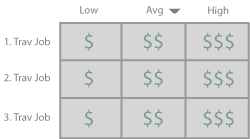
We've ranked the travel jobs by those that pay the most, require the least experience, and provide the most schedule & location flexibility.
In addition, we've provided extensive guides per job that include how to get each travel job, step-by-step, and everything you must know per travel job before you unleash yourself onto the world in search of adventure!




What are Travel Jobs?
Travel jobs, or jobs overseas, are international jobs that allow you to work and travel around the world. In some cases travel jobs can also allow you to work from home.
International travel jobs can be broken down into multiple categories that are listed just below. The most popular travel job categories are Digital Nomad Jobs (Remote Jobs), Expat Jobs, and Backpacker Jobs. Backpacker Jobs are also known as Gap Year Jobs or can be the same or closely related to Work Exchange Programs.
Traveling the world & working abroad offers a great sense of freedom and it’s absolutely worth it in terms of experience and income if you do it right. Keep reading this entire guide to ensure you’re well informed and confident before you start your journey abroad!
Top 23 Travel Jobs – The Best of the Best!
Of the 88 jobs we’ve compared, these are the top 23 travel jobs!
How we compare and rate travel jobs
The best travel jobs are determined by overall ratings, not just pay. While pay is the most important factor, there are a handful of other very important factors to consider. Below, you can see the major factors that comprise our travel job ratings:
- Pay & estimated monthly savings per region of the world.
- Housing and/or food included?
- Pay reliability – Consistent pay. Some travel jobs have high hourly rates but may not provide enough hours.
- How easy it is to get the travel job? The less experience and education needed, the better.
- Job demand throughout the world. Ideally, you can hop from one country to the next with the right travel job.
- Schedule flexibility. Ensuring you have time to actually be a tourist.
You can check out our filterable travel jobs comparison table just below the top jobs.
1. Teach English Abroad
Overall Rating
(out of 5)

Job Opportunity
This job is in high demand and easy to get.
Job Compensation
This job is very reliable with reasonable pay.
Job Flexibility
This job has a somewhat flexible schedule and you can work almost anywhere in the world.
Teaching English Abroad is atop most every ‘best of’ travel job lists on the internet for a reason! Anyone that speaks English natively or fluently can do it! You don’t even have to love English or be particularly good at it. The schools typically provide you with step-by-step instructions per lesson and the majority of your sessions will likely be beginner level.
How much do teachers get paid to Teach English Abroad?
Hourly
- $8 per hour at the low end
- $13 per hour on average
- $25 per hour at the high end
Weekly
- $320 per week at the low end
- $520 per week on average
- $1,000 per week at the high end
Monthly
- $1350 per month at the low end
- $2,250 per month on average
- $4,300 per month at the high end
Annually
- $16,500 per year at the low end
- $27,000 per year on average
- $52,000 per year at the high end
There’s also a good chance that housing is provided. This is especially true in more expensive cities.
To compare this travel job’s pay, check out our travel job comparison table. For more information on how we came up with these numbers, check out our data sources.
How much can I save Teaching English Abroad?
- $750-$1,000 per month
This is based on a scenario where one is receiving average pay, living an average lifestyle, and resides in a region of the world that is considered a medium cost of living.
If you’re teaching in more expensive cities then you’l likely make enough to get by but likely not much in savings. But it’s worth it! Checking out all the sights and taking in all a culture has to offer in expensive cities is far more affordable as an expat than as a tourist!
Check out the Travel Job Comparison table to see all potential savings scenarios, cost of living categorization by city, and our data sources.
Basic Requirements to Teach English Abroad
- Native or Fluent English Speaking
- TEFL Certification
How to be an English Teacher Abroad – Everything you need to know!
2. International Flight Attendant
Overall Rating
(out of 5)

Job Opportunity
This job is in high demand but requires some experience to get.
Job Compensation
This job is very reliable and pays well.
Job Flexibility
This job has some schedule flexibility and the locations are somewhat flexible.
International Flight Attendant jobs allow you to save a lot of money while traveling and seeing the world! The one obvious barrier of entry for most folks is the fact that flight attendants have to put up with rude passengers every day. The amount of patience needed to do this job does not come naturally to most folks.
PLEASE treat flight attendants with the respect they deserve! If something sucks in transit, it’s 99.9% likely that it’s NOT their fault. They are not your punching bag, nor your therapist.
How much do International Flight Attendants get paid?
Hourly
- $18 per hour at the low end
- $25 per hour on average
- $40 per hour at the high end
Weekly
- $630 per week at the low end
- $875 per week on average
- $1,400 per week at the high end
Monthly
- $2,700 per month at the low end
- $3,800 per month on average
- $6,000 per month at the high end
Annually
- $33,000 per year at the low end
- $46,000 per year on average
- $73,000 per year at the high end
To compare this travel job’s pay, check out our travel job comparison table. For more information on how we came up with these numbers, check out our data sources.
How much can I save as an International Flight Attendant?
- $2,000-$2,500 per month
This is based on a scenario where one is receiving average pay, living an average lifestyle, and resides in a region of the world that is considered a medium cost of living.
International Flight Attendant jobs are unique in that you can get paid wages that allow you to comfortably live in high cost of living cities but you can really save money if you’re able to base yourself in a medium cost of living region of the world.
Given the travel demands for flight attendants, it’s common for them to live in shared apartments as another easy way to save gobs of cash!
Check out the Travel Job Comparison table to see all potential savings scenarios, cost of living categorization by city, and our data sources.
Basic Requirements
- Anyone over 21 (or in some cases 18) with a high school diploma can apply to be an international flight attendant.
- You will have to get through a rigorous training program to land the job. 🙂
How to become an International Flight Attendant – Everything you need to know!
3. Freelance Writing Jobs
Overall Rating
(out of 5)

Job Opportunity
This job is in high demand and easy to get.
Job Compensation
This job is reliable with reasonable pay.
Job Flexibility
This job has a flexible schedule and you can work almost anywhere in the world.
Freelance Writing Jobs are one of the very best ways to make money while traveling the world! The biggest downside is the freelance lifestyle. You’re not guaranteed a full 40 hours a week and rates may vary per project. Therefore, it’s best to have 6-12 months worth of savings prior to long-term travel.
How much do Freelance Writers get paid?
Hourly
- $12 per hour at the low end
- $30 per hour on average
- $60 per hour at the high end
Weekly
- $420 per week at the low end
- $1,100 per week on average
- $2,100 per week at the high end
Monthly
- $1,800 per month at the low end
- $4,600 per month on average
- $9,100 per month at the high end
Annually
- $22,000 per year at the low end
- $55,000 per year on average
- $109,000 per year at the high end
To compare this travel job’s pay, check out our travel job comparison table. For more information on how we came up with these numbers, check out our data sources.
How much can I save as a Freelance Writer abroad?
- $2,500-$3000 per month for established freelance writers.
- $0-$1500 for new freelance writers.
This is based on a scenario where one is receiving average pay, living an average lifestyle, and resides in a region of the world that is considered a medium cost of living.
This scenario also assumes the Freelance Writer is working an average of 35 hours per week. The nature of the freelance life style can be unpredictable so it’s recommended that you have up to 6-12 months of savings before you go gallivanting around the globe.
Check out the Travel Job Comparison table to see all potential savings scenarios, cost of living categorization by city, and our data sources.
Basic Requirements
- Anyone can be a freelance writer!
- However, you are expected to have excellent grammar and writing skills as well as prior experience with writing.
- Although not required, it is highly encouraged to have a bachelor’s degree in either journalism or mass communications.
How to be a Freelance Writer – Everything you need to know!
4. Backpacking Guide Jobs
Overall Rating
(out of 5)

Job Opportunity
This job is in somewhat high demand but requires some experience to get.
Job Compensation
This job is reliable with reasonable pay and room & board is sometimes included.
Job Flexibility
This job’s schedule is somewhat flexible and you can work in many parts of the world.
Backpacking guides are responsible for leading individuals and groups on trips in the backcountry and wilderness. They will help people explore the natural landscape safely and informatively.
The primary function of a backpacking guide is to lead individuals safely through the backcountry while educating.
How much do Backpacking Guides get paid?
Backpacking tours can be as short as a few days or as long as a few months, and you will be essentially working 24/7.
Backpacking guide jobs don’t have an hourly schedule like a more traditional, indoors job. Survival in the wilderness is not a 9-5 occupation, but a constant task.
However, to make things more simple and comparable we’ve broken down the typical weekly/monthly pay to hourly pay below.
Hourly
- $15 per hour at the low end
- $21 per hour on average
- $31 per hour at the high end
Weekly
- $600 per week at the low end
- $920 per week on average
- $1,200 per week at the high end
Monthly
- $2,600 per month at the low end
- $4,000 per month on average
- $5,400 per month at the high end
Annually
- $31,000 per year at the low end
- $48,000 per year on average
- $65,000 per year at the high end
To compare this travel job’s pay, check out our travel job comparison table. For more information on how we came up with these numbers, check out our data sources.
How much can I save as a Backpacking Guide?
- $2,200-$2,600 per month
This is based on a scenario where one is receiving average pay, living an average lifestyle, and resides in a region of the world that is considered a medium cost of living.
Check out the Travel Job Comparison table to see all potential savings scenarios, cost of living categorization by city, and our data sources.
Basic Requirements
- If you’re planning for a backpacking guide job abroad then you’ll want to consider that some locations abroad may not have openings for expat, foreign, guides as it takes away jobs from local folks more than capable of doing the same job. However, there may be potential scenarios that make it necessary, such as severe language barrier issues. Best check with major guide companies in your target location before getting your hopes up.
- Anyone with a love for and ample experience with backpacking can be a backpacking guide.
- You need to be prepared for intense physical training and a great deal of research.
How to be a Backpacking Guide – Everything you need to know!
5. Teach English Online
Overall Rating
(out of 5)

Job Opportunity
This job is in high demand and easy to get for a wide range of individuals.
Job Compensation
This job is reliable with reasonable pay It takes some effort to earn a full 40 hours a week but somewhat rectified with higher hourly pay.
Job Flexibility
This job has a flexible schedule and you can work almost anywhere in the world.
Teaching English Online is one of the quickest ways to location independence! It’s especially effective if you’re living a modest lifestyle in Asia, or Southeast Asia, as this is where the bulk of your students will be from. Having matching timezones will help you log more hours!
To be safe, with this travel job you’ll want to ensure that you have three to six months worth of living expenses budgeted before you embark the nomad lifestyle abroad.
How much do teachers get paid to Teach English Online?
Teaching English Online doesn’t always guarantee that you’ll have a full schedule. In fact, it’s smarter to plan for part-time hours. The weekly, monthly and annual estimated pay below is based on 30 hour work weeks due to the nature of teaching english online.
Hourly
- $14 per hour at the low end
- $20 per hour on average
- $30 per hour at the high end
Weekly
- $420 per week at the low end
- $600 per week on average
- $900 per week at the high end
Monthly
- $1,800 per month at the low end
- $2,600 per month on average
- $3,900 per month at the high end
Annually
- $22,000 per year at the low end
- $31,000 per year on average
- $47,000 per year at the high end
To compare this travel job’s pay, check out our travel job comparison table. For more information on how we came up with these numbers, check out our data sources.
How much can I save Teaching English Online?
- $900-$1,250 per month
This is based on a scenario where one is receiving average pay, living an average lifestyle, and resides in a region of the world that is considered a medium cost of living.
Check out the Travel Job Comparison table to see all potential savings scenarios, cost of living categorization by city, and our data sources.
Basic Requirements
- Anyone that is fluent in English can Teach English Online. No prior experience teaching is required and you don’t need a degree.
- While it’s true that Native English speakers are preferred, it’s also true that learning English is in high demand in most of the world so the chances are good that you’ll be able to get this job even if English isn’t your native tongue.
- TEFL Certification
How to be an Online English Teacher – Everything you need to know!
6. Online Proofreading Jobs
Overall Rating
(out of 5)

Job Opportunity
This job is in high demand and easy to get.
Job Compensation
This job is reliable with reasonable pay.
Job Flexibility
This job has a flexible schedule and you can work almost anywhere in the world.
Proofreaders read written content or transcripts to check for spelling, grammatical, or typographical errors. Proofreaders are the final step in content writing, and act as the last defense against common errors within a text.
The essential function of a proofreader is to make sure that a body of written work contains as few grammatical, spelling, or typographical errors as possible. The content has often passed through the hands of many editors before it reaches the proofreader, and so the proofreader needs to be able to catch what others did not.
How much do Online Proofreaders get paid?
Hourly
- $10 per hour at the low end
- $18 per hour on average
- $45 per hour at the high end
Weekly
- $400 per week at the low end
- $720 per week on average
- $1,800 per week at the high end
Monthly
- $1,700 per month at the low end
- $3,100 per month on average
- $7,800 per month at the high end
Annually
- $21,000 per year at the low end
- $37,000 per year on average
- $94,000 per year at the high end
To compare this travel job’s pay, check out our travel job comparison table. For more information on how we came up with these numbers, check out our data sources.
How much can I save Proofreading Online?
- $1,400-$1,750 per month
This is based on a scenario where one is receiving average pay, living an average lifestyle, and resides in a region of the world that is considered a medium cost of living.
Check out the Travel Job Comparison table to see all potential savings scenarios, cost of living categorization by city, and our data sources.
Basic Requirements
- Anyone that is fluent in the language that they will be proofreading could be a proofreader.
- While a college degree will certainly give you a leg up when looking for proofreading jobs, it is by no means necessary.
- It is imperative for the proofreader to know the common conventions of proofreading–e.g. markup symbols–and much of this knowledge can be acquired in college level courses.
How to be an Online Proofreader – Everything you need to know!
7. Remote SEO Jobs
Overall Rating
(out of 5)

Job Opportunity
This job has a high demand but it takes considerable time and effort to succeed.
Job Compensation
This job is reliable and pays well.
Job Flexibility
This job has a flexible schedule and you can work almost anywhere in the world.
Working Remote SEO Jobs abroad can be a great way to make money while abroad! However, it’s one of those jobs that is very time demanding, which leaves little time to be a tourist, and requires a lot of client communication, which can be challenging if your clients are on the other side of the globe.
There are a lot of moving parts with SEO. Each part has significant depth and is constantly advancing. To be a subject matter expert you’ll need a deep passion for SEO.
If you’re able to successfully work out the logistics and you have a passion for SEO then you’ll be able to comfortably live most anywhere in the world!
How much do Specialists get paid to do Remote SEO?
Hourly
- $30 per hour at the low end
- $45 per hour on average
- $65 per hour at the high end
Weekly
- $1,200 per week at the low end
- $1,800 per week on average
- $2,600 per week at the high end
Monthly
- $5,200 per month at the low end
- $7,800 per month on average
- $11,300 per month at the high end
Annually
- $62,000 per year at the low end
- $94,000 per year on average
- $135,000 per year at the high end
To compare this travel job’s pay, check out our travel job comparison table. For more information on how we came up with these numbers, check out our data sources.
How much can I save doing Remote SEO?
- $6,000-$6,500 per month
This is based on a scenario where one is receiving average pay, living an average lifestyle, and resides in a region of the world that is considered a medium cost of living.
These numbers may not be realistic if you’re taking on clients based in the U.S. but are living on the opposite side of the globe, as it’s harder to operate during their business hours.
Check out the Travel Job Comparison table to see all potential savings scenarios, cost of living categorization by city, and our data sources.
Basic Requirements
- Full-time SEO jobs will typically require a marketing degree or related.
- Remote SEO freelance jobs are readily available without degree requirements.
- SEO is complex and requires 1-2 years of experience in most cases. You can gain that experience via your own projects and a great deal of online learning.
How to be a Remote SEO Specialist – Everything you need to know!
8. Remote Developer Jobs
Overall Rating
(out of 5)

Job Opportunity
This job is in high demand but requires considerable time and effort to succeed.
Job Compensation
This job is very reliable and pays well.
Job Flexibility
This job has a flexible schedule and you can work almost anywhere in the world.
A developer creates and builds applications and software, they will write, fix, and carry out the source code for a software application. Developers can also be called software developers, computer programmers, software coders or engineers, or programmers.
As a remote developer, you will need to have quality management and leadership skills, be fast-thinking, lead and develop project teams, identify and resolve client tasks, and provide creative ideas to the project.
There’s no doubt about it, developers make a lot of money and they can do so while working remotely! While this is true, it’s also true that this job is incredibly demanding of one’s time and is difficult to execute well if you’re bouncing around as a tourist, especially if the client has different working hours than you.
How much does a Remote Developer get paid?
Hourly
- $41 per hour at the low end
- $54 per hour on average
- $72 per hour at the high end
Weekly
- $1,600 per week at the low end
- $2,200 per week on average
- $2,900 per week at the high end
Monthly
- $7,000 per month at the low end
- $9,400 per month on average
- $12,500 per month at the high end
Annually
- $84,000 per year at the low end
- $112,000 per year on average
- $150,000 per year at the high end
To compare this travel job’s pay, check out our travel job comparison table. For more information on how we came up with these numbers, check out our data sources.
How much can I save as a Remote Developer?
- $7,500-$8,000 per month
This is based on a scenario where one is receiving average pay, living an average lifestyle, and resides in a region of the world that is considered a medium cost of living.
You’ll also want to be aware that it can be quite challenging living in regions of the world that are medium cost of living if they take you to the opposite side of the globe. In this case, you’d be tasked with keeping your clients happy by working during their working hours, which will be in the middle of the night for you.
If your clients are in USA then you may want to consider medium cost of living in Central and South America to better align with your clients’ working hours.
Check out the Travel Job Comparison table to see all potential savings scenarios, cost of living categorization by city, and our data sources.
Basic Requirements
- The majority of computer software and development jobs will require a bachelor’s degree in software engineering or computer science.
- However, you can confidently find remote developer freelance jobs without any degree or certification requirements.
How to be a Remote Developer – Everything you need to know!
9. Virtual Assistant Jobs
Overall Rating
(out of 5)

Job Opportunity
This job is in high demand and easy to get.
Job Compensation
This job is reliable with reasonable pay.
Job Flexibility
This job has a flexible schedule and you can work almost anywhere in the world.
A virtual assistant is a self-employed individual who handles tasks such as scheduling appointments, making phone calls, preparing travel arrangements, and maintaining email communications for clients remotely, typically from a home office.
Virtual assistants, or virtual professionals, are remote self-employed administrative assistants that act as secretaries and usually work from home. Tasks they typically perform include scheduling appointments, making phone calls, organizing travel arrangements, maintaining email communications, executing social tasks, or entering data on platforms. However, the tasks they are provided with depend on their particular skill set.
Be sure to do your research with any work-at-home position to make sure they are legitimate and avoid scams before signing any contract or sharing banking information.
How much do Virtual Assistants get paid?
Hourly
- $10 per hour at the low end
- $16 per hour on average
- $28 per hour at the high end
Weekly
- $640 per week at the low end
- $1,100 per week on average
- $1,700 per week at the high end
Monthly
- $1,700 per month at the low end
- $2,700 per month on average
- $4,900 per month at the high end
Annually
- $21,000 per year at the low end
- $33,000 per year on average
- $58,000 per year at the high end
To compare this travel job’s pay, check out our travel job comparison table. For more information on how we came up with these numbers, check out our data sources.
How much can I save being a Virtual Assistant?
- $1,000-$1,400 per month
This is based on a scenario where one is receiving average pay, living an average lifestyle, and resides in a region of the world that is considered a medium cost of living.
Check out the Travel Job Comparison table to see all potential savings scenarios, cost of living categorization by city, and our data sources.
Basic Requirements
- Anyone that is fluent in English can get a Virtual Assistant Job. No prior experience is required, although it may be helpful, and you don’t need a degree.
- However, if you want your virtual assistant business to grow significantly, taking courses will help you save time and reach your goals quicker.
How to be a Virtual Assistant – Everything you need to know!
10. Remote Editing Jobs
Overall Rating
(out of 5)
Job Opportunity
This job is very reliable with reasonable pay.
Job Compensation
This job is in high demand and easy to get.
Job Flexibility
This job has a somewhat flexible schedule and you can work almost anywhere in the world.
Editors are largely involved in the coordination and revising of material set to be published in newspapers, magazines, books, or websites.
A remote freelance editor has the freedom not only to choose what projects they work on, but to choose their own schedule. There will likely be a deadline for a particular project, but as long as the project is complete by then, the hours are at the freelance editor’s discretion.
If an editor is working remotely within a company instead of freelancing, they may have to conform to the company’s working hours.
How much do Remote Editors get paid?
Hourly
- $18 per hour at the low end
- $25 per hour on average
- $50 per hour at the high end
Weekly
- $720 per week at the low end
- $1,000 per week on average
- $2,000 per week at the high end
Monthly
- $3,100 per month at the low end
- $4,300 per month on average
- $8,700 per month at the high end
Annually
- $37,000 per year at the low end
- $52,000 per year on average
- $104,000 per year at the high end
To compare this travel job’s pay, check out our travel job comparison table. For more information on how we came up with these numbers, check out our data sources.
How much can I save as a Remote Editor?
- $2,600-$3,000 per month
This is based on a scenario where one is receiving average pay, living an average lifestyle, and resides in a region of the world that is considered a medium cost of living.
Check out the Travel Job Comparison table to see all potential savings scenarios, cost of living categorization by city, and our data sources.
Basic Requirements
- While it’s not mandatory to have a relevant college degree, it can be extremely beneficial for someone looking to get hired as an editor to have a bachelor’s degree in communications, English, or a similar field.
How to be a Remote Editor – Everything you need to know!
11. Remote IT Jobs
Overall Rating
(out of 5)

Job Opportunity
This job is in high demand but requires some experience to get.
Job Compensation
This job is very reliable and pays well.
Job Flexibility
This job has a flexible schedule and there’s a chance you’ll have to stick close enough to your employer’s timezone.
Remote IT jobs is an umbrella term that refers to various jobs in information technology. However, the roles that most often get associated with IT are server admins, cyber security specialists, and technical support.
Remote IT jobs are flexible in that they allow you to work from anywhere and build your own schedule, especially when freelancing.
How much does a Remote IT get paid?
Hourly
- $15 per hour at the low end
- $25 per hour on average
- $45 per hour at the high end
Weekly
- $600 per week at the low end
- $1,000 per week on average
- $1,800 per week at the high end
Monthly
- $2,600 per month at the low end
- $4,300 per month on average
- $7,800 per month at the high end
Annually
- $31,000 per year at the low end
- $52,000 per year on average
- $94,000 per year at the high end
To compare this travel job’s pay, check out our travel job comparison table. For more information on how we came up with these numbers, check out our data sources.
How much can I save as a Remote IT?
- $2,600-$3,000 per month
This is based on a scenario where one is receiving average pay, living an average lifestyle, and resides in a region of the world that is considered a medium cost of living.
Similar to other high paying jobs, Remote IT jobs are highly technical and require a great deal of time. Saving this kind of money will require you to stay put in one spot for longer periods of times while potentially working in the middle of the night to align with your clients’ working days.
Check out the Travel Job Comparison table to see all potential savings scenarios, cost of living categorization by city, and our data sources.
Basic Requirements
- Many positions for IT jobs require a computer science or similar degree to be considered for the job.
- However, the value of industry certifications is almost on par with the perceived value a four year degree.
- IT certifications such as MS, CompTIA, Cisco, VMWare, etc. are helpful in showcasing that you have the skill set needed to tackle any challenges in the field.
How to be a Remote IT – Everything you need to know!
12. Yacht Jobs Abroad
Overall Rating
(out of 5)

Job Opportunity
This job is in high demand and easy to get.
Job Compensation
This job is somewhat reliable and it’s likely you’ll only get part-time hours but the hourly rates are reasonable.
Job Flexibility
This job’s schedule is not flexible, however, you can work almost anywhere in the world.
A yacht job is where you work on a yacht as part of a crew. You can work on a superyacht which is a large, luxurious, professionally crewed motor or sailing yacht, or on a smaller, privately owned yacht. You’ll be working directly for the yacht owner if you choose a privately owned yacht position.
There are a variety of positions on a yacht so the responsibilities and tasks differ. Training and experience are required for management positions on a yacht which includes the captain, first officer, engineer, and chef. However, the most common yacht jobs are deckhands and stewardesses because they are the easiest positions to get into without experience.
You work long hours, some days being 20 hours long. You’ll need to be the first person up and you’ll be the last person in bed. You’re also on call 24/7 while on the yacht.
How much does a Yacht Crew get paid?
Hourly
- $10 per hour at the low end
- $15 per hour on average
- $22 per hour at the high end
Weekly
- $400 per week at the low end
- $600 per week on average
- $880 per week at the high end
Monthly
- $1,700 per month at the low end
- $2,600 per month on average
- $3,800 per month at the high end
Annually
- $21,000 per year at the low end
- $31,000 per year on average
- $46,000 per year at the high end
To compare this travel job’s pay, check out our travel job comparison table. For more information on how we came up with these numbers, check out our data sources.
How much can I save as a Yacht Crew?
- $900-$1,250 per month
This is based on a scenario where one is receiving average pay, living an average lifestyle, and resides in a region of the world that is considered a medium cost of living.
Check out the Travel Job Comparison table to see all potential savings scenarios, cost of living categorization by city, and our data sources.
Basic Requirements
- Almost anyone can work on a yacht. There are two positions that don’t require prior experience- deckhand and stewardess.
- However, if you want to be a captain, chef, first officer, or engineer, you’ll need experience and training. Also, anyone boarding the boat is required to obtain a seafarer medical certificate and attend a 5-day basic safety training course.
How to become a Yacht Crew – Everything you need to know!
13. Remote Graphic Design Jobs
Overall Rating
(out of 5)

Job Opportunity
This job has a high demand but it takes considerable time and effort to succeed.
Job Compensation
This job is reliable and pays well.
Job Flexibility
This job has a flexible schedule and you can work almost anywhere in the world.
Whether you’re just trying to pick up some extra cash or needing a full-time commitment, being a Graphic Designer offers a quick and easy way to travel and work around the world. However, you need to have skill and passion!
If you’re just getting started out as a graphic designer then it’s recommended that you take the time to establish yourself online with a strong portfolio and profile on major freelancer websites.
In addition, it’s recommended to have 3-6 months worth of savings before you take the leap into the digital nomad lifestyle.
How much does a Remote Graphic Designer get paid?
Hourly
- $17 per hour at the low end
- $25 per hour on average
- $45 per hour at the high end
Weekly
- $680 per week at the low end
- $1,000 per week on average
- $1,800 per week at the high end
Monthly
- $2,900 per month at the low end
- $4,300 per month on average
- $7,800 per month at the high end
Annually
- $35,000 per year at the low end
- $52,000 per year on average
- $94,000 per year at the high end
To compare this travel job’s pay, check out our travel job comparison table. For more information on how we came up with these numbers, check out our data sources.
How much can I save Designing Graphics Remotely?
- $2,600-$3,000 per month for experienced professionals with established online portfolios and profiles on major freelance websites.
- $300-$1,000 per month for newbies
This is based on a scenario where one is receiving average pay, living an average lifestyle, and resides in a region of the world that is considered a medium cost of living.
Check out the Travel Job Comparison table to see all potential savings scenarios, cost of living categorization by city, and our data sources.
Basic Requirements
- There are options for working in graphic design: either as an employee at a graphic design agency, or by creating your own design business as a freelancer.
- Agencies will likely expect you to have obtained an advanced degree, which is why working on a freelance basis is more desirable for many graphic designers.
How to be a Remote Graphics Designer – Everything you need to know!
14. Remote Web Design Jobs
Overall Rating
(out of 5)

Job Opportunity
This job has a high demand but it takes considerable time and effort to succeed.
Job Compensation
This job is reliable with reasonable pay.
Job Flexibility
This job has a flexible schedule and you can work almost anywhere in the world.
Remote Web Design Jobs can be your ticket to the world if you’re smart about the logistics.
Remote Web Design Jobs are similar to other digital nomad jobs that allow you to make money while you travel abroad. They pay well but clients may be harder to come by if you’re on the other side of the globe and you likely won’t see the type of money estimated below unless you’re staying put in one spot for longer periods of time and working odd hours to align with your clients’ business hours.
It’s recommended that you have at least 3-6 months of savings before you take on a digital nomad job such as a remote web designer.
How much does a Remote Web Designer get paid?
Hourly
- $17 per hour at the low end
- $20 per hour on average
- $30 per hour at the high end
Weekly
- $680 per week at the low end
- $800 per week on average
- $1,200 per week at the high end
Monthly
- $2,900 per month at the low end
- $3,500 per month on average
- $5,200 per month at the high end
Annually
- $35,000 per year at the low end
- $42,000 per year on average
- $62,000 per year at the high end
To compare this travel job’s pay, check out our travel job comparison table. For more information on how we came up with these numbers, check out our data sources.
How much can I save as a Remote Web Designer?
- $1,700-$2,100 per month for experienced professionals with an established online presence.
- $500-$1,000 per month for newbies
This is based on a scenario where one is receiving average pay, living an average lifestyle, and resides in a region of the world that is considered a medium cost of living.
Similar to other high paying jobs, remote web design jobs are highly technical and require a great deal of time. Saving this kind of money will require you to stay put in one spot for longer periods of times while potentially working in the middle of the night to align with your clients’ working days.
Check out the Travel Job Comparison table to see all potential savings scenarios, cost of living categorization by city, and our data sources.
Basic Requirements
- While it is possible to become a web designer without a degree or certificate, it might take extra hard work and diligence to compete with candidates who have more educational credentials and experience.
- A bachelor’s degree in computer science, communications, or business can help you get a job as a web developer. A minor or double-major in graphic design or web development may also be helpful.
- Web design certificate programs are also offered. These programs usually take six to nine months. They aren’t too demanding, so finishing a program while working or caring for a family is doable.
How to be a Remote Web Designer – Everything you need to know!
15. Ski Resort Jobs Abroad
Overall Rating
(out of 5)

Job Opportunity
This job has just average demand but is easy to get.
Job Compensation
This job is reliable with reasonable pay.
Job Flexibility
This job’s schedule has little flexibility but you can potentially work at any ski resort in the world.
Ski resort workers have a variety of positions to take on but each one includes supervising the activities on the ski slopes, operating at the lodge, providing instructions to skiers, ensuring the safety of resort patrons.
It’s usually a seasonal job starting from November and ending in April in the northern hemisphere. However, you can hop down under to fantastic places like New Zealand to keep the dream alive year-round!
How much does working in a Ski Resort get paid?
Hourly
- $11 per hour at the low end
- $18 per hour on average
- $30 per hour at the high end
Weekly
- $440 per week at the low end
- $720 per week on average
- $1,200 per week at the high end
Monthly
- $1,900 per month at the low end
- $3,100 per month on average
- $5,200 per month at the high end
Annually
- $23,000 per year at the low end
- $37,000 per year on average
- $62,000 per year at the high end
To compare this travel job’s pay, check out our travel job comparison table. For more information on how we came up with these numbers, check out our data sources.
How much can I save working in a Ski Resort?
- $1,400-$1,800 per month
This is based on a scenario where one is receiving average pay, living an average lifestyle, and resides in a region of the world that is considered a medium cost of living.
Check out the Travel Job Comparison table to see all potential savings scenarios, cost of living categorization by city, and our data sources.
Basic Requirements
- Almost anyone can get an entry-level ski resort job.
How to work in a Ski Resort – Everything you need to know!
16. International Hospitality Jobs
Overall Rating
(out of 5)

Job Opportunity
This job has just average demand but is easy to get.
Job Compensation
This job is reliable but is lower pay.
Job Flexibility
This job’s schedule is somewhat flexible and you can work in many parts of the world.
There are so many options in the international hospitality industry–from hotel jobs, tourism, nightlife, and food service, but the common denominator in all of these is customer service and sales.
If you can land yourself a job with a worldwide brand then you’re set… assuming you can manage the emotions of unruly patrons from time to time.
Honestly, hats off to hospitality staff! You all rock and we’re not quite sure how you do it.
How much does a career in International Hospitality get paid?
Hourly
- $6 per hour at the low end
- $11 per hour on average
- $25 per hour at the high end
Weekly
- $270 per week at the low end
- $500 per week on average
- $1,100 per week at the high end
Monthly
- $1,200 per month at the low end
- $2,100 per month on average
- $4,900 per month at the high end
Annually
- $14,000 per year at the low end
- $26,000 per year on average
- $59,000 per year at the high end
To compare this travel job’s pay, check out our travel job comparison table. For more information on how we came up with these numbers, check out our data sources.
How much can I save with a career in International Hospitality?
- $450-$800 per month
This is based on a scenario where one is receiving average pay, living an average lifestyle, and resides in a region of the world that is considered a medium cost of living.
Check out the Travel Job Comparison table to see all potential savings scenarios, cost of living categorization by city, and our data sources.
Basic Requirements
- It is recommended that you have a relevant degree–such as hospitality or business–to get into the international hospitality industry, but it is not always necessary.
- Anyone who has excellent customer service and communication skills, as well as a love for traveling and willingness to work hard, can work in international hospitality.
How to have a career in International Hospitality – Everything you need to know!
17. Summer Camp Counselor Abroad
Overall Rating
(out of 5)

Job Opportunity
This job has just average demand but is easy to get.
Job Compensation
This job is reliable, room & board is sometimes included, part-time, and somewhat reasonable pay.
Job Flexibility
This job’s schedule is somewhat flexible and can work in many parts of the world.
Camp counselors ensure that their campers are safe, healthy, and happy while they participate in camp activities. Counselors can help plan activities, lead them through events, and can be trained to emotionally support children who are away from their families.
While summer camps have been popular in The United States for quite a while, they’re becoming more and more popular throughout the world, including Asia!
Summer camp counselor jobs and summer camp director jobs are great ways to earn a decent chunk of change quickly, over the course of two months or less.
In some cases they can open doors to becoming a full-time teacher at highly sought after international schools, even if you don’t have a teaching degree.
How much does a Summer Camp Counselor Abroad get paid?
Summer camp counselors are temporary workers. However, you could potentially string a number of camps together throughout the year if you’re willing to travel to different hemispheres and/or are flexible with the type of camp.
Hourly
- $7 per hour at the low end
- $14 per hour on average
- $20 per hour at the high end
Weekly
- $140 per week at the low end
- $280 per week on average
- $400 per week at the high end
Monthly
- $600 per month at the low end
- $1,200 per month on average
- $1,700 per month at the high end
Annually
- $7,000 per year at the low end
- $15,000 per year on average
- $21,000 per year at the high end
To compare this travel job’s pay, check out our travel job comparison table. For more information on how we came up with these numbers, check out our data sources.
How much can I save Counseling at Summer Camps Abroad?
- $0-$5,000 per camp
This is based on a scenario where one is receiving average pay, living an average lifestyle, and resides in a region of the world that is considered a medium cost of living.
Summer camp counselors are unique in that they are typically temporary workers spanning a two month period. Whether you take on a counselor role or a director role, It’s a quick way to put away a nice chunk of change and have some fun while you’re at it.
Check out the Travel Job Comparison table to see all potential savings scenarios, cost of living categorization by city, and our data sources.
Basic Requirements
- Generally, camp counselors are young adults. However, there are camp director positions for older adults.
- A good counselor has upstanding moral character, ample patience and maturity.
- It is best if counselors are physically fit and have good health to keep up with their young campers.
How to become a Summer Camp Counselor Abroad – Everything you need to know!
18. Freelance Photographer
Overall Rating
(out of 5)

Job Opportunity
This job is in high demand and easy to get.
Job Compensation
This job is somewhat reliable with reasonable pay but typically not full-time.
Job Flexibility
This job has a flexible schedule and you can work almost anywhere in the world.
A Freelance Photographer is an independent contractor that takes photographs of clients based on the client’s specifications.
Travel photographers will want to make sure they have an established online presence prior to trying to make it work as a viable income source while traveling.
How much do Freelance Photographers get paid?
Hourly
- $7 per hour at the low end
- $25 per hour on average
- $45 per hour at the high end
Weekly
- $210 per week at the low end
- $750 per week on average
- $1,400 per week at the high end
Monthly
- $900 per month at the low end
- $3,200 per month on average
- $5,900 per month at the high end
Annually
- $11,000 per year at the low end
- $39,000 per year on average
- $70,000 per year at the high end
To compare this travel job’s pay, check out our travel job comparison table. For more information on how we came up with these numbers, check out our data sources.
How much can I save as a Freelance Photographer?
- $1,500-$1,900 per month for very experienced and established photographers.
- $0-$500 for newbies
This is based on a scenario where one is receiving average pay, living an average lifestyle, and resides in a region of the world that is considered a medium cost of living.
As with any freelance travel job we recommend that you have 3-6 months of savings before you unleash yourself onto the world. If you’re just starting out as a freelance photographer then it’s a good idea to have 12 months of savings prior to departure.
Check out the Travel Job Comparison table to see all potential savings scenarios, cost of living categorization by city, and our data sources.
Basic Requirements
- Anyone that knows how to use a camera can be a photographer. However, to be a successful freelance photographer, you’ll want to understand lighting, composing, and editing photographs to build a strong portfolio.
- It is not required that you have a degree to become a freelance photographer, but there are many universities, colleges, and technical schools that offer undergraduate and graduate programs if you want a formal education in photography.
- Some schools even offer short-term courses, seminars, and workshops to teach you specific genres of photography including black and white, how to use a DSLR camera on manual mode, or Photoshopping images.
How to become a Freelance Photographer – Everything you need to know!
19. Remote Travel Agent Jobs
Overall Rating
(out of 5)

Job Opportunity
This job has just average demand but is easy to get.
Job Compensation
This job is somewhat reliable with reasonable pay.
Job Flexibility
This job has a flexible schedule and you can work almost anywhere in the world.
Remote travel agents help their clients plan and arrange their vacation or other trip from a home office. They work within the client’s budget and specifications to find accommodations, travel arrangements, and help create fun itineraries.
The daily schedule will likely vary, but one of the great things about working independently from home is your ability to choose your own schedule. You’ll have to schedule meetings with clients and conduct work during hours where you can contact the necessary travel companies. If you work within a host agency or as a remote employee for a travel company, then your hours might be more rigid.
How much do Remote Travel Agents get paid?
Hourly
- $15 per hour at the low end
- $30 per hour on average
- $45 per hour at the high end
Weekly
- $600 per week at the low end
- $1,200 per week on average
- $1,800 per week at the high end
Monthly
- $2,600 per month at the low end
- $5,200 per month on average
- $7,800 per month at the high end
Annually
- $31,000 per year at the low end
- $62,000 per year on average
- $94,000 per year at the high end
To compare this travel job’s pay, check out our travel job comparison table. For more information on how we came up with these numbers, check out our data sources.
How much can I save as a Remote Travel Agent?
- $3,500-$3,800 per month for well established full-time remote travel agents.
- $1,500 for new remote travel agents
This is based on a scenario where one is receiving average pay, living an average lifestyle, and resides in a region of the world that is considered a medium cost of living.
Check out the Travel Job Comparison table to see all potential savings scenarios, cost of living categorization by city, and our data sources.
Basic Requirements
- Anyone who loves to travel and has an aptitude for planning, budgeting, and scheduling can be a remote travel agent.
- It is recommended, but not required, that you have education in a relevant area such as travel and tourism, marketing, or hospitality.
- Additionally, find travel and tourism training/certification courses to ensure that you are properly qualified.
How to be a Remote Travel Agent – Everything you need to know!
20. Remote Customer Service Jobs
Overall Rating
(out of 5)

Job Opportunity
This job has a high demand and is easy to get.
Job Compensation
This job is reliable with reasonable pay.
Job Flexibility
This job has a somewhat flexible schedule and there’s a chance you’ll have to stick close enough to your employer’s timezone.
A remote customer service agent constantly interacts one-on-one with customers online and over the phone. This requires specific skills such as patience, problem-solving skills, and the ability to listen intently.
This job is flexible in that it allows you to work from anywhere and usually make your own schedule from part-time to full-time.
How much do Remote Customer Service Agents get paid?
Hourly
- $10 per hour at the low end
- $18 per hour on average
- $25 per hour at the high end
Weekly
- $400 per week at the low end
- $720 per week on average
- $1,000 per week at the high end
Monthly
- $1,700 per month at the low end
- $3,100 per month on average
- $4,300 per month at the high end
Annually
- $21,000 per year at the low end
- $37,000 per year on average
- $52,000 per year at the high end
To compare this travel job’s pay, check out our travel job comparison table. For more information on how we came up with these numbers, check out our data sources.
How much can I save as a Remote Customer Service Agent?
- $1,500-$1,800 per month
This is based on a scenario where one is receiving average pay, living an average lifestyle, and resides in a region of the world that is considered a medium cost of living.
Check out the Travel Job Comparison table to see all potential savings scenarios, cost of living categorization by city, and our data sources.
Basic Requirements
- Technically, anyone can be a remote customer service agent, even with no prior experience nor a degree.
How to become a Remote Customer Service Agent – Everything you need to know!
21. Remote Data Entry Jobs
Overall Rating
(out of 5)

Job Opportunity
This job has a somewhat high demand and is easy to get.
Job Compensation
This job is somewhat reliable but you can typically find full-time work with reasonable pay.
Job Flexibility
This job has a flexible schedule and you can work almost anywhere in the world.
Data Entry positions involve inputting data from various sources into computer systems and databases for processing and data management. Data entry clerks will often have to handle sensitive information pertaining to the companies they work for.
This job is flexible in that it allows you to work from anywhere.
How much does a Remote Data Entry Specialist get paid?
Hourly
- $10 per hour at the low end
- $15 per hour on average
- $22 per hour at the high end
Weekly
- $450 per week at the low end
- $675 per week on average
- $990 per week at the high end
Monthly
- $2,000 per month at the low end
- $3,000 per month on average
- $4,300 per month at the high end
Annually
- $23,000 per year at the low end
- $35,000 per year on average
- $51,000 per year at the high end
To compare this travel job’s pay, check out our travel job comparison table. For more information on how we came up with these numbers, check out our data sources.
How much can I save as a Remote Data Entry Specialist?
- $1,200-$1,600 per month
This is based on a scenario where one is receiving average pay, living an average lifestyle, and resides in a region of the world that is considered a medium cost of living.
Check out the Travel Job Comparison table to see all potential savings scenarios, cost of living categorization by city, and our data sources.
Basic Requirements
- Anyone can become a Remote Data Entry specialist!
- There are no specific degrees or certifications required to become a data entry specialist. You will only need a high school diploma to qualify for most data entry positions.
- However, college classes in relevant areas can improve your chance of landing a job.
How to become a Remote Data Entry Specialist – Everything you need to know!
22. State Department Jobs Abroad
Overall Rating
(out of 5)
Job Opportunity
This job has just an average demand and takes some effort to get.
Job Compensation
This job is reliable and pays well, and sometimes includes room & board.
Job Flexibility
This job doesn’t have a flexible schedule but you can work in most parts of the world.
As a whole, the US State Department deals with promoting peaceful and prosperous relations to areas of the world vital to American interests. With numerous allies and partners globally, the State Department promotes democratic development, American businesses abroad, fair trade, and provides information and services for US citizens either travelling or living abroad, and they issue visas to immigrants.
As an employee of the US State Department, your goal would be to further those ideals, and you will help to sustain secure and democratic relations and aid with poverty and peace globally.
As this job requires a ton of adaptability, hours are likely long and typically vary between assignments. At least a full work week can be expected.
How much do State Department Personnel Abroad get paid?
Hourly
- $25 per hour at the low end
- $40 per hour on average
- $55 per hour at the high end
Weekly
- $1,000 per week at the low end
- $1,600 per week on average
- $2,200 per week at the high end
Monthly
- $4,000 per month at the low end
- $7,000 per month on average
- $9,500 per month at the high end
Annually
- $52,000 per year at the low end
- $83,000 per year on average
- $114,000 per year at the high end
To compare this travel job’s pay, check out our travel job comparison table. For more information on how we came up with these numbers, check out our data sources.
How much can I save as a State Department Personnel Abroad?
- $5,000-$5,500 per month
This is based on a scenario where one is receiving average pay, living an average lifestyle, and resides in a region of the world that is considered a medium cost of living.
Check out the Travel Job Comparison table to see all potential savings scenarios, cost of living categorization by city, and our data sources.
Basic Requirements
- Americans who have a bachelor’s degree or greater in a field such as political science or cultural anthropology generally have a better chance of getting a job in the State Department than those who do not.
- Beyond that, the difficulties in getting a job in the State Department lie in the rigorous testing and application process.
How to be a State Department Personnel Abroad – Everything you need to know!
23. Hostel Worker Jobs Abroad
Overall Rating
(out of 5)

Job Opportunity
This job has a somewhat high demand and is easy to get.
Job Compensation
This job is somewhat reliable with low or no pay but room is typically included.
Job Flexibility
This job’s schedule is somewhat flexible but you can work in many parts of the world.
Hostel workers are people who work in a hostel and make sure that guests comply with the particular rules of the hostel, and that the establishment runs smoothly.
This can be a quick and easy way to have free housing in great locations around the world! Also, it can be boatloads of fun!!
How much does a Hostel Worker Abroad get paid?
Hourly
- $10 per hour at the low end
- $13 per hour on average
- $17 per hour at the high end
Weekly
- $270 per week at the low end
- $350 per week on average
- $460 per week at the high end
Monthly
- $1,200 per month at the low end
- $1,500 per month on average
- $2,000 per month at the high end
Annually
- $14,000 per year at the low end
- $18,000 per year on average
- $24,000 per year at the high end
To compare this travel job’s pay, check out our travel job comparison table. For more information on how we came up with these numbers, check out our data sources.
How much can I save working in a Hostel Abroad?
- $0-$150 per month and dorm-style housing is provided.
This is based on a scenario where one is receiving average pay, living an average lifestyle, and resides in a region of the world that is considered a medium cost of living.
Check out the Travel Job Comparison table to see all potential savings scenarios, cost of living categorization by city, and our data sources.
Basic Requirements
- There are no requirements for a hostel worker other than a love of travel and the relevant skills such as organization, communication, and cleaning.
How to become a Hostel Worker Abroad – Everything you need to know!
How much you can save per month with travel jobs?
The ‘Save/mo.’ columns on the table below are estimates based off cost of living data provided by numbeo.com.
All estimates are net savings. Meaning, it’s what you’d actually have left over after taxes and other basic expenses.
You can see how your estimated monthly savings change based on the travel job, region of the world/cost of living, and lifestyle.
Just below the travel jobs comparison table, we’ve provided a detailed explanation of the data.
Cost of Living Breakdown
- Low COL: $33.15/day – Mostly South Asia. Specifically, India and surrounding countries.
- Med COL: $56.13/day – South East Asia, Eastern Europe, parts of Southern Europe, Central America, and Mexico.
- High COL: $110.01/day – Western Europe, U.K. & Ireland, Scandinavia, USA, Canada, East Asia, Australia, New Zealand
- Most Expensive Cities COL: $144.00/day – This list is comprised of just over 30 major cities, including well-known expensive cities such as San Francisco, New York, Tokyo, Paris, Hong Kong, Singapore, London, Zurich, etc.

About the Data
- Cost of living data is provided by numbeo.com.
- Taxes ARE included in the COL calculations.
- Tax Rate data was researched via a number of sources consisting of official websites of each country. Primary sources include: taxsummaries.pwc.com and Deloitte via advanced Google search. Tax Rates are based on average salary tax brackets, not the high bracket typically reported by sites comparing country tax rates.
- Initial Pay Rate data is provided by a combination of: ZipRecruiter.com, Glassdoor.com, Payscale.com, and a few other sources in specific hard-to-find cases. However, some data may be adjusted to be more accurate via ongoing consultations with experts within the field.
- Ratings are calculated based on a number of factors. The primary factor is, of course, pay. However, it’s balanced by important factors such as risk, qualifications required, and flexibility- in terms of schedule and access to the world.
Back to Travel Ranking Comparison Table.
Travel Job Categories & Guides
Each of these travel job category guides provides lists of the best jobs that allow you to travel the world. In addition, each travel category guide covers the following respectively: visa requirements, education & experience requirements, pay, reliability, pros & cons, how to get the jobs, best places for the jobs, best companies to work, interesting statistics, frequently asked questions, tips, tools, and resources.
(Remote Jobs)

Digital Nomad jobs allow you to work from anywhere. While they’re harder to establish reliable income compared to other travel job types, it’s definitely doable and worth the extra initial effort given the freedom.

Expat jobs offer reliable income but have less schedule flexibility. Some of the more popular jobs, such as teaching English, require little-to-no experience and easy-to-get certifications.

Sometimes referred to as Gap Year Jobs or Work Exchange, these are jobs that require little-to-no experience. They’re typically short-term, often provide a shared room, and can be a fun experience. Just don’t expect to save much.

Work for a major airline, hotel, or cruise ship and get some serious travel perks with decent pay and benefits.

Civilian & former military members can get paid a great salary with amazing benefits that included housing while working in other countries! Score one of these jobs in a beautiful but low cost of living areas and you’re saving A LOT!

Also known as Adventure travel, these jobs allow you to find an endless summer or never ending slopes. No doubt, a fun experience short term or as a full-time career.
Best Seasonal & Adventurous Travel Jobs
Who can work travel jobs?
In short, most anyone can work a travel job! The best thing about travel jobs is the variety that exists. Whether you’re a college student seeking out a gap year, a professional looking for an alternative to the typical 9-5 lifestyle, or a retired senior wishing to embark on a new adventure, there’s a travel job that’ll likely align well with your needs!
Top 5 Most Popular Entry Level Travel Jobs
Have the urge to just drop everything and go but don’t know how you’re going to finance your travels? Were here to quell your fears with the very realistic travel jobs that anyone at entry-level can start working!
Top 5 Most Popular Travel Jobs For Seniors
It doesn’t matter how old you are, there are always travel jobs for seniors who want to travel the world. Below are five of the top travel jobs for people over 50.
- Remote Travel Agent Jobs
- International Tour Guide Jobs
- International House Sitting Jobs
- Campground Worker
- Peace Corps
Top 5 Most Popular Food Travel Jobs
Whether you’re a chef that wants to share their local flavors with the world or just trying to earn an extra buck in your travels, below are the most popular food travel jobs.
- Traveling Chef
- Line Cook
- Traveling Superintendent (Cold Storage & Food Processing)
- Traveling Dining Services Chef Manager
Top 5 Most Popular Travel Jobs For Couples
Travel jobs for couples can be incredibly exciting or quite ordinary. But when you consider the thrill of adventure, traveling together to another part of the world, anything that will enable you to make money and travel together will surely be appealing.
Top 5 Most Popular Travel Jobs For Introverts
Need a travel job that let’s you travel the world without dealing with people? We have you covered.
Top 5 Most Fun & Cool Travel Jobs
Want to travel the world and skip the whole teaching english thing but don’t know what you can do? We got you covered!
Top 5 College Student & Recent College Graduate Travel Jobs
Look, you’ve just completed 12-16+ years of schooling. Take a year off and enjoy your youth while gaining some global perspective! There are countless adventures that await you! Experience them before the 9-5 work lifestyle consumes your soul.
Top 5 Science Careers With Travel Opportunities
Top 5 Most Popular Travel Jobs That Require No Degree
There are plenty of Travel Jobs that do not require a degree. While degrees are imperative in some industries, such as healthcare, other industries, such as Information Technology, degrees become obsolete within 5 years of graduation. According to Business Insider: Google, Apple, and Tesla don’t even require 4 year degrees to work there. With all that money you save from skipping a degree you can afford to do A LOT, including travel around the world a few times. The best part? You wont have insurmountable debt!
Here are the most popular travel jobs without a degree:
What Degrees Allow You To Travel?
There are several degrees with studies that lend themselves to open travel opportunities to their students and graduates.
Top Degrees that Enable you to Travel
- Biology
- International Studies
- Geoscience
- Social Science (International Development or Social Policy)
- Environmental Engineering
- Marine Science
- Business Management
- Medicine (Doctors without Borders)
- Public Health
- Arts or Graphic Design
- English or Education
Top 5 Most Popular Travel Jobs That Allow You To Work Overseas With No Experience
In addition to the travel jobs mentioned just above, here’s an additional top 5 best travel jobs that allow you to work overseas with no experience.
Travel Jobs Required Visas For Work Abroad
Digital Nomad Jobs, remote work, you can do from anywhere without getting into hot water. However, it’s a good idea not to tell the customs agent at the airport that it’s your intention to work while you stay there.
Remote jobs aside, if you’re looking for a traditional job in a different country you’re going to need a work permit visa. You won’t be hired for an international job if you don’t have one.
Visit the website or actual building of an embassy of your desired country of employment prior to traveling there. They’ll be able to issue a work visa or tell you the requirements per type of work visa at the very least.
If you’re not planning on needing a work visa you’ll still want to check about a tourist visa. One hundred seventeen countries allow U.S. citizens Visa-free tourist travel, some countries ask visitors to apply for Visas ahead of time, and most policies of Visa-free will last up to 90 days. For a complete list of specific visa requirements per country, visit The Bureau of Consular Affairs.
Countries That Offer Working Holiday Visas
If you’re looking to spend 6-12 months in another country while working then you’re in luck! The countries below offer working holiday visas! In some cases you may even be permitted to live and work longer than a year.
- New Zealand
- Australia
- Singapore
- South Korea
- Ireland
What are the highest paying travel jobs?
Looking for a travel job that pays well, making you a lot of money?
From this list of the highest-paying travel jobs in the world, you will see that they are spread across various fields.
These include jobs where you get paid to travel as well as other travel jobs abroad that you can pick up while on the move.
- Telemedicine Jobs
- Remote Data Science Jobs
- Remote SEO Jobs
- Remote Developer Jobs
- Stock Day Trading
- Travel Nurse Jobs
- International Teaching Jobs (Especially Middle-East if K-12 or anywhere if you’re a university professor)
- US Embassy Jobs
- State Department Jobs Abroad
- International Flight Attendant
Travel Jobs That Provide Housing
Sometimes all you need is a roof over your head, some food, and a backpack to travel the world!
If you’re tired of blowing up to half the money you earn on housing and aren’t too fussy about the types of jobs you work then the jobs below might appeal to you! They all typically include housing and some may even provide meals!
- WWOOFing
- Hostel Worker Jobs Abroad
- Seasonal Hotel or Resort Worker
- Ski Resort Jobs Abroad (Sometimes)
- International Teaching Jobs (Sometimes)
- Teaching English Abroad (Sometimes)
- Pet Sitting International
- International House Sitting
- Work On A Cruise Ship
How do you pay taxes with travel jobs?
Ultimately it depends where in the world you are liable for income tax. Regardless of your location, If you’re a digital nomad, remote worker, and you’re getting paid from a company established in your home country, such as the U.S., then you’ll still have to pay U.S. taxes. This includes paid projects on freelance websites.
The complexities emerge when digital nomads register a business in one country but end up working in another. It’s a complex situation that relates to the “permanent establishment” of where the business is carried out. Only an expert can answer the question fully.
Are Travel Jobs Reliable?
Travel jobs are absolutely worth it! Whether you’re considering travel as your permanent lifestyle, or just taking a gap year, career gap year, a travel job provides freedom from the inhumane conditions of the 9-5 lifestyle.
There are countless people already living and working comfortably with travel jobs so it’s more than enough proof that travel jobs are worth it.
Pros & Cons of Having A Travel Job Abroad
Those who decide to get a job that allows them to travel the world will tell you it’s the best decision they’ve ever made. But in reality it’s just a lifestyle choice over a traditional life with a job that keeps you tied down. Everything in life has pros and cons. These are some of the pros and cons of the travel job lifestyle.
| Pros | Cons |
|---|---|
| – Most economical way to travel | – Harder to catch up with friends/family in a different timezone |
| – Live as a local, dive deep into culture | – It can be a lonely lifestyle |
| – Location-independent lifestyle | – Can burn out if you travel too much |
| – New perspective, inner-growth | – You will miss specific food from back home but it’s likely bad for you anyway. |
| – Inspiration from traveling the world | – It can be tough missing important milestones back home like birthdays, weddings, even funerals. |
| – The endless unique experiences that await | – There is always a danger of losing a sense of home or belonging |
| – You will meet incredible people while you are working abroad | – Sometimes hard to communicate with locals |
| – New countries and adventures are right on your doorstep | – Sometimes locals attribute you with your president |
| – Endless new opportunities | – Harder to diet if you’re traveling more often |
| – Become a more interesting person with endless stories | – Hard to travel with pets |
| – Shed biased views, become more objective of humans | – Cards against humanity isn’t funny when playing with people that don’t know the references |
15 steps on how you can get a job or career that allows you to travel and make money abroad for a living
The idea that you can travel and make money at the same time can seem too good to be true. Rest assured, it’s very possible! Whether you’re fed up with the inhumane 9-5 lifestyle or just craving the unknown, we have you covered. Below we cover the best approach to get a travel job that will enable you to travel and live around the world while getting paid – Step-by-step.
Before you Leave
- Have at least $10,000-$15,000 in savings before you go
- Traveling the world for a full year with basic amenities, in cheaper areas such as Southeast Asia, will cost between $20,000-$30,000 USD. This is cost of living and travel costs.
- It’s possible to achieve a year’s worth of travel and living for less but it’s at the cost of a better experience and quality of life.
- It’s also possible to underestimate your own spending habits, going way over budget in the first few months.
- $10,000-$15,000 is about the cost it’ll cost you to travel and live for 6 months with basic amenities. This includes flights and other travel costs.
- If you’re able to obtain a travel job within the first few months then you’ll be able to get away with not having as much in savings but we still recommend always having a 6 month safety net.
- Traveling the world for a full year with basic amenities, in cheaper areas such as Southeast Asia, will cost between $20,000-$30,000 USD. This is cost of living and travel costs.
- Establish a side hustle
- Whether you’re in need of an extra buck to extend your travels or you’re trying to grow a side hustle into a job that can fully support your nomad lifestyle, having a side hustle can really be powerful. It’s especially powerful when you’re earning USD and living in cheap but astonishingly beautiful areas such as Southeast Asia.
- You can do this on freelancer platform sites like Flexjobs, Fiver, or Upwork.
- This is also a great way to fill in gaps in your resume.
- Get your TEFL Certificate
- No matter what travel job you’re planning on working while abroad, teaching English should always be an option or a backup plan at the very least. These jobs are always in demand and you can typically find short-term or long-term work while Teaching English Abroad. With these jobs you’ll be able to travel, live, and work abroad indefinitely.
- Have Multiple Resumes
- Chances are you’ll be applying to a few different types of jobs in your search for a travel job. Make sure you have a resume tailored to each type of job with specific bullet points aligning your skill set with their job description.
- Of course, you’ll want to make sure you have relevant experience prior to sending out a resume. Best to gain that prior to embarking on your journey.
- Try to get a job lined up before you travel abroad
- While this isn’t always possible, some jobs make it easier than others, such as Teaching English Abroad.
- If you’re unable to make this happen don’t let it stop you from booking your ticket abroad! If you have at least 6 months of savings then you’ll have plenty of time to job search abroad.
- Connect with Expats on Social Media
- Get on social media and connect with expats currently living in the areas you want to go and working the jobs you want to work abroad. People make the world turn, they may be able to help you get started via some job leads or at least give you some must-know information about the area.
- Get The Right Passport & Visas
- First, get the passport with the most pages. The U.S. offers passports with 28 pages and 52 pages. Opt for the larger.
- If you already have a job lined up then the company should help take care of all your work visa requirements or provide you explicit instructions on what documentation you’ll need prior to leaving.
- If you’re not sure where you’re going to work before you leave then you’ll at least need a tourist visa for the country. you wish to travel.
- In addition, you’ll want to get tourist visas for nearby countries as well. Some countries issue visa on arrival be sure to research if your country requires a visa prior to arrival or not.
- Consider a Work Holiday
- Work holidays allow people, typically 30 and younger, to work 6 months to a year, with the potential for extensions, anywhere in the country.
- This is a much safer approach than showing up with a tourist visa and hoping a company will pay you under the table.
Upon Arriving Abroad
- Be a Tourist First
- Embarking on a new life style that is living and working around the world is exciting! Do yourself a favor and get some of those travel bug jitters out of your system before you have to get serious about your new travel job.
- We recommend taking 1-3 months of traveling abroad before you actually begin working your travel job.
- Of course, you’ll always have weekend trips aplenty while working your travel job.
- Embarking on a new life style that is living and working around the world is exciting! Do yourself a favor and get some of those travel bug jitters out of your system before you have to get serious about your new travel job.
- Make friends with all the Hostels & Hotels nearby
- Hostels typically have bulletin boards with travel jobs posted. Also, hostel and hotel workers will have the most insight on potential travel job leads. It might help if you actually stay at the hostel or hotel but don’t be shy to make your rounds to all of. the nearby hostels and hotels.
- It’s even possible the hostel or hotel would be willing to hire you as it’s common for backpackers to work hostel jobs in exchange for free housing. Be sure to come prepared with a resume in hand.
- If you’re staying at a hostel then chances are that there are other guests on the same mission as you are. They may even have work lined up and can help make an introduction.
- Map out all the potential employers and drop off your resume in person
- A little gumption goes a long way to help you stand out, especially for travel jobs requiring basic skills and are entry-level jobs.
- This tactic is especially effective if you’re wanting to teach english abroad and are native english speaking. Most language schools will at least setup an interview. Some will be willing to pay you even if you’re on a tourist visa.
- Network at expat events
- The expat community in the city you’ve traveled to likely has events or social meetups on a regular basis. Be sure to attend these events and let it be known that you’ve just arrived and are searching for work. Of course, prioritize genuine socializing over advertising.
- Consider other countries
- If you’re not having luck finding a travel job in your current country then consider adding other nearby or even far away countries into your job searches.
- Rinse and repeat! Chin up, don’t give up!
- If all the above steps don’t result in you having a travel job then keep at it! Hunting for jobs abroad can be very much like hunting for travel jobs abroad. It can take time and just remember not to take it personally if you’re not getting considered. It’s all apart of job hunting.
- This is where having 6 months of savings really helps.
- Worst case, venture back home after 6 months
- At the very least you’ll have 6 months of awesome travel experiences, assuming you took our advice and saved 6 months worth of travel and cost of living expenses.
- You can continue the travel job search abroad while at home, saving for the next trip!
Best Companies to Work For Likely Hiring Now For Travel Jobs
There are lots of travel jobs available for people who want to work and travel or get jobs overseas. These are some of the top companies that typically offer travel jobs and are likely hiring now.
According to Glassdoor, the best travel companies to work for are those listed below. Job options vary from front desk agents and flight attendants to behind-the-scenes corporate jobs.
- Delta Air Lines
- Southwest Airlines
- Kimpton Hotels & Restaurants
- Omni Hotels
The Best Places To Work Travel Jobs
Best cities for travel jobs
Best countries for work abroad
According to a 2019 expat survey done by CNBC, Below are the top countries for expat jobs where employees are happiest in their positions.
- Taiwan
- Vietnam
- Estonia
- Czechia (the Czech Republic)
- Norway
- Luxembourg
- Netherlands
- Germany
While these are great, we still believe Thailand should be included, above Vietnam, based on our own years of expat experience living and working in Southeast Asia, mostly in Vietnam.
We get it, EVERYONE talks about Thailand and only the cool kids talk about lesser known countries like Vietnam. But there are many reasons why Thailand has been so hyped over the years and still deserves the hype.
While it doesn’t make for unique or new titles for amazing content, it’s more than reasonable to say Thailand is still one of the best countries to live and work as an expat with a travel job.
The travel industry shouldn’t be treated like the fashion industry where the hottest styles are all the rage one year and totally beneath the ‘in the know’ crowd the following year.
Let’s be real, Thailand is unmatched with its variety in beauty, culture, and unique experiences.
Thailand offers off the beaten path experiences, spiritual journeys, astonishingly beautiful island hopping, fun and wild experiences, and still has first world amenities in Bangkok, common to every major city. It’s centrally located in Southeast Asia, making it easy to establish Thailand as a home base and travel the region with cheap flights to many major regional and international destinations. All of that AND the locals are some of the most beautiful, most accepting people in the world! Thailand is STILL worth the hype!
Additional Tips, Tools, & Resources for Travel Jobs
In this section we provide additional tips and go over the latest tools & resources we’ve uncovered for Travel Jobs. In addition to the tips & travel tools, we have a number of interesting statistics related to travel jobs. Of course, what guide would be complete without FAQs? We have a number of FAQs pertaining to travel jobs to complete this travel job guide.
Travel Job Tips
13 Important Tips For Those Seeking Travel Jobs Abroad
- Be a tourist first
- As mentioned elsewhere in this guide, we definitely recommend that you be a tourist in your new city, country, and region before you get settled into your new travel job routine.
- Stay put and explore one region for longer periods
- It’s tempting to hop from one travel job to another. We recommend that you find a central spot in a region you want to explore and take a year or so and do just that.
- It can get quite overwhelming and you can burn out if you don’t take long breaks in between travel, where you have an established routine. If you’re going to live and work abroad for more than a year then we recommend one month of travel, three months of routine or even less aggressive.
- The hype is real but don’t drink the kool-aid
- There are no shortages of amazing travel photos or stunning travel video in our social media feeds. At a rate of one out of every ten instagram photos being a person tugged along by a beautiful woman in exotic lands, it’s easy to get lost in the wonderful world of travel and imagine what it would be like.
- While the hype is real, the travel job lifestyle is most definitely better than your typical 9-5 lifestyle, it’s also important not to over-romanticize travel. There are plenty of cons to help balance out the pros.
- Please don’t propitiate an unhealthy, unrealistic over-romanticization of travel via social media. Post the bad and ugly side of things along with the good. Encourage others to seek out the same experiences by giving actionable tips.
- Shed biased views, become more objective of humans
- Whether you’re aware of them or not, you likely have biased views. We, as humans, are very impressionable. We’re not saying it’s possible to have no biased views whatsoever, but admitting that even you, as open-minded as you might be, are susceptible to biased views and it goes a long way to remind yourself of that when you’re experiencing something completely new that may confuse or scare you, such is the case when you’re traveling deep into other cultures in far away lands.
- Injustice is everywhere, lower expectations and breathe
- While part of your motivation for traveling might be to escape the horrific political or racist conditions of your own country, please don’t expect other countries to be void of similar injustice.
- The longer you stay in one location and dive into local culture, the more you’ll be exposed to all the injustices. Just like that, all those overly-romanticized you once had as a tourist vanish.
- The tip here is to keep low expectations. Someone trying to charge you five times the amount because you’re not a local? Get cut off in traffic 10 times today? It’ll bother you less if you accept it as a part of your new normal, breathe, and remind yourself the pros outweigh the cons.
- Get a travel credit card!
- The travel points, travel hacking game can quickly become overwhelming so I’m not going to dive too deep here. The travel best cards for the past few years have been the Chase Sapphire Reserve and the American Express (AMEX) Platinum. They carry a high annual fee but with travel reimbursement credits you’ll quickly see that it’s really not a high fee at all and these cards become no brainers to own.
- While there are a lot of benefits to these cards, the standout benefits for me are the amount of points you earn with travel and restaurant related charges, car ride share credits, and airport lounge access worldwide with buffets and open bar in most cases. In addition, some lounges include areas where you can sleep and sometimes, shower.
- If you don’t believe you’re going to get approved for a credit card then jump to the next tip to learn about one of the best benefits of a premium travel card that you can still obtain.
- Get premium airport lounge access!
- Without a doubt, this is a must have if you’re a frequent flyer, especially if you’re traveling abroad often.
- If you’re unable to get this perk due to not being approved for one of the travel credit cards mentioned above then you can still purchase an annual pass to some major airport lounge networks such as Priority Pass with over 1,300 lounges worldwide at a price point that quickly shows return on investment when you consider what you’d pay elsewhere in the airport.
- One of the best aspects about this perk is the fact that I look forward to going to the airport now, arriving a few hours prior to departure to enjoy all the splendor airport lounges have to offer.
- In addition to having a great buffet, open bar, wifi, and comfortable seating, the lounge isn’t overcrowded compared to the common airport areas. When you’re in the lodge you feel calm and peaceful. You don’t feel like you’re at an airport. Do yourself a favor and opt to board last but don’t keep people waiting.
- Inform your banks and credit cards of your travel itinerary
- Short and simple, you don’t want to find yourself in a foreign country without the ability to access your money due to fraud protection. Be sure to contact your banks to let them know of your complete travel itinerary.
- If you do find yourself in a situation where your card is declined, even your debit card, then you should be able to pull money from an ATM still. However, even that is declined at times and you’re not always near an ATM.
- It makes sense to always have about $50-$100 worth of local currency on you just in case.
- Backup all your important travel docs on Google Drive
- Scan your passport, visa, driver’s license, social security card, birth certificate, etc. and upload it to Google Drive, along with any other important travel docs, such as flight and hotel confirmations.
- Be sure to make the folder that contains all of these docs are accessible offline.
- Transfer your phone number to Google Voice
- If you’re going to travel for a year or longer then it makes sense to port your number to Google Voice so you don’t lose it.
- With this approach you can easily forward all your calls, texts, voicemails to your new phone number in whatever country you’re at in the world.
- Your friends and family never have to pay long distance. In fact, they simply call you as they always have, no new number to type in.
- Get the passport with the most pages
- You’re going to travel quite a bit on your adventures abroad and your passport should have a lifespan of a decade or more depending on where you’re from. Might as well get the passport that has the most pages so you don’t have to bother with it again.
- U.S. passports have options of 28 or 52 pages. Opt for the larger.
- Get a protective cover for your passport
- Passports get knocked around and dinged quite easily while you’re gallivanting the globe. Get a cheap, clear, protective cover for your passport on Amazon and save yourself from the potential of having to deal with the paperwork of filing for another passport due to damage.
- Download a maps app that works offline
- You’re not always going to have internet and it can be hit or miss with local sim card retailers at the airports.
- Be prepared and download a maps app that works offline. Google Maps should have the capability to work offline if you configure it to do so but it’s a good idea to have an additional maps app where you can download regional maps directly onto your phone.
- These map apps also provide directions via public transit, walking, driving, etc. Maps.me is an example of one map app that does just that.
Travel Jobs Tools & Resources
Freelancer Platforms For Digital Nomads & Remote Workers
- Outsourcely
- Outsourcely earns high reviews from the digital nomad community as a remote work site with large array of remote work opportunities including front-end web developers, all sorts of development jobs really, copywriting & proofreading, design, virtual assistants, marketing, advertising, sales.
- FlexJobs
- FlexJobs is a great platform for freelancers, digital nomads, and remote workers to find remote work! With just a quick browse through, you can see a number of remote teaching jobs and remote customer service jobs amongst others.
- Upwork
- At this point anyone serious about finding freelance and remote work online should know about Upwork so we’re not going to dive much deeper than the fact that it’s legit but you still have to be mindful that there are more spammy freelancer profiles. They can usually be sussed out by requesting a video interview if you’re the client or by offering, pitching a video interview as the freelancer, remote worker.
- Fiver
- Fiver is a great place for a digital nomad to earn some extra cash while gallivanting the globe! If you have a super niche skill that is fairly scalable then dive deep into Fiver, it’s likely a good fit!
- Hubstaff
- Hubstaff is a great option for remote workers looking for gigs, especially if you’re a developer. While they seem to have an abundance of developer jobs, they still have all types of remote jobs in other remote-friendly departments.
Productivity & Organization Tools For Those With Travel Jobs
- Google Workspace (formally known as Google Suite), Google Drive
- Google Workspace is the collection of all Google services but with some nice business & team features. Heck, just the upgrade to 1tb of Google Drive space (unlimited storage if you have 5 or more users on your team) is worth it.
- Slack
- Organizing your team’s communication and minimizing email clutter are the essential features of Slack. Slack is widely used by entrepreneurs, small-to-large- businesses, and digital nomads alike.
Project Management Tools for Digital Nomads & Remote Workers
- Start Infinity
- We use this project management tool here at Youmu Travel and love it! After trying many other PM tools but ultimately being fed up with the high monthly costs, we stumbled upon this lifetime deal offering all the features you could need out of a PM tool! At the time of this writing they’re still offering lifetime deals starting at $150!
- Asana
- Asana is a juggernaut in the project management space. It’s a great tool, no doubt, but is definitely on the pricy side. It has a free tier so if you don’t plan on growing past 15 team members or so then go for it! We think it’s most user friendly while still providing all the powerful, yet easy-to-use features.
- Trello
- Trello is widely known and loved for its visual, kanban board approach to project management. If your PM needs can be confined to a kanban board then this is a great option as they’re the best in class for this specific PM feature.
Internet Connectivity & Security Tools for those with Travel Jobs
- PureVPN
- There’s no doubt that governments and internet service providers around the world block access to some portion of the internet and can track what you’re doing. For example, in China, Google is blocked. In order to get around that you should have a few paid VPN solutions available as primary, backup, etc. VPNs are essentially an easy way to circumnavigate an attempt to censor your internet usage. Most VPNs do not cost more than a few bucks per month, and they’re constantly going on sale or even have lifetime deals that pop-up.
- NordVPN
- Yet another VPN solution to add to your arsenal of VPNs. They’re known to have Lifetime deals.
- Tripmode
- It’s common for Digital Nomads and travelers alike to find themselves using their phone’s data while in transit. Tethering that internet connection to your computer is MUCH more convenient to get real work done. However, the problem is that computers often do a lot of data transfer in the background and can quickly eat up your data plan allotment. Enter, Tripmode. It’s a simple app for your computer that stops unnecessary data usage while turned on. It’ll save you money, for sure!
- Skyroam Solis International WiFi Hotspot
- This personal WiFi hotspot is available practically everywhere and is earning rave reviews from the digital nomad community. It even has a built in VPN! If you’re looking to quell your internet woes abroad, simply and without much fuss then this is the perfect solution!
- MAC Address Spoofer
PO Box and Mail Forwarding Tools For Those with Travel Jobs
The below tools largely offer the same service of getting your mail digitally or physically forwarded while you’re living abroad, at a low cost. Super handy and useful for digital nomads!
- Mail-a-Letter
- PO Box Zone
- Earth Class Mail
- Shipito
Coworking Space Directories For Digital Nomads & Remote Workers
- Coworker.com
- This is a well known coworking space directory in the digital nomad community.
- Regus
- Need a temporary office? Mail delivery and digital delivery? Business address in multiple cities? Regus offers all that and more! They’re one fo the oldest and most established coworking companies, providing access to most cities, large and small, across the globe!
- Coworking Wiki
- Simple and straightforward: A wiki providing a directory of working spaces all over the planet.
Voice Over IP Calling (VOIP) Tools For Those With Travel Jobs
- Google Voice
- Planning on living and working abroad for a long time but want to keep your current cell phone number that all your friends and family already know? Just port it over to Google voice and forward all calls to your new number abroad and/or to your gmail. Super easy, convenient and just a one time cost of $12 or so to port the number.
- Twillio
- If you’re a techie and want full control over how to route all incoming calls, with access to advanced features such as managing many numbers from around the world and automated answering dialogs, then this is the way to go.
- Grasshopper
- If you’re looking for many advanced phone features but easy to use, then this is the solution for you! It’s a Skype killer.
Interesting Travel Job Statistics
Number of travel jobs abroad
According to the U.S. Travel Association states that there are about 16 million travel jobs for U.S. citizens. In addition, they go on to say From 2010-2018 the travel jobs industry increased 22 percent compared
to 17 percent in the rest of the private sector.
This is encouraging for anyone looking to land a travel job!
Travel Job Frequently Asked Questions (FAQ)
How can I travel the world and get paid for free?
Nothing in life is free and there are no travel jobs or people in their right mind that will give you money to travel the world and want nothing in return.
If you find yourself in a situation where someone is promising you this then run! It’s a scam or something far worse!
How can I fly for free?
Not only can you fly ‘free’ but you can do so in first class! What the what?! By using travel points from credit cards such as the Chase Sapphire Reserve or AMEX Platinum, you can purchase flights for ‘free’ – well, as close. to free as possible. You still have to earn the points through qualifying purchases over time leading up to your travels.
How can you travel the world with no money?
There are two ways that you can technically travel the world with no money.
- You can earn a lot of travel points with a premium travel credit card and use those points to purchase all your travel around the world.
- You can travel the world with almost no money initially, as long as you have a plane ticket and are able to find a travel job soon after arriving to your new country.
How much does a remote year cost?
Obviously it depends on which region of the world you travel. According to our cost of living research:
A remote year in a major city within a highly developed economic area is estimated to cost about $40,000 or $3,333/mo. This includes cities such as:
- Hong Kong
- Singapore
- Honolulu
- London
- Paris
- Dublin
- Amsterdam
- Chicago
- Los Angeles
- Sydney
- Tokyo
- and more
A remote year outside of a major city within a highly developed economic area is estimated to cost about $30,000 or $2,500/mo. This includes regions such as:
- The United States & Canada
- Northern & Western Europe
- The UK & Ireland
A remote year in an average developed economic area is estimated to cost about $16,000 or $1,333/mo. This includes regions such as:
- Southeast Asia
- Central America & Mexico
- Eastern Europe
- Southern Europe
- Parts of South America
A remote year in a low developed economic area is estimated to cost about $10,000 or $833/mo. This includes regions such as:
- Southern Asia (India, Pakistan, Sri Lanka, Nepal, etc.)
Digital Nomad Jobs (Remote Jobs) Guide

Contents
- Digital Nomad Requirements – Visa, Education, & Experience
- How Much Digital Nomads Get Paid & How Taxes Work
- Are Digital Nomad Jobs Reliable?
- Pros & Cons of Being a Digital Nomad
- How To Get a Digital Nomad Job
- The Best Companies To Work For As A Digital Nomad
- The Best Places To Be A Digital Nomad
- The BEST Digital Nomad Jobs (Remote Jobs)
Digital Nomad, Remote Jobs Tools & Resources are included in the parent category of Travel Jobs Tools & Resources on this page.
What are Digital Nomads?
Digital Nomads are location-independent people that make a living with remote jobs, also known as Digital Nomad jobs. Instead of being in an employer’s office all day, they work remotely from home, coffee shops, a beach in some far away country, or anywhere else with an internet connection.
What is the Digital Nomad Lifestyle?
Digital Nomads can spend as much or as little of their time traveling and living around the world. Of course, it’s not all fun and games, digital nomads need to be diligent with their schedule to ensure their work is still prioritized amidst the surfing, skiing, and beach time. Check out our full list of pros and cons for digital nomads.
Different Types & Examples of
Digital Nomad Jobs
There are a few types of remote jobs that allow you to travel. Whether you’re curious about what kind of jobs digital nomads do for a living or just seeking inspiration with digital nomad jobs ideas, we cover all of that just below. Alternatively, you may skip this section to view a full list of work you can do remotely.
Most Popular Remote Jobs From Home (Full-time or Part-Time)
Working in remote jobs full-time from home is something millions of people dream about. The good news is that there are hundreds of reputable companies out there who are offering this opportunity in a range of industries including technology, banking, engineering, gaming, and global marketing.
Remote jobs That Are Not Customer Service
Remote jobs that are not customer services appeal to people who don’t like interacting with customers or prefer less interaction with people on a daily basis. Below are a few examples and guides we’ve created to help you out. We’ve picked jobs that have a low entry barrier; easy to get jobs that are not customer service, nor people focused.
Non-Tech Digital Nomad Jobs
There are non-tech digital nomad jobs and those that suit non-tech-savvy people, even though digital nomads commonly opt for so-called techie jobs. Just below, we’ve provided some examples.
Do digital nomads need work visas?
It depends on which country you are visiting. It also depends on certain circumstances that relate to your visit. If you are freelancing online and being paid in your home country then you shouldn’t need a work visa.
As an example, if you’re getting paid through a freelance website and they pay you via your bank in your home country then it’s highly unlikely that you’ll need a work visa. Even if there’s a country claiming that you still need one in this scenario, how exactly are they going to prove you’ve been working online?
In many countries tourist visas only last for a short period of time before you have to leave the country. However, the good news is most countries are fine with letting you right back in the same day, assuming you have a believable story such as being a tourist in a nearby country for the day. Customs agents will always treat you suspect, it’s their job, just stay calm.
Regardless of the above example typically working out, there’s always the chance that customs doesn’t let you back into their country because you have too many stamps going back and forth.
How many stamps is too many? It’s at the customs agent’s discretion but it would have to be a lot. In our experience, this doesn’t happen often so you should be good. The point is to always be prepared for that outcome just in case.
Entry-Level Digital Nomad jobs (Remote Jobs) with no experience, no degree
If you’re looking for digital nomad jobs with no experience required, you might be surprised at how many opportunities there are. They cater for everyone from stay-at-home parents who have never worked, college students, to those with specialized degrees and many years of experience.
There are remote entry level jobs available in most job categories, just as there are jobs for experienced workers in every niche, from software development and marketing, to healthcare.
Remote jobs that don’t require a degree include tech jobs that cater to the many developers who are self-taught. Research shows that college and university education still matter, but that non-degree certifications, specialized skills, and other abilities often rank even higher as degrees in this field can quickly become obsolete.
Top 5 most popular digital nomad jobs with no experience required
How much money do digital nomads make?
Some people think that remote jobs pay less but that’s not true. A FlexJobs survey in 2018 uncovered that 22% of digital nomads earn more than $50,000 while 18% earn more than six figures – $100,000 a year.
What are the best paying digital nomad remote jobs?
While the available of remote jobs in industries like real estate, insurance, healthcare, banking, and finance has grown substantially, some of the best-paying jobs are in science, technology, engineering, and mathematics. Well paid Telemedicine Jobs are also rapidly growing in popularity.
Looking for remote jobs that pay 100k might seem like a pipe dream, but they aren’t rare at all. While many are in technical fields, there are also management-level positions in many industries in a wide variety of fields including operations and sales. If you shop around and you have the right skills, you’ll find something.
Top 5 highest paid digital nomad, remote jobs
How do remote workers get paid?
Remote workers, AKA Digital Nomads, get paid the same way as any other non-remote employee if they’re working as a full-time employee. If they’re working as a freelancer and are hired through a freelance website then the employer pays the freelance website/marketplace via escrow then the remote worker will get paid once the work is complete. An escrow is an account owned by a third party, in this case the freelance website, that the employer places payment into. Upon satisfactory results the employer releases those funds to the worker. If there’s a dispute then the third party arbitrates to determine which party should have the funds.
How do digital nomads, remote workers, pay taxes?
Ultimately it depends where in the world you are liable for income tax. Regardless of your location, If you’re a digital nomad, remote worker, and you’re getting paid from a company established in your home country, such as the U.S., then you’ll still have to pay U.S. taxes. This includes paid projects on freelance websites.
The complexities emerge when digital nomads register a business in one country but end up working in another. It’s a complex situation that relates to the “permanent establishment” of where the business is carried out. Only an expert can answer the question fully.
Is working remotely worth it?
You’ll find there are lots of advantages working remotely. But, like everything in life, there will be disadvantages too. Some people say remote working itself is a skill. What they’re referring to is the need to be able to stay organized and productive while surrounded by all the distractions that come with working from home or working while traveling.
Companies that believe in remote work often report reduced turnover and increased productivity, as well as employees who are much happier working this way.
Pros & Cons of Being a Digital Nomad, Remote Worker
The Pros
When you make the choice to become a digital nomad you know that wherever you are you can work remotely. You can travel the world non-stop and go where you want to when you want to. You don’t need to check into an office to work and so you have a great sense of freedom. Your life is an adventure that provides the opportunity to meet new people every day. Office politics is over and your capacity for professional and personal growth is limitless.
The Cons
When you become a digital nomad, traveling the world doesn’t mean you don’t have problems. It’s just a different lifestyle. You are more likely to get lonely and you might feel that you don’t have a sense of belonging because you don’t have a permanent home. Managing your time might be more difficult as well because high paid remote jobs still demand a great deal of your time. In addition, if you’re planning on working abroad while in different timezones then you become less attractive to potential employers and logistics can be very problematic.
| Pros | Cons |
|---|---|
| – Work as you travel the world! | – Harder to find work while in a different timezone |
| – No messy office politics | – Less team dynamic |
| – Far less pointless meetings | – Potential for more miscommunication |
| – An overwhelming sense of freedom | – Feelings of loneliness |
| – The endless unique experiences that await | – To succeed you still have to schedule normal working hours |
How To Start:
The Best Approach to Digital Nomad & Remote Jobs
In this section we cover the basics on how to get a digital nomad, remote job, identify some of the best remote companies to work for, as well as best freelancer platforms for remote work. In addition we’ll provide a list of the most popular countries and cities for digital nomads and finally we provide a list of the best digital nomad jobs (remote jobs), where each job is linked to a comprehensive guide.
How to get a digital nomad job and work remotely online
The easiest remote work for digital nomads can be found on freelancer platforms such as Flexjobs.
- These are typically one-off jobs and require a lot of hustle and salesmanship as there are many other freelancers bidding for the same project.
- However, it’s easy to stand out amongst a crowd of mostly spammy profiles if yours is authentic and you address specific client needs in your initial communication.
- Upon creating a profile on a freelance marketplace website you may have to take on a few low paying gigs that are quick to complete to ensure you have a few 5 star reviews but in the end, it’s worth it.
The hardest remote work to obtain are full-time remote jobs.
- However, the best approach is to contact major job recruiter companies and let them do all the leg work of finding potential companies and setting up interviews.
- These recruiting companies, AKA head hunters, often have a direct relationship with the hiring managers for remote jobs so you can often skip or put HR on hold while you find out if the job is a good fit based on skill and goal alignment – much more efficient for both the employer and candidate.
- Even though recruiting companies are the best approach, they still don’t have an abundance of highly sought after remote jobs. No matter how you slice it, remote jobs require all the same due diligence as traditional 9-5 office jobs but are even a bit harder to obtain. The increased difficulty is largely due to the larger applicant pool available to the employer and the extra attention other remote workers will give to a remote job posting over a traditional job posting.
- In addition to full-time remote jobs being harder to obtain, it’s likely they’ll have less flexibility on working hours so while you’ll be able to work from home your travel abroad won’t be as easy.
This is why you see more digital nomads opting to take on entrepreneurial endeavors such as freelancing or starting their own company instead of full-time remote jobs.
This approach provides schedule flexibility that enables a digital nomad to truly have worldwide location-independence rather than regional independence.
Best digital nomad (remote job) companies likely hiring now
There are a wide variety of companies offering jobs that allow you to work and travel or work from home. You can break it down into a few sections: Individual companies, job recruiting agencies that have direct relationships with hiring managers within large and small companies, and well-known remote job board websites.
We researched Flexjob’s annual list of top 100 companies with remote jobs and Glassdoor’s top ten companies to work for from home, remotely and have combined them into the list below:
- Appen
- Lionbridge
- VIPKID
- Kelly services
- Working Solutions
- Liveops
- TTEC
- Dell
- Hopper
- Intuit
- UnitedHealth Group
- Trusted Health
- Kaplan
- BroadPath Healthcare Solutions
Best places to be a digital nomad
Digital nomads tend to work from home or in countries with a cheaper cost of living. Let’s not over-romanticize being a digital nomad. While it’s true some digital nomads can afford to stay in highly developed economic regions, the majority of digital nomads can’t and need to stay in cheaper areas.
The good news is that there are many countries in the world that offer amazing beauty, unique experiences, and cheap cost of living – perfect for a digital nomad.
Top 5 Most Popular Countries To Be A Digital Nomad
- Thailand – Thailand is the most obvious most popular country for digital nomads for a reason. Stunning beauty for a low cost. It’s insanely beautiful, offering up a variety of different experiences from beaches to temples. The Thai people are some of the most amazing and accepting people of the world. It’s the perfect perch for a Digital Nomad. If you’re needing to extend your visa then simply hop across the border for a day or two to Cambodia and check out one the world’s most incredible sites: Angkor Wat and upon return your Thai visa will have an additional 90 days!
- Indonesia (Bali) – Bali, Indonesia is very friendly to tourists and digital nomads alike. Whether you’re staying, Ubud, or nearby, you’ll be able to find low cost of living surrounded by insane beauty – just don’t carry bags around the monkeys ;-).
- Belize – Let’s say you’re from North America, want the amazing weather, beaches, low cost of living but don’t want to live on the other side of the planet in S.E. Asia. What do you do? The answer is Belize!
- New Zealand – Definitely not the cheapest option but with their generous nine month tourist visa and awe-inspiring beauty (especially in the south island), and Hobiton (home of the Hobbits from Lord of the Rings), it’s worth saving up and budgeting while being a digital nomad in New Zealand.
- Portugal – Recently Portugal has gained a lot of popularity as a Digital nomad hot spot! They even have an amazing visa called the Portugal Passive Income Visa. It allows you to stay up to 8 months per year if you can prove you earn at least 20,000 euro per year.
Luckily, there are remote jobs for digital nomads at every level, so whether you’re a professional with advanced technical certifications or a relatively inexperienced entry-level job seeker with a few computer skills, you’ll find something that suits you.
If you are searching for what are the best work-from-home jobs, you’ll be happy to learn that because home-based jobs have become more common, there are a multitude of possibilities. An increasing number of companies prefer to have employees working remotely and they are happy to have people like you working from home.
The most common digital nomad jobs stem from a handful of popular employment niches. These include technical jobs, business and marketing (including SEO and social media marketing), the support niche, online teaching, and jobs that involve content creation and other artistic possibilities.
- Teach English Online Guide
- Remote Data Entry Jobs Guide
- Virtual Assistant Jobs Guide
- Freelance Writing Jobs Guide
- Online Transcription Jobs Guide
- Online Tutoring Jobs Guide
- Remote Developer Jobs Guide
- Remote Graphic Design Job Guide
- Remote Project Manager Jobs Guide
- Remote Customer Service Jobs Guide
- Remote Accounting Jobs Guide
- Remote IT Jobs Guide
- Freelance Translator Guide
- Freelance Photographer Guide
- Online Yoga Instructor Guide
- Remote Travel Agent Jobs Guide
- Online Proofreading Jobs Guide
- Remote Editing Jobs Guide
- Remote Sales Jobs Guide
- Remote Medical Coding Jobs Guide
- Remote Legal Jobs Guide
- Remote Data Science Jobs Guide
- Telemedicine Jobs Guide
- Remote SEO Jobs Guide
- Remote QA Jobs Guide
- Remote Web Design Jobs Guide
- Online Survey Taker Guide
- Stock Day Trading Guide
- Sell Products Online Guide
- Become A Youtube Vlogger-Influencer Guide
Digital Nomad Tips, Statistics, & FAQs
In this section we provide Digital Nomad & Remote Worker tips, interesting statistics related to digital nomads and remote jobs, and FAQs pertaining to digital nomads and remote workers. Digital Nomad & Remote Worker Tools & Resources are in the general travel jobs part of this page.
Digital Nomad & Remote Worker Tips
The 7 Most Important Tips For Digital Nomads
- Be a tourist first
- Juggling being a tourist and a productive digital nomad isn’t ideal. Being a successful, productive digital nomad still requires you to adhere to a consistent schedule, ideally in good health and not hungover. However, being a tourist is best when your only worry is finding the next adventure, and perhaps some mayhem.
- Therefore, upon arriving in a new region, take two weeks or a month to do your initial exploring before you settle into the digital nomad lifestyle.
- With this approach, there’s always room for weekend trips.
- One month of being a tourist followed by three months of being a digital nomad, then repeat that cycle. It typically coincides well with required visa runs.
- Establish a routine
- Poking at your workload in between beach visits and a half day of hiking isn’t going to cut it. If you want to succeed as a digital nomad you’ll need to take it on as a serious endeavor.
- Being a digital nomad does provide more freedom than a 9-5 but think flexibility, not anarchy.
- Set short-term goals
- A digital nomad lifestyle comes with a great deal more freedom than a typical 9-5 lifestyle. However, to really make it work, setting and ticking off short-term goals is imperative.
- How do you go about setting short-term goals as a digital nomad? Start with a your long-term goals and build a roadmap of major milestones required to reach these goals. Then break down those major milestones into realistic, manageable chunks of time and the short-term timeline should be apparent.
- Monthly and weekly goals are a great example of realistic and manageable short-term goals for digital nomads.
- If you’re feeling overwhelmed and/or unproductive then the best cure is to set simple daily goals that are easy-to-average difficulty in terms of effort and time. In addition, continuously remind yourself that you’re chipping away in the right direction each day.
- Find reliable workspaces
- “Ah, finally, beach time with a margarita and laptop – time to get some real work done.” — Amateur, Digital Nomad Noob
- While that scenario is possible, it’s not very realistic. A newbie will quickly find out that having expensive electronics on a beach isn’t ideal. There’s a very real possibility of sand getting into every crevice of your laptop, the sun makes it quite hard to see the screen, and there are mostly naked humans running about.
- Only a small step up from the above scenario is finding a cafe with reliable internet and are likely not ‘cool’ with you spending half the day in their establishment for a just a few dollars worth of menu items but smile anyway. Honestly, this may possible, guilt free, if it’s a large chain. However, if it’s a local establishment at least be mindful enough to spend a decent amount of money if you’re going to spend a half or full workday there. Of course, then you have to reevaluate the cost-benefit analysis of working there in the first place.
- So what’s the solution? What realistic workspaces exist for Digital Nomads? The budget options are the obvious: working from home, hotel, or hostel common area. However, coworking spaces have become all the rage in most digital nomad communities. If you have the budget for such a workspace it’s highly recommended.
- Get a passport with the most pages possible (U.S. Passport is 52 pages)
- As a Digital Nomad you’re going to hop around from country to country quite a bit. Whether it be for a month-long vacation or a quick weekend visa run, your passport is going to fill up fast with all those visa stamps. Some countries, China for example, have gigantic stamps that take up the entire page.
- Bonus tip: If you’re going to get a Chinese visa be sure to opt for the TEN year visa at no additional cost from the one year visa. Yes, you heard right, TEN YEARS!
- As a Digital Nomad you’re going to hop around from country to country quite a bit. Whether it be for a month-long vacation or a quick weekend visa run, your passport is going to fill up fast with all those visa stamps. Some countries, China for example, have gigantic stamps that take up the entire page.
- Stay put and explore one region for longer periods
- Jumping from country to country is not ideal for Digital Nomads. It’s expensive and very disruptive.
- A realistic approach is to find a region of the world you’d like to experience and setup a central home base. Ideally, this location would be near enough to an international airport.
- Finding an apartment or short-term housing is the way to go. Of course, beware of scams. The best approach is to find reputable hotels and/or hostels upon arrival and consult with them on where and what to look for in the area.
- The most economical option is staying in a hostel long term. It’s doable but definitely full of a lot of distractions and additional stress if you’re trying to be productive. Again, as mentioned in the first tip, mixing the tourist lifestyle with the digital nomad lifestyle can be problematic. However, when there’s a will, there’s a way and there are some nicer hostels out there that offer a great deal of privacy!
- Be realistic, have a budget
- The urge to drop everything and hop on a plane can be intoxicating. However, this approach is almost sure to spit you right back where you came from and in worse shape.
- A better approach is to research, plan, and budget. Honestly, as soon as you start researching it starts to become real. You’ll find yourself better able to put up with a toxic work environment because you’ll see the light at the end of the tunnel. Once you’ve turned that research into plans and put in the time to save a proper budget then you’ll confidently jet set into the digital nomad lifestyle opposed to simply acting on an urge to run away from the atrocities of the 9-5 lifestyle.
Interesting Digital Nomad & Remote Worker Statistics
How many digital nomads are there?
Research done by MBO Partners has found that of the 41 million people in America who work as freelancers, consultants, contractors and so on, 4.8 million consider themselves to be digital nomads. About 17 million have aspirations to become digital nomads.
Do Remote Positions Pay Less?
Not necessarily. Increasingly, it’s becoming more about value output than number of hours worked. If that’s not the conversation you’ve been hearing then perhaps you should take active measures to shift the focus, lead the way!
Forbes states that 44% of workers would take a 10% pay cut for the opportunity to work from home permanently. But we think the more remote work becomes the norm there will be less of a need to take a pay cut. Remember, the company also wins with less overhead.
Stack Exchange’s annual survey uncovered that remote developers earned 40% more than their office peers.
Digital Nomad & Remote Worker Frequently Asked Questions (FAQ)
Is being a digital nomad legal?
Being a digital nomad is legal as long as you comply with the legislation of the country you are visiting. There’s no global rule for legal issues, including visas that give you official permission to visit. Wherever you decide to be a digital nomad, make sure you lookup local laws, especially visa stay length and all rules relating to visas for the country or countries you’d like to be a digital nomad in. It’s not uncommon for digital nomads to do visa runs to a neighboring country while you renew their visa. A Visa run is simply leaving the country you’re in and then reentering in a day or more’s time. Digital nomads typically avoid telling the customs agents that they’re living and working in their country, even remotely, as tourist visas don’t technically permit it but a very hard thing to enforce.
Is being a digital nomad legit?
Absolutely! Being a digital nomad and living a digital nomad lifestyle of traveling and working is real and within reach for most! Of course, some digital nomads have the ability to live in more expensive areas than others and some remote work isn’t going to be feasible if there’s a 12 hour time difference but when there’s a will, there’s a way and many digital nomads are currently living the dream all around the world – it’s legit!
Teach English Online Guide
Online English Teachers organize and present lessons that refine the reading and communicating skills of students. They conduct classes online, as opposed to within traditional classrooms.
This job is in high demand and easy to get for a wide range of individuals.
Demand
- High Demand
Experience & Degree
- No Experience Required
- No Degree Required
- Certification Preferred.
Citizenship
- No Restrictions
This job is reliable with reasonable pay It takes some effort to earn a full 40 hours a week but somewhat rectified with higher hourly pay.
Pay Range
- Hourly: $14-$30/hr.
Reliability
- Reliable
Housing
- Room and Board Not Provided
This job has a flexible schedule and you can work almost anywhere in the world.
Location
- Very Flexible
Schedule
- Flexible
Language
- Fluent in English.
Who can Teach English Online?
Anyone that is fluent in English can Teach English Online. No prior experience teaching is required and you don’t need a degree.
While it’s true that Native English speakers are preferred, it’s also true that learning English is in high demand in most of the world so the chances are good that you’ll be able to get this job even if English isn’t your native tongue.
There are no restrictions in your way. You can start this job today!
What are the responsibilities of an online english teacher?
As an instructor teaching English online you will be provided with a curriculum that outlines what you are to teach your students based on their proficiency level.
There’s often further support via step-by-step instructions for the teacher. Even better, there are some amazing resources for teachers online should you need ready-to-go activities for your students.
Key Responsibilities
- Preparing and delivering lessons to improve students’ reading, writing and conversation skills
- Developing educational content such as notes and quizzes
- Assigning activities to facilitate students’ consolidation of learning material
- Tailoring your teaching style in accordance with students’ needs
- Managing interpersonal dynamics to ensure that the class is conductive to learning
- Tracking and reporting on students’ progress
- Remaining up to date with our learning software
- Ensuring that your equipment is in good condition at all times and you have access to all the tools you need to conduct the classes
What’s the typical schedule for an online english teacher?
This job is flexible in that it allows you to work from anywhere. However, you will have to conform to your students’ timezones.
This can be tricky if you’re planning to do this job while living in the U.S. but it’s doable and it’s still better than a 9-5, right?
Each tutoring session will take about one hour and you’ll likely have at least a few sessions scattered throughout the day or night.
The best part about this job is that you’re in control of your own schedule. Many of the sites that provide the online teaching jobs allow you to take on more or less hours as you wish. However, it wouldn’t be surprising if some of the more reputable companies require a minimum commitment for the sake of the students.
Income Reliability
In general, teaching English online is a reliable job that provides a constant stream of work.
Typical Job Duration
Teaching English Online can be short-term or long-term.
Estimated Hours Per Week
It’s estimated that you can work between 30-40 hours per week, as an online English teacher.
Room & Board
Teaching English online doesn’t typically provide room & board.
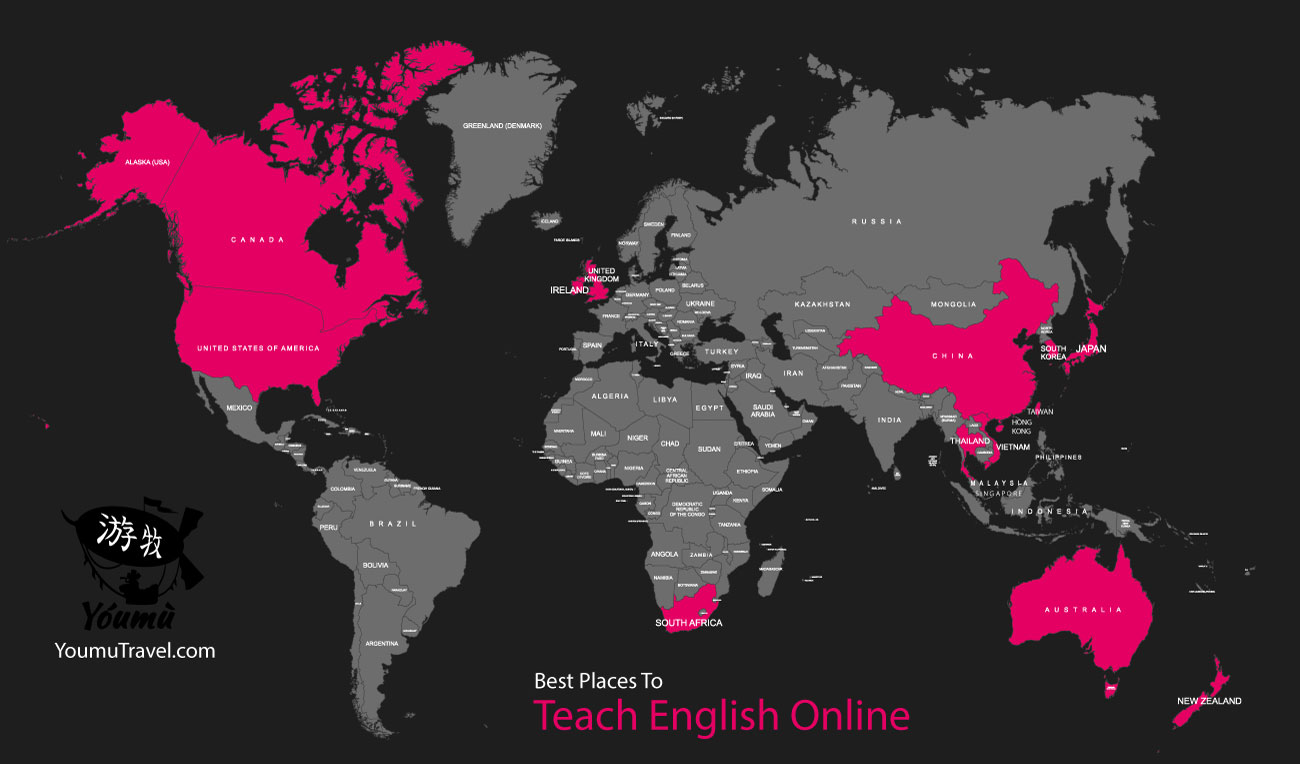
Best Places to Teach English Online
This remote job can technically be done anywhere in the world. However, you’ll want to make sure your clients or employer are okay with the timezone difference. You’ll also want to make sure you’re not living an expensive lifestyle as this job won’t be able to support such a lifestyle.
Here are some of the best places to teach English online.
Countries with High Demand for Online English Teachers
- China
- Hong Kong
- Japan
- South Korea
- Vietnam
- Taiwan
- Thailand
Citizens from the following countries are typically hired by the above countries:
- Australia
- Canada
- Ireland
- New Zealand
- South Africa
- United Kingdom
- United States of America
Get a TEFL Certification
While there are many job opportunities to teach English online without a TEFL certification, there are far more opportunities to those that have their TEFL certification.
Therefore, it’s highly recommended that you consider getting your TEFL certification with one of the best courses below.
Two Best TEFL Courses to Teach English Online
- International TEFL Academy

2. International TEFL and TESOL Training

Compare pay & cost of living per location
Using our pay breakdown on this page to see what countries work best for Teaching English Online.
Find a job teaching english online
Freelance Marketplaces
Similar layout to step 1 resources but maybe not as big?
Best Companies To Teach English Online
Similar layout to step 1 resources but maybe not as big?
Can you teach English online without a degree?
Yes, You Can Teach English Abroad Without a College Degree! One of the best things about the field of teaching English as a foreign language (TEFL) is that it’s open to just about anyone.
How much do online English teachers make?
Generally speaking, online English teachers typically make anywhere between $10 – $40 USD per hour depending on their level of qualification. Platforms such as VIPKID offer base rates plus incentives. Incentive bonuses may include things like an extra $1 of pay per class if you complete more that 45 classes per month.
How can I teach English online at home?
What You’ll Need to Teach Online. To teach online successfully, you’ll need a good broadband speed, Skype, a webcam and headset, and a TESOL/TEFL certificate. Generally, it’s also important to be a native English speaker. Finally, most important is a friendly, patient and punctual personality.
What qualifications do you need to teach English online?
Whether teaching K-12 students completely online or in a blended classroom-online environment, most public school teachers need to meet basic educational requirements, which include earning bachelor’s degrees, completing teacher training programs, gaining supervised teaching experience and earning licensure.
How much does TEFL certification cost?
You know you need it, but how much does TEFL certification cost? Prices vary depending on some key factors, but expect to pay about $200 for very minimal online certification, and closer to $400-500 USD for online certification of enough hours to qualify for most TEFL jobs (at least 100).
Is teaching English online legit?
With that being said, there are the one’s that really, truly are legitimate. With online teaching you may not make as much as you would teaching at a physical school, and they are generally contract jobs, so don’t expect health benefits.
Does teaching English online pay well?
While pay depends on your qualifications and the specific job, you can expect to make anywhere from $12-$25 USD/hour (and sometimes more) as an online English teacher. We’ll break down the factors involved in pay and help you make the move to teaching English online.
How can I make the most money teaching English online?
Generally speaking, online English teachers typically make anywhere between $10 – $40 USD per hour depending on their level of qualification. Platforms such as VIPKID offer base rates plus incentives. Incentive bonuses may include things like an extra $1 of pay per class if you complete more that 45 classes per month.
How much does a TEFL teacher earn?
How much do TEFL teachers earn? ESL teacher salaries greatly vary depending on where you’re teaching. A teacher’s salary can be as little as $600 USD per month to as much as $4,000 USD!
How do I start teaching English for beginners?
Here are 6 steps to teach English to beginners like a pro!
- Keep it simple, stupid
- Always check for understanding
- Give them lots of time to practice
- Show, don’t tell
- Always use positive reinforcement
- Don’t be boring
How do I get my TEFL certification online?
- Decide if you’re “in” or not
- Review your qualifications
- Get educated on what getting TEFL certified means
- Start shopping for TEFL certification courses
- Talk to at least 3-5 different TEFL certification providers
- Do your last minute sleuthing, then pick a TEFL program and apply
- Once you’re accepted, it’s time to get focused.
- Think about your next move, then complete the TEFL certification course like a champ.
Is tefl hard to pass?
Generally speaking TEFL is not hard to pass. Face-to-face courses generally have interviews and strict admission requirements so if it is not likely to complete or pass the course, they will not be admitted in the first place.
Remote Data Entry Jobs Guide
Data Entry positions involve inputting data from various sources into computer systems and databases for processing and data management. Data entry clerks will often have to handle sensitive information pertaining to the companies they work for.
This job has a somewhat high demand and is easy to get.
Demand
- Somewhat High Demand
Experience & Degree
- Basic Understanding Required
- No Degree Required
- Native English Speaking Preferred
Citizenship
- No Restrictions
This job is somewhat reliable but you can typically find full-time work with reasonable pay.
Pay Range
- Hourly: $10-$22/hr.
Reliability
- Somewhat Reliable
Housing
- Room and Board Not Provided
This job has a flexible schedule and you can work almost anywhere in the world.
Location
- Very Flexible
Schedule
- Very Flexible
Language
- Can get by with English only
Who can work a Remote Data Entry Job?
Anyone can become a Remote Data Entry specialist!
There are no specific degrees or certifications required to become a data entry specialist. You will only need a high school diploma to qualify for most data entry positions.
However, college classes in relevant areas can improve your chance of landing a job. Telecommunications, computer sciences, and software development are all classes that will look tempting on your application.
What are the responsibilities while working a Remote Data Entry Job?
Data entry specialists will need to efficiently manage a large amount of data. Data entry specialists will mainly be entering data from a variety of sources into a company database. This data is further processed into reports for further use by the company.
Key responsibilities may include:
- Prepping and sorting through data that needs entry.
- Entering data into database software and performing secondary checks to ensure accuracy.
- Fixing any discrepancies in information and completing any blank fields in documents.
- Creating backups of data.
- Completing information requests for other company employees.
- Testing new software and updates to current software.
What’s the typical schedule for a Remote Data Entry Job?
This job is flexible in that it allows you to work from anywhere. However, you may have to conform to certain working hours per your employer’s timezone.
This job is typically a 9-5, 40hr week type position. Commonly it will be a full-time position, but there are part-time and temporary positions available.
Income Reliability
In general, remote Data Entry jobs provide a steady income, however the pay may not be as high as other remote jobs.
Typical Job Duration
Remote Data Entry jobs can be short-term or long-term positions.
Estimated Hours Per Week
It’s estimated that you can work full time, 40 hours per week, as a Remote Data Entry specialist.
Room & Board
Teaching English online doesn’t typically provide room & board.
Remote Data Entry Jobs – Country Map
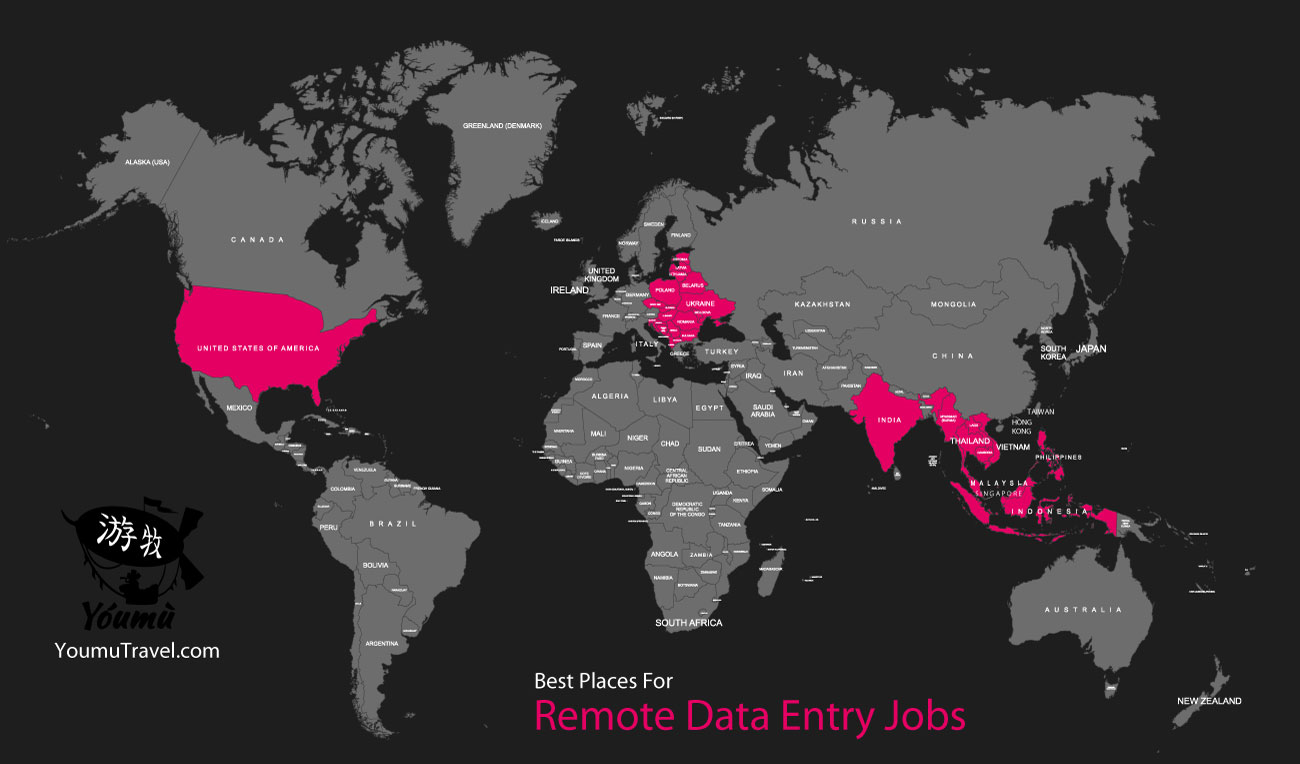
The Best Places for Remote Data Entry Jobs
This remote job can technically be done anywhere in the world. However, you’ll want to make sure your clients or employer are okay with the timezone difference. Here are some of the best places for remote data entry jobs.
- US
- India
- SE Asia
- Eastern Europe
Familiarize Yourself With What the Job Requires
Data entry jobs require many different types of skills and require the data entry clerk to work on a variety of tasks. The responsibilities of data entry clerks may vary depending on the employer’s goals and necessities.
- Data entry is basically entering different types of data into an electronic format, often a database. Data entry clerks will often be required by their company to use a specific software to enter the data.
- Data entry jobs can be listed under many different titles, such as “data entry specialist,” “data entry clerk,” or “information processing.”
- Nearly every company at some point requires data entry work to be done. This is part of the reason data entry jobs are so great for obtaining work. As a potential employee, data entry experience makes you appealing to many different companies.
- Work in data entry involves organizing and preparing data, checking documents for accuracy and completeness, data updates, removing unnecessary files, translating information into an electronic format, reviewing and digitizing documents, and general clerical duties.
Check Into Educational Options
There are no specific degrees or certifications required to obtain a data entry position. You will need a high school diploma to qualify for the majority of data entry positions. However, college classes in similar vocations can increase your chances of getting a job. Software development, telecommunications, and computer sciences are all classes that will look tempting on your application.
Practice Using Different Data Entry Software
For data entry, gaining experience in a many different softwares can enhance your chances of landing a job. Different companies may use a variety of softwares for data entry duties. The more software proficiencies you can add to your resume, the better your chances of getting a job.
- The most frequently used softwares for data entry are from the Microsoft Suite: Open Office, Word, Excel, Access, and PowerPoint. Remember that many companies keep data in-house on systems that might be Microsoft-based or might not be. Proficiency with many different databases that have graphic user interfaces is definitely beneficial.
- Many people can successfully learn software skills by looking for how-to instructions and then playing around within the software. There are plenty of free online tutorials that can teach you about different data entry softwares.
- Colleges and some community learning centers offer classes in computer skills. Research what is available in your area and consider taking a course or two.
Work on Your Typing Speed
Typing is a critical skill of a great data entry clerk. The job requires many clerical duties and therefore requires a lot of typing. Although, typing is not the same as data entry. Typists are generally required to be accurate at 60 wpm or higher. Data entry must be even faster and more accurate since data is often in numeric form and automated spell checkers cannot work on numbers.
- Accuracy is extremely important for data entry positions. A ton of information is in the form of prices, codes, and numbers that must be inputted accurately. Because of the large amount of data being transcribed, you will need to be able to touch-type. This means being able to type without looking down at your keyboard. You must also use the number pad for figures, instead of the top row of numbers on your keyboard.
- Speed is also important. The minimum wpm most employers expect is at least 60. Generally, 80 to 90 WPM is preferred. You can test your typing speed online.
- Typing skills can really only be improved over time, and with lots and lots of practice. To improve your skills, practice transcribing some random content each day, for at least 30 minutes. There are also typing classes that you can take through various routes such as community colleges or vocational schools. Even practicing typing tests online can improve speed and accuracy. You’ll mostly be transcribing numbers though, so keep that in mind when practicing. Perhaps try transcribing lists of numbers and names as well.
- Colleges and some community learning centers offer classes in computer skills. Research what is available in your area and consider taking a course or two.
Fine Tune Your Resume
A good resume is your first step toward finding that remote data entry job you are looking for. Make sure you work on improving your resume and catering to the specific position before sending it out to potential employers.
- Edit your resume with the potential employer in mind. Make sure to place recent and relevant information at or towards the top of your resume since this is what the hiring manager will see first. For a data entry job, this might include previous data entry work, software skills related to the job, and any clerical duties. Do not include all of your experience, only include what is relevant and recent, to an extent.
- Put your name in bold at the top of the page, and be sure to list your contact information just underneath. They should be easily visible so your potential employer can find your contact information. Use a bigger font and highlight your name in bold.
- Keep an eye out for keywords used frequently in data entry job postings. Do a lot of data entry job postings ask for organization or enthusiasm? Use that terminology in your resume so you come across as ideal for a position.
- Use bullet points. Skills, accomplishments, and job duties can ideally be listed with bullet points. This makes them easier to read and skim through, thus drawing the eye of the hiring manager.
Look Online for Remote Positions
The internet contains a plethora of work opportunities in data entry where you can WFH. Working remotely saves you time and money on a commute, and the hours will often be more flexible than a traditional office job.
- However, these positions can be more competitive. Due to their convenience, they are more desirable than traditional data entry positions. Don’t give up if the search takes time. Be persistent.
- Online databases work great for finding WFH/remote positions. You can just add the word “online” or “remote” to your search. You might also find some online jobs while searching for positions in your area.
- Unfortunately, you’ll need to be on the lookout for scams. If you are contacted, and hired very quickly, be cautious. Bad grammar and broken English are also signs of potential scammers.
- Again, watch out for scams. If you hear back and are hired very quickly, be cautious. Bad grammar and broken English are signs of potential scammers.
Be Aware of Average Salaries
While data entry is great for building your resume, many employees don’t work in data entry long-term. Salaries are quite low when compared with similar office-type jobs.
- Data entry workers can earn about $23,000 to $35,000 a year. The average salary is about $28,000 a year.
- Upward movement and promotions depend on the employer and your skills and ambition. There are no specific career paths for data entry employees and advancement is more difficult than with similar office jobs.
Professional Networking
As you move along in your career as a data entry clerk, make sure to keep in touch with previous coworkers and employers, especially your direct supervisors. Make a good impression by expressing interest in continued advancement opportunities, and show your eagerness to take on more responsibilities. This increases your chances of landing a higher paying job that has more responsibilities.
Factor In Your Future Goals
Frequently data entry positions will be a stepping stone to other jobs. Consider your long-term goals.
- Customer service and administration jobs are often positions that longer-term data entry clerks can move into. If you like working with people, you may want to discuss with your employer about potential future opportunities in these fields.
- If your data entry jobs are related to science or mathematics, you could consider technical positions such as computer science for your future.
- Government organizations sometimes provide training to help data entry workers expand their skill set. This can open up opportunities for better positions with greater responsibilities. Look into programs in your area that work with your goals and interests.
How can I get a remote data entry job from home?
Below you can find some common places to search online for data entry jobs for beginners.
- FlexJobs.
- Microworkers
- Amazon MTurk
- Clickworker
- Fiverr
- SigTrack
Are remote data entry jobs legit?
Data entry jobs can be completed in-office, however, many companies are using remote positions nowadays. Entry-level data entry jobs are not high-paying positions. If the pay seems well above the average for other listed positions, it is likely a scam. Avoid these postings if at all possible.
Do online data entry jobs really pay?
The Better Business Bureau notes that anyone looking for an online-only job should be on alert when postings seem too good to be true. Serious companies offering WFH/remote positions will not make you pay for any items before starting your job, whether this is software licenses, office equipment, etc.
Is a data entry job hard?
Applicants are often required to ace a test for typing accuracy and speed. Punctuation, organization of data, and sorting are all common duties. Many jobs will require a certain typing speed (WPM) and may require proficiency with a certain software. To get a job as a data entry specialist, you’ll need to practice and improve your typing skills.
How can I get a data entry job?
In order to get a job in remote data entry, you will need experience with computers, typing, and some basic clerical skills.
Beef up your typing skills:
- Ensure your typing is accurate. Mistakes cost time.
- Work toward high typing speed.
- Build your typing skills through time and lots of practice!
How can I be a good data entry clerk?
Key Skills to be a Data Entry Clerk:
- Basic business software knowledge.
- Written and oral communication skills.
- Fast Typing Speed.
- Efficiency and concentration while working.
- Typing Skills and accuracy.
Virtual Assistant Jobs Guide
A virtual assistant is a self-employed individual who handles tasks such as scheduling appointments, making phone calls, preparing travel arrangements, and maintaining email communications for clients remotely, typically from a home office.
This job is in high demand and easy to get.
Demand
- High Demand
Experience & Degree
- Basic Understanding
- No Degree Required
- Native English Speaking Preferred
Citizenship
- No Restrictions
This job is reliable with reasonable pay.
Pay Range
- Hourly: $10-$28/hr.
Reliability
- Reliable
Housing
- Room and Board Not Provided
This job has a flexible schedule and you can work almost anywhere in the world.
Location
- Flexible
Schedule
- Somewhat Flexible
Language
- Fluent in English.
Who can work Virtual Assistant Jobs?
Anyone that is fluent in English can get a Virtual Assistant Job. No prior experience is required, although it may be helpful, and you don’t need a degree. However, if you want your virtual assistant business to grow significantly, taking courses will help you save time and reach your goals quicker.
What are the responsibilities of a virtual assistant?
Virtual assistants, or virtual professionals, are remote self-employed administrative assistants that act as secretaries and usually work from home. Tasks they typically perform include scheduling appointments, making phone calls, organizing travel arrangements, maintaining email communications, executing social tasks, or entering data on platforms. However, the tasks they are provided with depend on their particular skill set.
Be sure to do your research with any work-at-home position to make sure they are legitimate and avoid scams before signing any contract or sharing banking information.
Key Responsibilities
- Respond to emails and phone calls
- Schedule meetings
- Book travel and accommodations
- Manage a contact list
- Prepare customer spreadsheets and keep online records
- Organize managers’ calendars
- Perform market research
- Create presentations, as assigned
- Address employees administrative queries
- Provide customer service as first point of contact
What’s the typical schedule for a virtual assistant?
Being a virtual assistant you have some flexibility in your schedule, depending on your clients and deadlines of your tasks. For a full-time client, you’re looking at a typical 8 hours a day 5 days a week with the times chosen by you, especially if time-zones differ between you and your client. The best part of being a virtual assistant is that you can work from anywhere!
You can work up to 40 hours a week, depending on your client’s needs and number of clients.
Income Reliability
In general, Virtual Assistant Jobs are reliable and provide a constant stream of work.
Typical Job Duration
Virtual assistant jobs typically last at least a year.
Estimated Hours Per Week
It’s estimated that you can work full time, 40 hours per week, as a Virtual Assistant.
Room & Board
Virtual Assistant jobs do not provide room and board.
Virtual Assistant Jobs – Country Map
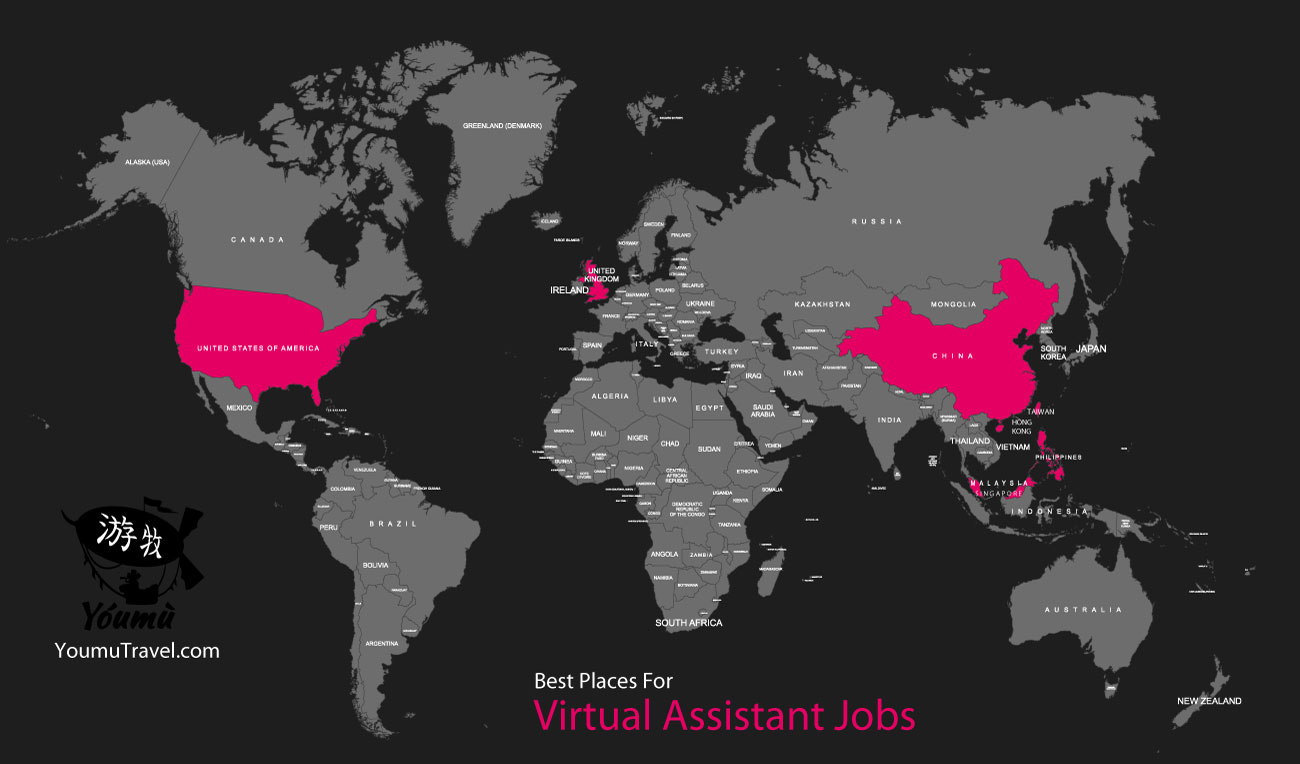
The Best Places to work Virtual Assistant Jobs
This remote job can technically be done anywhere in the world. However, you’ll want to make sure your clients or employer are okay with the timezone difference. Here are some of the best places for virtual assistant jobs.
- US
- Philippines
- Malaysia
- China
- UK
Business Structure
There isn’t a textbook answer for setting up your business structure because it depends on many variables including your location, what types of clients you work with, what type of virtual assistant work you will be doing, your personal responsibilities outside of work, risk tolerance, and the structures available in your area. You may want to speak to an accountant or attorney for feedback that is specific to your situation such as deciding if you’ll be a sole-proprietorship, LLC, or a corporation (S-Corp or C-Corp in US), or a partnership. This is a very important decision to get right because changing costs time which in turn costs you money.
Services You’ll Offer
This is the most important step because it often means changing, adding, or eliminating services per client demand, profitability, your own availability, and your personal interests; in other words, you need to be adaptable and be willing to learn new skills. Typical virtual assistants services are maintaining emails, phone calls, and your client’s calendar, but you’ll want to be able to offer more than just that. After a bit of experience, you’ll be able to more easily recognize the needs of your clients and adjust accordingly.
Pricing
So how much do you charge for your services? This answer can vary due to the role itself varying in what it entails as well as your skillset and experience. Assuming your charging hourly, you’ll need to figure out what would make it worth your time because you’re trading time for money. The main 3 things you’ll need to take into consideration are:
- You’re not an employee but a subtractor which means, in the US, you’ll need to pay both employee and employer’ side of taxes
- You are not entitled to any type of benefits (sick days, health insurance, retirement, paid vacation unless otherwise specified)
- Think of the overhead you’ll need to cover which could include things like website hosting, office expenses, software, etc.
Due to these expenses that you will be responsible for, it would be unfair to compare that to a typical day job. Also, remember that business owners prefer hiring a freelance virtual assistant instead of a part-time or full-time employee because they don’t have to deal with the cost or time of training/setting up a new employee.
Decide on Brand
After you’ve chosen what work you’re going to do, it’s time to decide on a company name and design your branding and logo. Don’t be afraid to settle on something even if it’s not perfect because you can redesign later as your business grows. You’ll also need to build up your presence online, meaning having a website and maintaining your social media profiles because those will be judged by prospective clients. However, don’t let the designing distract you from your main goal of acquiring clients.
Create Website
Although it’s not required to have a website to gain clients or even beginning your virtual assistant business, it will help you look more professional and provide you a place to send prospective clients so you seem well established. It’s also easy and cheap to set up a professional-looking website nowadays without the hassle of coding so you won’t need to hire anyone to do it for you!
Business Finances
Now it’s vital to have a sufficient way for clients to pay you and to keep a track of your income and expenses. In the beginning, you can maintain a spreadsheet and a PayPal account, but once your business begins to flourish, you’ll need to look into programs like FreshBooks or Quicken. It would also be a good idea to open a bank account and acquiring a credit card for business expenses. If you’re able to get organized with your finances early, the easier everything will be in the future, especially when tax season arrives.
Marketing Strategy
Now that you’re prepared to start your business, it’s time to think about advertising and marketing yourself. This is a difficult project for many individuals, but it is the best and most effective way to gain clients. There are plenty of ways to market yourself that isn’t hard or uncomfortable. One way is if you already have social media accounts, utilize them by sharing your services and announce to the people already following you on them that you’ve started your own business. If you want to keep your personal life and your business life separated, you can create social media accounts just for advertising your virtual assistant services. The second way is if you already have a blog or a website that has a developed contact list, share your new business with that list! The people on it already support you by following you so use them to help you network further. Thirdly, you can take advantage of Facebook ads or blog posts to catch the eyes of online business owners. Lastly, make some flyers and design yourself business cards to hand out to local businesses.
Find Your First Job
- Try Freelancer Websites. Virtual assistant positions are easy to find on freelance websites such as Upwork and People Per Hour and it’s a great way to get started if you don’t have much experience. However, positions on these sites are usually of lower pay so as you gain experience and learn the appropriate skills, start to raise your prices; it’s okay to renegotiate pricing with clients later on.
- Social Media. Utilize posting on all social media so that friends, family, and coworkers know that your business is starting up so they can help you network even further. You never know how someone might know someone else that can connect you to the job you’re looking for!
- Local Businesses. Small business owners are great prospective clients. Ask them if they could use assistance with what you’re offering. This is a relatively new position so local businesses may not realize it’s an option. Let them know how they could benefit from your services and persuade them that they need your help. This will even help you practice your marketing skills.
- Network with Influencers. Is there a business that you follow religiously? Contact the owner and ask if they are searching for any assistance in their business. Keep your email short, friendly, but confident as you describe what all you have to offer. If they respond that they’re not looking, send them a link to your website and tell them to keep you in mind in case anything changes. After three months, reach out again to show you’re still interested. Be sure to subscribe to their email list so you are one of the first people to know of any job openings.
- Network with Other Virtual Assistants. Don’t be intimidated by other virtual assistants. Instead, reach out to them too because they can offer advice on pricing, services, and resources for training and conferences. They may even know of some openings that reflect the need for your services that they couldn’t provide and offer you those opportunities.
Freelance Marketplaces
- Zirtual. Zirtual is actually a company that connects virtual assistants with clients who need help with various different tasks.
- Office 88.
- Virtual Office VA.
- 99 Dollar Social.
- Fancy Hands.
- Lifebushido.
- Red Butler.
Best companies to work for as a Virtual Assistant
- MyOutDesk
- WoodBows
- BELAY
- Virtual Assistant Talent
- 20Four7VA
- Elite VA
- Hello Rache
How do I become a virtual assistant?
- Choose your business structure.
- Decide which services you’ll offer your clients.
- Decide on your pricing structure.
- Launch your website and create your online presence.
- Start pitching and networking.
- Build relationships.
How much does a virtual assistant make?
Virtual assistants can make from $10-$28 an hour. Depending on experience levels and skill set.
What skills do you need to become a virtual assistant?
- Word Processing skills.
- Oral Communication and Writing skills.
- Computer skills.
- Self Motivation and Discipline.
- Quick Thinking and Effective Decision Making.
- Lastly, Love for Continuous Learning.
How do I become a virtual assistant with no experience?
- Step 1: Sort your skills.
- Step 2: Research the VA market.
- Step 3: Take the plunge.
- Step 4: Get work as a virtual assistant.
- Step 5: Have a system.
- Step 6: Increase your va skills, increase your pay.
How do I become a virtual assistant at home?
- Create your menu of services.
- Make a list of potential clients.
- Create a business plan.
- Decide your business name.
- Determine your business structure.
- Get needed permits and licenses.
- Develop a marketing plan.
- Get clients and provide great service.
Is there a demand for virtual assistants?
The demand for virtual assistants continues to grow as businesses move online and work from home.
What jobs does a virtual assistant do?
- Calendar and schedule management.
- Travel arrangements.
- File and document organization.
- Email monitoring and organizing.
- Answering and directing calls.
- Billing and accounting activities.
- Writing and maintaining records.
- Vetting potential clients, projects, partnerships, etc.
What are the requirements to be a virtual assistant?
A virtual assistant will need at least a high school diploma; however, some employers may require or prefer an associate’s or bachelor’s degree. Some employers may accept a high school diploma as long as prospective candidates have the required amount of related work experience.
How do virtual assistants get clients?
It is important to network with other virtual assistants who offer different services. You’ll want to introduce yourself, explain who you mainly help and the skills you can bring to your prospective clients, and ask if they can refer you to someone in need of your services. Be sure to offer to do the same for them!
Is it hard to be a virtual assistant?
If you are not a self-starter or find it difficult to stay motivated, it can be a difficult position. It’s not a job that you can do last minute or slack off in the slightest, even if you are working from home. It is also important to keep up a good reputation in this position because it could make or break your career.
What programs do virtual assistants use?
- Hubstaff. Hubstaff is a web-based time tracking and project management tool that’s super simple to use.
- Dropbox. Make use of this popular tool to share files with one another.
- Google Calendar.
- GroupMe.
- LastPass.
- Rhino Support.
- Skype.
- SnagIt.
Freelance Writing Jobs Guide
A freelance writer is someone who is self-employed that is then hired by a client to write content on a project basis. A freelance writer will usually report to an editing manager or chief editor.
This job is in high demand and easy to get.
Demand
- High Demand
Experience & Degree
- Basic Understanding
- No Degree Required
- Native English Speaking
Citizenship
- No Restrictions
This job is reliable with reasonable pay.
Pay Range
- Hourly: $12-$60/hr.
Reliability
- Reliable
Housing
- Room and Board Not Provided
This job has a flexible schedule and you can work almost anywhere in the world.
Location
- Very Flexible
Schedule
- Very Flexible
Language
- Native English Speaking and Local Language
Who can get Freelance Writing Jobs?
Anyone can be a freelance writer! However, you are expected to have excellent grammar and writing skills as well as prior experience with writing. Although not required, it is highly encouraged to have a bachelor’s degree in either journalism or mass communications.
There are no restrictions in your way. Start a blog today and find that writing job in no time!
What are the responsibilities of someone working Freelance Writing Jobs?
As a freelance writer, you will be provided with the responsibility to develop and write content for a client that hires you on a project-basis.
You’ll usually report to an editing manager or chief editor who will outline what is expected of you and the story you will be covering.
Key Responsibilities
- Creating content that aligns with editorial and formatting guidelines
- Communicating with clients about project-based expectations, as required
- Explaining assignment-related challenges with the client as they are presented
- Properly researching the information presented in compositions
- Creating and maintaining content that is unique
- Proofreading projects for spelling and grammar errors and correcting them
- Submitting finalized works via appropriate means
- Logging and tracking hours spend per project (if required)
What’s the typical schedule for someone working Freelance Writing Jobs?
This job is flexible in that it allows you to work from anywhere and you make your own hours. However, it is important to have time management skills and plan out a writing schedule.
Full-time writers sometimes dedicate 9-10 hours days while part-time writers only have to put in approximately 3-4hours.
The best part about this job is that you’re in control of your own schedule so you can add or subtract as many hours as you see fit as long as you meet that deadline and provide quality work.
Income Reliability
In general, freelance writing online is a reliable job that provides a constant stream of work, especially with internet ever-growing.
Typical Job Duration
Freelance Writing can be short-term or long-term.
Estimated Hours Per Week
It’s estimated that the average full-time freelance writer works 36+ hours a week.
Room & Board
Freelance writing doesn’t typically provide room & board.
Freelance Writing Jobs- Country Map
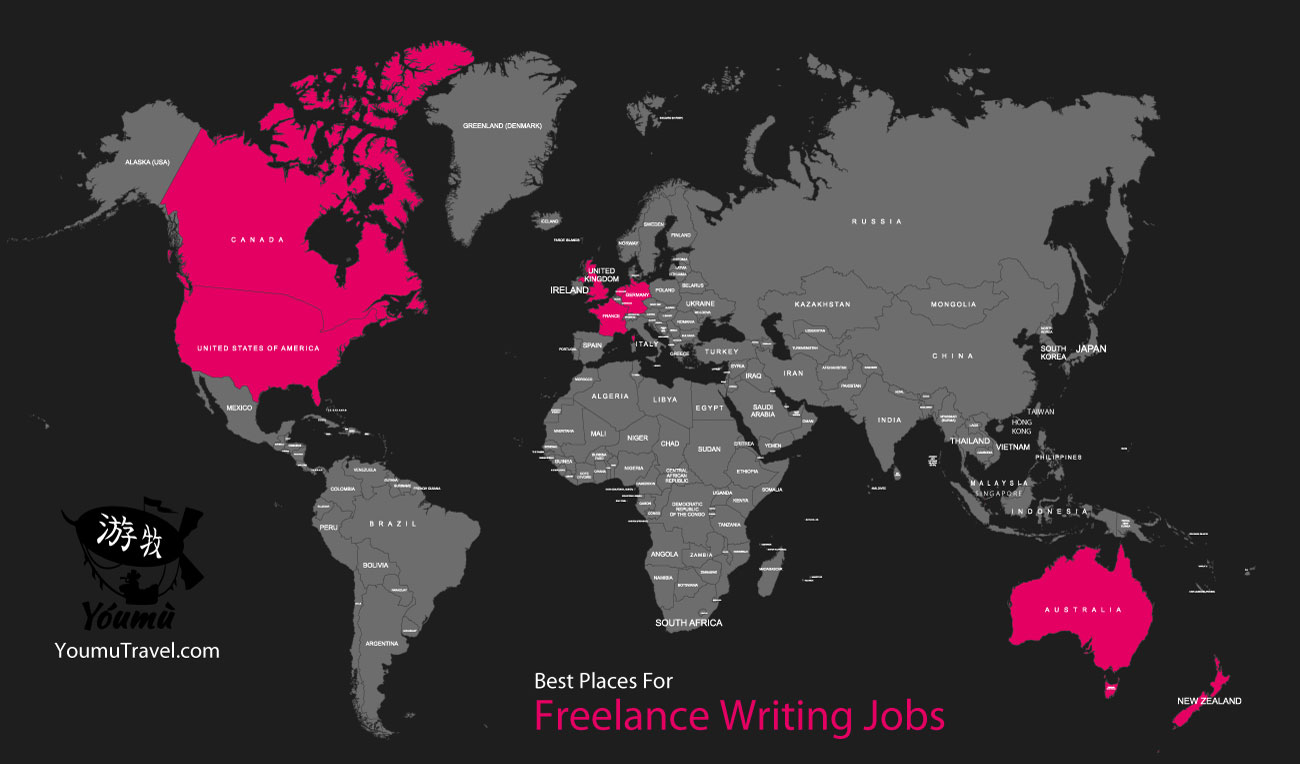
The Best Places for Freelance Writing Jobs
Most major countries throughout the world have opportunities for those looking for freelance writing jobs. Here are some of the best places for freelance writing jobs.
- US
- UK
- Germany
- Netherlands
- Canada
- Australia
- France
- New Zealand
- Singapore
Types of freelance writers
When researching how to become a freelance writer, it can be overwhelming at first due to all the different types of freelance writing that are out there- magazines, newspapers, blogs, etc. Where do you begin? Well, let’s clear that up by first understanding what type of writing freelancers do. As a beginner, the basic types you’ll see include:
- SEO writing
- Blogging
- Copywriting
- Technical writing
- B2B writing
Writing tools and skills required
- Organizational Skills. Organization skills are one of the most important for freelance writers because you are usually given a timeline to follow and there will be a lot to keep up with such as all of your projects, billing information, client information, pitches sent, and a content schedule for your blog and sometimes even your client’s blog. You will also need to create a writing routine to help you stay on track with the development of your articles/blog posts. How are you going to outline your content? What research do you need to do to fully understand the topic you are writing on? Having a reliable schedule and workflow is key to growing your business because you are less likely to make a mistake or forget vital information.
- Blogging Skills. You have to know how to engage an audience. You may think writing is easy because who hasn’t written a couple of essays back in high school? This is much different. It’s about captivating a reader from just your headline and introduction. However, just like your term paper, you want to include reputable sources for any claims or factual information you reference. Not only does the writing have to be attractive, but so does the formatting. Pay attention to your subheadings, the white space you’re creating, and don’t be afraid to utilize lists and tables! It’s also important to leave your audience some actionable tips- encourage them to research more into the topic themselves even after reading your content.
- Confidence. Rejection is tough. We’ve all been denied a job that we were so sure we had in the bag, but the important thing is to not give up! Even the best writers face rejection every now and then. To be a successful writer especially a freelancing one, you’re going to need unwavering confidence despite all the odds and lose the fear of pitching. You may not have the skills to sell yourself at first and that’s okay; that comes with practice, experience, and taking action. Yes, that means applying for jobs you aren’t fully qualified for or delivering a pitch that isn’t quite perfect. You just have to do it; you can’t succeed without failing first.
- Task Management Program. Working alone can be great until you realize that means you are your own receptionist among other things. That means you are in charge of keeping track of everything. There are applications out there to help with that; a few being Google Task Manager, Trello, Asana, or even Microsoft Excel. Research a few programs and find the one that works best for you and start creating a system to manage your projects, finances, and if you want, your blog content you send out.
- Image Editing Program. With the growth of media on the internet, you may be asked to do images for your client’s content and it may be something to consider offering yourself. Knowing how to add text to blog images is vital for a freelance writer because it shows prospective clients you know just how to blog and that you are up-to-date with the modern world. Free editing programs like Canva and PicMonkey are easy to use and great for beginners.
- Editing. You will want to have your work edited with Grammarly, Hemingway, or some other editing app to check for any spelling or grammar errors.
Practice
You don’t have to be a novel-selling author to be a successful writer, but it is important to know how to create a coherent story from start to finish and write complete, proper sentences. If you are already a fairly good writer, there’s still room for improvement. Try things like adding sensory details, fully removing filler words, and overall continuing to try different techniques and writing styles. Starting a blog is a great way to do this. It won’t only help you become a better writer, but also markets your freelance writing business. What if English isn’t your first language? Don’t let that stop you! There are many freelance writers who aren’t native English speakers and they still make a living. You may have to work a little harder to show clients you are just as capable of writing, but if it’s what you want to do, go for it!
Create a Portfolio
Most, if not all, writing jobs you apply to will ask for examples of your work, especially published ones. What if you don’t have any? If you started a blog, you have published work. You can also create samples and upload them as a Google Doc or publish them on Medium. There are plenty of blogs that will accept guest writers and having a post on them means you have a link to share that counts as a publication.
Start pitching
Finally, you can start actively searching for freelance writing jobs, but the question is where do you look? You can go to job boards like Problogger and Freelance Writing Jobs who post new, quality jobs daily. What do you do when you find a job you’re interested in? Be one of the first people to apply which means checking the job board frequently and prepare a pitch that stands out amongst the pile. To do this, you’ll want to show credibility with guest posts and testimonials.
Get Out There
The best thing you can do for yourself as a new freelance writer is to continue learning and practicing your writing. You want to check writing, business, and pitching tips from experts to help where you’re lacking and always remember there is room for improvement.
Where to Find Freelance Writing Jobs?
Here are a few common ways to find freelance writing jobs:
- Visit Problogger Job Board.
- Visit FreelanceWritingGigs.com.
- Visit MediaBistro.com Job Board.
- Visit Journalism Jobs.
- Visit Craiglist.
- Visit Morning Coffee Newsletter.
- Visit All Indie Writers.
- Visit Blogging Pro Job Board.
- LinkedIn jobs
- Sign up with creative placement firms
How do freelance writers get paid?
Most freelance writers are paid by joining freelancing websites for free and listing their services for clients to find and hire them. The top websites for this are:
- iWriter. iWriter is a very easy to use website to get started on your writing career right away.
- Freelancer.
- Listverse.
- Stay at Home Mum.com.au.
- Freelance Mom
- UpWork
What are the highest paying freelance writing websites?
Most of the time pay varies depending on the client and the project you are working on. The following are 10 websites with the best-paying freelance writing jobs so you can not only get paid but also build up your portfolio and get your name out there:
- BloggingPro. Pay Varies.
- FlexJobs. Pay varies.
- Freelance Mom. $75-$100 per article.
- FreelanceWriting.com. Pay varies.
- Income Diary.
- The Penny Hoarder.
- Talent, Inc.
- The Writer Finder.
Is freelance writing a good career?
Freelance writing is a project-based writing position where you are hired as a self-employed individual to write any composition a client has asked of you. The advantages of this type of job are freedom to make your own schedule and profitability because the amount paid per article varies, you can get multiple projects as well as multiple clients at a time, and writers are always in high demand especially with the internet ever-growing.
What are the highest paying types of writing jobs?
Here are 6 of the highest paying jobs for writers:
- Technical Writer. If you have a knack for distilling complex ideas into plain English, a career in technical writing may be a good fit.
- Editor. Good writers usually make good editors.
- Magazine Writer.
- News Reporter.
- Social Media Manager.
- Blogging.
Do you need a college degree to be a freelance writer?
Technically, you do not need a college degree to be a freelance writer. However, it is often encouraged that you have a Bachelor’s degree in English, journalism, or communications.
Online Transcription Jobs Guide
A transcriptionist can expect to listen to audio recordings, translate them to physical writing, review final transcriptions, and act as a liaison with the client to ensure their satisfaction with the document.

This job just has an average demand but it’s easy to get.
Demand
- Average Demand
Experience & Degree
- Basic Understanding Required
- No Degree Required
- Native English Speaking Preferred
Citizenship
- No Restrictions
This job is somewhat reliable, likely part-time, and paying reasonable rates with the chance of lower rates.
Pay Range
- Hourly: $8-$30/hr.
Reliability
- Somewhat Reliable
Housing
- Room and Board Not Provided
This job has a flexible schedule and you can work almost anywhere in the world.
Location
- Very Flexible
Schedule
- Very Flexible
Language
- Can get by with English only
Who can get Online Transcription Jobs?
The ideal transcriptionist is focused, attentive to detail, and possesses superb writing and listening skills. Additionally, fast typing skills are a huge advantage. You should be able to type 60 words per minute on average, but higher level companies require a typing speed of at least 75 WPM. Proper grammar, vocabulary, and punctuation are all vitally important to a successful, understandable transcription.
The ideal candidate will also have the ability to multitask, communicate effectively with clients, and have knowledge of word processors like MS Word.
What are the responsibilities of someone working Online Transcription Jobs?
As an online transcriptionist, you will be responsible for creating written documents that correspond exactly with an audio file. These audio files might be from business meetings or quick conversations. Accuracy is imperative for the client’s comprehension of the transcript.
Key Responsibilities
- Understanding client specifications and noting any formatting or notations requests prior to completing the transcription
- Completing transcriptions in a timely manner and reviewing drafts for any spelling, grammar or formatting errors, as well as other inconsistencies
- Adhering to all confidential guidelines and respecting sensitive information
- Showing up on time for scheduled meetings and court proceedings
- Keeping abreast of transcription software updates and attending refresher workshops as required
- Communicating with the client or supervisor when there are issues
- Submitting completed drafts to clients and correcting any errors as per their feedback
- Keeping typing skills sharp by completing regular typing drills
What’s the typical schedule for someone working Online Transcription Jobs?
Transcriptionists can work full- or part-time during the employer’s business hours, but a freelancer is likely to work part-time. Specific hours are likely to vary by company or industry. If the position is for an office environment, the hours are likely to be 9-5 within the company’s timezone, but a freelance transcriptionist may be able to create their own schedule.
Income Reliability
While there are plenty of online transcription positions to be had, it is unlikely for a beginner freelance, remote transcriptionist to be able to subsist on this income alone. Online transcription can, however, provide a boost to your income.
Typical Job Duration
Online transcription can be long or short term.
Estimated Hours Per Week
It depends on who you are transcribing for. If it is freelance work, it is likely to be part time and varying, but there are full time, 40-hour positions available.
Room & Board
Transcription online doesn’t typically provide room & board.
Online Transcription Jobs – Country Map
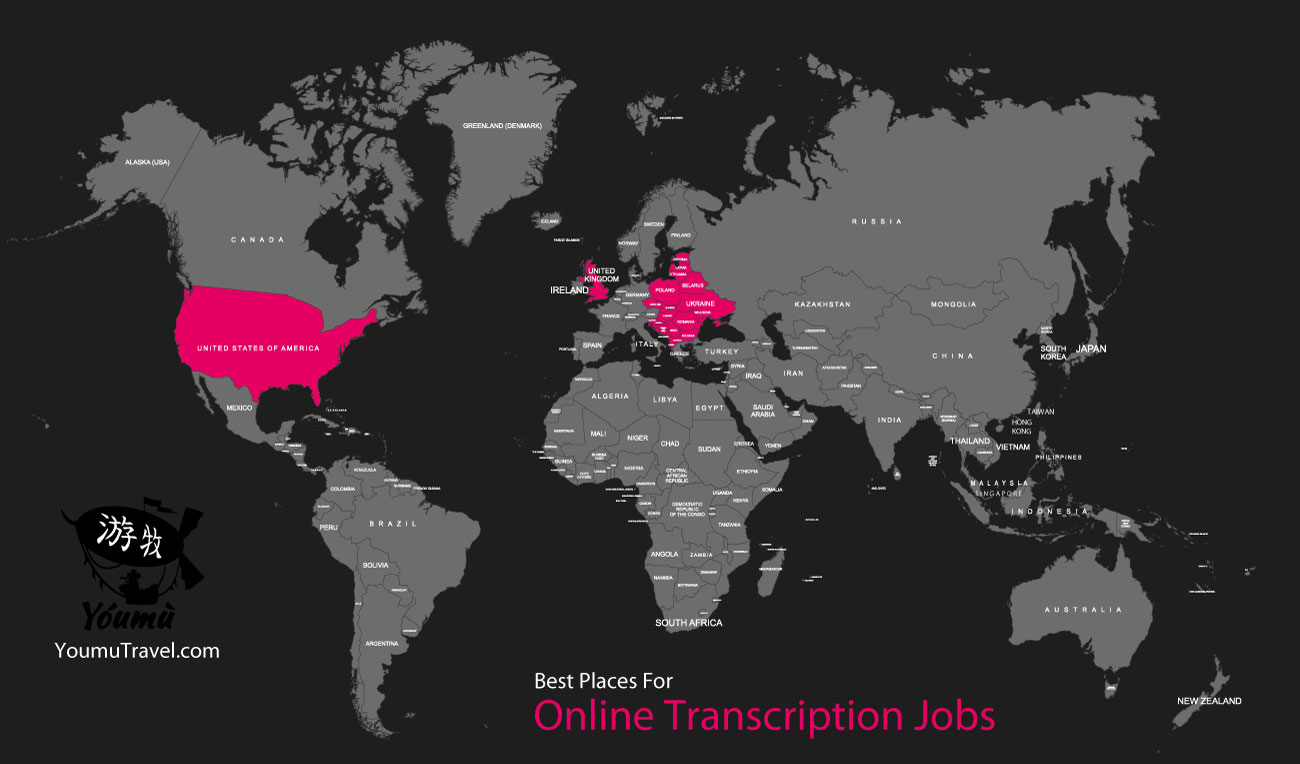
The Best Places for Working Online Transcription Jobs
This remote job can technically be done anywhere in the world. However, you’ll want to make sure your clients or employer are okay with the timezone difference. Here are some of the best places for online transcription jobs.
- US
- UK
- Eastern Europe
Learn a transcriptionist’s skill set.
These skills shouldn’t differ between companies, and can carry you to many different transcription jobs. They are:
- Quick, accurate typing.
- Acute listening abilities.
- Fluent command of English.
- Knowledge of Microsoft Word or other similar programs.
- Thorough knowledge of editing, grammar, and proofreading skills.
- Ability to multitask.
- Focus on task completion and time management.
Have the technological requirements.
These, too, shouldn’t differ by company and are relatively universal. They are:
- Up-to-date computer
- A reliable internet connection.
- Transcription software, which most beginner-level companies will provide. These are simple to install to your computer.
- A better paying transcription job might require you to provide your own software and to use a foot pedal.
- Microsoft Word.
- Some companies require particular web browsers to have access. For example, TranscribeMe can only be used on Google Chrome.
- Proper headphones are required by all transcription companies.
Maintain your typing, grammar, and vocabulary skills.
Prior to beginning your career as a transcriptionist, you need to make sure that these abilities are on par, or it will be difficult to land a transcription job. Grammar, vocabulary, and punctuation are all vitally important to a successful transcription.
You should be able to type 60 words per minute on average, but higher level companies require a typing speed of at least 75 WPM. However, it isn’t always typing speed that might slow a transcriptionist down. The quality of the audio file, quick conversations, and unfamiliar terminology are the biggest roadblocks in a transcriptionist’s way. Don’t worry too much, you’ll get faster with practice, but accuracy remains essential. Strive for 100% accuracy.
Practice transcribing.
Practicing your transcription skills will give you a sense of what the job actually entails and if it’s a good fit for you. GoTranscript has some practice jobs that should be helpful, though they are simplistic. Another service is Express Scribe, which is completely free. The software requires that you download and install it to your computer, and download audio files to open them in the program.
Learn the different transcript style guidelines.
Learn what different companies require in their transcriptions prior to beginning work for them. This will help you pass the initial test when you apply for transcription jobs. You can see what a particular company’s guidelines are on how to handle certain situations, such as what to do when you can’t tell what’s being said in a file, or how to spell a mispronounced word. Companies will have different style guidelines that you should look into prior to taking their transcription tests.
Find a transcriptionist job.
There are plenty of companies that will hire a burgeoning transcriptionist without any prior experience. Many of these remote positions will pay fairly low, but there is opportunity for advancement within the profession.
How much do online transcriptionists make?
A transcriptionist can usually expect to make around $15/hour, but an advanced or experienced transcriptionist can earn $25-$30/hour. At that rate, a transcriptionist could earn $1,500 per month with only a few hours of work a day. The median salary for a transcriptionist is $15.22/hour, according to PayScale.
How can I get transcription jobs online?
There are a few different websites and companies that can help you find an online transcription job. These include companies like TranscribeMe, AccuTran Global, Casting Words, and Daily Transcription.
How long does it take to transcribe 1 hour of audio?
On average, it takes a transcriptionist four hours to transcribe one hour of audio. This rate applies to slow, easy-to-hear audio files, and might vary by audio and transcriptionist.
Does TranscribeMe pay well?
The base level salary for TranscribeMe is $15 per audio hour, which is admittedly low. But with that in mind, TranscribeMe can be a great opportunity to try out transcription to see if it’s a good fit for you before diving headlong into a full transcription career or business.
Is transcribing hard?
Transcription, like anything, is a skill that you can learn and get better at over time. One factor that contributes to a transcriptionist’s success is their ability to type–the slower the typing speed, the more difficult transcription might be.
Which is better Rev or TranscribeMe?
The comparison on Glassdoor.com shows that Rev.com employees rated their experience higher than TranscribeMe in Career Opportunities, Compensation & Benefits, and in their Overall Rating.
Is working for Rev worth it?
This depends on the potential transcriptionist’s opinion on what is “worth it.” Rev is great for a boost to your income that you can make at home, but it is unlikely for a transcriptionist on a site like this to be able to subsist on this income alone. While the work is easy to do, there is not enough money to be made from it unless you devote all your energy to it.
Are online transcription jobs worth it?
Online transcription is potentially one of the easiest part-time online jobs, and potentially one of the best paying. Depending on the assignment, you can make over $100 per job. If that remains consistent, that equates to a part-time income of around $36,500 a year with daily work.
How do you pass a transcription test?
Online transcription companies will have you take a test before they hire you. Here are some tips to help you pass these tests:
- Practice your typing skills often.
- Pay attention and listen carefully.
- Make sure your grammar and spelling skills are good, including punctuation.
- Learn the format that is necessary in transcription.
- Try out and invest in transcription tools.
- Use your best judgement and critical thinking.
How fast do you need to type to be a transcriptionist?
The average transcriptionist can type at least 50 words per minute, and those who work on time-sensitive files can usually reach speeds of 65 to 70 WPM. However, there is not an official typing speed requirement.
How many words is an audio hour?
A typical speaking pace in English is 130 WPM, so an audio hour would clock in at about 7,800 words, depending on the content.
How can I transcribe audio faster?
Here is a list of tips to increase your transcription productivity to become a speedier and better transcriptionist:
- Ensure the quality of your equipment including your computer, headset, transcription software, and sound editors. Consider trying a foot pedal.
- Brush up on your knowledge of Word; there are time-saving features that can help you as well as dictionaries with pictures.
- Practice your typing skills and transcription abilities off-the-clock.
- Make sure you have good audio quality, and remember you can adjust the speed of the audio as you see fit.
- You can transcribe topics you know fairly well, and you can also put effort into learning the jargon of the type of industry you’re working in.
- Become comfortable conducting your own online research, compiling the research materials, and keeping track of resources.
- Communicate with the client about what they need from you and what you might need from them. Ask for documentation of your work.
- When transcribing, avoid distractions from external noises to ensure the quality and accuracy of your transcription.
Online Tutoring Jobs Guide
Online tutors offer instruction via a virtual learning environment. This may be one-on-one or group instruction. Online tutors typically have the ability to speak back and forth with students. They utilize tools such as whiteboards, testing, and homework assignments, as well as making lecture notes and other course material available online.

This job has a high demand but it takes considerable time and effort to succeed.
Demand
- High Demand
Experience & Degree
- No Experience Required
- No Degree Required
- Native English Speaking Preferred
Citizenship
- No Restrictions
This job is reliable but is typically part-time, reasonable pay.
Pay Range
- Hourly: $10-$30/hr.
Reliability
- Reliable
Housing
- Room and Board Not Provided
This job has a flexible schedule and there’s a chance you’ll have to stick close enough to your employer or client’s timezone.
Location
- Somewhat Flexible
Schedule
- Flexible
Language
- Can get by with English only
Who can get Online Tutoring Jobs?
Tutors should be mastered in the subjects they teach; oftentimes they will have formal education/degrees in their subjects. Employers of tutors may expect tutors to have subject-specific certifications, such as the TEFL (Teaching English as a Foreign Language) certificate when teaching non-native students English. Other jobs might require official teaching credentials and previous teaching experience in the classroom.
There are some tutor training programs available online, which offer strategies in getting students to listen, group dynamics, and diversity awareness. Others give advice for building a business as a self-employed tutor. Organizations like the National Tutoring Association can be a good option for online tutors to complete certifications/become professionally certified.
What are the responsibilities of someone working Online Tutoring Jobs?
What will you do?
- Give lectures.
- Resolve student questions and concerns about the material.
- Reconcile technical/connectivity problems.
- Respond to student messages.
- Stay in contact with peers and school administrators.
- Grade tests and assignments.
- Evaluate progress of students.
- Recommend development for programs/curriculum to school administrators.
- Upkeep records for students.
What’s the typical schedule for someone working Online Tutoring Jobs?
This job is flexible in that it allows you to work from anywhere. However, you will have to conform to your students’ timezones.
This can be tricky if you’re planning to do this job while living in the U.S. but it’s doable.
Each tutoring session will take about one hour and you’ll likely have at least a few sessions scattered throughout the day or night.
The best part about this job is that you’re in control of your own schedule. Many of the sites that provide the online tutoring jobs allow you to take on more or less hours as you wish. However, it wouldn’t be surprising if some of the more reputable companies require a minimum commitment for the sake of the students.
Income Reliability
In general, tutoring online is utilized for an additional income source. It is a viable option for full-time work, though, if you are able to teach enough courses/tutor enough students.
Typical Job Duration
Tutoring online can be short-term or long-term.
Estimated Hours Per Week
Depending on course load/student load, it is normal to work around 20 hours per week doing actual lectures and communication with students. This may not include time spent making lesson plans and grading.
Room & Board
Tutoring online doesn’t typically provide room & board.
Online Tutoring Jobs – Country Map
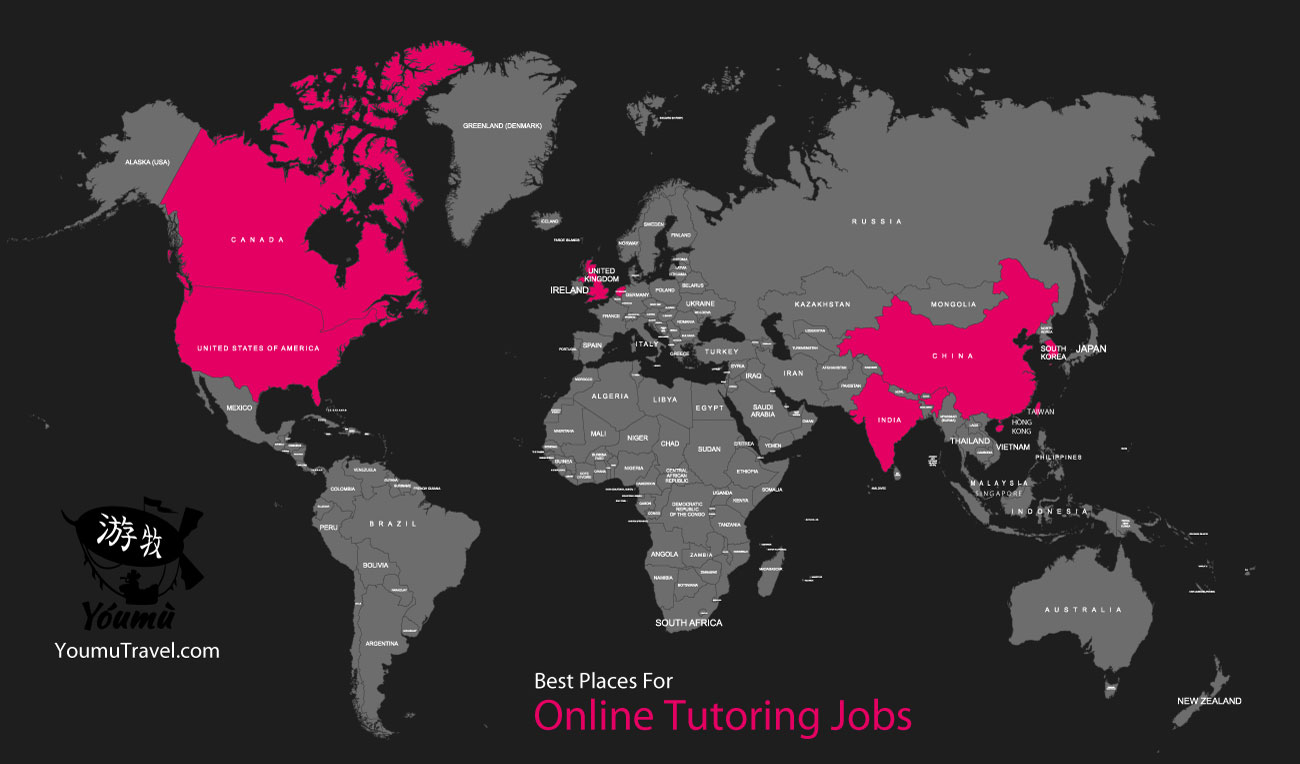
The Best Places for working Online Tutoring Jobs
This remote job can technically be done anywhere in the world. However, you’ll want to make sure your clients or employer are okay with the timezone difference. Here are some of the best places for online tutoring jobs.
- US
- India
- China
- South Korea
- UK
- Canada
- Netherlands
Assess necessary requirements
Research the online tutoring business before beginning; prerequisites, techniques, perks and difficulties, etc. Look into specific areas of focus and build a viable plan. Insure you have a clear understanding of what it means to be an online tutor, as well as what skill is required from you.
Ask and answer these questions:
- What audience do you want to teach?
- Why should students choose you instead of somebody else? Why are you unique?
- How will you succeed in a competitive market?
There are plenty of opportunities for online tutoring, but it is necessary for a tutor to gain certification in a specific subject. Students and parents will have higher confidence in your ability to teach them in this area.
Understand your students
Analyze what your target audience requires. Who are they? Where are they needing help? Why do you want to help them? Calculate traits for certain age groups, personalities, locations, and more. Hone in on what they require, and alter how you tutor to meet their needs.
Pick your subject
Depending on skill level, pick what you will feel confident teaching. Plan lessons to go over with students. Holding a degree/specialization in the subject will advance your credibility. Students are expecting to be tutored by experts in the given topic in order to magnify their understanding of it.
Perfect your teaching methods appropriately to engage students: plan interactive lessons and activities, use games and stories to entertain them. Students learn best when they can have fun at the same time.
Decide on a course plan
Once you understand your audience, utilize your skill and knowledge to meet their needs. Research different platforms for online tutoring. Will your students learn best in video format or written format? Video lectures, whiteboards, messaging, and more are all available for online tutors. With more experience comes a refined business technique, allowing you to stand-out against other tutors.
Pick your course model
There are two main forms of online learning, the “academy model”, and the “night school model.” Create a course around the model that is most appropriate for your skills and your audience.
Academy model:
This model offers extensive options for learning rather than focus on a specific topic. For subscribing (monthly or yearly charge), students will have many courses available to them (or be given pre-selected courses). Skillshare is one example of this.
Night school model:
This model is more traditional, and has been utilized by universities and institutions for years. It normally consists of students who are taking a class or two in addition to their day job. The student pays for the course and completes the given curriculum. Tutors present standalone courses (normally with course materials) via online lectures, (requested) live classes, and (requested) physical sections. Udemy is one example of this.
Decide on a platform
You have two choices for beginning your tutoring job: create an account with an existing tutoring website, or design your own tutoring platform.
Both have their own pros and cons; designing your own platform gives you more freedom and encourages a long future in online tutoring, but using an existing site expedites how soon you can begin to teach. Existing sites also mean credibility and established professionalism.
There are a multitude of online tutoring websites. Listed below are popular ones from 2019:
- Wiziq – A platform for creating courses and presenting them online; over 400,000 training services and close to 5 million student subscribers, with support available at all hours.
- Tutorpace – Tutors lecture via live classes in mathematics (economics, statistics, accountancy) and science (chemistry and biology).
- Newrow – Students are able to participate with peers via a digital classroom.
- Tutorroom.net – Offers options for one-on-one and group lectures so students can move through the curriculum at an appropriate speed for them. Tutors are able to upload their classes, schedule, and take care of payments on this platform.
- SmartSchool from Pinlearn – This program allows tutors to have maximum freedom for customization, with interactive tools such as whiteboards and the option for cross-platform usage (both web-view and mobile).
- Mytutoring – Allows personalization for your tutoring business via logos, scheduling, tools, payment, and collaboration.
- Vectera – Specializes in video conferences and meetings for ease of contact between tutor and student.
- Takelessons – Free platform that offers administration and advertisement tools; known for its scheduling and attendance features.
- Learnspeed – Platform will the capability for calendar scheduling and payment/payroll in addition to offering a place to tutor, counsel, and help students prepare for exams.
- Google Classroom – Free platform that encourages communication between teachers and students; a good virtual alternative to more traditional paper assignments/tests.
Customize your courses
Upload your courses to the chosen platform, making sure to unify their appearance. Create recognizable logo and color palette. Update courses consistently to avoid becoming outdated.
Familiarize yourself with online collaboration tools to allow for optimum interaction with students. Subjects such as math and science, for example, normally utilize a digital writing pad. Research apps that promote brainstorming and projects. Be sure to stimulate communication between tutors, students, and parents.
Advertise your tutor platform
Draw up a strategy for standing out among competitors. Learn from ads you see on sites like Facebook. Here are more tips for marketing your business:
- If you have the funding, set up paid ads with Facebook/Google (or cheaper alternatives).
- Research “sales funnel” in order to better understand how to turn ad viewers into subscribers.
- Utilize email marketing and blogging to engage your audience.
- Seek forums/communities where you can talk with other tutors and students; advertise your courses.
How do I get hired as a tutor?
Steps for starting a career as a tutor:
- Obtain a high school diploma. This will be the minimum requirement to tutor students.
- Research training for tutoring and education. There are plenty of resources online and areas to specialize in.
- Be part of a tutoring association.
- Complete certifications in tutoring.
- Become a licensed tutor.
- Set your rates and advertise.
How do I get a job online tutoring?
Steps for TutorMe:
- Fill out an application, making sure to include education and work experience.
- Pick subjects you’re proficient in.
- Get to know students.
- Start tutoring students.
- Receive pay weekly.
How much money can you make online tutoring?
Independent online tutors normally make about $30 per hour, with possibility to expand to $50/$60 per hour depending on the difficulty of the subject (calculus or SAT preparation, for example).
Here are online tutoring companies that pay the most:
- VIPKid (Best paying option for teaching English online)
- Lingoda
- Magic Ears
- SayABC
- Qkids
- Twosigmas
- DadaABC
- Cambly
- Italki
- Landi English
- English First
- Englishhunt
- Palfish
- Oakary
- iTutor
Are online tutoring jobs legit?
In short, yes. Oftentimes people tutor online to make money in addition to their day job. Others are able to work full-time and earn a living wage. Income is largely determined by skill level and experience. Children, high schoolers, college students, and adults are all possibilities for those who have the knowledge to be able to tutor at the required level.
Is VIPKid a scam?
No. It is a legitimate platform for online tutoring. Many traditional school educators will also do online tutoring in addition to the in-person classroom setting in order to increase their income. Some are able to transition to full-time online tutoring.
How do I become an online language tutor?
Steps to being a language tutor:
- Pick a language (likely one you are fluent in).
- Offer free classes in lieu of an internship.
- Seek out students to tutor.
- Create lesson plans.
- Be willing to tutor in a variety of ways/ages in order to increase income.
- Take feedback and advice from other tutors.
Is Vendatu free of cost?
Yes. Vendantu (tutoring company in India) has a free learning app for Android devices. Students are able to submit questions to tutors and teachers and receive immediate answers.
What is the best online tutoring company to work for?
9 companies for online tutoring positions:
- VIPKid (one-on-one ESL tutoring for Chinese students)
- Chegg (open to applicants world-wide)
- Brainfuse
- Tutor.com
- Skooli
- Yup
- Landi Subject English
- Elevate K-12
- TutorMe
What tutors are in highest demand?
- Math for all age groups:
- Basic early math (arithmetic, counting, geometry)
- Middle school math (algebra, geometry, measurement)
- High school math (pre-calculus, calculus, trigonometry, math for SAT & ACT testing)
- Physical sciences (physics, chemistry, astronomy, etc)
- English (reading comprehension and writing)
- Language (secondary language acquisition)
Can you make a living off tutoring?
Tutoring is frequently utilized by people wanting to receive additional income. However depending on variables such as location, dedication, and outreach, it is possible to make somewhere between $25,000 and $50,000 a year (at around 20 hours a week).
Remote Graphic Design Jobs Guide
Graphic designers communicate through the visual medium via text and images. This may mean anything from company logos to promotional products. A wide range of industries utilize graphic designers to represent their brand in a clear and attractive way that will draw in consumers.
This job has a high demand but it takes considerable time and effort to succeed.
Demand
- High Demand
Experience & Degree
- At Least One Year of Experience Required
- No Degree Required but Preferred
- Native English Speaking Preferred
Citizenship
- No Restrictions
This job is reliable and pays well.
Pay Range
- Hourly: $17-$45/hr.
Reliability
- Very Reliable
Housing
- Room and Board Not Provided
This job has a flexible schedule and you can work almost anywhere in the world.
Location
- Very Flexible
Schedule
- Very Flexible
Language
- Can get by with English only
Who can get Remote Graphic Design Jobs?
Graphic designers – also known as ‘graphic artists’ and ‘communication designers’ – use a combination of art and technology to speak through visuals on websites and paper.
Graphic designers are largely involved in advertising and public relations: marketing relies on graphic design for sales, and informational material such as brochures utilize graphics to convey knowledge in a reader-friendly manner. Companies need logos to establish a recognizable brand.
To become a graphic designer, you will likely want to obtain a degree in graphic design. There are options for working in graphic design: either as an employee at a graphic design agency, or by creating your own design business as a freelancer. Agencies will likely expect you to have obtained an advanced degree, which is why working on a freelance basis is more desirable to many graphic designers.
What are the responsibilities of someone working Remote Graphic Design Jobs?
Working in graphic design means creating content for clients. A day in the life of a graphic designer may consist of the following things:
- Designing materials for communication purposes: websites, logos, books, brochures, magazines, advertisements, etc.
- Creating products via software technology; Adobe’s Creative Suite is typical for this occupation (meaning familiarity with programs like Photoshop, Illustrator, and InDesign is a necessity).
- Communicating with clients to establish a vision for the project. Use images and designs to manifest this vision.
- Ensuring readability of text and image by editing type size/style.
- Submitting drafts to clients and revision based on feedback provided.
- Assessing final product for mistakes to guarantee it meets client expectations.
What’s the typical schedule for someone working Remote Graphic Design Jobs?
It is normal for graphic designers to work a standard 36-40 hour work week, Monday through Friday. This may increase depending on upcoming project deadlines. Part-time work/setting your own hours is a possibility, especially for those who freelance. Work schedules will likely vary depending on what’s needed for current projects.
Income Reliability
Graphic designers are in demand for advertising and marketing by many companies. Working at an agency may be more reliable for steady funds than freelancing, but as you gain experience in the industry and develop a greater skill-set, the easier it will be to find work.
Typical Job Duration
Graphic design can be a steady job, such as for a magazine that publishes frequent issues, or short-term projects for multiple clients.
Estimated Hours Per Week
It’s estimated that you can work full time, 40 hours per week, as a graphic designer.
Room & Board
Graphic design jobs don’t typically provide room & board, however there may be internships opportunities that do.
Remote Graphic Design Jobs – Country Map
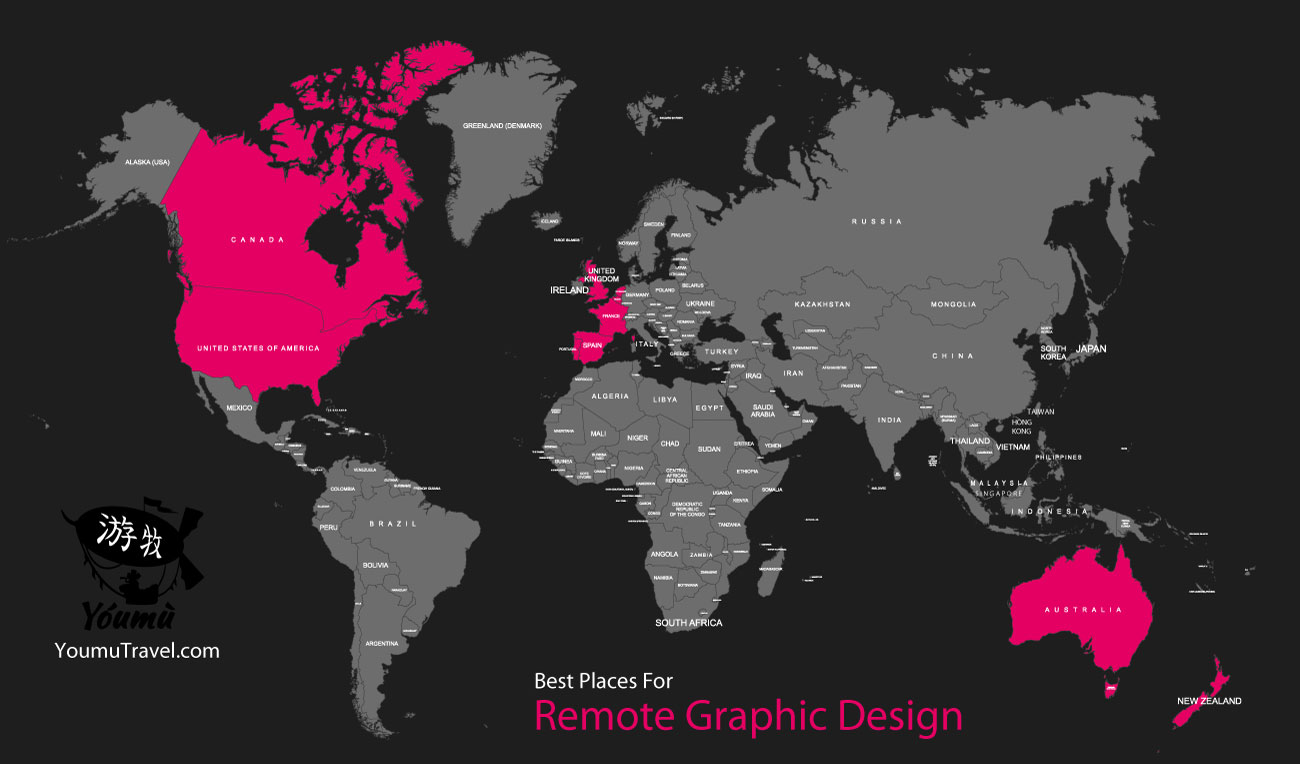
The Best Places for working Remote Graphic Design Jobs
This remote job can technically be done anywhere in the world. However, you’ll want to make sure your clients or employer are okay with the timezone difference. Here are some of the best places for remote graphic design jobs.
- USA
- UK
- Netherlands
- Belgium
- France
- Portugal
- Spain
- Canada
- Australia
- New Zealand
Skill-building.
Educate yourself on the basics to understand what skills you will need.
- Visual identity graphic design
- Marketing and advertising graphic design
- User interface graphic design
- Publication graphic design
- Packaging graphic design
- Motion graphic design
- Environmental graphic design
- Art and illustration graphic design
After learning the types of graphic design, build your skills from the ground up: learn to draw, learn graphic design comedy, learn basics in user experience, and learn to write. Mock-ups for written text aren’t enough; be thorough in the work that you do. Combine word and text to communicate in the most effective manner. Try out the website “Voice and Tone” for tips on persuasive writing.
Mastering software.
We live in a digital world; employers will expect you to deliver in this format. Adobe Illustrator and Adobe Photoshop are the favorites among designers. For any print design, Adobe InDesign will be a necessity.
- Adobe Illustrator. Begin with Illustrator before Photoshop. Textbooks and video tutorials are a convenient way to learn, and “Adobe Illustrator Classroom in a Book” contains the fundamentals.
- Adobe Photoshop. Online is a way to go for knowledge on Photoshop as well. “PSDTuts” and “TutsPlus” offer reliable tutorials for mastering the program.
Unique portfolio.
Portfolios are a way of presenting an argument for why you are the best person for the job. They showcase your knowledge and experience. Your graphic design program should provide tips for creating a strong portfolio to use for jobs and internships once graduated. List your best work, rather than all your work. Be specific in what you have to offer.
Students may also utilize mock projects/ads/logos to exhibit what they have to offer. After completing real world jobs/internships outside of school, use these in your portfolio. Reaching out to organizations and local businesses for volunteer work/small pay rate to gain sample material for your portfolio is also an option.
- Use your best samples
- Diversify examples
- Give context
- Provide additional skill sets
- Design a website for your work
Be up-to-date.
Graphic design is continuously innovating and restructuring. Follow industry trends and stay informed about new software and computer graphics. This is especially important for freelancers or those who want to move up in companies. The American Institute of Graphic Arts and the Graphic Artists Guild both act as informants for new technology, software, and technique. Credentials can be improved via certification programs in vendor-specific software.
Get a job.
- Work as a freelancer and hunt for opportunities. Send your portfolio to local agencies who use freelancers. Stay in regular contact with clients. Supply a link to your website so potential clients are able to determine whether you’re the right fit. Utilize your social groups; friends, family, coworkers, peers. Ask them to support you by sharing what you do with others.
- Do remote work. Job-search sites like LinkedIn and Indeed list openings that can be found by searching. Start with entry-level jobs or assistant positions. Even entry-level positions normally seek freelancers with 1-2 years of experience and proven skill, so be sure your portfolio reflects what you have to offer.
How do I start a career in graphic design?
Steps for becoming a graphic designer:
- Begin as soon as possible. Gain skills and knowledge in high school, as jobs like graphic designing are particularly competitive.
- Obtain a degree in graphic design.
- Seek internships.
- Build a unique portfolio.
- Keep yourself informed on modern graphic design technique and innovation.
- Continued education in school.
How can a graphic designer be self taught?
Getting into graphic design without a degree:
- Specialization in an area of high demand, such as logo-making.
- Software expertise.
- Invest in what you need, such as a quality laptop.
- Increase writing skills.
- Curate your personal style.
- Create an online portfolio.
- Understand the importance of user experience.
- Study the business aspects of design.
- Educate yourself on design theory.
- Get hired as a designer.
Can you work at home as a graphic designer?
There are options for working in graphic design: either as an employee at a graphic design agency, or by creating your own design business as a freelancer. Agencies will likely expect you to have obtained an advanced degree, which is why working on a freelance basis is more desirable to many graphic designers.
Are graphic designers in demand?
Graphic design is a competitive field: the projected growth is about 3 percent from 2018 to 2028, which is below average for all job occupations.
Is graphic design a dying career?
The landscape for graphic design is constantly changing and evolving. It is not a dying career, but it does require those who dedicate themselves to the occupation to adapt to frequent shifts in workflow.
Is being a graphic designer worth it?
The income for a graphic designer is dependent on education and employer. The median salary for a graphic designer is $48,800 a year. A graphic design degree will increase salary, as will working at a large company such as Apple where the median is $96,000 a year.
Is graphic designing hard?
Graphic design is for the passionate and creative. To design is to speak through illustration with the talent and the vision you hold. For those who love it, graphic design is not hard but an enjoyable and rewarding occupation.
Can graphic designers be rich?
With certain variables in place, yes graphic designers can make a lot of money. For example, selling a design at a high price to a single client can be good money for only a few days worth of work. However, to make maximum wages it is necessary to be selling designs that many people will be purchasing rather than a single client.
Does graphic designing require math?
Undergraduate coursework for a graphic design program will expect students to complete around 3-4 credits of math classes, including traditional subjects like algebra and calculus.
Is graphic design stressful?
If you enjoy it, the job process itself isn’t stressful. Stress may be a byproduct of deadlines and expectations for expensive jobs. This pressure may increase as a freelancer without a team to help.
Do graphic designers draw?
As it is a digital platform, most of the work falls into the category of typography rather than by-hand illustration. However, graphic designers who also possess a talent for illustration have amplified job opportunities.
Is it hard to find graphic design jobs?
Hard work and talent pays off in the creative field. There are plenty of jobs for graphic designers who are practiced and confident in their abilities.
Remote Project Manager Jobs Guide
Project managers plan and oversee company projects to ensure they are completed on-time, within budget, and within the company’s goals. More specifically, PMs designate resources, write budgets, track progress, and keep stakeholders informed.

This job has a high demand but it takes considerable time and effort to succeed.
Demand
- High Demand
Experience & Degree
- At Least Two Years of Experience Required
- No Degree Required
- Easy Certification Required
Citizenship
- No Restrictions
Pay Range
- Hourly: $15-$45/hr.
Reliability
- Reliable
Housing
- Room and Board Not Provided
This job has a somewhat flexible schedule and there’s a chance you’ll have to stick close enough to your employer’s timezone.
Location
- Flexible
Schedule
- Somewhat Flexible
Language
- Can get by with English only
Who can get Remote Project Manager Jobs?
Project managers should have a bachelor’s degree in computer science or business and several years of relevant work experience. Project managers can also opt to pursue a Project Management Professional (PMP) certification. To be successful, project managers should be detail-oriented and possess outstanding communication skills.
However, you can have a degree in a completely different subject and still be a successful project manager. No matter what college degree you have, it can prove useful for a career in project management. Academia primes you for study, research, and knowledge acquisition, which is essential for a project manager who must learn all the facets of a project’s scope quickly. A propensity for and a desire to self-learn and self-develop are vital traits for maintaining a successful career.
What are the responsibilities of someone working Remote Project Manager Jobs?
Project managers designate resources, write budgets, track progress, and inform stakeholders of that progress. Project managers are necessary to a variety of projects and departments such as construction, IT, HR, and marketing.
Key responsibilities include:
- Coordinate with cross-discipline team members to ensure that all parties are on target with a given project’s requirements, deadlines, and schedules.
- Meet with the project team to find and solve any problems.
- Submit project deliverables and ensure that they follow quality standards.
- Assemble, analyze, and summarize pertinent information to prepare status reports.
- Establish efficient communication plans and ensure proper execution.
- Ensure all parties are informed when changes occur to handle any impact on the schedule and budget.
- Enable successful implementation of the processor system to the client(s) via coordination of user manual development, training materials, and other documents.
- Confirm customer acceptance of deliverables.
- Manage customer satisfaction within the project’s transition period.
- Evaluate successful and unsuccessful project elements in post.
What’s the typical schedule for someone working Remote Project Manager Jobs?
It is likely that as a project manager in a remote office environment that the hours will be the typical 9-5 workday, though it may vary slightly by employer and will adhere to the employer’s time zone. However, one of the benefits of remote project management is that your work is available to you at any time of day.
Of course, it is important to remember that a large part of being a successful project manager is maintaining effective communication channels with coworkers, team members, and clients. The schedules of all the people involved in a project should align so that the whole team can work together even though they are physically separate.
Income Reliability
In general, remote project management is a reliable, in-demand job with a steady workflow.
Typical Job Duration
Remote project management can be seasonal, temporary, part-time, or full-time.
Estimated Hours Per Week
It’s estimated that you can work full time, 40 hours per week, as a remote project manager.
Room & Board
Remote project management positions do not typically provide room & board.
Remote Project Manager Jobs – Country Map
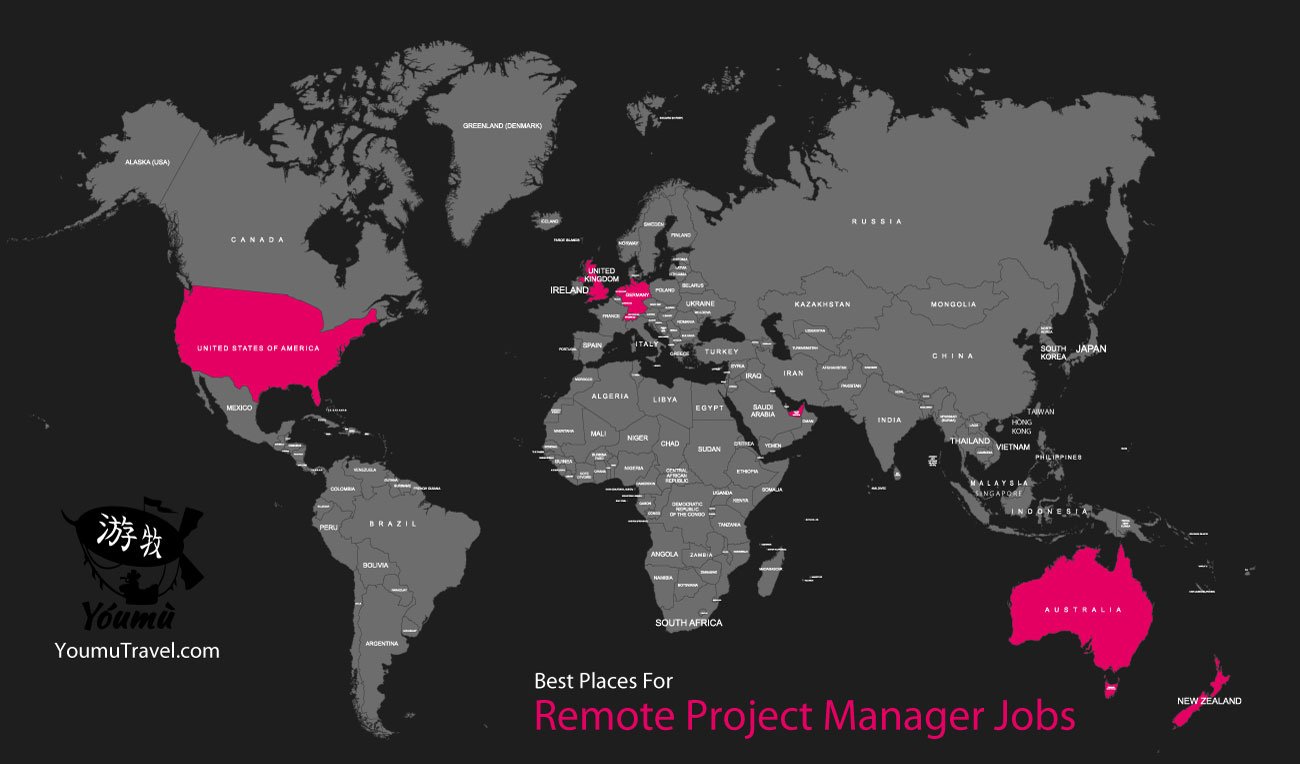
The Best Places for working Remote Project Manager Jobs
This remote job can technically be done anywhere in the world. However, you’ll want to make sure your clients or employer are okay with the timezone difference. Here are some of the best places for remote project manager jobs.
- Australia
- Switzerland
- US
- UK
- Netherlands
- Germany
- UAE
- New Zealand
Decide if this is the right job for you.
Prior to beginning your journey as a project manager, you need to ascertain if this is the right career for you. You can find the stories of other project managers, connect with them to ask questions, or try an internship. You can also take introductory courses online to get a taste of the subject. These courses have you practice interacting with the business to see if you can handle the responsibilities.
Understand that remote project management poses unique challenges.
Managing projects and teams in different locations can make it more difficult to stay on track with tasks and deadlines. Without in-person meetings and interactions in an office setting, there is less of a chance to answer questions or have occasional check-ins. A flexible approach to team operations helps keep work moving without the traditional tools like traffic meetings or status calls.
Regardless if what approach you take, it is important to remember the following when establishing your remote project management:
- Communication
- Collaboration and cooperation
- Schedules and deadlines
- Project specific budgets
- Team engagement
- Keep focused on these different aspects of remote work; your team (and your projects) will benefit.
Familiarize yourself with project management tools.
Some of the most commonly used project management software/tools include: Trello, Slack, Asana, and Basecamp. They have particular importance in a remote work environment. If you’re not familiar with all of them, that’s okay–no job expects you to know the ins-and-outs of every major program, but try to study up on the ones you do know.
If you’re new to the project management world and don’t have familiarity with any of these programs, you can take a course to get you comfortable using a program. Make sure to highlight your newfound skills on your resume.
Display metrics.
Project managers produce numbers and metrics in their work. For example, perhaps you worked with ten different clients, supervised six projects, met project deadlines 100% of the time, and stayed 25% under the projected budget.
Whatever it may be, display these metrics in your cover letter and resume. Hiring managers like measurable evidence of your abilities and productivity.
Utilize the best job board.
Finding a remote project manager position can be difficult because of job scams and confusing job descriptions.
Use a job board that specializes in flexible work, such as Remote.co or FlexJobs, to facilitate your search and remove the risk of scams. Sites such as these usually have advanced search options to aid you in finding remote project manager positions. These select results give you less unfit options to sift through, and more application opportunities that actually fit your requirements.
Additionally, use the best keywords in your search. “Remote project manager” is a good place to start, but consider other keywords like “virtual,” “telecommute,” and “work from home” to get more results. Also, you can try other job titles that might be used to refer to project managers like “program manager” or “project coordinator.”
Exhibit your remote work skills during interviews.
Remote jobs require employees who have the necessary skills for remote work. Make sure to note previous remote experience on your resume and cover letter, talk about your home workspace set up, your excellent communication abilities with other remote coworkers, and note the boost to your productivity that remote work supplies.
If you lack previous experience with remote work, try to come up with an example where you worked remotely for just a short period. Maybe you were too sick to attend work in-person, but did some tasks from your bed. Use this example to gauge how well you’ll work remotely. Employers want to know that you will communicate well and use the benefits of working from home to the project’s advantage.
Can project managers work remotely?
Project managers can absolutely work remotely.
What other careers can project managers do?
Project managers have transitioned into careers such as:
- Business Developers
- Chief Executive Officers
- Engineers
- Estimators
- IT Consultants
- Management Consultants
- Operations Directors
- Principals
- Senior Business Analysts
- Superintendents
Is Project Manager a stressful job?
Project management can be pretty stressful. Project managers are responsible for many complex tasks such as efficient deliveries, remaining within budget and scope, and long to-do lists. They may also have to contend with limited or sub-par resources and unrealistic client expectations.
Are project managers in demand?
Project managers are in high demand because they are necessary in a myriad of industries. According to the Project Management Institute (PMI®), an expected 22 million new project management job opportunities will open through 2027.
What is higher than a project manager?
Senior positions to project managers include Chief Project Officers and, in large organizations, VP of project management. CPOs lead the group in organization, prioritization, supplying resources, general support, and internal consultations. VPs of project management are responsible for the management and direction of projects.
Is project manager a good career?
Project management careers are in high demand as many companies are constantly initiating projects in order to increase their revenue, minimize their costs, and increase economy. Project management is a good career choice as it provides a good, stable living.
Is project management a dead end job?
No, project management is not a dead-end job. There are plenty of project management titles that range from entry- to executive-level to consider as you continue on in your career.
Is project manager a hard job?
As with any job, being a project manager can have its downsides. Realistically, it can be difficult to handle the unique challenges of project management, and you have to be prepared to work long hours to ensure that your project remains on-track to be completed and delivered before the deadline.
Are project managers happy?
Studies have shown that the happiness level of project managers is in the bottom fifty percent against the U.S. benchmark, taking into account work experience, age, gender, and employment status.
What do project managers do all day?
Project managers can expect to have a long to-do list of daily tasks, such as communication with their team members via emails, calls, check-ins, or meetings.
Remote Customer Service Jobs Guide
A remote customer service agent constantly interacts one-on-one with customers online and over the phone. This requires specific skills such as patience, problem-solving skills, and the ability to listen intently.
This job has a high demand and is easy to get.
Demand
- High Demand
Experience & Degree
- No Experience Required
- No Degree Required
- Native English Speaking Preferred
Citizenship
- No Restrictions
This job is reliable with reasonable pay.
Pay Range
- Hourly: $10-$25/hr.
Reliability
- Reliable
Housing
- Room and Board Not Provided
This job has a somewhat flexible schedule and there’s a chance you’ll have to stick close enough to your employer’s timezone.
Location
- Somewhat Flexible
Schedule
- Somewhat Flexible
Language
- Can get by with English only
Who can get Remote Customer Service Jobs?
Technically, anyone can be a remote customer service agent, even with no prior experience nor a degree. However, some companies may have specific requirements such as an Associate’s degree or sales experience, but many provide on-the-job training.
So there should be no restrictions in your way for basic customer service positions. You can start this job today!
What are the responsibilities of someone working Remote Customer Service Jobs?
A remote customer service agent is a position that is constantly interacting one-on-one with customers online and over the phone which requires specific skills such as patience, problem-solving skills, and the ability to listen intently.
The responsibilities of a remote customer service agent vary depending on the employer, but there is typically on-the-job training so don’t worry if you don’t have any prior experience!
Key Responsibilities
- Answer customer questions and requests in a timely manner through all means of communication (telephone, email, and online chat)
- Track all questions, requests, conclusions, and follow-up assignments
- Transfer questions and requests when necessary to the appropriate person or department
- Present a polite and compassionate attitude to all customers
- Research answers for customer questions and requests
- Build professional relationships with exceptional customer service and effective sales techniques
- Meet quantitative performance metrics
- Upkeep customer accounts with up-to-date information during calls
What’s the typical schedule for someone working Remote Customer Service Jobs?
This job is flexible in that it allows you to work from anywhere and usually make your own schedule from part-time to full-time.
Hours a week and when you work are based on the availability you provide to your employer.
Income Reliability
In general, remote customer service is a reliable job that provides a constant stream of work.
Typical Job Duration
Being a remote customer service agent can be short-term or long-term.
Estimated Hours Per Week
It’s estimated that you can work full time, 40 hours per week, as a remote customer service agent.
Room & Board
Remote customer service doesn’t typically provide room & board.
Remote Customer Service Jobs – Country Map
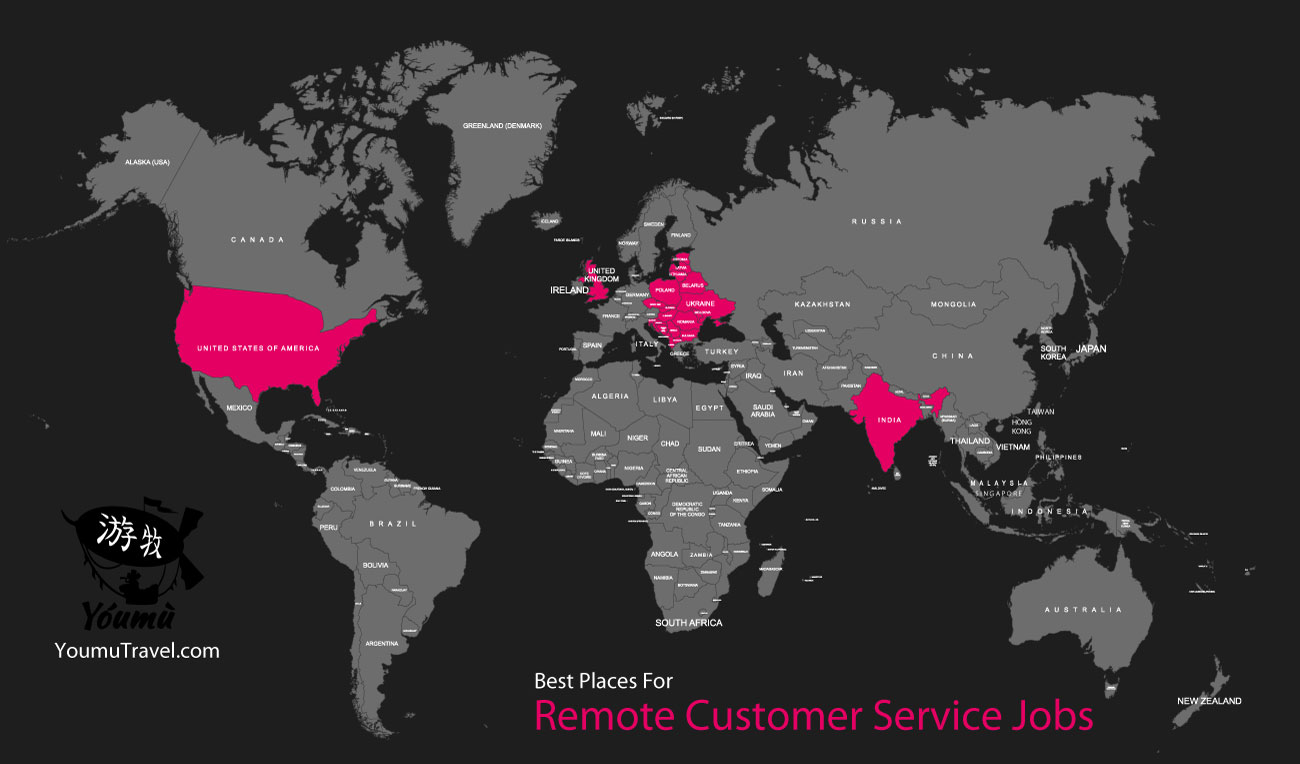
The Best Places for working Remote Customer Service Jobs
This remote job can technically be done anywhere in the world. However, you’ll want to make sure your clients or employer are okay with the timezone difference. Here are some of the best places for remote customer service jobs.
- US
- India
- Eastern Europe
- UK
Find the right position for you.
There are plenty of customer service jobs, but it’s important to find the right one for you. Some will require you to have past sales experience while others will just need you to answer phone calls and emails. You’ll also want to check the education qualifications; some, not all, will require at least a high school diploma or an Associate’s Degree at highest. Usually, the positions with more skill requirements pay better though so if you fit the standards, apply to those! You can even find positions with flexible schedules that will allow you to telecommute.
Build a professional resume.
The cover letter may be the first document an employer will read, but the resume is what sells you and can seal the deal for an interview. A professional resume should clearly outline your work history as well as any other experience in the field. Be sure to highlight distinct skills from the job description and for inspiration, research resume examples, and templates to get you started.
Prepare.
Since this job is customer-centered, you can expect questions like “do you work well with others?” and “how would you handle a dispute?”. You don’t want to trip over these kinds of questions so it’s vital that you prepare beforehand. Google some sample questions and answers and practice at least an hour on how you would answer any potential questions that are listed.
Research employers.
Knowing a thing or two about the company you are applying to increases your chances of getting the job so research, research, research! Do this for your cover letter, writing up your resume, or when preparing for your interview. Definitely take a look at their website if they have one and examine how they distribute customer service. What’s the company culture like, what are the company’s values, what are their customer service policies, and what do they want their customers to remember about their shopping experience? Knowing the answers to these questions and including them in your interview will impress the hiring managers, elevating your chances of being hired.
Update your skills for the job.
Remember that different companies have different responsibilities for their customer service agents. Some companies expect you to already know online programs that you will be using while others will want you to have sales experience and so on. Thankfully, many will provide on-the-job training, but you should also always be willing to learn more on your own time. The more skills you can offer, the more money you could be making by applying to higher-paying positions.
Create your resume.
To land an interview for a remote position, your resume needs to reflect the skills that remote companies are looking for. Here are just a few things you should include in your resume to help it stand out:
- Software: You’ll need to know how to stay in contact with your company and their customers so list any software tools that you are familiar with using. Popular ones include:
- Slack
- Salesforce
- Basecamp
- Trello
- Harvest
- GoToMeeting
- Google Hangouts
- Skype
- Zoom
- Zapier
- Communication. Communication is vital for any company but specifically remote companies because it can make or break them. Your resume should highlight your communication skills and there should be no typos whatsoever. This means keeping in good contact with the hiring managers and recruiters as well. You should also mention how you take cybersecurity very seriously as a remote employee.
- Portfolio. Highlight any innovations you’ve had a hand in with past positions and share your portfolio if you have one.
- Side projects. Side projects are a good thing to talk about in an interview but should not be included on your resume unless it enhances your experience. Working on a side project on your own shows that you take initiative. However, some employers may see it as a threat to your availability and reliability.
- Results. If you have any percentages or hard number data that show how you have created results in your past positions, put that on your resume as well.
- Independency. Be sure to talk about any time(s) that you worked with little or no supervision because this shows that you are a self-starter and can work independently. This is a valuable skill for remote working.
Finding a job.
Many job sites don’t have a filter for “remote work” yet since it’s just starting out so it can be time-consuming trying to find a remote job. However, the listed websites below do the sifting for you:
- https://angel.co/
- Upwork.com
- Remote.com
- Remote.co
What is a remote customer service agent?
A remote customer service agent is the same as an in-person customer service position except you deal with customers via computer and on the phone. Your responsibilities vary depending on your employer but it usually includes responding to complaints, describing what services/products your organization provides and working independently with little to no supervision.
Can I work customer service from home?
Yes, you can work as a customer service agent from home! One of the best types of remote customer service jobs is being an online chat agent. This position is great for anyone who wants to work from and prefers not to speak on the phone. However, your job may also entail tech support, answer billing questions, process returns, or sell products through communications like email, text, and online chatting.
What is the highest paying customer service job?
Here is a list of the highest paying customer service jobs and their salary:
- Customer Experience Associate ($19 per hour, on average)
- Customer Engagement Representative ($19 per hour, on average)
- Customer Service Advisor ($18 per hour, on average)
- Customer Service Representative ($17 per hour, on average)
- Retail Customer Service Representative ($16 per hour, on average)
- Customer Service Sales Associate ($16 per hour, on average)
- Customer Service Professional ($14 per hour, on average)
- Bilingual Customer Service Representative ($14 per hour, on average)
How much does it cost to start a call center?
It ranges from $2,500 and $10,000 per workstation to prepare a fully functional call center. Only 5% to 10% of the operating costs is real estate while the rest (80%+) is labor costs.
How do you work with customer service?
Important skills to have to be a successful customer service professional are as follows:
- Patience. Patience is crucial for customer service professionals.
- Attentiveness.
- Ability to communicate clearly.
- Knowledge of the product.
- Ability to use positive language.
- Acting skills.
- Time management skills.
- Ability to read customers.
- Unflappability.
- Goal-oriented focus.
- Ability to handle surprises.
- Persuasion skills.
- Tenacity.
- Closing ability.
- Empathy.
- Willingness to learn.
Remote Accounting Jobs Guide
Accountants assess and communicate financial information for businesses, individuals, and governments that want to fully understand and manage their finances.
Remote Accountants operate online as part of an accounting firm or in an independent capacity, supplying services such as accounts receivable management. Responsibilities of remote accountants may include reviewing statements, reviewing taxation and finance forms, and performing data entry activities.

This job has a high demand but it takes considerable time and effort to succeed.
Demand
- High Demand
Experience & Degree
- At Least One Year of Experience Required
- No Degree Required
- Hard Certification Required
Citizenship
- No Restrictions
This job is reliable and pays well.
Pay Range
- Hourly: $18-$35/hr.
Reliability
- Reliable
Housing
- Room and Board Not Provided
This job has a flexible schedule and you can work almost anywhere in the world.
Location
- Very Flexible
Schedule
- Flexible
Language
- Can get by with English only
Who can get Remote Accounting Jobs?
Most accounting positions will require a bachelor’s degree in accounting or something similar, such as business management.
Depending on specific state regulations, you may not need an accounting degree, but you will need a certain number of educational credits in accounting, business, and ethics.
Further qualifications include becoming a Certified Public Accountant (CPA). This often requires an additional 150 credit hours of coursework, and may in some cases be combined into a 5-year graduate accounting program.
Consider pursuing an accounting degree before exploring accounting job opportunities!
What are the responsibilities of someone working Remote Accounting Jobs?
As a remote accountant, you will work online as part of an accounting firm or in an individual capacity. You will provide services to businesses such as the management of accounts receivable/accounts payable.
Key Responsibilities
- Account preparation and tax returns
- Overseeing payrolls and managing income and expenditure
- Auditing financial information
- Collecting and submitting reports, budgets, business plans, reviews, and financial statements
- Dissecting accounts and business plans
- Providing tax-preparation services while following current legislation
- Financial forecasting and risk assessment
- Dealing with bankruptcy cases
- Negotiating financial terms for business deals between clients and allied organizations
- Managing tough workloads and tight deadlines
What’s the typical schedule for someone working Remote Accounting Jobs?
This job is flexible because it allows you to work from anywhere. However, you will have to conform to your employers’ timezones.
Most accountants know that filing taxes is generally seasonal work.
This offers a perfect opportunity for freelancers to find remote accounting jobs with companies, big or small, due to high demand.
This allows for some flexibility in terms of how much work you’d like to take on. Also, oftentimes remote positions offer more flexibility in terms of working hours than the traditional in-office position.
On the downside, because this is financial work you may run into many projects and employers that have strict deadlines.
Income Reliability
In general, Remote Accounting is a reliable job that provides a steady stream of work. Extra work can be found around tax time.
Typical Job Duration
Remote Accounting Jobs can be seasonal, short-term, or long-term. Many larger firms will contract out extra work during peak season!
Estimated Hours Per Week
It’s estimated that you can work full time, 40 hours per week, as an online Online Accountant. However, during peak times of the year, working 40+ hours per week is common.
Room & Board
Remote Accounting jobs do not typically provide room & board.
Remote Accounting Jobs – Country Map
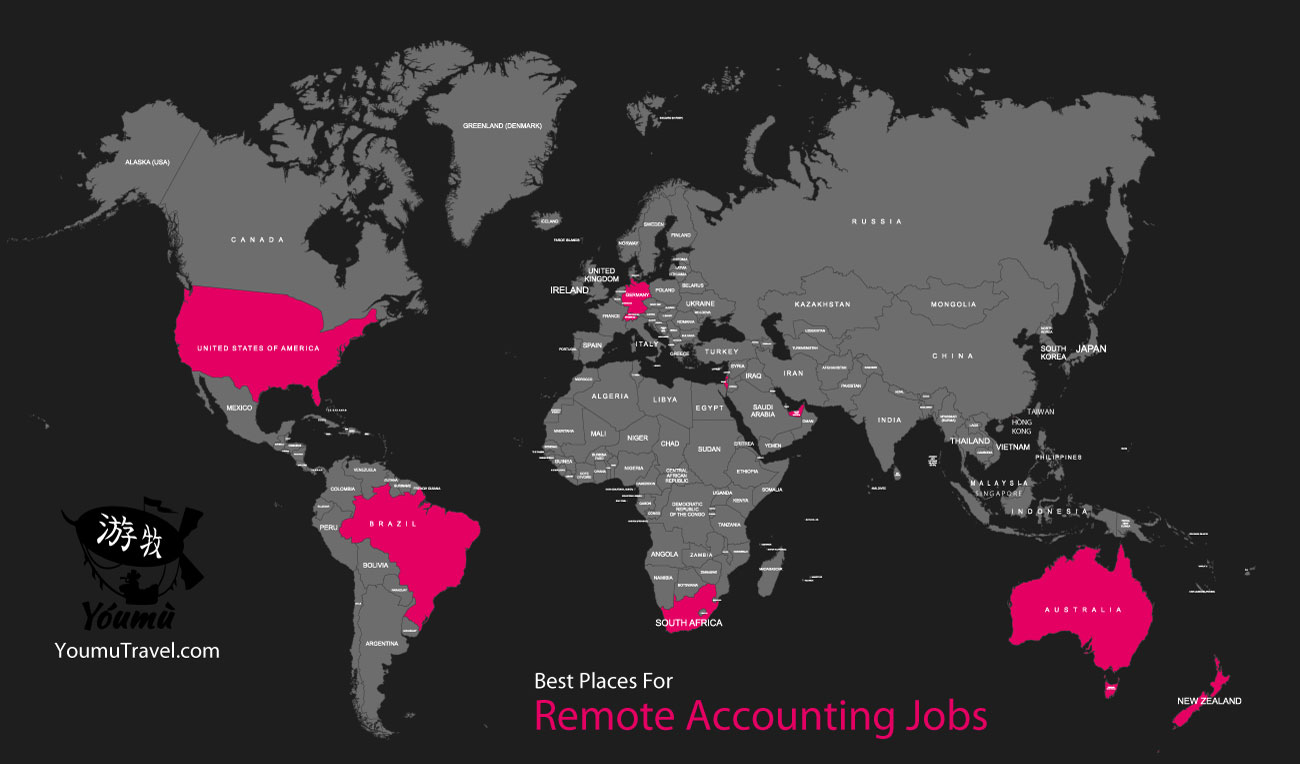
The Best Places to Work Remote Accounting Jobs
This remote job can technically be done anywhere in the world. However, you’ll want to make sure your clients or employer are okay with the timezone difference. Here are some of the best places for remote accounting jobs.
- US
- Germany
- New Zealand
- Brazil
- Hong Kong
- Dubai
- South Africa
- Switzerland
- Israel
Learn about the different Accountant types
First, you will need to understand the main differences between a standard accountant, a chartered accountant (CA), and a certified public accountant (CPA). Chartered Accountants and Certified Public Accountants are both accountants, however, they are not interchangeable.
General Accountant
Accountants assess and communicate financial information for businesses, individuals, and governments that want to fully understand and manage their finances.
The US Bureau of Labor Statistics (BLS) states that the typical minimal educational requirement for becoming an accountant is a bachelor’s degree.
General Accountants typically find work in one, or multiple of the four main fields: financial accounting, administrative accounting, taxation, and auditing.
Certified Public Accountant (CPA) and Chartered Accountant (CA)
Becoming a CPA or CA is not required of an accountant, however, getting these extra certifications will add value to your knowledge and experience, which will attract prospective clients and employers.
Both paths require extra coursework, certifying examinations, and gaining a number of professional hours on-the-job, often under the tutelage of a CA/CPA mentor.
If you’d like to specialize, or if your goal is to eventually become a CFO (Chief Financial Officer) down the line, then a CA qualification might be the way to go.
CPA qualification, on the other hand, can be a great choice for those wishing to expand their accounting skills into further specialties such as marketing, development, production, and costing.
CPAs are considered as fiduciaries with a legal obligation, whereas a non-CPA accountant does not have quite the same expectation, and is not considered an executor to their clients.
Get an Accounting Degree
Many accountant jobs will require a bachelor’s degree (or higher) in accounting or a similar field, such as administration or business management. This will also depend on your individual state’s requirements, but most accountants at least get a number of college credits in accounting, business, or ethics before they can obtain employment in the accounting field.
If you are looking to obtain a degree in accounting, check your local requirements first, and consider talking to an educational advisor. If you wish to be a Certified Public Accountant (CPA), many states require that you obtain at least 150 hours of college credits (30 hours more than the usual bachelor’s program). Some schools have a 5-year program to obtain a master’s degree in accounting, including CPA accreditation.
- If you’re not in a 5-year degree program, you can take extra classes through your school to obtain the necessary credits. Your college/university may have a program to guide you in obtaining those extra 30 credit hours.
- For eligibility to take the CPA exam, you might get lucky and your employer will pay the fees for those extra 30 credit hours.
Take a Remote Accounting Course
Listed below are four accounting courses for beginners that will help you advance toward becoming a remote accountant. All of these courses can be completed online and are easy to access from anywhere:
edX – Accounting Courses This accounting course is an awesome way to achieve a greater understanding of the industry, improve your current skills, or get further continuing education credits that may be required for CA or CPA status. From beginner to advanced courses, there is a huge range of options at edX, so don’t hesitate to try this program if you are looking to further your skills!
Udemy – Accounting Courses Udemy is hugely popular for its valuable study materials. If you are looking to start a career in remote accounting, Udemy can help you do this as well. They have a substantial list of accounting courses, that all have student ratings and reviews. Another perk is that all courses have a 30-day money-back guarantee. This is great for those just exploring their options.
Coursera – Accounting Courses Like Udemy, Coursera courses also have a rating system where students can leave reviews. You can also filter by useful categories such as language, skill level, type of skills, and partner educators. Coursera is another awesome resource for online accounting courses for beginners or those who already have plenty of experience under their belt.
Harvard Business School – Financial Accounting Fundamentals This course covers eight weeks of accounting principles and teaches major accounting concepts including, “Business Analytics,” “Economics for Managers,” and “Financial Accounting.” You can be confident learning from a professor at one of the world’s most prestigious business schools.
Get an Accounting Internship
To gain some initial on-the-job experience, you should consider getting an internship. This will help you obtain some real work experience in an accounting firm, often for college credit to boot!
- Internships can be full time over summer breaks, or they can be full-time during the school year.
- Internships are the perfect opportunity to network and gain connections that might just help you land that dream job.
Get your CPA Certification and State License(s)
Look into state requirements. Once you are nearly complete with your degree (or shortly after receiving it), you should start looking into the different federal and state licenses and certifications that you’ll need. Each certification/license has certain specifics you must meet. These may include an exam, fees, education, and experience.
- Accountants can fill quite a few different roles, and each requires its own certification.
- Oftentimes employers will pay the certification fees for you, as a job perk!
Certified Public Accountant (CPA) licensing. Should you be filing reports with the Security and Exchange Commission, you are required by law to be a CPA. Becoming a CPA is extremely desirable if you are looking to move up at your firm or expand your number and quality of clients. To get your CPA license, you must pass an exam and meet all your state’s requirements. Check your state’s conditions before you start the process of becoming a CPA.
- CPA candidates are required in most states to complete 150+ credit hours of college coursework.
- All states will require the Uniform CPA Examination. Many states expect a passing grade on all portions of the exam (there are 4 parts) within 18 months of passing the first portion.
Other options:
- Get a certification to be a management accountant
- Get an internal auditor certification
- Obtain an information systems analysis certification
Gain experience as a Junior Accountant
As with any job, it will take time to build up the experience and certifications needed to advance in your positions. Many accountants will need to work in an entry-level position for several years before their company grants them greater responsibilities and opportunities for upward movement. Once you have obtained more certifications and experience, you can look toward more senior positions. Managerial/supervisory positions may eventually convert into partnerships.
- It is exceedingly far-fetched that you will become an executive straight away. It can take many, many years to rise up the chain at an accounting firm.
Consider all the Remote Accounting job options available
Accounting firms (these are often outsourced accounting jobs):
It can be difficult to determine which of these firms are WFH opportunities or not. One way you could determine your options is to make a list of firms you are interested in working for and checking out their websites for job listings. Or you can email them directly to inquire about any WFH opportunities they may have.
On-site accounting and finance:
If you prefer not to do outsourced work for multiple different clients at a time, you can work in-house in a company’s finance/accounting department.
You can find in-house accounting opportunities often at startups or other remote-friendly companies. Despite these companies having fewer accountants on staff compared to larger accounting firms, these are places where you’ll have plenty of upward growth opportunities. In addition to remote work, many tech companies have good benefits and competitive pay, including retreats, stock options, and equipment allowances to furnish your home office!
Freelance accounting for startups and small businesses:
Most accountants will tell you that business comes during tax time! This is the perfect chance for freelancers to find remote accounting jobs with companies of all sizes. For example, some larger companies will still contract out more accounting jobs during peak season. Additionally, larger companies will post on job boards so that accountants know exactly what they are looking for.
Smaller accounting firms may also contract out extra work to external accountants. For example, many small, successful firms have a good amount of regular clients. Yet, during peak season, they know using a freelancer might be better than turning away business!
During these peak times, they are likely to reach out to freelancers such as you! Most smaller companies will use sources such as staffing agencies to reach out to candidates. However, these smaller firms seem to prefer freelance accountants that live nearby, so if you are looking to work from anywhere, you may wish to consider a larger company.
Apply to Remote Accounting Jobs
In order to land a job, you’ll need to polish up your resume and start submitting applications! Ensure you have relevant and recent experience toward the top of your resume, and detail any skills clearly. Place your contact information just underneath your name at the top of your resume and make sure it is highly visible. For submitting applications and finding remote positions here are a few recommended websites:
- Flexjobs
- Indeed
- Upwork
- We work remotely
- Remote Ok
- Truelancer
- People Per Hour
- Jobspresso
Can you be an accountant remotely?
In today’s world, a lot of accounting work is digital, which means it can be completed remotely, from anywhere in the world. If you are lob-searching and you have a degree in accounting, a CPA certification, or on-the-job experience, you can certainly find plenty of employers who are offering remote jobs.
What jobs can you get from accounting?
Accountants with a degree in accounting and any other specific certifications may obtain jobs as any of the following:
- Chartered accountant.
- Chartered certified accountant.
- Chartered management accountant.
- Chartered public finance accountant.
- Company secretary.
- External auditor.
- Forensic accountant.
- Stockbroker.
Is accounting a stressful job?
The quick answer is NO. Accounting requires exceptional attention-to-detail, just like many other jobs.
Are accountants happy?
Accountants rank as average on the happiness scale compared to most jobs. This obviously varies based on the particular employer and also WFH opportunities on average rank as happier positions due to the work-life balance they offer!
At what age do most accountants retire?
Most high ranking firms have a mandatory retirement age of somewhere around 60-66. This requirement is due to the large number of partners that are willing to continue work after this age.
How can I get my first accounting job with no experience?
It is usually recommended to obtain some kind of experience in your field prior to beginning your job search, however, here are some tips:
- Create a network with other professionals in your desired field. This often helps.
- Gain qualifications, such as education and certifications.
- Learn what it means to be an accountant, and look up different accounting software.
- Apply!
- Get experience in similar positions.
- Work on your interview skills. Flesh out your resume.
- Volunteer or get internship positions.
What is the highest position of accountant?
CFO (Chief Financial Officer) – For large companies, the head accountant is most likely the chief financial officer. The CFO is overseeing the financial situation of the company, as well as keeping watch over regulatory requirements and external reporting.
Remote IT Jobs Guide
Remote IT jobs is an umbrella term that refers to various jobs in information technology. However, the roles that most often get associated with IT are server admins, cyber security specialists, and technical support.
This job is in high demand but requires some experience to get.
Demand
- High Demand
Experience & Degree
- At least One Year of Experience Required
- No Degree Required but Preferred
- Native English Speaking Preferred
Citizenship
- No Restrictions
This job is very reliable and pays well.
Pay Range
- Hourly: $15-$45/hr.
Reliability
- Very Reliable
Housing
- Room and Board Not Provided
This job has a flexible schedule and there’s a chance you’ll have to stick close enough to your employer’s timezone.
Location
- Flexible
Schedule
- Flexible
Language
- Fluency in English
Who can get Remote IT Jobs?
Many positions for IT jobs require a computer science or similar degree to be considered for the job. However, industry certifications like MS, CompTIA, Cisco, VMWare, etc. are helpful in showcasing that you have the skill set needed to tackle any challenges in the field.
The main aspect of getting an IT job is having a strong knowledge of computers–how they operate, a broad understanding of their hardware and software, what operating systems they use, and basic computer programming. You should also familiarize yourself with online applications, especially security.
What are the responsibilities of someone working Remote IT Jobs?
Remote IT jobs is an umbrella term that encompasses various different positions. Some examples of positions and the potential required responsibilities are outlined below.
Key Responsibilities
Cyber Security Specialist
- Evaluate, implement, and operate cyber security defense tools.
- Provide tech support in various ways.
- Ensure cyber security infrastructure operates at its best performance.
- Take note and troubleshoot any breaches in cyber security.
- Liaise with other teams to ensure optimum performance and implementation of plans.
- Adhere to company procedures and policies.
Technical Support
- Provide aid in common technological issues.
- Troubleshoot hardware, software, or computer issues based on phone and email inquiries.
- Pass more severe issues up the ladder to other tech support specialists.
- Keep track of call activity.
IT Administrator
- Respond to requests for technological support via telephone or email.
- Install, support, and perform maintenance on hardware such as servers, desktops, monitors, printers, etc.
- Maintain and troubleshoot office network systems such as phone systems, servers, switches, routers, access points, and VPN.
- Install, run, and maintain software such as Microsoft Office, Zoom, etc.
- Create and run backup systems.
- Manage anti-virus.
- Document your work thoroughly.
- Maintain security standards.
- Help with after-hours upgrades when needed.
What’s the typical schedule for someone working Remote IT Jobs?
Remote IT jobs are flexible in that they allow you to work from anywhere and build your own schedule, especially when freelancing.
This job can be part-time, full-time, or per contract so the hours range depending on the position you are taking and the project you are working on.
Income Reliability
In general, remote IT jobs are reliable positions that provide a constant stream of work, especially with the advancements of technology.
Typical Job Duration
Remote IT jobs can be short-term or long-term.
Estimated Hours Per Week
It’s estimated that you can work full time, 40 hours per week, as a remote IT.
Room & Board
Remote IT jobs don’t typically provide room & board since you can work from anywhere, especially at home.
Remote IT Jobs – Country Map
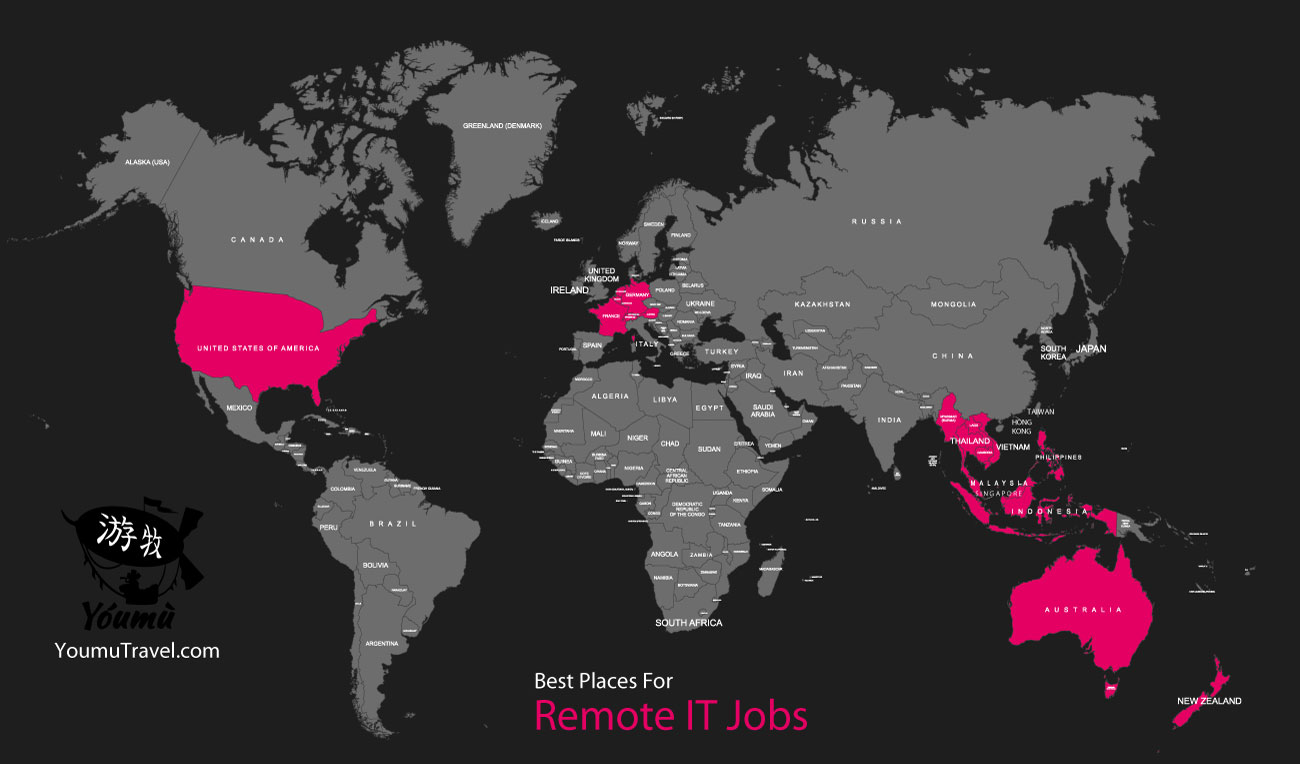
The Best Places for Remote IT Jobs
This remote job can technically be done anywhere in the world. However, you’ll want to make sure your clients or employer are okay with the timezone difference. Here are some of the best places for remote IT jobs.
- USA
- Western Europe
- Australia
- SE Asia
Understand the IT job market.
With so many opportunities within remote IT jobs, it’s important that you first understand what is out there. You could be working within the healthcare field, corporate spheres, government systems, etc. IT jobs are in high demand because nearly every industry relies on computers for some reason or another, which gives you the opportunity and ability to specialize. It’s important that you do research on the different opportunities, so that you can choose a direction to go in and take the proper steps toward it.
Hone your abilities.
Whether you want to go into general tech support, web development, coding, cyber security, or any other job within the sphere of remote IT careers, you’ll have to make sure your skills are up to par. Make sure you know the common conventions of your desired career and that you are fluent in the processes and jargon. You can do this by building apps and websites that showcase your technological skills, or providing technological support for friends and family. This experience will also help you stand out from other job applicants in the future. Additionally, take in-person or online courses to make sure you have the most current information at your disposal. Learn HTML, as this will be a necessary skill in almost any position. Javascript is also immensely helpful. Consider learning other operating systems, such as Linux, and read as many tech books as you can get your hands on to strengthen your abilities. Practice your skills by creating a website using only your knowledge base, not a template.
Garner experience.
As mentioned, every company, organization, and facility requires computers to run smoothly, and therefore they will need people to help them run and maintain their systems. To get experience that will allow you to be hired for a remote IT position, consider volunteering or interning. You could volunteer at a charity or intern at a smaller office. This experience will let you flex your tech skills and build up your resume.
Update your resume/CV/job board profiles.
Keeping these documents up-to-date as you work and progress your skills will help you land a remote IT position. Make sure if you’re aiming for a cyber security position, for example, that you mention in these documents your previous experiences with cyber security technology or breaches. If you’re looking to enter the world of tech support, make sure to recount your experiences troubleshooting software, hardware, or computer problems in the past.
Apply.
There are plenty of websites that allow you to search specifically for remote IT jobs, such as remote.co/remote-jobs/it. Find the job listings that match your interests and proclivities–such as Technical Support Specialist, or Cyber Security Specialist–and send your resume/CV and a cover letter to these companies. If they like your application, you will be invited to interview, which is where you can really expound on your previous professional and educational experience in the world of remote IT. Remember, be willing to start at entry level. You can get entry level positions without a degree as long as you have the right skill set. However, if you want to work up the ladder, a college degree will take you a lot farther.
What IT jobs can be done remotely?
- Remote Cyber Security Specialist
- Remote Server Administrator
- Remote Technical Support
- Network Engineers
- Systems Engineers
- IT Project Managers
How do I become a remote technician?
Here are 6 of the best sites for finding remote positions:
- FlexJobs. This site offers full-time, part-time, and even some jobs that are perfect for testing your way into starting a freelance business.
- AngelList.
- Hubstaff Talent.
- Pangian.
- Remote.com.
- Remote.co.
- WeWorkRemotely.
- Jobspresso.
How much can you make as a remote IT?
As an IT consultant, you can make an average of $77,500 and this position is given a “bliss score” ranking of 3.83.
What skills will you need to work remotely?
There are 6 vital skills that you will need in order to work remotely and succeed:
- Ability to Work Independently.
- Self-Motivation.
- Strong Written Communication Skills.
- Comfort in Learning and Using Digital Tools.
- Be a Team Player and Have Cross-Cultural Literacy.
- Reliable and Secure Equipment.
Can I work from home successfully?
8 Tips from Experts on how to work from home effectively:
- Organize.
- Set up a workspace.
- Schedule your day.
- Be computer savvy.
- Avoid home distractions.
- Limit the times you check your email.
- Work on your communication skills.
- Set office hours.
Which IT jobs are in demand?
Some of the most in-demand IT careers include network engineers, systems engineers, and IT project managers. This is not a comprehensive list, and plenty of other IT positions are open to you.
Which IT jobs pay the most?
Some of the best paying IT jobs this year include big data engineering, information systems security management, database management, security analysis, and more.
What are the best IT jobs for the future?
Some great IT career paths for the future include IT security specialists, health information technicians, database admins, and network admins, among many others.
Freelance Translator Guide
Freelance translators are independent professionals who help convert written words from one language to another. Their main objective is to make sure that the translated portion has the same meaning in one language as it was in the original language. Freelance translators can specialize in a variety of document translations, including scientific, commercial, legal, technical, or literacy. Those who are successful freelance translators will often display proficiency in linguistic, accuracy, creativity, time management, IT, and written communication skills. In addition to mastering these skills, the majority of freelance translators have a bachelor’s degree in foreign languages and certification to prove their translation abilities.

This job has somewhat high demand but it takes considerable time and effort to succeed.
Demand
- Somewhat High Demand
Experience & Degree
- At Least One Year of Experience Required
- Easy Certification Required
- Native English Speaking Preferred
Citizenship
- No Restrictions
This job is somewhat reliable with reasonable pay.
Pay Range
- Hourly: $20-$40/hr.
Reliability
- Somewhat Reliable
Housing
- Room and Board Not Provided
This job has a flexible schedule and you can work almost anywhere in the world.
Location
- Very Flexible
Schedule
- Very Flexible
Language
- Fluency in English and Local Language
Who can be a Freelance Translator?
Anyone fluent in English and other languages can become a freelance translator. Also, those who can master specific skills, like written communication and detail-orientation skills they can give the freelance translation industry a shot.
At this time, translators are widely needed around the world, especially in the U.S. Whether it’s from individual clients or freelancing websites, many platforms have jobs in multiple niches that require people to translate from one language to another.
What are the responsibilities of a Freelance Translator?
As a freelance translator, converting documents to different languages may seem like the only task that you need to complete. However, that isn’t the case as there is more work that goes into meeting all clients’ expectations.
Key Responsibilities
- Read materials and research information
- Convert texts and recordings from one language to another
- Make sure that the meaning of the translated portion matches the original portion
- Prepare subtitles for videos and presentations
- Cross-reference tools to verify the accuracy of the text
- Proofread and editing the translated documents
- Follow up with clients and team members to make sure their translated documents meet their expectations
- Regularly network with translation field experts to continue to learn about new and improved translation tools and methods
What’s the typical schedule for a Freelance Translator?
A freelance translator job is flexible in that it allows you to work from anywhere. However, you will have to conform to your clients’ timezones and schedules. Also, you can set your hours, especially if you’re working for a freelancing platform.
Income Reliability
Generally, working as a freelance translator can offer some income reliability, especially since the translator can pick and choose how much they work.
Typical Job Duration
Being a freelance translator can be short-term or long-term.
Estimated Hours Per Week
A typical freelance translator can work full-time for up to 40 hours a week if they consistently land gigs. It also depends on the type of work the translator is looking for, as this is a flexible job.
Room & Board
Being a freelance translator doesn’t typically provide room & board.
Freelance Translator – Country Map
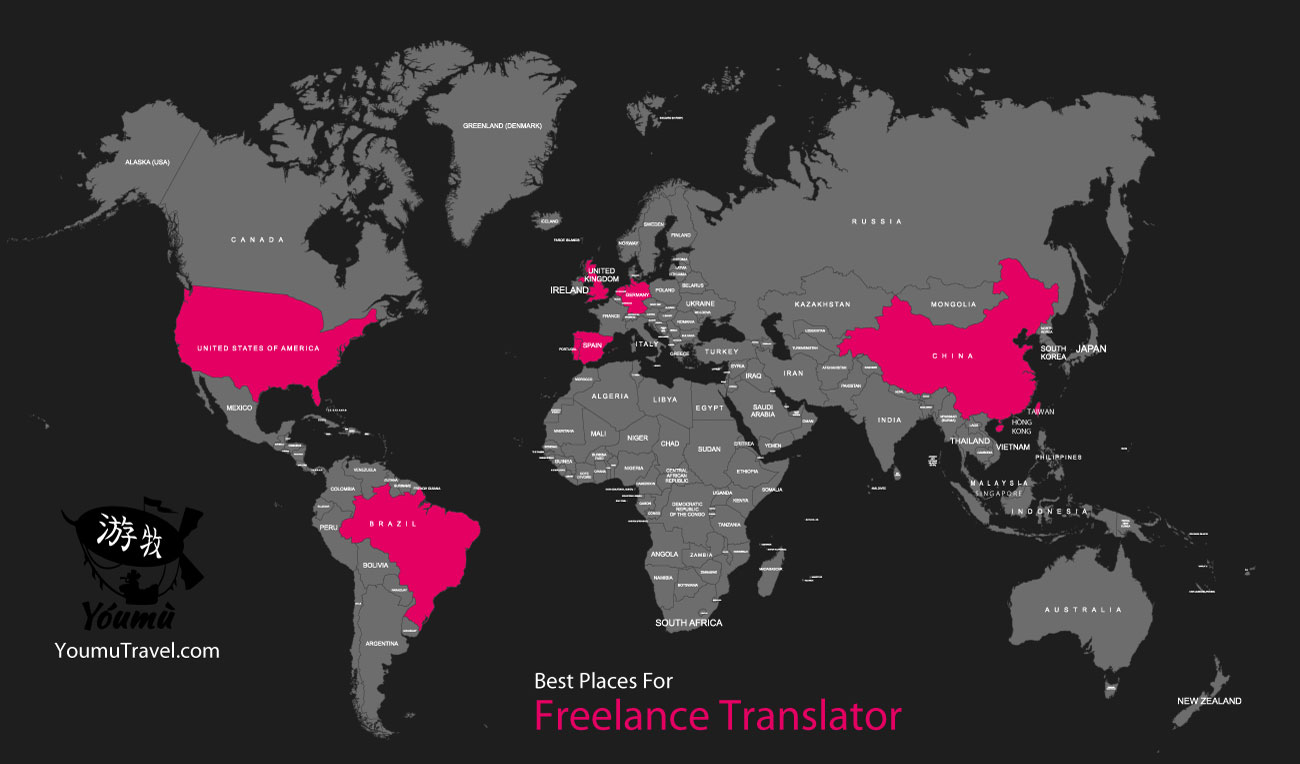
The Best Places to be a Freelance Translator
Most major countries throughout the world have opportunities for those looking to be a freelance translator. Here are some of the best places for freelance translators.
- US
- UK
- China,
- Spain
- Portugal
- Brazil
- German
- Netherlands
Learn all aspects of professional translation
Being a freelance translator is more than just taking documents and changing them to another language. Instead, there is more action that goes into the translation process that translators would consider as art. To learn more about what freelance translating entails, check out these links, and take some time to understand what translation means to you and your potential career.
Choose your niche
When new freelance writers start their careers, they tend to only focus on one niche. It would be wise to set your foot in more than one niche to make yourself seem more marketable and experienced. Also, working in different niches will help you find your desired niche since not every job will be for you. For instance, just like some people become accountants and don’t mind sitting at a desk all day, others would consider this thought a nightmare. Also, when some people light up at being good at something, others may believe that this isn’t enough.
Freelance translators can specialize in a variety of professional fields within their careers. Some of the niches that you can specialize in include the technical, scientific, financial, legal, judicial, juridical, certified, and literary fields.
Get savvy with the business component of freelance translator jobs
If you want to scale and grow your translation business, you must learn some basic accounting principles. These principles will come in handy to help you plan and budget your business effectively. Try starting out with organizing your own books and taking advantage of the software that is available for you to use. That way, you can work closely with your numbers to understand how your business is doing. If you come across any issues, then you could always hire an accountant to help you as well.
Brand yourself and land a Freelance Translator job!
One of the good things about marketing is that anyone can do it, even when it becomes overwhelming. All that it takes to market yourself is believing in yourself and just diving straight into the action. Although it’s common for people to dislike marketing and sales, it’s a skill that you’re going to need to last as a business owner. Don’t forget to learn as you go and don’t get discouraged too easily.
Always improve your portfolio of resources
Your work and your linguistic assets are similar to gold since once you take care of them and manage them properly, they will continue to grow. The same idea applies to you as you continue to get paid for your translation services. Therefore, it’s time to focus on finding and landing more work.
Translation agencies/platforms to provide you steady work
Be sure to start your research by making a list of agencies that you would like to contact for work and check their websites out. Keep in mind that you shouldn’t spam them since they would often prefer that you fill out an online form instead of sending an email. Not abiding by the instructions for applying for gigs will only cause you to waste your time since no one will look at your application.
When applying with a cover letter, be sure to keep it short and functional. You also want to make sure that each word on your cover letter and CV has a purpose for being there. In your cover letter, you have to make sure that it’s short and divided into four different parts: the ‘greeting,’ the ‘who you are’ section, the ‘relevant skills’ section, and the ‘why you want to work for them’ section. Keep in mind that every word on your cover letter will get people to open your CV, so make it count. For your CV, be sure that it’s easy to read, that all-important information is there, and that all irrelevant information is removed. If you need help, then you could use an Online Translator CV Builder to help you and allow you to modify your CV as you please.
Setup your freelance translator business
The legal part.
Working as a freelance translator means that you have to register as self-employed. To learn more about how to register, check out your country’s government website, and review your options.
Invest in the right tools.
To function as a freelance translator, be sure to invest in a reliable computer, such as a Windows computer, and a high-speed internet connection to access all your tools, communicate with your clients and conduct research. You should also invest in Microsoft Office software and CAT tools that will help you advance in your freelance translating career.
Providers offering freelance translator jobs
There are four main ways for freelance translators to land their first clients: their ex-employers, translation agencies, freelancing websites, and translator portals.
Ex (or current) employer
If you’re on good terms with your past or current employer, then you should reach out to them for work. Doing this is a great way to start since your employer already knows the type of worker you are and the skillsets you possess, so they would be open to working with you.
General freelancer websites
Freelancing websites help aspiring freelancers connect with employers looking for people to perform their tasks. The rates on these websites may not be as appealing at first, but they are great for beginners hoping to gain some experience within the freelance translation and business fields. These websites also have checks on payments thanks to the security of a third-party. Keep in mind that you can make these websites work for you, so you don’t have to settle for the lowest rates on there. Make sure that you have a clear action plan and goals, which include getting reviews, filling your portfolio, and getting out as soon as possible. If you can manage to raise your rates to your desired level, then it’s okay to stay on the platform for a little longer.
Translators Portal
Freelance translators who register for translators portals will have access to communities of professionals, industry news, and jobs that will help them advance in their careers. Three of the top portals that translators typically join are Translatorscafe, ProZ, and Chartered Institute of Linguists. In addition to having access to job opportunities, other communities provide credibility to their members as they search for more opportunities. Translatorcafe and ProZ do this, but other portals that perform this tasks include the ATA (American Translators Association), ITI (Institute of Translation and Interpreting), IOL (Chartered Institute of Linguists), SFT (French Translators Association), BDÜ (German Translators Association), NAJIT (US National Association of Judiciary Interpreters and Translators), ITA (Israel Translators Association), OTTIAQ (Ordre des traducteurs, terminologues et interprètes agréés du Québec).
If you choose to sign up for the ProZ portal, there are some pointers to keep in mind to maintain your success. It’s crucial to reply to offers where you have relevant experience, make your responses personal, always include your contact information, add your CV, and answer any questions that you’re able to answer in your particular field.
Translation agencies
Translation agencies are another great way for freelance translators to land gigs. These agencies require you to put in more work since you have to convince potential clients to send you work. Nonetheless, it’s worth it since the agencies invest in various sales, marketing, and project management tools to help attract clients with large projects. You’re going to have to put in work to land these gigs, so that means creating high-quality work constantly and becoming a reliable source for agencies to land repeat clients. Also, you won’t always have direct clients since freelance translators gain their jobs from both personal and translation agencies. To succeed with these agencies, you must complete two tasks: identifying the reputable agencies and persuading them to hire you for the job. From there, you must produce quality work for them that will make them want to keep you.
How do I become a freelance translator?
To be a freelance translator, you must first sign up for websites that post translation jobs. Upwork, Freelancer, and PeoplePerHour are a few examples of popular sites where companies post their translation jobs and their fees per project.
How do freelance translators find work?
Freelance translators find work through several different methods. One primary way is to work their craft, which essentially means practicing the skill until they have it mastered. Putting themselves out there through offline networking and professional association directories is another excellent way to land them more work. Social media and content marketing are other significant ways to land jobs, especially since more people tend to look for workers online through different platforms. Then there’s the ProX Blue Board, where freelance translators can enter a number to represent their likelihood of working again (LWA) with an outsourcer. Finally, cold email prospecting is the boldest way to land new clients and translation gigs.
How do I get a job as a translator?
The best way to get a job as a freelance translator is to sign up for translation websites and agencies that require workers for their upcoming gigs. Also, freelance translators can create their own websites and drive in clients with the samples they have completed.
How fluent do you have to be to be a translator?
Freelance translators have to be fluent in two languages at the least, with the first one being English. Those freelance translators that possess a bachelor’s degree, however, typically have the upper hand from those who only know more than two languages.
Can I be a translator without a degree?
Freelance translators can still work without a degree. All they need is to know more than one language and gain plenty of experience to start in the craft and land gigs.
What languages are in high demand for translation?
Depending on what part of the world a freelance translator is in can determine the languages that are in high demand. Some of the languages that are currently in need in the U.S. include Arabic, Farsi/Dari, Chinese (Mandarin mostly) Japanese, Korean, Hindi, Urdu, German, French, and Russian.
Who hires translators?
Freelance translators are typically hired by international organizations, NGOs, and lobbying bodies that need help translating documents and more for others.
Are translators obsolete?
Although freelance translators are being used today, they will become obsolete in the future. This is due to the advancement of technology, which will lead to no use for people to translate.
Is translating a good career?
Today, freelance translators are in high demand due to the increased amount of online jobs and the market growth for translators in recent years.
Is it hard to become a translator?
The level of difficulty to become a freelance translator depends on the field that a person wants to enter. Linguistic skills are the primary skills that freelance translators must possess, but they may have to take an examination for the field they wish to join, like law.
What skills do you need to be a good translator?
Becoming a freelance translator requires a good understanding of language and country-specific cultures, subject matter knowledge, writing skills, grammar skills, detail-oriented skills, and time management skills.
What is the difference between a translator and an interpreter?
The main difference between a freelance translator and a freelance interpreter is that the freelance translator manually deciphers written words. In contrast, freelance interpreters work to communicate the meaning of spoken words.
Freelance Photographer Guide
A Freelance Photographer is an independent contractor that takes photographs of clients based on the client’s specifications. Freelance photographers might work events like weddings, graduation parties, engagement parties, etc., or they might take portraits of people, families, and objects.

This job is in high demand and easy to get.
Demand
- High Demand
Experience & Degree
- No Experience Required
- No Degree Required
- Native English Speaking Preferred
Citizenship
- No Restrictions
This job is somewhat reliable with reasonable pay but typically not full-time.
Pay Range
- Hourly: $7-$45/hr.
Reliability
- Somewhat Reliable
Housing
- Room and Board Not Provided
This job has a flexible schedule and you can work almost anywhere in the world.
Location
- Very Flexible
Schedule
- Very Flexible
Language
- Can get by with English only
Who can be a Freelance Photographer?
Anyone that knows how to use a camera can be a photographer. However, to be a successful freelance photographer, you’ll want to understand lighting, composing, and editing photographs to build a strong portfolio.
It is not required that you have a degree to become a freelance photographer, but there are many universities, colleges, and technical schools that offer undergraduate and graduate programs if you want a formal education in photography. Some schools even offer short-term courses, seminars, and workshops to teach you specific genres of photography including black and white, how to use a DSLR camera on manual mode, or Photoshopping images. However, it’s more important to have a high-quality, professional-looking portfolio rather than a degree. Gaining experience through an internship or apprenticeship with a veteran photographer is just as beneficial as getting academic credentials.
What are the responsibilities of a Freelance Photographer?
The main function of a freelance photographer is to take pictures of a client-specified event, person, or item that look nice and evoke a particular feeling. Many tasks go into this.
Key Responsibilities
- Stay adaptable–you may be photographing a wedding one day and a newborn the next.
- Help the client achieve the imagery they want in these photos. For example, wedding photos should look happy and serene, whereas photos of the reception might want to depict more of the party aspect.
- Handle payment.
- Update your social media, websites, and portfolio.
- Arrive at destinations punctually with equipment.
- Edit photos.
- Correspond with clients.
What’s the typical schedule for a Freelance Photographer?
It is extremely flexible because you are your own boss and it depends on how many photoshoots you want to schedule in one day or how many clients you have to work with. Maybe you photograph just a wedding for one day but the next day you have 6 different photoshoots.
Income Reliability
In general, freelance photography is a reliable job that provides a constant stream of work.
Typical Job Duration
Freelance photography can be short-term or long-term.
Estimated Hours Per Week
It’s estimated that you can work full time, 40 hours per week, as a freelance photographer.
Room & Board
Freelance photography doesn’t typically provide room & board.
Freelance Photographer – Country Map
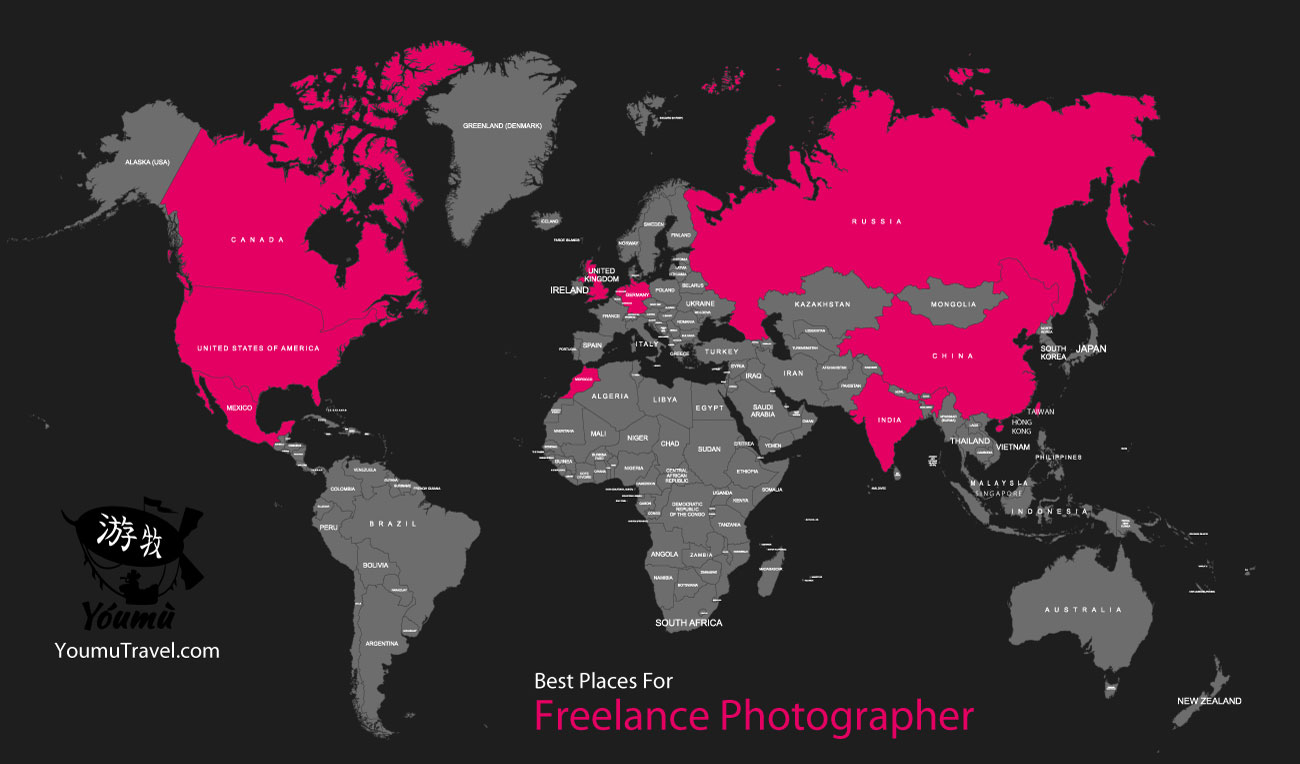
The Best Places to be a Freelance Photographer
Most major countries throughout the world have opportunities for those looking to be a freelance photographer. Here are some of the best places for freelance photographers.
- US
- UK
- Netherlands
- Mexico
- Canada
- India
- China
- Germany
- Morocco
- Russia
Choose a photography niche.
It may be overwhelming at first to see all the different types of photography that are in demand today and how many photographers there are in each. However, each business is unique from their compositing, editing, and aesthetics. Some of the most common types of photography that photographers specialize in are:
- Event photography
- Portrait photography
- Commercial and product photography
- Stock photography
- Photojournalism
- Social media photography
Get equipment.
There is quite a variety of equipment as there are types of photography so it’s essential to research what products are available and what works best for you and your type of photography. There are all kinds of camera brands, accessories, and editing software all ranging in quality and price. However, it’s vital to remember that “it’s the artist, not the tool” which means that it’s not the priciest equipment that’s going to create a great photograph, it’s you. Knowing how to work the camera and its necessary accessories are going to make you successful more so than that $3,000 lens. You may want to invest in formal education to learn about camera functions, lighting, posing, and editing programs to stand out amongst the crowd of photographers.
Get a business license.
As is for any business, a freelance photography business needs a permit or license to operate in your location. In most cases, you’ll just need a general business license, but if your home is also your studio, you may need a Home Occupancy Permit. Be sure to get the necessary license(s) and permit(s) before photographing. If you’re uncertain of what license or permit you need in your area or how to get them, visit SBA.gov for more information.
Price your services.
Before you get your first client, you’ll want to be able to tell them how much the photoshoot is going to be. For pricing, you’ll want to include expenses like equipment, taxes, operation fees, the time you’re putting into the project, and how much you’re paying to travel for the photoshoot, if applicable.
Choose payment methods.
Not only will your clients want to how much you charge but how they can pay you. You’ll want a variety of payment options such as cash, credit cards, and checks. There are many apps and accessories that make it easy to accept credit cards on your tablet or smartphone such as Square who will even send you your first card scanner for free, but the application itself does charge a small handling fee per credit swipe. You can even set up your website to accept payment online with programs like PayPal or Venmo.
Create your portfolio.
Your most crucial marketing move is creating a collection of your best works to show off your photography skills to prospective clients. If you have no experience and are looking to build one, ask family and friends if they would act as models or you could contact local models to help each other out. Your portfolio should change depending on the job you’re applying for and reflect on what kind of photography you want to do as well. If you’re trying to be a food photographer, don’t have a portfolio full of portraits. You’ll also want to have a digital and hard copy of your portfolio because some employers/clients want to have the convenience of looking your portfolio up before an interview while others will be impressed by your printing skills too.
Create a website.
When starting a business, especially a freelance photography one, you’ll want a website that you can direct prospective clients to so they can see your work and know what to expect. Your website should also be a way for customers to get a hold of you, commission you, and obtain their pictures so it’ll need to be easy to navigate and mirror your portfolio with only your best works. It may even be worth adding your Instagram feed to your website so people can see your daily uploads to see what you’ve been up to or behind the scenes of a shoot. There are great services out there to help you build a website if you don’t know how including WordPress, GoDaddy, and Adobe Portfolio.
Market yourself.
Once you have a portfolio, you can start updating your social media accounts and website to present your photography skills to the rest of the world. This will help expand your audience and clientele, but you also have to send emails, call, and network to find and maintain relationships with those people interested in your business! Then as you work, constantly update your Instagram and Facebook pages with current photoshoots. Having an online presence is crucial to build a reputable status.
Network.
You can’t just sit around and wait for the jobs to come to you. Visit and connect with related businesses to find new customers. Let’s say you want to be a wedding photographer, you’ll want to reach out to event planners to introduce yourself and show off your portfolio. This way they can recommend you later on when other brides start asking for a photographer. Get your name out there!
Do free work.
When first building a reputation as well as a portfolio, sometimes you have to swallow your pride and do some free shoots. You want people to spread your photography business by word of mouth because recommendations are the best way to gain prospective clients. Family and friends are great people to start with or checking with local small businesses to help photograph their marketing materials.
Improve your skills.
Just as with any other job, there is always room for improvement. With freelance photography, you’ll need to upgrade your equipment every few years to keep up with the ever-changing technological advancements and even join a photography group with others who can teach you how to photograph genres that you’re lacking in. You can always take courses as well or get on the job training with a photography studio. Maybe you’re looking for a challenge? Enter some contests with previous work or create something entirely new!
How much money can you make as a freelance photographer?
As of March 26, 2020, the average salary for a freelance photographer is $41,542. However, the salary usually ranges from $33,050 to $47,002.
What does it mean to be a freelance photographer?
A freelance photographer is a self-employed individual who photographs clients according to their needs including portraits, weddings, newborn, birthday, etc. You have to be able to market yourself through social media, websites, and a strong portfolio full of examples to find prospective clients.
How do I start as a freelance photographer?
To get started as a Freelance Photographer, you’ll need to create a business plan that fits within your chosen photography market. Additionally, you’ll have to invest in the best kind of equipment and software for your profession. You will also have to decide what you might charge for your services, and finally get your name out there by marketing, creating a portfolio, and creating a social media presence.
How do freelance photographers find work?
Freelance photographers mainly attract clients through their online presences on social media, websites, and their portfolio. However, the following websites are great for finding freelance work if you’re not sure how to market yourself yet:
- Upwork.
- Freelancer.
- Guru.
- PeoplePerHour.
- Hubstaff Talent.
- Fiverr.
- Your own photography website.
Is photography a good career?
Yes, photography is a good career choice! There is always a need/want for photos, especially when it comes to milestones like graduations, weddings, birthdays, etc and it’s easy to grasp if you have no experience. It also allows flexibility since you can be self-employed or become an assistant to a professional photographer or even find a job with news reporters. There’s plenty of variety as well.
What are the 4 types of photography?
The most popular types of photography are:
- Sports/Action Photography
- Wedding/Event Photography
- Baby/Family Photography
- Portrait Photography
- Food Photography
- Nature Photography
- Architectural/Real Estate Photography
How do I start my photography career?
To start your career in photography, you need to get the right education for you in a photography program, as well as choose a particular focus or niche. Internships can be a great way to start off in the industry and make connections as well. Get as many certifications as possible and land your first entry-level job, and you’re well on your way!
How do I find my first photography client?
Finding your first client can be tricky, but some good ideas include getting referrals from friends, family, coworkers, etc. Everyone you know could potentially come in contact with a prospective client, so make sure your friends and family know to promote you when possible. Additionally, network with industry professionals who might be able to give you a referral. Advertise your services on social media, or even use paid services to promote your work.
How do I sell myself as a photographer?
To sell yourself as a photographer, you’ll want your own website. Abide by these 7 aspects to attract customers and present yourself as a professional:
- Show off large images in your galleries.
- Show a picture of yourself.
- Keep the design simple and clean.
- No background music.
- Make it easy for your visitors to get in touch with you.
- Display your “starting at” prices.
- Tell visitors why you do what you do, and don’t just talk about how much you love photography.
Online Yoga Instructor Guide
An online yoga teacher instructs classes online about a variety of levels and aspects of yoga including stretches, meditation, and mindfulness.

This job is in high demand but takes a considerable amount of time and effort to succeed.
Demand
- High Demand
Experience & Degree
- At Least One Year of Experience Required
- Hard Certification Required
- Native English Speaking Preferred
Citizenship
- No Restrictions
This job is somewhat risky and is part-time but has reasonable pay.
Pay Range
- Hourly: $15-$55/hr.
Reliability
- Somewhat Risky
Housing
- Room and Board Not Provided
This job has a flexible schedule and you can work almost anywhere in the world.
Location
- Very Flexible
Schedule
- Very Flexible
Language
- Can get by with English only
Who can work as an Online Yoga Instructor?
Although many employers will require or prefer at least a certification, it’s not regulated by the state or national level so basically anyone can become an online yoga instructor.
However, if you wanted to become registered or certified, there are various and easily accessible options to do that.
What are the responsibilities of someone working as an Online Yoga Instructor?
The main function of an online yoga teacher is to provide students with instruction in the art of yoga. Many tasks go into this.
Key Responsibilities
- Teach online classes with students of varying sizes and experience levels.
- Demonstrate poses and motions according to student goals/needs.
- Advise students on at-home practice.
- Inform students of potential benefits and techniques for improving their skill or alleviating pain.
- Lead meditations.
- Describe the spiritual and intellectual principles of yoga for a well-rounded yoga education.
- Maintain digital tools/software to keep class running smoothly.
What’s the typical schedule for someone working as an Online Yoga Instructor?
This job is highly flexible in that you create your very own schedule. You choose how many hours you work and when you work because it’s up to you how many live streams you perform or how many videos you post.
Income Reliability
In general, teaching yoga online is a reliable job that provides a constant stream of work if you work through the Yoga Alliance.
Typical Job Duration
Teaching Yoga Online can be short-term or long-term.
Estimated Hours Per Week
It’s estimated that you can work full time, 40 hours per week, as an online yoga instructor.
Room & Board
Teaching Yoga online doesn’t typically provide room & board.
Online Yoga Instructor – Country Map
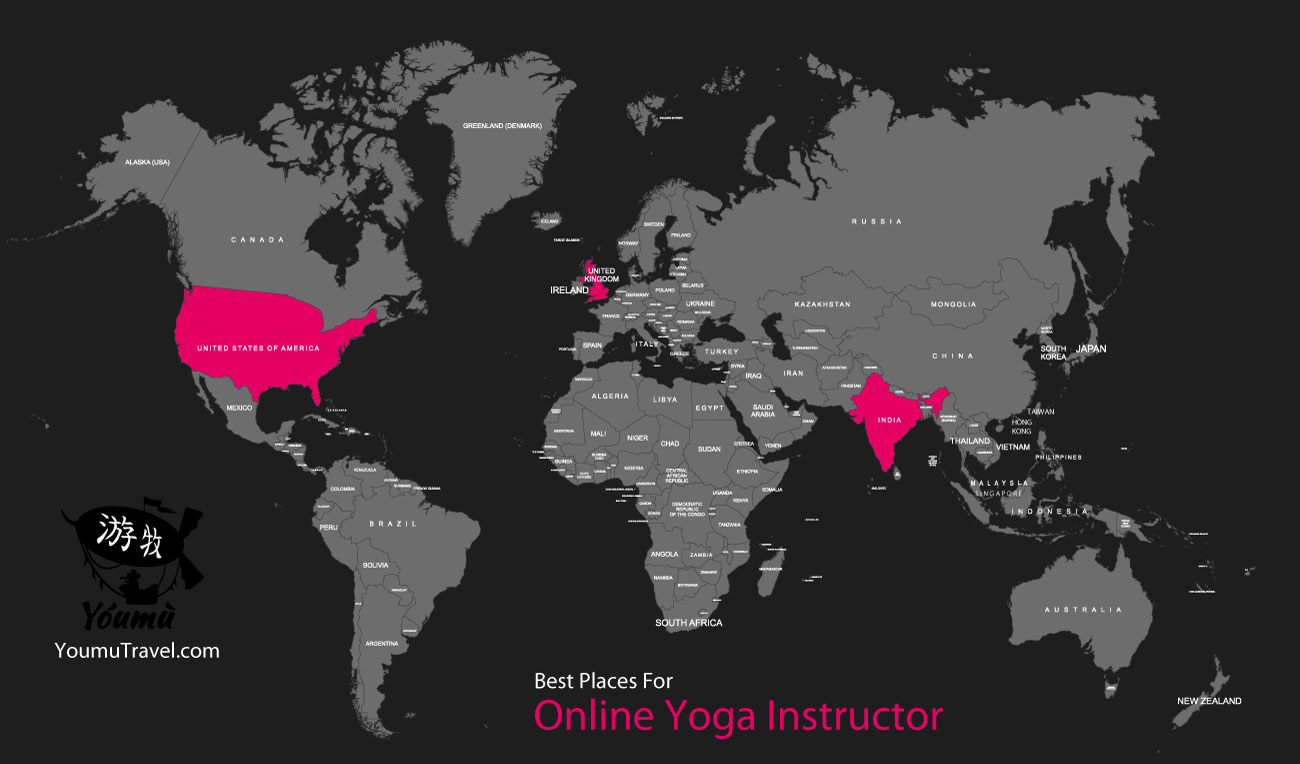
The Best Places to Work as an Online Yoga Instructor
This remote job can technically be done anywhere in the world. However, you’ll want to make sure your clients or employer are okay with the timezone difference. Here are some of the best places for online yoga instructors.
- US
- UK
- India
Learn yoga.
A. Understand the practice and philosophy of yoga by learning the different main yoga styles
- Vinyasa yoga
- Hatha yoga
- Iyengar yoga
- Kundalini yoga
- Ashtanga yoga
- Bikram yoga
- Yin yoga
- Restorative yoga
- Prenatal yoga
- Anusara yoga
- Jivamukti yoga
B. Perform yoga as a student any chance you get
C. Certification through the Yoga Alliance is not vital for teaching yoga online and you can pay the Yoga Alliance for permission to use their RYT trademark after your name that doesn’t really mean anything at the government, state, or national level. Certification is mainly for yoga and fitness studios in the US to show that you have the minimum education to teach it. Whether it’s worth pursuing or not is up to you.
D. Training is available in various forms of yoga since there are 11 main types of yoga so it’s smart to try as many different ones as you can before deciding on which one you want to learn/teach. You’ll want to find a style that you enjoy but also feels good and natural for your body. It’s also important to consider where you go for training because, along with type, location and cost vary greatly too. Be sure to talk to other teachers as well so you can get advice on how to complete training and find a job not long after being certified.
E. Practice, practice, practice!
Choose your teaching style.
It’s time to decide on how you’ll teach yoga. Are you going to offer classes for groups of people or private classes for one-on-one training? The pro of teaching virtually is you have unlimited space unlike a physical yoga studio if you want to teach groups of students. However, you’re less likely to be able to see every student and be able to critique their execution. With live classes for individual students, they can use a computer or phone camera so you can see what they’re doing and give them advice on how to fix their posing. The other pro of teaching virtually is you can either do it live or record ahead of time and let students watch the videos any time they want to.
Price your services.
There are three options that you can choose from when deciding on how much to charge for your yoga classes:
- Free. Offering classes for free is the easiest option because you don’t have to worry about setting limitations to ensure only students that pay have access to your live streams and classes. However, this option brings in no income.
- Donations. You still offer classes for free, but you let your students know that if they enjoy your classes, they can donate any amount of money they feel they can spare. This is also easy to set up. Just make a PayPal account and share your link for students to click on. This is a great option for teachers who have a strong community with students that want to support them.
- Charge for classes. There are website platforms that make this easy for you such as Namastream or Fitgrid. However, if you want to use a free tool like Facebook Live or YouTube, it becomes more difficult, because you want only students who have paid to find your live stream. If it’s a one-off class, the easiest way to use Facebook live is to create a private group and only accept students into that group once they’ve paid and you can post in that group when you’re going live so that only they know. You could also offer a subscription such as setting a strict amount for a set amount of time (They get live classes and all replays for $20 a month). Here is a list of ways to get paid:
- WordPress. You can use the free event calendar plugin to schedule events and people can buy tickets to those events once you add the event tickets plugin.
- Stripe is a tool that allows you to accept credit card payments and the best part is it’s to free to sign up!
- A Squarespace or Wix website allows you to set up a shop to accept payments or just add a PayPal button.
- If you’re looking to sell private classes, Acuity or Calendly helps with setting up booking slots and you get paid through them. They also both coordinate with Zoom so they are easy to use and manage multiple types of events.
Choose a streaming tool.
There are various applications you can utilize for live streaming your classes. Here are just a few:
- Zoom. All you have to do is set up a session and share the link with your students/audience. It’s only $15 a month which includes handling classes up to 100 students at a time and automatically recording sessions for easy replay.
- Facebook Live. It’s free, easy to live stream, and you can utilize their restriction tools such as creating a private Facebook Group. However, this is assuming that all of your students have a Facebook account.
- YouTube Live. You’ll need to set up a YouTube account and activate it for going live which can take up to 24 hours so do this in advance. It’s easy to restrict access on here too by going live with an unlisted video and having a private link to share with only those who want to have it.
- Mixture. Namastream and Fitgrid are premium platforms that integrate Zoom with MindBody or Streamyard which offers the option to stream to YouTube and Facebook simultaneously.
Get equipment.
It’s vital to have the proper equipment to help your classes look and feel more professional and make it easy for students to follow along including a good microphone and DSLR camera.
Set up your space.
You’ll want a clean, organized, well-lit area to film in. Decide where to set up your mat, what you want in the background, where the camera should be placed, any lighting you’ll use, and how you’re going to record sound. It’s important to tape out a “safe area” perimeter for when you move around so you know when you’re moving out of frame and you’ll want to make sure that the camera can capture your entire body. If you have a small space and you can’t move the camera far enough to capture you completely, you can buy a wide-angle lens to help for filming. Natural light is best either behind the camera or to the side, not behind you, but you can also invest in a ring light or some softbox photography lights if you don’t have a window.
Virtual workshop.
It helps to grow an audience if you create a unique workshop that reflects the skills that you have and others are lacking in. Offer something new rather than the typical 30-day cleanse cliche.
Create a class series.
Fixed-price class series are popular with online users. These types of classes offer a start-to-end date, have a set payment, and an easy-to-follow curriculum that students can check in advance. This is not only good for the students but you by offering a steady income with monthly subscription schedules. If you are using your own website or YouTube to stream, you should aim for 10-minute videos, but if you’re looking to do longer streams, it’s best to use a software company that specializes in Yoga.
Blog.
To get a presence online and to build a brand, you should consider starting a yoga blog. You can post a variety of things on it from recipes, tips, the culture, or even books and films that revolve around yoga.
Create a social media presence.
It’s not about just getting your students excited about your classes, but also helping them feel like they belong to a community; build a connection with you and the other students. This helps you sell products more naturally and easily. Utilize tools like Later which help you find the most effective hashtags to use, schedule your posts for the best times of day, and evaluate how well you post is reaching your followers. It’s recommended to post daily with stories like what happened to you that day or your daily routines with yoga because you’ll want to build a personal relationship with your audience. This also helps with creating ads because you can use the data of your current followers to know who and how to cater your ads to.
Can I become a yoga instructor online?
Yes, you can! Some tips on how to start include: decide what topics you want to teach, develop your own style of yoga, get connected with the global yoga community, and become location independent.
What is the best online yoga certification?
The best online yoga certification depends on your experience and what type of yoga you are interested in teaching. Here are a few of the top certifications:
- Overall: YogaWorks.
- For Beginners: Embrace Yoga DC.
- For Intermediate: Kripalu Center for Yoga & Health.
- For Advanced: Himalayan Institute.
- For Vinyasa: Vinyasa Yoga School.
- For Hatha Yoga: Oil Yoga.
- For Ashtanga Yoga: One Breath of Yoga.
- For Hot Yoga: Y7 Studio.
How much does a yoga instructor make a year?
Yoga instructors make an average of $7,500 a month.
What is the difference between RYT and YTT?
YTT just stands for Yoga Teacher Training. The real difference that is important to know is RYT, Registered Yoga Teacher, or CYT, Certified Yoga Teacher. To become an RYT, you only need 200 hours of face-to-face training while becoming a CYT requires you to attend an educational program with a yoga teacher training school.
How do I start a yoga business from home?
To start your own yoga business, you’ll need to first get a yoga instructor certification. Then you should create a business plan and work on building your customer base. It’s important for you to market yourself to extend your reach as an instructor, so make sure you have a nice website with an eye-catching logo that reflects the type of yoga you teach.
What should I look for in yoga teacher training?
A good Yoga Teacher Training Program will be Yoga Alliance-Certified. Additionally, make sure it fits in your day-to-day schedule and that the syllabus has subjects you are interested in, as well as anatomy. Make sure to do ample research on the instructors to see if they are a good fit for you, as well as the history of the program.
What is the best online yoga site?
The best 8 websites for practicing yoga are as follows:
- Druyoga.
- Yogaglo.
- EkhartYoga.
- Curvy Yoga Studio.
- Do Yoga With Me.
- Yoga Studio App.
- Yoga Vibes.
- Yogis Anonymous.
How much does it cost to be certified in yoga?
The price for becoming a certified yoga instructor with the Yoga Alliance ranges from $1,000 to $3,000, depending on location.
How long does it take to train to be a yoga teacher?
The lowest course of 200 hours can take around three to five months while the highest course of 500 hours averages between six months to a year. This, of course, all depends on your dedication and how quickly you want training over with.
Should I get Yoga certified?
If you are serious about teaching yoga, then you should invest in getting certified, or at least becoming a registered yoga instructor.
Remote Travel Agent Jobs Guide
Remote travel agents help their clients plan and arrange their vacation or other trip from a home office. They work within the client’s budget and specifications to find accommodations, travel arrangements, and help create fun itineraries.
This job has just average demand but is easy to get.
Demand
- Average Demand
Experience & Degree
- No Experience Required
- No Degree Required but Certification Preferred
- Native English Speaking Preferred
Citizenship
- No Restrictions
This job is somewhat reliable with reasonable pay.
Pay Range
- Hourly: $15-$45/hr.
Reliability
- Somewhat Reliable
Housing
- Room and Board Not Provided
This job has a flexible schedule and you can work almost anywhere in the world.
Location
- Very Flexible
Schedule
- Very Flexible
Language
- Can get by with English only
Who can get Remote Travel Agent Jobs?
Anyone who loves to travel and has an aptitude for planning, budgeting, and scheduling can be a remote travel agent. It is recommended, but not required, that you have education in a relevant area such as travel and tourism, marketing, or hospitality. Additionally, find travel and tourism training/certification courses to ensure that you are properly qualified.
What are the responsibilities of someone working Remote Travel Agent Jobs?
The main function of a remote travel agent is to help their client arrange, plan, book, and embark on a vacation or other trip. Many tasks go into accomplishing this.
Key Responsibilities
- Plan and book transportation arrangements, accommodations, insurance, etc.
- Determine client needs/desires.
- Provide advice/bookings based on this information.
- Give information, brochures, and guides to clients.
- Collect payment/fees.
- Use promotional marketing techniques to upsell packages to the client.
- Handle unforeseen travel issues/complaints.
- Keep updated on tourism trends with workshops and seminars.
- Keep thorough records and file systems.
- Network with other professionals in the travel/tourism industry.
- Ensure software is up to date and working well for your business.
What’s the typical schedule for someone working Remote Travel Agent Jobs?
The daily schedule will likely vary, but one of the great things about working independently from home is your ability to choose your own schedule. You’ll have to schedule meetings with clients and conduct work during hours where you can contact the necessary travel companies. If you work within a host agency or as a remote employee for a travel company, then your hours might be more rigid.
Income Reliability
In general, being a remote travel agent is a reliable job that provides a constant stream of work.
Typical Job Duration
Being a remote travel agent can be short-term or long-term.
Estimated Hours Per Week
It’s estimated that you can work full time, 40 hours per week, as a remote travel agent.
Room & Board
Being a remote travel agent doesn’t typically provide room & board.
Remote Travel Agent Jobs – Country Map
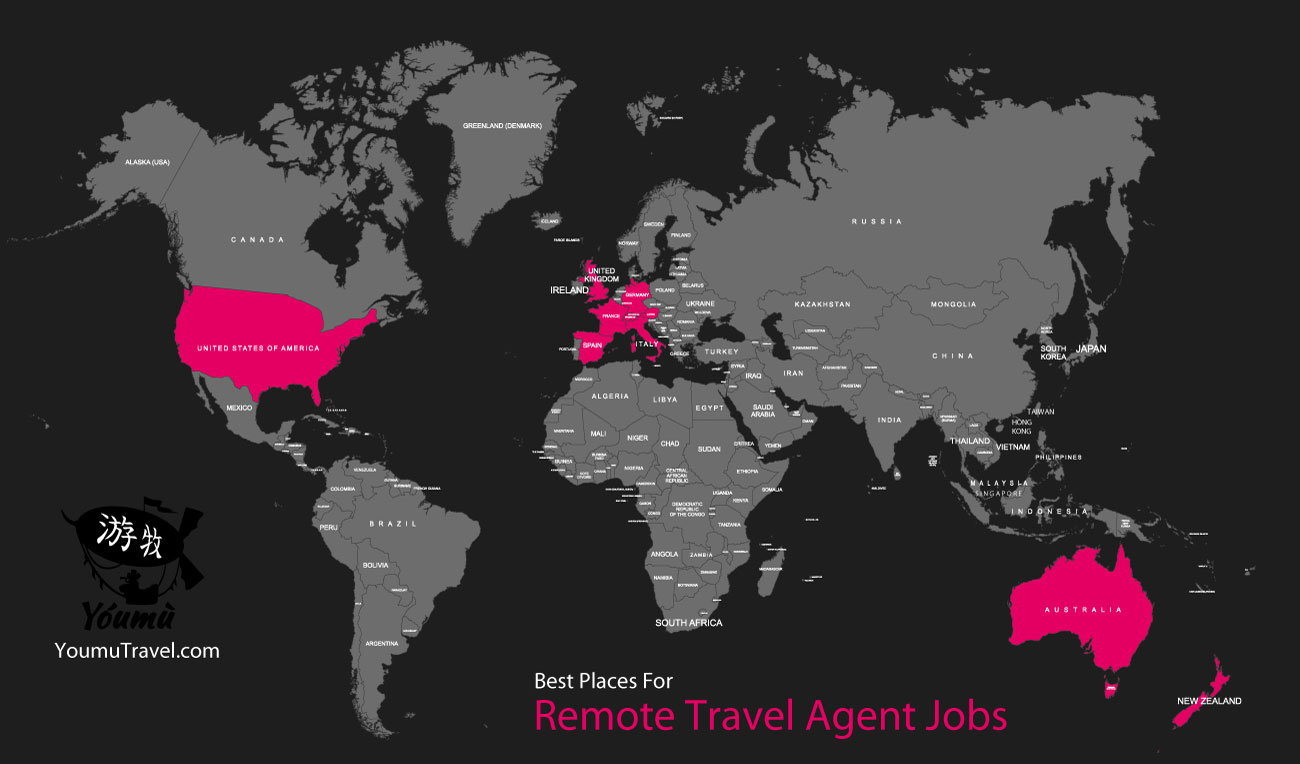
The Best Places to work Remote Travel Agent Jobs
This remote job can technically be done anywhere in the world. However, you’ll want to make sure your clients or employer are okay with the timezone difference. Here are some of the best places for remote travel agent jobs.
- US
- UK
- France
- Germany
- Switzerland
- Austria
- Australia
- Italy
- Spain
- New Zealand
Research.
It’s important for you to do research to determine if being a remote travel agent is the right position for you. Have a thorough understanding of what the job entails in terms of requirements and expectations. You also need to decide what kind of travel agent you want to be, so choose a niche market that you want to focus on.
Get trained/certified.
You need to be an expert in your field as a travel agent. Clients come to you for the best advice and arrangements. There are both free and paid training/certification programs out there. Sites like ASTA can be really useful for finding these programs. Additionally, it will help you in your business if you have had some experience traveling yourself, so that you can put yourself in your client’s shoes.
Learn about the industry.
As mentioned, you need to be an expert in all things travel, and the industry is not exempt from that. If you have connections in the industry, invite them to coffee to see what they might be able to teach you. If not, there are online resources such as forums and message boards that you can join. Additionally, subscribe to travel industry publications.
Register your business.
Travel agents are independent business owners, and so you will need to file your own taxes and manage your expenses within the business. It is recommended that you seek the professional advice of an accountant and lawyer to ensure that your business is registered correctly, and in a way that fits your vision of the business.
Join a host agency.
As an independent business owner, you’ll still need help from a host agency. These can help connect you with clients and resources for your business. You’ll also be able to earn commissions from these agencies. Some agencies you could look into include Cruises Inc., Cruise Planners, Disney Vacation Planner, and more.
Find a travel consultant job.
Conversely, if you don’t want to go through the hassle of owning your own business, you can find employment within a pre-existing travel company that hires remote agents. Some of these companies can also offer you travel perks that you wouldn’t be able to offer yourself with your own business. Try exploring companies like American Express, BCD Travel, Carnival, FlexJobs, JetBlue, Hilton, and more.
Can I work from home as a travel agent?
Yes! All you need to work from home as a travel agent is a simple home office set up that includes a stable internet connection, a phone, computer, and printer.
What is the best travel agency to work for?
Some great companies that hire remote travel agents include AirTreks, ADTRAV Travel Management, BCD Travel, and Carlson Wagonlit Travel, among many others.
Do travel agents travel for free?
A travel agent might get a discount or the commission they would make on a client, but it is unlikely that they would be able to travel for free.
Is becoming a home based travel agent a good idea?
This depends on you and your lifestyle. If you love to travel and help people fulfill their travel dreams all while working from home, then remote travel agent jobs might be just right for you.
Can you make a living as a travel agent?
Many remote travel agents work part-time and might make around $37,000 annually. Travel agents generally do not expect to make huge incomes in their line of work.
How do I become a freelance travel agent?
To become a travel agent–remote, freelance, or with an employer–you need to first build your client base. If you don’t have prior experience in the travel industry, it helps to have related experience in fields like marketing and hospitality. Try connecting with a host agency that can connect you with clients, as well as provide you with useful training and information.
What qualifications do I need to work in a travel agents?
It’s a good idea to have a certificate/diploma in Travel and Tourism at a level 1 or level 2, as well as a level 2 award in Principles of Customer Service in Hospitality, Leisure, Travel, and Tourism.
Why use a travel agent instead of booking online?
Travel agents are professionals at advocating for the best accommodations and travel arrangements for their clients–they will ensure that you have a great, easy trip from start to finish. Travel agents can relieve the stress of planning a vacation or trip for their clients.
Online Proofreading Jobs Guide
Proofreaders read written content or transcripts to check for spelling, grammatical, or typographical errors. Proofreaders are the final step in content writing, and act as the last defense against common errors within a text.
This job is in high demand and easy to get.
Demand
- High Demand
Experience & Degree
- No Experience Required
- No Degree Required but Preferred
- Native English Speaking Preferred
Citizenship
- No Restrictions
This job is reliable with reasonable pay.
Pay Range
- Hourly: $10-$45/hr.
Reliability
- Reliable
Housing
- Room and Board Not Provided
This job has a flexible schedule and you can work almost anywhere in the world.
Location
- Very Flexible
Schedule
- Very Flexible
Language
- Fluent in English
Who can get Online Proofreading Jobs?
Anyone that is fluent in the language that they will be proofreading could be a proofreader. It is imperative for the proofreader to know the common conventions of proofreading–e.g. markup symbols–and much of this knowledge can be acquired in college level courses. While a college degree will certainly give you a leg up when looking for proofreading jobs, it is by no means necessary.
What are the responsibilities of someone working Online Proofreading Jobs?
The essential function of a proofreader is to make sure that a body of written work contains as few grammatical, spelling, or typographical errors as possible. The content has often passed through the hands of many editors before it reaches the proofreader, and so the proofreader needs to be able to catch what others did not.
Key Responsibilities
- Read over written content to eradicate all remaining errors within a text.
- Double check references, sources, citations, and data.
- Review for consistency
- Work with editors, writers, and project managers to deliver content on schedule and within budget.
What’s the typical schedule for someone working Online Proofreading Jobs?
It is difficult to determine the typical schedule of a proofreader, as it depends on who/what they are proofreading for, whether or not they are freelance, and how much content the client puts out. Proofreaders are usually paid per hour of proofreading, and a job finishes when the text has been completely proofread. If this is a 500 page novel, then the proofreader could work 40 hours a week. If it is 1000 word articles for a blog, then the proofreader can expect fewer hours.
Income Reliability
Online proofreading is fairly reliable as freelance proofreaders are always in demand. The amount of work and pay may fluctuate.
Typical Job Duration
Online proofreading can be short-term or long-term.
Estimated Hours Per Week
It’s estimated that it is possible to work full time, 40 hours per week, as an online proofreader, but part-time is also common.
Room & Board
Proofreading online doesn’t typically provide room & board.
Online Proofreading Jobs – Country Map
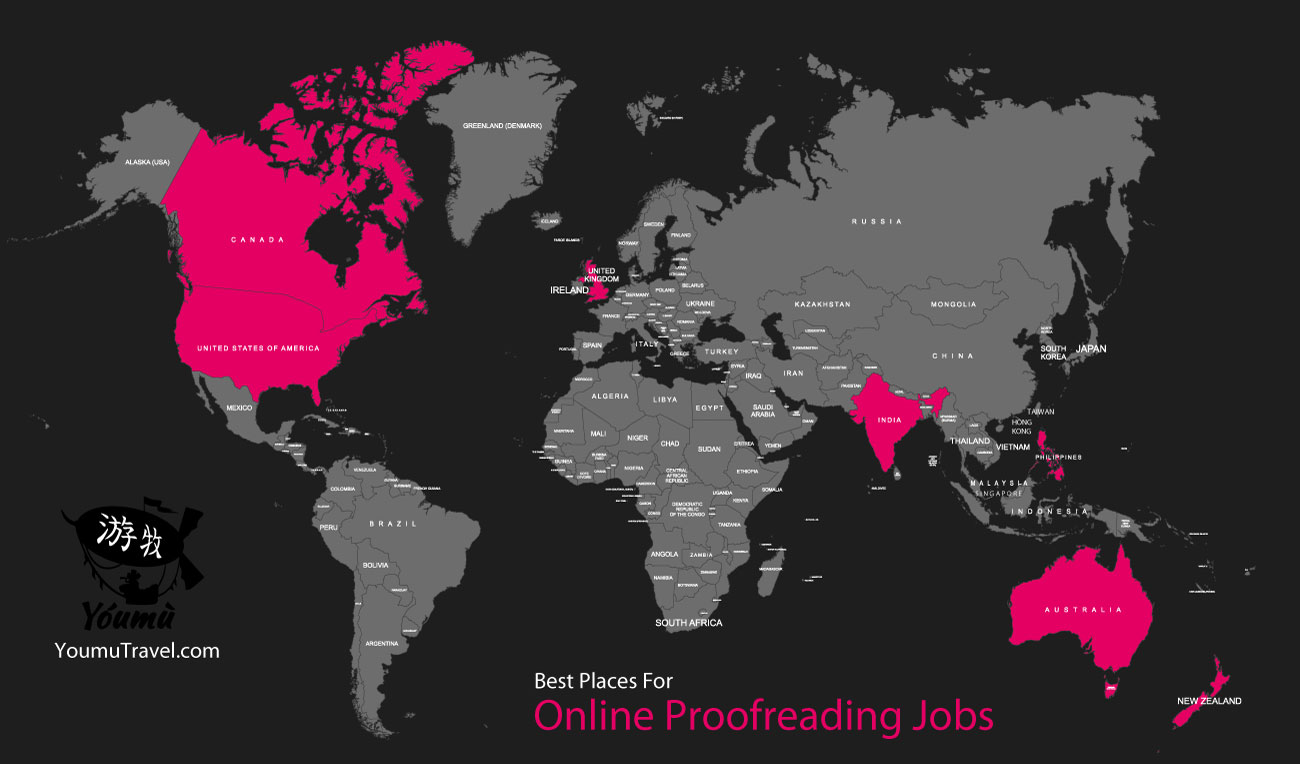
The Best Places working Online Proofreading Jobs
This remote job can technically be done anywhere in the world. However, you’ll want to make sure your clients or employer are okay with the timezone difference. Here are some of the best places for online proofreading jobs.
- US
- UK
- Australia
- India
- Canada
- Philippines
Develop your abilities.
A lot goes into strengthening your proofreading skills. You should be well read and well versed in various writing styles, be comfortable working in numerous word processors, and be familiar with multiple styles guides (namely Chicago Manual of Style, AP Style Guide, and the AMA Manual of Style).
Practice.
A great way to get better at proofreading is to train yourself to do it constantly. Mentally proofread everything you read–from the morning paper, your twitter feed, to your favorite books. You’ll be surprised what errors you can find in polished text–but this is exactly what a proofreader should be best at.
Choose a specialty, if any.
Areas of focus could include E-books, academic writing, marketing materials, resumes and cover letters, and legal transcripts. The baseline proofreading knowledge should allow you to work in any of these areas, but there is always industry-specific knowledge you could learn.
Create a website.
You should create a website that advertises your proofreading services and abilities. Make sure to include a little bit about you, your experience, and your specialties.
Start applying!
You can find proofreading jobs on specialized job boards like Mulberry Studio, Wordfirm, and Proofread NOW. There are also job boards that don’t specialize in proofreading alone but that have many proofreading jobs on them, such as Upwork, Fiverr, and Scribendi. You can also contact web owners directly to inquire about work opportunities.
How do I become an online proofreader?
To gain the proofreading skills you’ll need to succeed, you should have taken (at minimum) high school English, literature, and writing courses. College level courses in similar topics or specialized to editing and proofreading are also extremely helpful to provide the foundational skills a proofreader requires. Some of these courses can also be found online, and there are additional online tutorials.
How much does an online proofreader make?
Remember that a proofreader’s salary is dependent on how quickly they are able to work, as proofreading is generally paid by the hour. According to salary.com, the median yearly salary is around $52,000 per year. Some freelancers can make between $25-$30 an hour.
Is proofreading a legitimate career?
Absolutely. Proofreading is definitely a legitimate career and is an essential step in any business that creates written text. Many of these positions can also be found online.
What qualifications do you need to be a proofreader?
A degree is not always necessary to become a proofreader, but you should have taken (at minimum) high school English, literature, and writing courses. College level courses in similar topics or specialized to editing and proofreading are also extremely helpful to provide the foundational skills a proofreader requires.
Can you make money proofreading online?
Yes! Many paying proofreading positions can be found online. Professional proofreaders can make as much as $25-$44 an hour, and specialized proofreaders (such as those who proofread court transcripts) could earn more.
Are proofreaders in demand?
Studies show that the demand for proofreaders could see an annual increase of 4.25% over the next couple of years.
How do I become a certified proofreader?
There are a few options for US based potential proofreaders to become certified. You could take ACS Distance Education’s course to get a Certificate in Editing and Proofreading or you can take an online course at Poynter News University. Additionally, an impressive score on a proofreading aptitude test could help prove your skills to a potential employer, even though it is not an official certification.
Are proofreading courses worth it?
It is important that you know the official proofreading skills and tools required to be a professional proofreader–for example, thorough knowledge of markup symbols is required. If you do not feel confident that you know the ins and outs of proofreading, then courses might be worth it to you. But if you have a complete grasp of proofreading requirements, then you might be able to skip the courses.
How do I get a job as a proofreader?
You can look for proofreading jobs online on sites like Fiverr, Upwork, Scribendi, Reedsy, ProofreadingPal, and more.
Remote Editing Jobs Guide
Editors are largely involved in the coordination and revising of material set to be published in newspapers, magazines, books, or websites.

This job is in high demand but requires some experience to get.
Demand
- High Demand
Experience & Degree
- At least One Year of Experience Required
- No Degree Required but Preferred.
- Native English Speaking Preferred
Citizenship
- No Restrictions
This job is reliable and pays well.
Pay Range
- Hourly: $18-$50/hr.
Reliability
- Reliable
Housing
- Room and Board Not Provided
This job has a flexible schedule and you can work almost anywhere in the world.
Location
- Very Flexible
Schedule
- Very Flexible
Language
- Fluency in English.
Who can get Remote Editing Jobs?
While it’s not mandatory to have a relevant college degree, it can be extremely beneficial for someone looking to get hired as an editor to have a bachelor’s degree in communications, English, or a similar field.
Additionally, editors are under constant pressure from deadlines, and so a prospective editor should be comfortable and willing to work in a high-pressure environment.
What are the responsibilities of someone working Remote Editing Jobs?
An editor’s main function is to optimize content to fit their publication and please their readers, but this function can be broken down into many tasks.
Key Responsibilities
- Read and revise content to remove spelling, grammatical, or typographical errors.
- Revise content for clarity and flow.
- Double check facts using company standard reference sources.
- Judge many submissions from writers to choose what is publishable.
- Work with writers to ensure their comfort in assigned stories and to ensure success
- Plan content in advance according to the specific publication’s usual style, policy, and history, while being mindful of the audience.
- Approve final versions of documents to be published.
What’s the typical schedule for someone working Remote Editing Jobs?
A remote freelance editor has the freedom not only to choose what projects they work on, but to choose their own schedule. There will likely be a deadline for a particular project, but as long as the project is complete by then, the hours are at the freelance editor’s discretion.
If an editor is working remotely within a company instead of freelancing, they may have to conform to the company’s working hours.
Income Reliability
In general, remote editing is a reliable job that provides a constant stream of work. Freelance remote editing will be more variable.
Typical Job Duration
Remote editing can be short-term or long-term.
Estimated Hours Per Week
It’s estimated that you can work full time, 40 hours per week, as an online editor. Freelancers, again, are likely to see more fluctuation in their hours.
Room & Board
Remote editing doesn’t typically provide room & board.
Remote Editing Jobs – Country Map
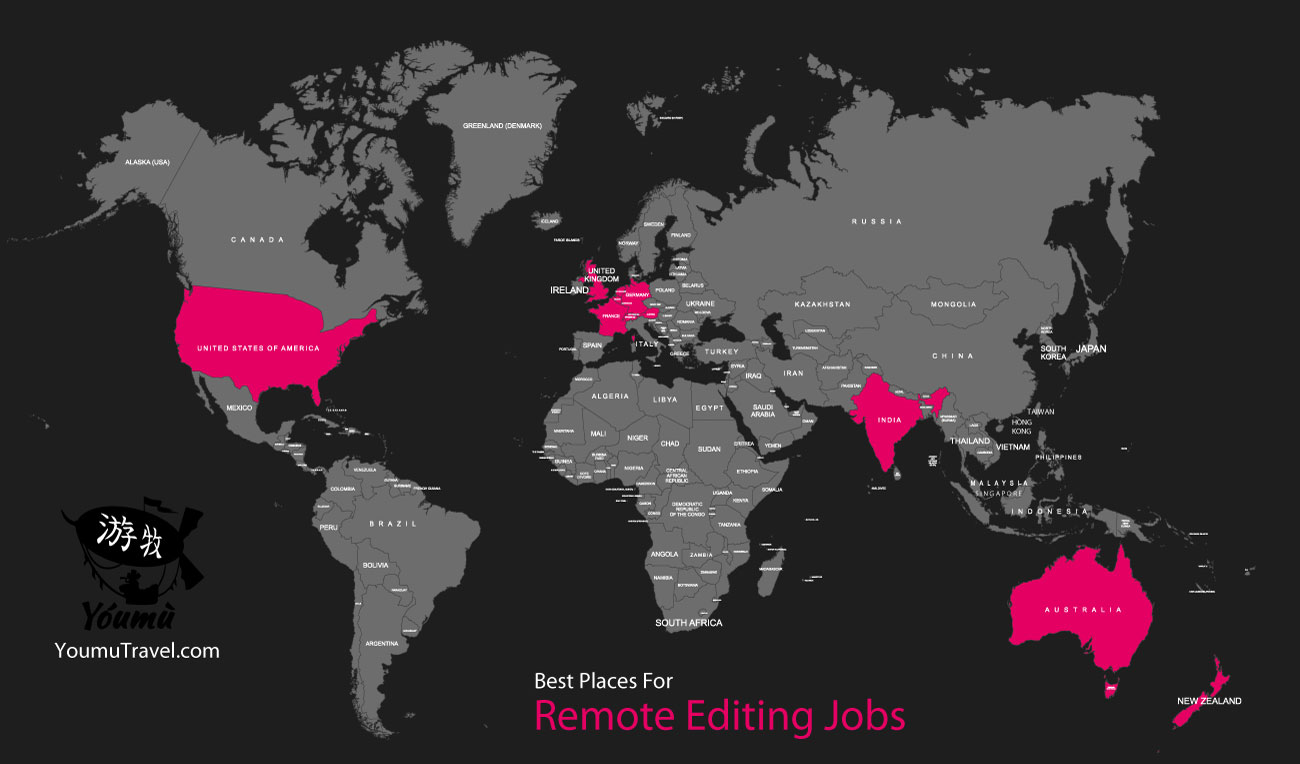
The Best Places to work Remote Editing Jobs
This remote job can technically be done anywhere in the world. However, you’ll want to make sure your clients or employer are okay with the timezone difference. Here are some of the best places for remote editing jobs.
- USA
- UK
- Australia
- Western Europe
- India
Read as much as you can.
By reading voraciously, you can consciously and subconsciously notice what goes into well-written and well-edited content from books, magazines, and web pages. You can bring this knowledge to your own edited content.
Consider a degree in English or communications.
While a degree is not mandatory, it is highly desirable in a good editor. College courses will provide you with the necessary skills to be a great editor.
Choose a niche.
This could be fiction books, news and magazine articles, academic papers, or web content such as blogs. The basics of editing is primarily the same for all of these niches, but there is specialized knowledge for each.
Apply for editorial internships/jobs.
Internships or jobs as an editorial assistant will look great on your resume to achieve future editing positions in a higher rank, and will provide you with real-life experience necessary to succeed.
Apply for more jobs!
Now that you’ve had some real world experience, you’re ready to take your skills farther. Apply for editorial jobs that appeal to you and are within your niche
Create a website.
A website can help you create your brand as an editor and will attract employers.
What is remote editing?
A remote editor combs over text for spelling, grammatical, and typographical errors as well as for overall clarity and readability. A remote editor will usually log into the blog or website to clean it up, or receive documents via email to edit.
How do I get a job editing books at home?
Take a look at some of these websites to begin your online editing career: Scribe Media, Domainite, Editor World, Polished Paper, Proofreading Pal, and Scribendi.
Do editors work from home?
It certainly depends on who the editor is working with, but editing is very conducive to working remotely. An experienced editor can work with little supervision and is trusted to make executive decisions about the text. Freelance editors most often work from home and they are able to set their own hours and projects, which provides a level of freedom many enjoy.
How do I become a freelance editor with no experience?
To break into editing without experience, definitely practice in a non-professional setting. Mentally edit the things you read, and look online for editing aptitude tests. It might also be helpful to choose a niche to work in–a type of writing that you might be really good at editing. Keep a portfolio of what you have edited.
Remote Sales Jobs Guide
Remote salespeople perform the same job as regular sales representatives as far as communication with customers trying to sell products or services on a regular basis, but with the opportunity to perform their responsibilities and make commissions from home. You are focused on molding each customer relationship to potentially create future business, organizing the team members’ sales efforts, and setting deadlines.

This job has just an average demand and it takes considerable time and effort to succeed.
Demand
- Average Demand
Experience & Degree
- At Least Two Years of Experience Required
- No Degree Required
Citizenship
- No Restrictions
This job is somewhat reliable with reasonable or well-paid situations.
Pay Range
- Hourly: $20-$60/hr.
Reliability
- Somewhat Reliable
Housing
- Room and Board Not Provided
This job has a flexible schedule and there’s a chance you’ll have to stick close enough to your employer or client’s timezone.
Location
- Somewhat Flexible
Schedule
- Little Flexibility
Language
- Can get by with English only
Who can get Remote Sales Jobs?
Anyone that can perform self-motivated work, utilize new selling platforms, can build and maintain trusting relationships with potential/existing clients and can achieve agreed upon sales targets can be a remote salesperson.
What are the responsibilities of someone working Remote Sales Jobs?
As a remote salesperson, you are performing all the same tasks as an in-house sales rep. without meeting with a client face to face.
Key Responsibilities
- Create, grow, and manage to keep customer quality customer relationships and business
- Always improve sales techniques through feedback, and speed up resolving customer problems or complaints to achieve maximum satisfaction.
- Analyze market potential, track sales, and status reports, and keep informed regarding best practices and promotional trends
- Sell products/ services by using strong arguments of presentation to prospective and existing customers
- Coordinate team members’ sales efforts to achieve agreed sales targets and scheduling outcomes.
- Analyze the cost-benefit and needs of potential/existing customers to better meet those needs.
- Report on customer needs, interests, problems, the potentiality of new products/services, competitive actions being taken, and inform management of results.
- Use cold calling to reach out to customers
What’s the typical schedule for someone working Remote Sales Jobs?
This job is flexible in that it allows you to work from anywhere. However, you will have to work to complete sales and reports for the company you are contracted for effectively.
Income Reliability
In general, work as a remote sales rep. is a reliable job that provides a constant stream of work.
Typical Job Duration
Being a remote salesperson can be short-term or long-term.
Estimated Hours Per Week
It’s estimated that you can work full time, 40 hours per week, as a remote salesperson.
Room & Board
Work as a remote salesperson doesn’t provide room & board.
Remote Sales Jobs – Country Map
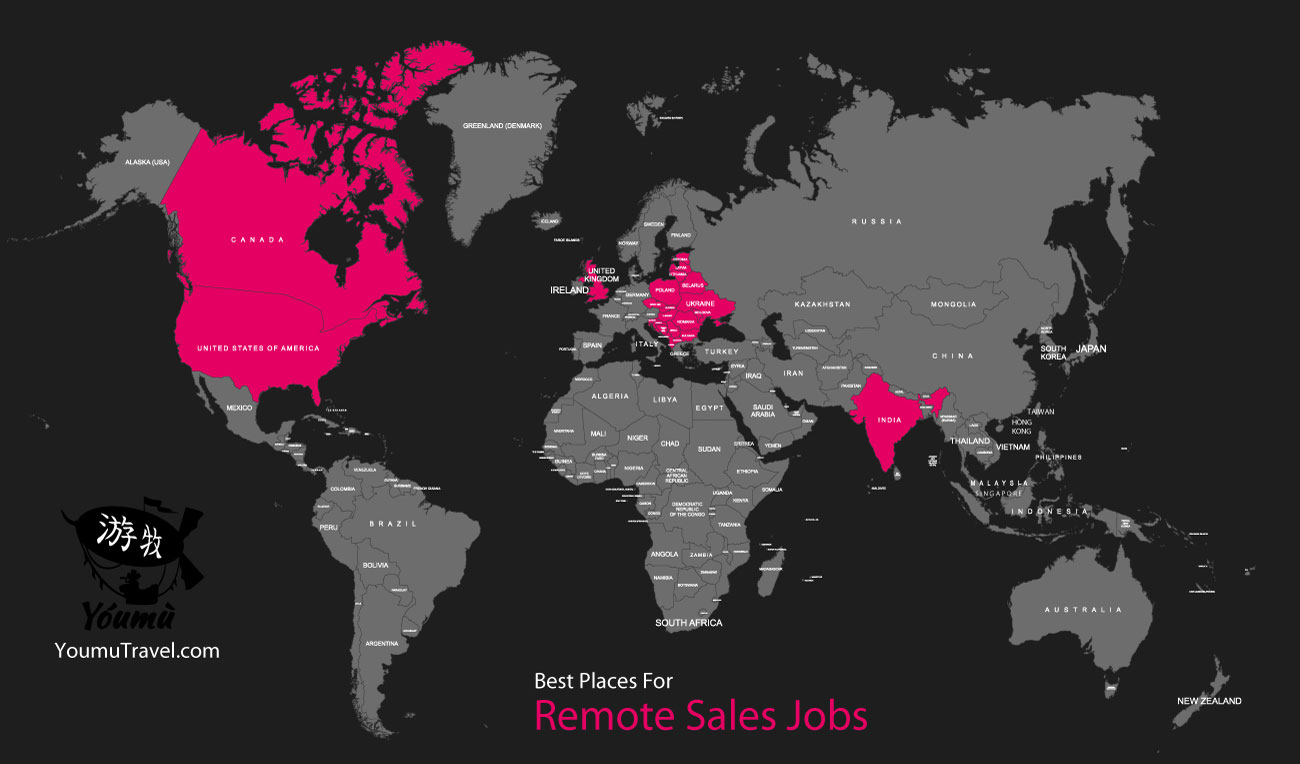
The Best Places to work Remote Sales Jobs
This remote job can technically be done anywhere in the world. However, you’ll want to make sure your clients or employer are okay with the timezone difference. Here are some of the best places for remote sales jobs.
- US
- Canada
- UK
- India
- Eastern Europe
Getting Ready for Sales
The most important thing to keep in mind when starting out in sales is that they rely on incentives from the performance. This can be scary for salespeople, but commissions are not difficult if you are responsible and can set goals for yourself.
Nowadays, the way you communicate a sale is more important than where you are selling. You don’t have to be standing in front of the customer to make a sale, now it can be done over the phone, email promotions, and social media ads.
Any sales position will require sales training and management in order to be successful. Sales training will include e-learning websites, systems to learn management, audio, and video. No more learning from an office cubicle.
Utilize New Platforms
Being available to channels of communication and outreach that did not exist 30 years ago or even 10 years ago, will open new means of sales. Having an immediate response with a customer via text can be extremely helpful in answering customer questions.
Social selling is another form of newer sales technique that involves engaging with customers on social media but is not solely focused on sales pitching.
Phone calls can allow for more personable conversation than a long-winded email and can help salespeople connect quickly with their customers.
Finding a remote position
Once you start working remotely, you will never want to work in person again. Here are some tips for finding the best remote position for both you and the company:
- Makeover your Linkedin Profile: A simple search will show you what a good Linkedin profile will consist of. If you don’t have one, then make one for yourself. Employers can look at your social profiles when hiring, so you’ll want yours to stand out!
- Look on Social Media for Opportunities: Utilize your social platforms to find people who already work in remote sales, and eventually, you will find someone with remote positions available.
- Think about Selling Directly: These are companies that don’t use Amazon or a typical storefront, and instead market directly to customers. For some industries, the personal engagement of a salesperson is needed to sell some of the highest quality products. Getting into sales is by no means easy, but salespeople who are successful will never want ‘normal jobs’ ever again.
What does remote sales mean?
Remote sales are when the prospective customer and the salesperson are in different locations throughout the sales process.
How do you succeed in remote sales?
- Stay focused on the desired outcome
- Form a routine
- Keep the business endings at the start of the day
- Utilize tech and engagement
- Create a process.
What is an inside sales rep?
A salesperson that works inside a physical office without visiting prospective customers in person is an inside sales representative. Usually, they would do their business over the phone, but with today’s technology, they are able to work using Skype, email, and other online communication services.
Is sales a good career?
If you are searching for a job with a flexible work environment, a personal challenge, potentially high-earning, and the development of your professional skills and abilities, then a career in sales is definitely worth exploring.
What skills do I need to work remotely?
If you want to work remotely, here are necessary skills for remote job hunters:
- Being able to work independently
- Be self-motivated
- Possess strong communication and writing skills
- Be comfortable with learning and using various digital tools.
- Possess secure and dependable equipment
- Possess cross-cultural literacy and be a team player!
How do remote freelancers work with clients?
How to do remote work with Customers:
- Utilize virtual tools to keep yourself organized
- Establish and enforce deadlines
- Make sure to form a trusting relationship from the very beginning. It’s imperative that a new client be able to trust you if you are going to be working with them in a remote capacity.
- Work with the customer to create a plan of communication
Remote Medical Coding Jobs Guide
Medical coders work in healthcare facilities to convert patients’ information into standardized codes used on documentation for databases and for healthcare insurance claims. They help practitioners receive reimbursement from healthcare insurance companies.

This job has a high demand but it takes considerable time and effort to succeed.
Demand
- High Demand
Experience & Degree
- At Least One Year of Experience Required
- No Degree Required but Preferred
Citizenship
- No Restrictions
This job is reliable and pays well.
Pay Range
- Average Hourly: $30-$65/hr.
Reliability
- Reliable
Housing
- Room and Board Not Provided
This job has a somewhat flexible schedule and there’s a chance you’ll have to stick close enough to your employer’s timezone.
Location
- Somewhat Flexible
Schedule
- Somewhat Flexible
Language
- Can get by with English only
Who can get Remote Medical Coding Jobs?
Anyone who completes an Associate’s degree or some certification can be a medical coder. An AAPC is required to become an expert medical coder.
What are the responsibilities of someone working Remote Medical Coding Jobs?
The responsibilities of a remote medical coder include:
- Assigning CPT, APC, DRG, HCPCS, ICD-10-CM, and ASA codes
- Making sure documents are free from any typing or grammatical errors
- Auditing charts
- Searching for any missing information in documents
- Making sure medical coding guidelines and policies are being complied with
- Pulling out any relevant information from patient records
- Training and helping physicians and staff with medical coding
- Communicating with physicians and other parties to ensure clarity of information.
- Letting supervisors know of any problems with computer programs and equipment.
What’s the typical schedule for someone working Remote Medical Coding Jobs?
Remote jobs are always more flexible than in-house jobs, the schedule included. Remote medical coding and billing as a position can be done as a part-time, full-time, contract job, but also per day.
Income Reliability
Medical coding is in high demand and often pays really well, so job while you may not be with one job or contract forever, there’s usually plenty more you can pick up!
Typical Job Duration
Medical coding can be short-term or long-term.
Estimated Hours Per Week
Varies depending on job type.
Room & Board
Medical coding doesn’t typically provide room & board.
Remote Medical Coding Jobs – Country Map
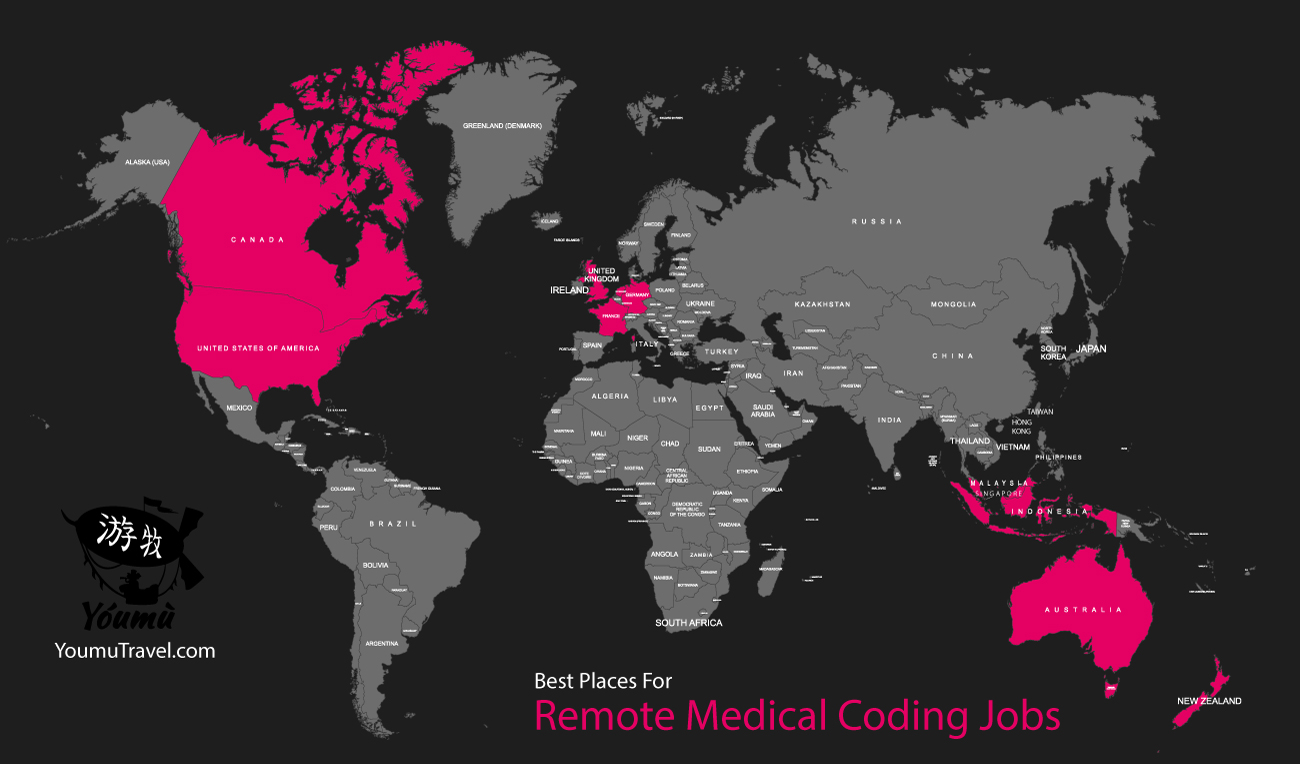
The Best Places to work Remote Medical Coding Jobs
This remote job can technically be done anywhere in the world. However, you’ll want to make sure your clients or employer are okay with the timezone difference. Here are some of the best places for remote medical coding jobs.
- US
- Canada
- UK
- Netherlands
- Germany
- Australia
- Malaysia
- Indonesia
- France
Fulfill basic requirements
To be a medical coder, you must have a high school diploma or equivalent. Background checks must also be passed. Anyone with a criminal history involving sexual crimes or drug offenses will likely be turned away!
Complete the proper training
You will need to start training. While there are no formal requirements with education levels, most employers are looking for candidates with some form of post-secondary up to an Associate’s degree. If you want a solid foundation of knowledge for this field, earning a Medical Coding Certificate, some courses can be completed in 9 months. Here are some courses you might take:
- Revenue Cycling and Billing
- Coding Foundations
- Ambulatory Care Coding
- ICD-CM Coding
- ICD-PCS Coding
Practical training and a good understanding of this field will help you hit the ground running once you get your first medical coding job.
Get Certified
Credentials will show potential employers your dedication as a medical coder, and that you’ve demonstrated all the required skills to be successful. Here are some common medical coding certifications you can specialize in:
- (CPC) Certified Professional Coder
- (CCS) Certified Coding Specialist
- (CCA) Certified Coding Associate
After you have experience in the field, you can decide for yourself if you want to specialize in your career as a coder and pursue a Specialty Medical Coding Certification for family practice, ambulatory care, anesthesia, general surgery, or several others.
Become Familiar with in-demand medical coding skills
Make sure you know exactly what employers are looking for, before applying for positions. Here’s some data to help you know exactly what skills you’ll need as a medical coder:<
Technical skills:
- ICD-10
- (HIT) Health Information Technology
- Physiology
- CPT Coding
- Outpatient Coding
- Anatomy
- Customer billing
- Inpatient coding
- Medical Terminology
- HCPCS Coding
This list is not as daunting as it may appear, but they are exactly the kind of skills you will learn in a Medical Coding Certification Course. Here are some transferable skills for medical coding:
- Research
- Being Organized
- Paying great attention to detail
- Communication
- Microsoft Office
- Collaboration
- Computer literacy
If you can fit with any of these skills, then being a medical coder would be a great fit for you.
Get a job
While trying to find a job, remember what kind of environment you want to work in. You have a lot of choices as a medical coder for a career, once you get past the front door and gain experience, then you can think about potential opportunities for advancing.
Can you get a remote medical coding job without a degree?
Yes, you can have a programming job without a degree. Coding boot camps can give you the skills you need, without a degree, and in a more affordable way, with more time efficiency to help you get started in your career in coding.
Can coders work remotely?
Yes, medical coding in fact is one of the easiest careers to remotely work from so long as you are working with a reputable company. Remote medical coding and billing as a position can be done as a part-time, full-time, contract job, but also per day.
Can you get a job with a coding certificate?
If you are a certified medical coder, then there are several jobs available to you. For example inpatient and outpatient hospital/facility coding, physician professional fee coding which is all types of services and specialties offered by ancillary staff or physician, and ambulatory surgery coding.
What is remote coding?
A medical coder is basically the same thing as a remote coder, except a remote coder does the work for hospitals and medical facilities without being in the building. There are even some healthcare organizations and hospitals that require remote coders in-house for some of the work.
Is medical coding a dying career?
It’s never wise to waste your time and money to train for a dying career. But experienced medical coders and billers can make significantly more money than newer ones. With national certification and experience, some medical coders can make up to $25-$30/ hour.
What is the highest paying coding certification?
Certified Physician Practice Managers (CCPM) have the highest average income with an annual salary of $64,666.
Is medical coding a good job?
Medical coding jobs offer good opportunities for advancement, the more experienced you get. Having knowledge with medical coding and billing can help lead you to a beneficial position for a long time.
Is it hard to get a job as a medical coder?
Finding a job in medical coding and billing itself is not hard to do, but anyone who wants to become a medical coder should complete a post-secondary associate’s degree program or certificate. An AAPC certification is a must if you wish to become an expert medical coder.
How long does it take to get a coding certification?
Since no formal education is needed to become a medical coder, the best way to become one is by completing a career-specific program. For most of these programs, you can be finished in 18-24 months, sometimes even less.
Is medical coding a stressful job?
There’s stress involved in the job if you’re doing it well. In order to do a good job, you need to understand all the parts of what you are billing. You need to know EHR/EMR and how dependable it is for certain levels of billing out.
Can medical coders make 6 figures?
You can go for 6 figures if you have a dependable and well-sourced client that you are working for as a medical coder.
Remote Legal Jobs Guide
Legal professions deal with the law. It’s the job of a legal professional to learn, develop, and apply it in their field after obtaining a degree in law. There are a wide variety of specific jobs in the two main legal systems – civil law and common law – and each require certain amounts of education and experience, and many can be done remotely.

This job has a somewhat high demand but it takes considerable time and effort to succeed.
Demand
- Somewhat High Demand
Experience & Degree
- At Least Two Years of Experience Required
- Master’s Degree Required
- Native English Speaking Preferred
Citizenship
- No Restrictions
This job is reliable and pays well.
Pay Range
- Hourly: $15-$60/hr.
Reliability
- Reliable
Housing
- Room and Board Not Provided
This job has a flexible schedule and there’s a chance you’ll have to stick close enough to your employer or client’s timezone.
Location
- Flexible
Schedule
- Somewhat Flexible
Language
- Can get by with English only
Who can get Remote Legal Jobs?
People already in legal work have a leg up, but most legal jobs require some sort of legal degree, depending on the level of work you’ll be doing. Some legal jobs only require an associates, such as Paralegal work, whereas Lawyering usually needs a bachelor’s or greater.
What are the responsibilities of someone working Remote Legal Jobs?
Just like normal legal work, the jobs available in the remote legal work field are vast, and are often split between core legal work and legal administrative support. Both areas are important to the legal field, and the jobs within each have differing responsibilities.
Core Legal Careers
These are the main jobs people associate legal work with. Some jobs in this field include:
- Lawyer
- Also called Attorneys or Counselors, lawyers advocate for their clients’ rights. This is done via negotiation, lawsuits, or litigation with other parties. They’re the workhorse of the legal field.
- Paralegal
- The right hand man of the Lawyer, a paralegal does tasks so the lawyer doesn’t have to, that way the lawyer can focus on things only they can do. Paralegals can draft pleas, assist clients, or perform legal research (under the supervision of the lawyer).
- Legal Secretary
- Also called Administrative Assistant, responsibility wise the Legal Secretary falls below the Paralegal but above an average secretary roll. Legal Secretaries can file maintenance and draft basic correspondence.
Legal Administrative Support
While the core legal jobs are the center of attention in the legal field, these positions are all important to the entire legal industry. Some jobs in this field include:
- Compliance Specialist
- The compliance in this title refers to applicable laws and policies at the local and federal level. A Compliance Specialist makes sure the company is compliant with the law.
- Conflicts Analyst
- A delicate roll, Conflicts Analysts research conflicts of interest between the employees of the law firm and all the parties involved in the case. Confidentiality here is critical.
- Legal Recruiter
- Working outside of law firms, a legal recruiter provides those firms and legal businesses with potential employees. Think of them as the agent for a famous actor. Recruiters provide both Lawyers and Paralegals.
- Court Messenger
- Court messengers deliver documents and other evidence to courts and lawyers.
- Law Firm Administrator
- Also called a Practice Administrator. A high end administrative job that looks over the day-to-day operations and finances of a law firm.
- Contract Administrator
- Typically works for the Law Firm Admin, dealing with more specific parts of his job, usually involving contractual obligations.
What’s the typical schedule for someone wokring Remote Legal Jobs?
This job is flexible in that it allows you to work from anywhere. However, you will have to conform to your students’ timezones.
This can be tricky if you’re planning to do this job while living in the U.S. but it’s doable and it’s still better than a 9-5, right?
Each tutoring session will take about one hour and you’ll likely have at least a few sessions scattered throughout the day or night.
The best part about this job is that you’re in control of your own schedule. Many of the sites that provide the online teaching jobs allow you to take on more or less hours as you wish. However, it wouldn’t be surprising if some of the more reputable companies require a minimum commitment for the sake of the students.
Income Reliability
Given the right field, legal work generally provides a steady income.
Typical Job Duration
Jobs here are typically long-term, especially considering one would have studied specifically for one certain job, such as lawyering.
Estimated Hours Per Week
Most legal work is full time, 40 hours a week, though some more minor positions can be part time.
Room & Board
Remote legal work doesn’t typically provide room & board.
Remote Legal Jobs – Country Map
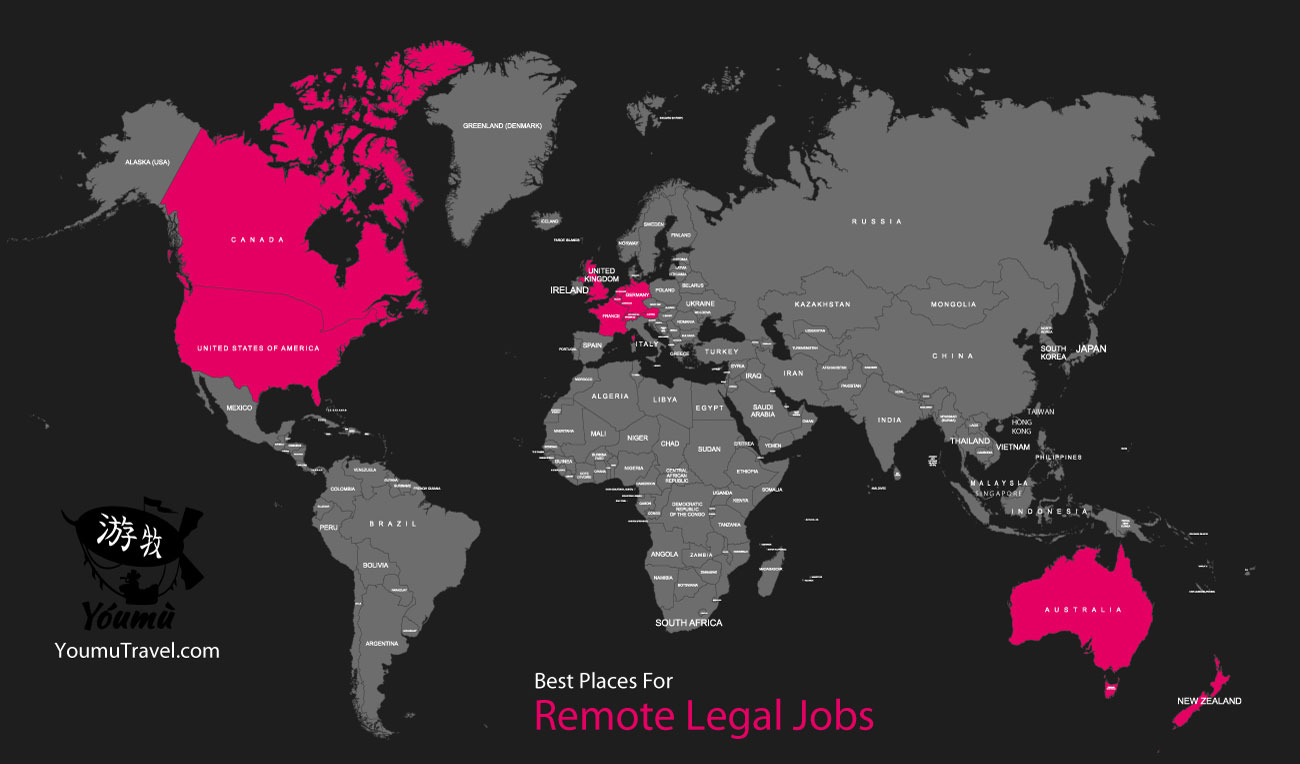
The Best Places to work Remote Legal Jobs
This remote job can technically be done anywhere in the world. However, you’ll want to make sure your clients or employer are okay with the timezone difference. Here are some of the best places for remote legal jobs.
- US
- UK
- Canada
- Western Europe
- Australia
- New Zealand
Step 1: Assess your options
Regardless of your specific legal position, during these current times it should be relatively simple to transfer your job to remote work without job swapping. Talk with your supervisor about the reasons why you think your work should go remote, it’s likely your request will be accepted as many other legal jobs are going remote at this time.
Step 2: Decide your career path
- If you will ultimately need to change jobs, there are three main paths you can go down – Company (in house) work, Law Firm, or Freelancing. There are things in each path you should know:
- Company – Make sure to update your CV and start looking for jobs that can include remote work. Here are a few websites which can help you out:
- Law Firm – While the above websites can help, it might be a good idea to make a list of law firms you’d want to work for. Make sure to check the career pages on their websites, but don’t be afraid to ask them directly about certain jobs. While they may not advertise for remote employment, it’s quite possible they’ll accommodate for you given you have a desirable skill set.
- Freelancing – Decide what legal services you’re going to provide. You have more flexibility than a law firm or a company to choose what area(s) you wish to provide, but still keep in mind your local demographics. For example, if your region doesn’t have a lot of manufacturing jobs, providing legal services for that area may put you out of work pretty quick. Always do some research first to see what people in your area need and what would have a steady demand. Keep in mind, you have control over your future in the field, and plenty of different options to consider, what foundation to lay. After that foundation is down, make sure to share your services with your network. Clients you will find usually come from other lawyers or law firms. Through it all, make sure to plan things out. You are your own company, and being your own company requires strategizing, time, and dedication to your work. It’ll be a rough start, but once you get going and people see how determined (and good) you are, that momentum is hard to slow down.
Step 3: Get yourself some tools
Like a carpenter needs a hammer and nails, you’ll need some equipment if you don’t have some already. Here’s a short list:
- Laptop
- Scanner
- Headset
- Cloud based email
- Cloud based case management software (for lawyers)
- Secure client portal
- Video meeting software or app
Step 4: Get the remote part of the job down
It’s one thing to know legal, another to know remote work. Here’s a few steps that could help you:
- Communicate the transition to remote work with clients, staff, colleagues (if they are the same ones as the ones you used to work with)
- Get a strong internet connection (and potentially a VPN)
- Set up remote access to cases and documents
- Scan paper documents
- Store documents in the cloud
- Prepare a positive remote experience for clients
- Communicate with your clients securely
- Set up mail forwarding
- Be reachable by phone
- Plan for professional video meetings
Can attorneys work remotely?
Attorneys are absolutely able to work remotely. Like most remote jobs, however, it’s important to have the right tools and know-how to run an operation like that, particularly when you need to “go to court” as it were. Documents and discovery can be filed electronically, and it’s important to have a tidy background for either a webcam or built in laptop camera for video chat court sessions.
Remote Data Science Jobs Guide
Analytics, statistics, and code all come together in the field of Data science. Data Scientists use their skills and expertise in those fields to create data-driven solutions to solve problems for jobs in a wide variety of industries. Most data scientists have at least a bachelor’s degree in a related field and typically use machine learning, databases, and other reporting technologies to advance their work.

This job has a high demand but it takes considerable time and effort to succeed.
Demand
- High Demand
Experience & Degree
- At Least Two Years of Experience Required
- No Degree Required
- Hard Certification Required
Citizenship
- No Restrictions
This job is reliable and pays well.
Pay Range
- Hourly: $25-$65/hr.
Reliability
- Reliable
Housing
- Room and Board Not Provided
This job has a flexible schedule and you can work almost anywhere in the world.
Location
- Very Flexible
Schedule
- Very Flexible
Language
- Can get by with English only
Who can get Remote Data Science Jobs?
People educated in the field of data sciences, who have degrees in related fields such as mathematics and statistics are more likely to get jobs in this field, provided they have the skill and expertise.
What are the responsibilities of someone working Remote Data Science Jobs?
- Create data models and algorithms based upon research and data in order to effectively optimize parts of their business.
- Make new data gathering techniques and forming predictive models of a quality nature to further collect data, and
- Make sure their models and research is of a high quality.
What’s the typical schedule for someone working Remote Data Science Jobs?
A full work week for a data scientist is a 60 hour week, though working remote could affect this.
Income Reliability
Data Science Jobs are in very high demand and pay very, very well, so you can expect a steady income.
Typical Job Duration
Typically long term.
Estimated Hours Per Week
It’s estimated that you can work full time, 60 hours per week, as a data scientist.
Room & Board
Remote Data Science jobs don’t typically provide room & board.
Remote Data Science Jobs – Country Map
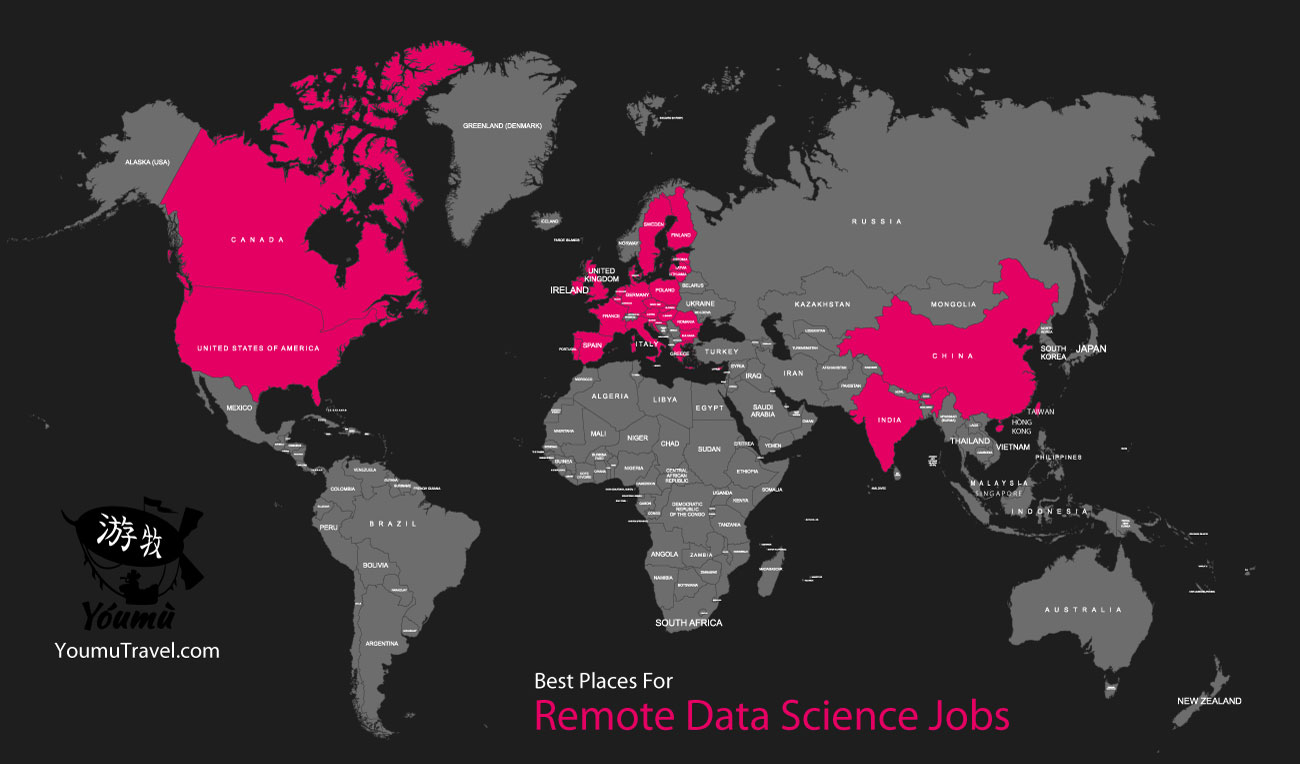
The Best Places for working Remote Data Science Jobs
This remote job can technically be done anywhere in the world. However, you’ll want to make sure your clients or employer are okay with the timezone difference. Here are some of the best places for remote data science jobs.
- US
- European Union
- UK
- China
- Canada
- India
Step 1: Deciding your role
As the industries data science can be applied to are vast, so too are the roles within the realm of data science. Data visualization, data engineering, machine learning, and other specifics all fall under the data science spectrum, and other jobs, such as software development, can easily make the transition into the data science world. It may be a bit confusing which area of data science you’ll want to focus on, and that may not change as your time in the field goes on, but talking to others in the industry, perhaps even getting some mentorship, may help you focus on what part of the field you want to be in. Just don’t rush into a decision you may regret down the way!
Step 2: Coursework
While it’s possible to self-teach data science skills, getting proper education in the field is decidedly better overall. There are plenty of courses, many from accredited universities, that’ll help you learn what you need, so long as you put the effort into it. These could either be in person or, increasingly, from an MOOC (Massively Open Online Course), which often run for free. Be sure to be an active rather than passive participant in whatever path you decide to take. Data Science is a demanding field, and the more prepared you are, the more in demand you will be.
Step 3: Pick and stick to a tool / language
Tools are means for implementation, and there are plenty of tools and languages you can use for your data science work. It’s best to do a bit of research on the ones available, and look up guies related to them, and stick to just one, at least at first. Stick to more GUI based tools if you’re not the best with coding, for instance, then as you learn more coding you can swap to a code based language.
Step 4: Make practical applications the priority
Theory is important in all science fields, but as a data scientist you have to consider that your company is going to want “laws”, as it were, items that can be applied to the real world. Doing exercises on your applications, working on open data sets and viewing solutions from others in the field can help keep you on track.
Step 5: Never stop learning
Many data scientists run blogs or post findings on other sites, and some even publish full findings. Make a habit of keeping up to date with other data scientists, so long as they’re competent in the field, and see if you can improve your own applications based on their wook or findings.
Step 6: Communication skills
While the data scientist often works alone, the data scientist must communicate his findings eventually, and before they are even hired, the data scientist needs to communicate their skills to a potential employer to avoid rejection. Develop communication skills early on, and they’ll be vital later on.
Step 7: Network, but not all the time
Learning comes first, then skill building, and only then are you in a good enough position to network. Meetups, hackathons, online communities can all be a great place to meet others in the field to either learn from or develop a strong network from – it’s not only who you know but how you know them. It might be possible to learn inside information or gain mentorship in meetups like these, and it could potentially make the job hunt a lot easier.
Step 8: The job hunt begins
Like any job search, yours should begin with finding companies you’d like to work for who offer positions in the field you want to work in. In these current times, looking for or negotiating with companies who will let you work remote is also a need. Many of these jobs will require you to learn specific languages, like Python, as many of them may already have certain data science systems in place, so generalizing yourself with various languages and techniques could make you more desirable. Sometimes you’ll be required to learn new techniques, like image recognition or natural language processing, and some jobs require a minimum education level such as a Masters or PhD in that specific field they’re hiring for. It’s best to do research on each specific company you’re considering, what they do and what they require, and for the remote aspect of the job, there are several websites you can use that could be helpful. A few of them are through job search websites, listed here:
- https://remote.co/remote-jobs/data-science/
- https://www.indeed.com/q-Data-Scientist-l-Remote-jobs.html
- https://remoteok.io/remote-data-science-jobs
- https://www.simplyhired.com/search?q=remote+data+scientist&job=RTP0ICRKfs4DLGNMuZt3dSRcvl8D9EMcCN0bDWjcwez03pqR200gOg
- https://www.workingnomads.co/remote-data-science-jobs
- https://www.glassdoor.com/Job/remote-data-scientist-jobs-SRCH_KO0,21.htm
Step 9: Prepping your CV and Resume
- Interviews typically start with your background, so having these ready will give you essentially a big old note card you can always refer back to, just make sure not to bury your nose into it during the process. Keep calm, and review both documents beforehand.
Can I work remotely as a data scientist?
You absolutely can do data science work remotely! Just like in-house work, remote data science work isn’t limited to just one job sector. Healthcare, education, sales, computer and information technology all have data science roles that can easily be done remotely.
Which country is best for data science jobs?
The United States has the highest salaries for data science jobs. Other good countries for data science include EU members, the United Kingdom, China, Canada, and India.
Do data scientists get paid well?
According to Indeed.com, data scientists earn on average $123,000 per year, but as data science continues to grow, this number is likely to get higher and higher. So yes, a job that could earn you 6 figure salaries does indeed pay well.
Is data science a stressful job?
Yes, the work of data science, or at least the environment, can be considered stressful. More often working a long, data science jobs involve long hours, and expectations from companies are generally high.
Can I teach myself Data Science?
While it’s not impossible, it’s certainly a challenge. As data science is a relatively newer field and interdisciplinary, you would have to learn much of the trade yourself.
Is Data Science hard?
The learning aspects of data science is hard, as you’ll typically have to learn both hard and soft skills, such as statistics and coding, on top of having to make your own business decisions.
Do data scientists code?
Generally, data scientists can and do code. While there are other people in similar fields who may code more often or better (some data scientists work with data engineers for that), data scientists who can code use that code in their production.
Which country pays the highest salary to data scientists?
For both junior and senior data scientists, the answer is generally the US, ranging from $120,000 annually for junior, and $160,000 for senior. For other countries based purely on salary, Switzerland pays really well, followed by Germany.
Is data science in high demand?
Data science is seriously in demand. Big data and AI, and a relatively slow growth of skilled employees, makes data scientists extremely valuable, especially when you consider how many fields use data science.
Which is the best country to do masters in data science?
France is a good country to receive a masters in data science, specifically IMt Atlantique, an accredited university specifically made for “elite” technology.
Can a data scientist become a millionaire?
While it’s certainly possible, it would have more to do with entrepreneurship skills and networking. Data science skills will still earn you a good salary compared to most jobs.
Is becoming a data scientist worth it?
Besides its high demand and high salary (6 figures), data science jobs also tend to rank high for job satisfaction. While whether a job is “worth it” depends on individual preference, it seems many would say it’s a field worth sticking around in.
Is it hard to get a job as a data scientist?
If you lack training or proper teaching, yes. Otherwise, if you’re educated and skilled enough in the field, with how high in demand the job is, then it shouldn’t be too hard to get a data scientist job in a variety of industries.
Telemedicine Jobs Guide
Telemedicine is the term used to describe the practice of providing healthcare for patients remotely–the provider and patient are physically separate from one another.
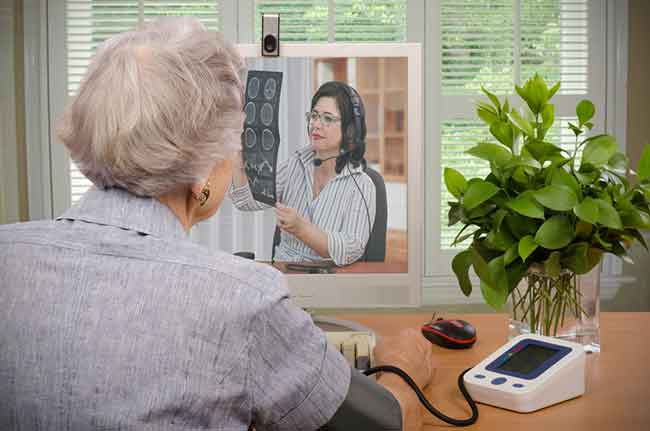
This job is in high demand but takes a considerable amount of time and effort to become one.
Demand
- High Demand
Experience & Degree
- At Least Two Years of Experience Required
- Master’s Degree Required
- Native English Speaking Preferred
Citizenship
- No Restrictions
This job is very reliable and pays well.
Pay Range
- Hourly: $40-$120/hr.
Reliability
- Very Reliable
Housing
- Room and Board Not Provided
This job has a flexible schedule and you can work almost anywhere in the world.
Location
- Very Flexible
Schedule
- Very Flexible
Language
- Can get by with English only
Who can get Telemedicine Jobs?
To attain a telemedicine position, you must be a board certified or board eligible medical doctor and have completed your medical training. A bachelor’s degree is required to enter medical school to earn your doctoral or professional degree. You also must complete a residency in your field of medicine and then pass the US Medical Licensing exam and meet your states medical requirements.
What are the responsibilities of someone working Telemedicine Jobs?
Overall, a telehealth professional will conduct medical visits with patients remotely, create treatment plans, write prescriptions, and more. Telehealth professionals provide the same services as in-person healthcare professionals with the only difference being the remote nature of the work.
Key responsibilities include:
- Reviewing a patient’s current symptoms and their specific medical history such as medications, allergies, etc.
- Asking questions and using the patient’s answers to help create an accurate diagnosis.
- Creating case-specific treatment plans to address patients’s non-threatening conditions like colds, flus, common infections, allergies, and skin rashes.
- Prescribing or administering diagnostic tests to help create an accurate diagnosis of an illness or condition.
- Analyzing the results of such tests and effectively explaining them to the patient.
- Writing prescriptions for medications with accurate specifics of dosages and directions.
- Writing and maintaining accurate patient records including contact details, medical history, previous and current medications, and progress.
- Advising patients on how to improve their health via diets and exercise regimens.
- Helping patients manage chronic illnesses or conditions.
What’s the typical schedule for an online english teacher?
One of the advantages of being a telemedicine professional is the ability to choose your own hours. Most consultations take around 15 minutes, and so you could consult four or five patients per hour of work. Your schedule is likely to vary day-to-day depending on your own set parameters, the patients’s needs, or the healthcare organization you are part of.
Income Reliability
In general, medical professions provide very reliable income. Telemedicine varies slightly in comparison with traditional in-person medicine, but still provides a steady stream of work and income.
Typical Job Duration
Most healthcare professions will be long-term.
Estimated Hours Per Week
It’s estimated that you can work full time, 40 hours per week, as an online healthcare provider, but you can also choose to work less or more hours.
Room & Board
Remote telemedicine doesn’t typically provide room & board.
Telemedicine Jobs – Country Map
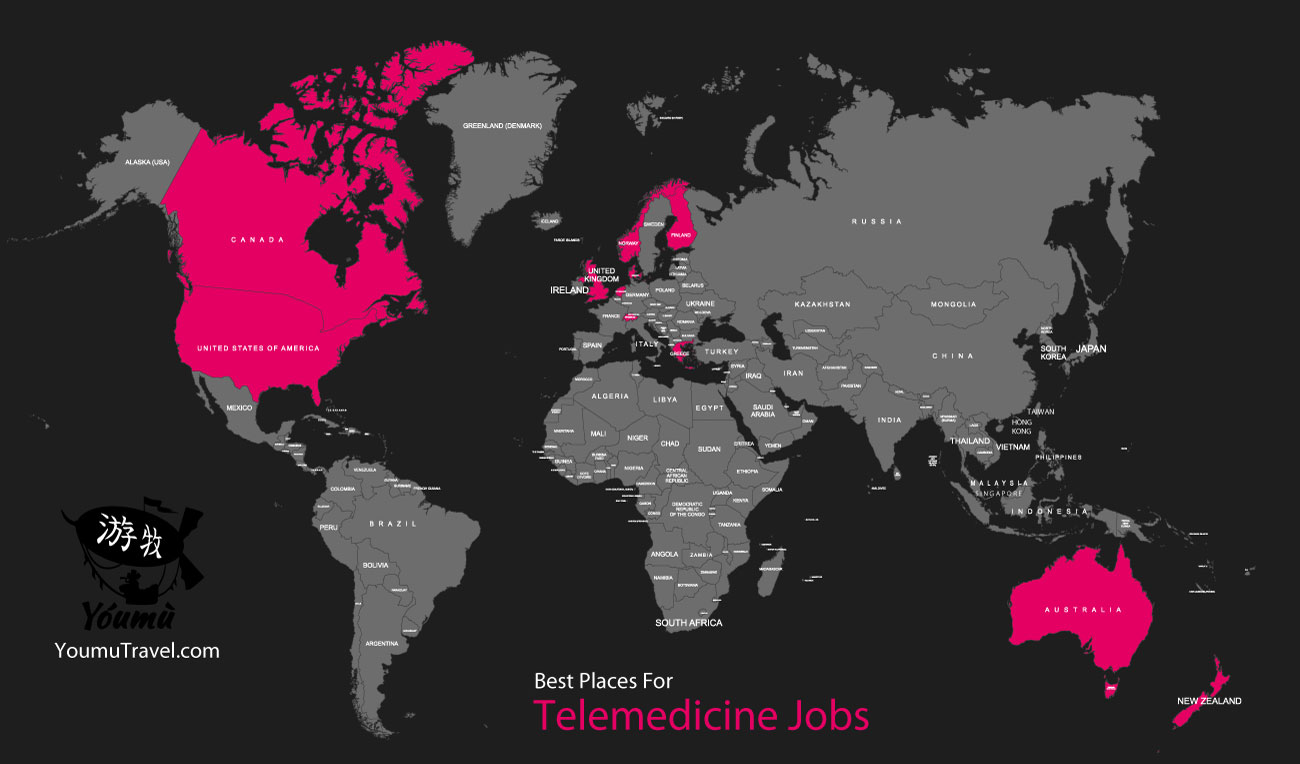
The Best Places to work Telemedicine Jobs
Most major countries throughout the world have opportunities for those seeking telemedicine jobs. Here are some of the best places for telemedicine jobs.
- US
- UK
- Finland
- Canada
- Norway
- Australia
- Switzerland
- Greece
- Denmark
- Netherlands
Complete your medical training.
You must be a board certified or board eligible doctor.
Make sure telemedicine is right for you.
As a telehealth professional, you will be conducting consultations for primary care patients, patients who have specifically sought online care, residents of nursing homes, and companies that work in a DME environment that need licensed medical practitioners. While the reimbursement rate is lower for telemedical professionals than for in-office practitioners, you can complete, on average, four or five consultations an hour. Additionally, it is less likely for a patient to be a no-show for a telehealth consultation.
Try out GoodRx Care.
You can give telemedicine a try with GoodRx Care. It allows you to decide how many hours you work each week, and it ensures the maintenance of the virtual platform, scheduling appointments, and payment. All you have to do is what you know, which is providing the best care to your patients.
Understand the laws.
Make sure to pay a visit to the American Telemedicine Association’s website so you can learn the specific telehealth laws in your home state. Particular states allow hub-and-spoke models of telemedicine, wherein a healthcare professional in one medical establishment consults a patient in a different medical establishment versus at home. Other states allow direct-to-consumer (DTC) services, which grant patients the ability to receive telehealth services in their own homes.
Understand the licensing.
Talk to an attorney or local medical boards to understand incorporation, licenses, etc. Also, make sure your medical license is up-to-date. It is imperative that you are completely licensed to practice medicine in your home state, and you might be required to apply for more licenses to provide telemedical services to people in different states.
Create spaces for conducting remote visits.
Set up a particular space where you plan to conduct your telehealth consultations. Such locations should be ideal for avoiding interruptions and ensuring privacy. Technological requirements might include a telephone, stable internet connection, camera/webcam, computer, and a microphone. Most of your visits will be through the telephone, but others may require a visual component as well. Smartphones provide a good advantage in this way.
Examine various video services.
Look at what HIPAA-compliant video platforms exist such as Zoom and Google Hangouts, and decide what is best for you and your patients.
Test out communication applications.
You can try a partnership with a virtual care company to expedite communication with patients about follow-up visits and more.
Check EHR for integrations.
Speak with your electronic health records representative–many EHR platforms provide virtual care tools which can expedite certain processes such as scheduling, billing, and monitoring.
Choose a payment plan.
Consider your options and be sure to keep an eye on the changeable reimbursement regulations in your home state. Consider these questions: do you want to receive insurance reimbursements? Do you want cash payments per visit? Do you want to charge monthly fees for night and/or weekend visits?
How do I get a job in telemedicine?
Try out the following steps to find a telemedicine job:
- Try out GoodRx Care
- Understand the laws and regulations
- Understand licensing
- Test out different video services
- Try various communication applications
- Double check EHR for integrations
- Choose the best payment plan for you
Can you still do telemedicine from home?
In short, yes. There are plenty of virtual practices that will allow medical practitioners to work from home or while they travel as long as they have the appropriate licensure.
What are the three different types of telemedicine?
The three types of telemedicine are store-and-forward, remote monitoring, and real-time interactive services. All three of these types can be beneficial for both the healthcare practitioner and patients.
What are the disadvantages of telemedicine?
The main disadvantage of telemedicine is finance and availability. Depending on a patient or practitioner’s real-life situation, they may not have access to telemedical services. It is also expensive for the provider to have a telemedicine service and might be too much for smaller facilities to offer.
How much does a telemedicine visit cost?
The average telehealth visit could cost around $79, while the average in-person office visit might be around $146.
Can nurses do telemedicine?
Yes! In fact, telehealth nursing can be done from any location. Nurses can conduct visits from the comfort of their homes, a medical environment like a clinic or hospital, or prisons. Essentially, any location that has the suitable technology to provide the service will work for telemedicine nursing.
Do telehealth nurses work from home?
Telehealth nurses do have the ability to work remotely from home, and they also can enjoy flexibility in their work hours.
How do I become a certified TeleHealth nurse?
The required qualifications for telemedicine nursing jobs are a nursing degree, nursing license, the physical equipment (ex. a working computer, webcamera, or telephone), and the exemplary communication skills required to provide medical advice remotely.
Remote SEO Jobs Guide
Search Engine Optimization (SEO) specialists optimize web pages so that they are more easily found and accessed from search engine results. The specialist analyzes web statistics, reviews the site, and creates appropriate changes to the site in order to accomplish this task.
This job has a high demand but it takes considerable time and effort to succeed.
Demand
- High Demand
Experience & Degree
- At Least One Year of Experience Required
- No Degree Required but Preferred
- Native English Speaking Preferred
Citizenship
- No Restrictions
This job is reliable and pays well.
Pay Range
- Hourly: $30-$65/hr.
Reliability
- Reliable
Housing
- Room and Board Not Provided
This job has a flexible schedule and you can work almost anywhere in the world.
Location
- Very Flexible
Schedule
- Very Flexible
Language
- Can get by with English only
Who can get Remote SEO Jobs?
A good SEO specialist today has to have superb problem solving skills, prioritization skills, decision making skills, and the ability to write engaging, relevant content for websites. SEO specialists know well that search engines prioritize quality content that includes keywords and phrases, and they can use this knowledge and manipulate the search engine’s function to their website’s advantage. It is important for an SEO specialist to be able to adapt many different optimization techniques, layouts, and advertising to achieve their goals. They understand the importance of internal links and the best approaches to placing such links.
What are the responsibilities of someone working Remote SEO Jobs?
The main function of an SEO specialist is to increase and maintain web traffic to websites. A variety of tasks go into this process.
Key responsibilities:
- Collect, test, and analyze data results in order to identify trends to get the maximum possible return on investments.
- Keep watch and analyze web page analytics as well as pay-per-click campaigns.
- Stay on budget, estimate costs per month, manage expenses, and fix any potential discrepancies.
- Create optimal landing page content.
- Discover new keywords/phrases continuously.
- Use SEO recommendations.
- Analyze advertising links of competitive websites.
- Develop optimal link creating strategy.
- Ensure that the best SEO practices are used on new code by working with the development team members.
- Keep in contact with editorial and marketing teams to ensure SEO in content creation/programming.
- Recommend and implement structural and visual changes to achieve maximum web search optimization.
What’s the typical schedule for someone working Remote SEO Jobs?
The schedule for someone working a remote SEO job depends largely on who they are working with. If you work in-house for a single remote company, you’ll work full-time in adherence with that company’s schedule. The same is true if you work for a remote agency on assignment with multiple clients. You can also freelance and choose your own hours, but a beginner freelance SEO specialist is unlikely to be able to work full-time.
Income Reliability
In general, remote SEO is a reliable job that provides a constant stream of work.
Typical Job Duration
Remote SEO can be short-term or long-term.
Estimated Hours Per Week
It’s estimated that you can work full time, 40 hours per week, as a remote SEO specialist.
Room & Board
Remote SEO doesn’t typically provide room & board.
Remote SEO Jobs – Country Map
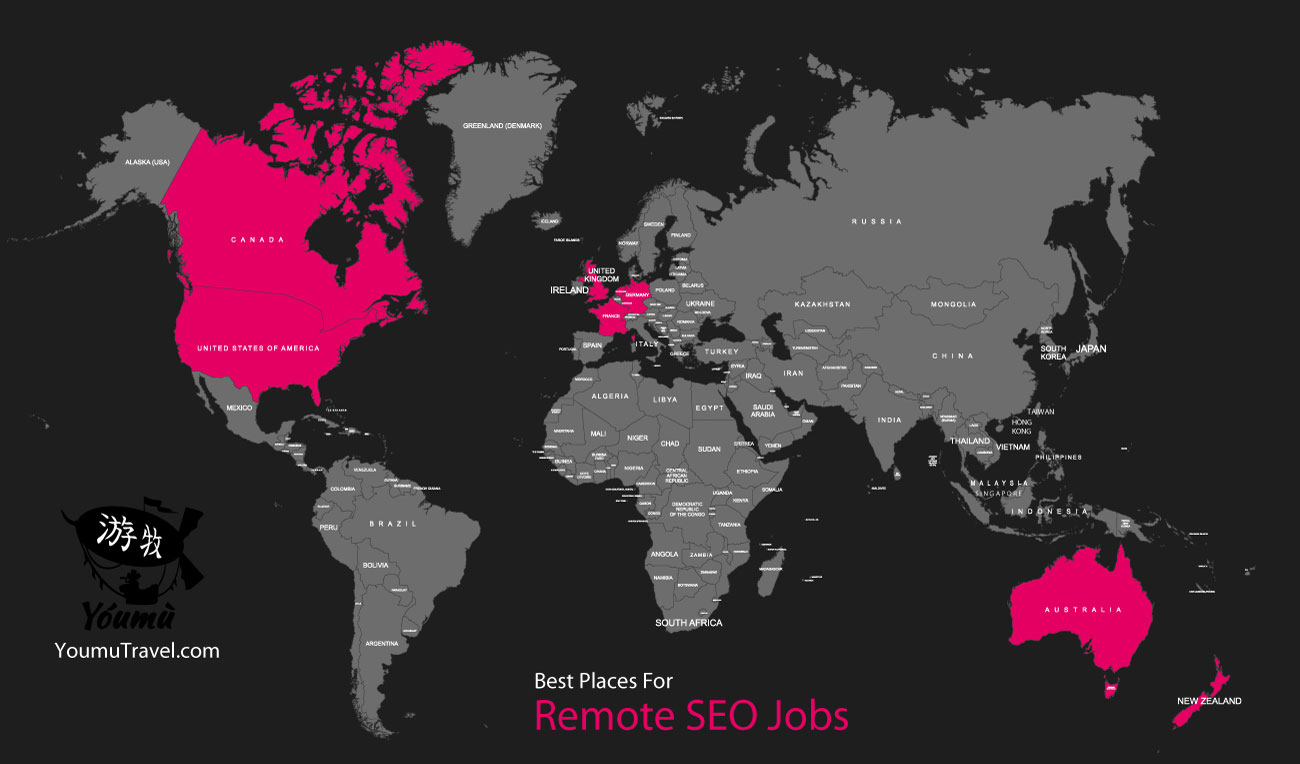
The Best Places to work Remote SEO Jobs
This remote job can technically be done anywhere in the world. However, you’ll want to make sure your clients or employer are okay with the timezone difference. Here are some of the best places for remote SEO jobs.
- US
- UK
- Germany
- Netherlands
- Canada
- France
- Australia
- New Zealand
Understand how search engines function.
Be sure to familiarize yourself with how search engines work as a user, and then work your way up to a more complex and professional understanding.
Understand what SEO means.
SEO is so much more than just keywords/phrases and links. SEO seeks to provide users with an optimal, easy-to-use experience so that they can achieve their goals. Your objective is to generate new web traffic, but also more importantly to turn those new web page hits into recurring visitors. This requires an understanding of the smaller pieces of SEO such as technical SEO, on-page SEO, off-page SEO, and content SEO. These include indexing, page optimization, promotion of the site, and optimal, engaging content.
Find the best SEO training for you.
There is an abundance of information regarding SEO online and so self-learning can be overwhelming. It is therefore a good idea to find a reputable training course/guide so that all the necessary information is in one succinct place.
Practice your SEO skills.
One of the best ways to learn is to practice. Theoretical knowledge is good to have, but practical experience will take you farther. Apply what you learned to your website and improve your search engine ranking. Each website is completely unique, and so practicing SEO on many different websites will only expand your knowledge and skill set. It can also be beneficial to read case studies and stories of how other specialists succeeded in their SEO goals. Such stories might inspire new ideas.
Stay on top of ever-changing industry news and knowledge.
You must be able to speak fluently on the latest SEO updates to do well in an interview and land an SEO job. You should be able to explain the facts of these updates, how they have affected the industry, and how they have affected you and your strategies. Make sure to read up on various programs and updates even if you’re an SEO beginner, and don’t ignore rumored upcoming changes. Stay vigilant.
Build links strategically.
Link building can be one of the most difficult but most essential parts of an SEO’s job. You should have an idea of how to link build successfully even if you have not had the opportunity yet. There are three main strategies for link building: organic links, non-editorial links, and outreach links.
Organic links refer to those on websites that link to your content. These are considered the best kind of links. A well done promotional campaign will grant you a number of organic links, but backlinks might be lacking.
Non-editorial links are created through comments, profiles, and more non-official content. These are easier to come by than organic links. Create a habit of commenting links to your content on other, related web pages. Make sure that these comments aren’t spam–they should provide actual value and insight to the reader. While these types of links are very useful, know that they are not awarded the same value as other types of backlinks.
Outreach links benefit both parties and are generally suggested by agencies that will benefit. The strategy is to find pages with broken links, reach out to the creators of that page, and suggest your own content to replace the broken link. This can provide you with plenty of backlinks from respected sources. This strategy, however, requires that you have already created quality, optimized content.
Have a thorough knowledge of SEO tools.
In an interview, you must be able to list the most reliable tools. SEO experts are always informed by data insights, and without the tools to grant those insights, you cannot be an SEO expert. Some of the best tools include but are not limited to:
- Google Analytics: this is the most common go-to for SEO professionals. It shows statistics like traffic, CTR, and views.
- Moz Pro: provides important metrics that most professionals use all the time.
- SEMrush: great for keyword research and link building.
- Majestic: helps analyze website health with comprehensive trust and citation flow metrics. Can be great for link auditing.
- Ahrefs: analysis tool for backlinks. It has a huge index and is easy to use.
- DeepCrawl: great for on-page audits and diagnostics.
- SEO PowerSuite: the jack of all trades of SEO software. It bundles valuable SEO tools.
Decide how you want to work and take steps toward it.
There are a few ways to work remotely in SEO:
- Doing SEO full-time for a single, remote company. You’ll learn the complete ins and outs of doing SEO for that company.
- Doing SEO full-time for an SEO or marketing agency that handles many different clients. This provides you with a lot of varied experience.
- Doing SEO freelance work. You’ll become a one-person SEO agency–you can choose what clients to work with, build your own brand, and network with potential clients. It can be difficult to freelance full-time as a beginner, so this is best in combination with one of the other options above, at least at first.
SEO jobs are advertised where most jobs are–job boards like LinkedIn, Indeed, etc. They would also be advertised on specialized job boards like Only Digital Jobs.
What are SEO interview questions and answers?
Potential questions during an SEO interview could include what factors make a website search engine friendly, how do you personally measure success in SEO, or how do you approach researching keywords for SEO? Potential answers to these respective questions could include creating traffic for a particular keyword or key phrase, or seeing an increase in referral traffic, newsletter sign-ups, or sales.
What is SEO interview question?
Some of the top SEO interview questions include but are not limited to:
- What is SEO and what are the main kinds of SEO methodology?
- Explain terminology such as Backlink, outbound links, cross-linking, body content relevance, and Googlebot.
- What function is provided by using keywords and phrases?
- What SEO tools do you prefer to use?
What is SEO Fullform?
SEO stands for Search Engine Optimization. This phrase refers to the process of optimizing or structuring web pages via varied techniques. These techniques should create web traffic and subsequently help your site achieve a high search engine rank.
What are SEO tools you use?
Some free SEO tools include Google Analytics, Google Search Console, Ubersuggest, MozBar, SEOWorkers Analysis Tool, WooRank, and Neil Patel SEO Analyzer.
What are the different types of SEO?
The three main categories of SEO necessary for holistic and organic search strategies are on-page SEO, off-page SEO, and technical SEO. Breaking SEO down into these three categories, it becomes easier to compartmentalize and complete optimization.
How do you measure SEO success?
Keyword rankings can be a good measure of search engine optimization. Higher ranked keywords equates to more web traffic. Additionally, you can create a timeline of organic visits to the website, a list of top keywords and percentages of visits, and what pages are receiving the most hits.
What is SEO example?
An example of search engine optimization is using keywords to achieve a higher ranking on a search engine like Google, Yahoo, or Bing.
How SEO works step by step?
A step by step strategy for SEO is as follows:
- Make a list of keywords and phrases.
- Look at the first page of Google results for a search.
- Write unique and better content.
- Make sure to include a hook.
- Optimize on-page SEO.
- Optimize search intent.
- Design content that is visually appealing.
- Create links for the web page.
- Continuously improve upon your content.
What is Google SEO tools?
The Google SEO Guide is a complete guide to competitive ranks on the search engine.
What is SEO technique?
SEO technique is the process of increasing and maintaining web traffic by making your website more visible on search engine results.
What are SEO backlinks examples?
Backlinks refer to links on a website that take the user to a different site. These could be texts or images.
Remote QA Jobs Guide
QA is responsible within a company to vet and verify that manufactured products and services promised by a company are high-quality and maintain the standard of the company’s promise to its customers.

This job is in high demand but it takes some experience to succeed.
Demand
- High Demand
Experience & Degree
- At Least Two Years of Experience Required
- No Degree Required but Preferred
- Native English Speaking Preferred
Citizenship
- No Restrictions
This job is reliable and pays well.
Pay Range
- Hourly: $18-$40/hr.
Reliability
- Reliable
Housing
- Room and Board Not Provided
This job has a flexible schedule and you can work almost anywhere in the world.
Location
- Very Flexible
Schedule
- Very Flexible
Language
- Can get by with English only
Who can Work Remote QA Jobs?
Candidates for this career will be required to possess the following:
Bachelor’s degree in Information Science, Computer science, or a computer science-related field.
No certifications are required, but voluntary ones can be obtained from the QAI Global Institute.
No experience required.
What are the responsibilities of someone working Remote QA Jobs?
Key Responsibilities
- Be responsible for the methods of testing all products to ensure quality conformance and deliverables.
- Assist operations in tracking, documenting, and reporting quality levels as well as CSR, environmental and health and safety goals/KPIs
- Analyze and investigate product complaints and reported issues to ensure correction in accordance with company guidelines and outside required regulations
- Develop or update company procedures for complaints and inspections to ensure capture and investigation, and properly document complaints
- Monitor risk-management procedures, and maintain analysis of problem logs to identify and approach recurring issues with management and product development
- Train and support quality assurance team on systems, policies, procedures, and core processes
- Ensuring that your equipment is in good condition at all times and you have access to all the tools you need to conduct the classes
What’s the typical schedule for someone working Remote QA Jobs?
This job is flexible in that it allows you to work from anywhere and that the amount of work you are analyzing and overseeing will vary depending on any quality issues that may arise.
It’s difficult to say how many hours a week you will be working when you don’t know the specific quantities of work you will have from product to product.
Income Reliability
In general, QA jobs are reliable because they specialize in ensuring the company’s quality of service and deliverables, and companies need them.
Typical Job Duration
A remote QA job can be short-term or long-term.
Estimated Hours Per Week
It’s estimated that you can work full-time or part-time, weekly hours depend on the product quantities and methodologies of the QA specialist.
Room & Board
Remote QA jobs don’t typically provide room & board.
Remote QA Jobs – Country Map
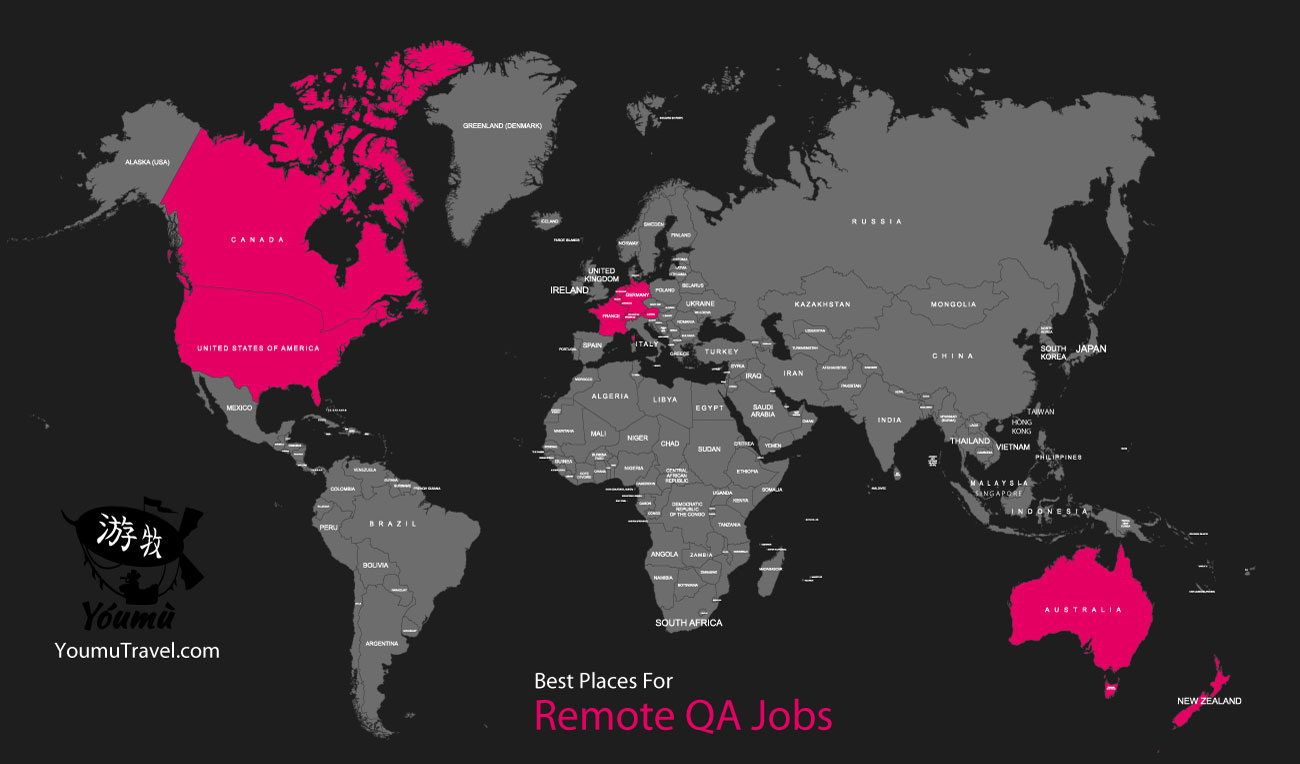
The Best Places to Work Remote QA Jobs
This remote job can technically be done anywhere in the world. However, you’ll want to make sure your clients or employer are okay with the timezone difference. Here are some of the best places for remote QA jobs.
- US
- Australia
- Canada
- Western Europe
Search for a training program
Regardless of education level completion or your chosen direction for a career change, the right computer science program will help you get a job as a QA specialist. For most situations, this means seeking a Bachelor of Science degree in computer science. Finding the best program for you depends on where you wish to attend, what resources you have, and whether or not it is a good fit for you financially.
Earn your degree
To finish your education in computer science, you will need to be effective in a variety of courses including:
- Statistics and math
- Programming languages
- Operating system software
- Fundamentals of network technology
- Logical design principles
- Information management
- Files and databases
- Data management
- Physics
- Computer science theory
- Architecture
STEM courses such as mathematics, statistics, calculus, physics and other general science studies may make up the core for a degree in computer sciences. Some computer science programs may require/ strongly encourage an internship for experience before completion of a degree.
Consider getting certified in QA software testing
If you choose to specialize in QA testing, pursuing a certification is a way to improve your knowledge and better your likelihood of getting a job. There are numerous certifications you can pursue for software testing and software design. Focus on job requirements and industries in your area as a tool when deciding which certification you wish to pursue.
Become experienced
When looking to gain experience for a QA position, an internship is a great tool. To find a QA analyst internship, work with your college campus advisors to see what partnerships are available to you. Professional organizations can be utilized to see if they know of any opportunities for you to intern in the field of quality assurance.
Once you have completed a degree in computer science, you can start gaining experience in the field. Apply for novice QA remote jobs using online resources like Indeed, or by looking for industries and professional organizations that interest you on job sites. Make sure your resume is complete and up to date with your education and experience, and carefully read any application instructions to be a competitive candidate.
Search for remote positions
Your internship can serve as a gateway to more challenging jobs, and apply for jobs on popular remote job platforms.
Is QA a dead-end job?
Yes, QA is a dead-end position, the IT work field in America can be considered to be a one-track career path. Unfortunately, the only job that will be available in this field, will be positions that cannot be performed remotely.
Is working remotely a good idea?
Yes, working remotely is a good idea for the most part. Companies that support remote work for their employees, report benefits such as higher levels of employees who stay with them, employee satisfaction and engagement, reduced turnover, increased productivity, and autonomy, as well as many others.
What is the QA life cycle?
- QA Life Cycle. An interconnected system of methodology activity which involves planning, implementation, assessment, reporting, and improvement to ensure the quality is of satisfactory levels to their client/customer.
- Test requirements.
- Test planning.
- Test design.
- Test execution and Defect logging.
- Test reports and acceptance.
- Sign off.
What are QA activities?
Quality assurance activities are actions that view the quality requirements, report, and review the results of control measurements for quality performance, to ensure quality standards and procedures are being properly utilized for the project.
Why should we hire you as QA?
Quality assurance professionals are focused on testing software or physical products for flaws. You want to hire someone who is the best candidate for your job position. People who have trained to spot the errors in a program, might not always have the ability to spot errors in physical products.
Is QA a good career?
It is if you possess quality experience in Testing / QA and feel it necessary to improve your skills and profile. Or, if you’re bored with the same job, working as a Business Analyst is a good choice for QAs to change their career.
What is the future of QA testing?
QA testers can become managers within QA, or they can choose to make a sideways career change and become testers for automation and strategy within the company. Full-time work as developers has also been a career change for QA testers.
Remote Web Design Jobs Guide
A web designer creates the features, layout, and look of a new website, then helps the manager or development team with maintaining and updating the website once it’s active. A good understanding of both graphic design and computer programming is essential for this job.
This job has a high demand but it takes considerable time and effort to succeed.
Demand
- High Demand
Experience & Degree
- At Least One Year of Experience Required
- No Degree Required but Preferred
- Native English Speaking Preferred
Citizenship
- No Restrictions
This job is reliable with reasonable pay.
Pay Range
- Hourly: $17-$30/hr.
Reliability
- Reliable
Housing
- Room and Board Not Provided
This job has a flexible schedule and you can work almost anywhere in the world.
Location
- Very Flexible
Schedule
- Very Flexible
Language
- Can get by with English only
Who can get Remote Web Design Jobs?
A bachelor’s degree in computer science, communications, or business can help you get a job as a web developer. A minor or double-major in graphic design or web development may also be helpful.
Web design certificate programs are also offered. These programs usually take six to nine months. They aren’t too demanding, so finishing a program while working or caring for a family is doable.
While it is possible to become a web designer without a degree or certificate, it might take extra hard work and diligence to compete with candidates who have more educational credentials and experience.
Self-motivation and the ability to work independently are essential for remote employees. The field of web design is constantly changing, so a willingness to adapt and learn new skills is essential for any developer. A web designer must also have familiarity with both coding and the principles of design.
Strong written communication skills are also important, as is the ability to work well with others and communicate with people from different cultures. Reliable equipment, and comfort in learning, using, and troubleshooting equipment and software is essential, as well.
What are the responsibilities for someone that works Remote Web Design Jobs?
As a web designer, you will be responsible for creating and maintaining websites. These tasks often require extensive communication and collaboration with your clients to ensure that you understand their standards and branding.
Key Responsibilities
- Working with clients on conceptualizing and planning ideas using sample pages and site maps, making sure that your designs match the client’s branding
- Establishing design guidelines
- Adding new features to existing websites
- Maintaining and improve a website’s design
- Using various content management systems.
What’s the typical schedule for someone that works Remote Web Design Jobs?
As a remote employee, you may be able to create your own schedule.
Freelance web designers have complete freedom to work as much as they like. However, while they have the advantage of choosing their own projects, they must also deal with the added responsibilities of running their own businesses.
Designers employed by a specific agency may have either regular or irregular full- or part-time schedules, with more working hours being necessary to address or troubleshoot problems.
Income Reliability
In general, web design is a reliable career. However, because the field is experiencing fragmentation, it’s becoming more important to focus your career on a specific industry or area within the field.
Typical Job Duration
Web designers can take on short-term or long-term projects. Some clients, for example, will only hire you to create a website. Others, however, may keep you involved with regular website maintenance and updates.
Estimated Hours Per Week
It’s estimated that you can work full-time, 40 hours per week, as a remote web designer.
Room & Board
Working as a remote web designer doesn’t typically provide room & board.
Remote Web Design Jobs – Country Map
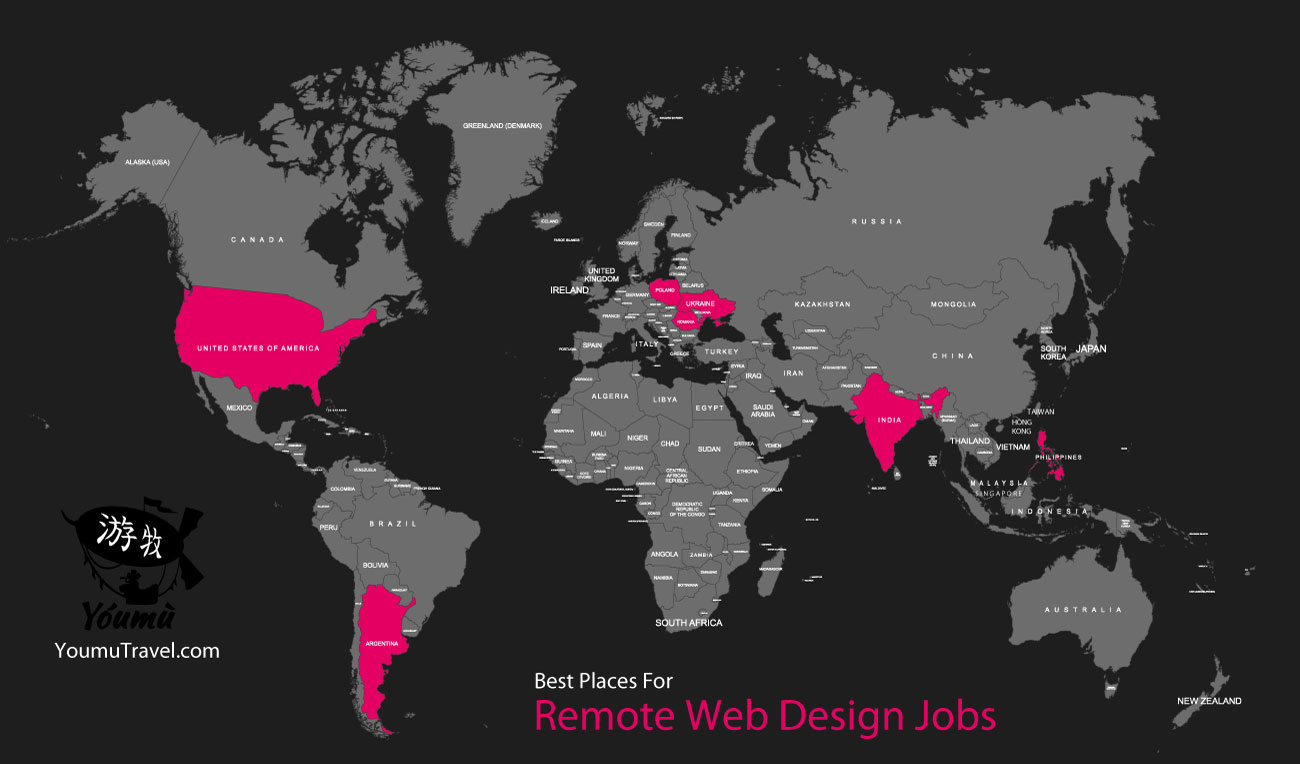
The Best Places for working Remote Web Design Jobs
This remote job can technically be done anywhere in the world. However, you’ll want to make sure your clients or employer are okay with the timezone difference. Here are some of the best places for remote web design jobs.
- US
- Philippines
- India
- Argentina
- Romania
- Poland
- Ukraine
Learn to code.
Knowing some programming languages is crucial for anyone pursuing a career in web design, because website platforms like Wix or Squarespace have technical limitations. A familiarity with coding allows you to determine whether or not the designs you think up are technically possible.
A web designer should be familiar with both HTML (Hypertext Markup Language) and CSS (Cascading Style Sheets). HTML sets the structure and content of the page, while CSS defines the styling options. JavaScript is one of the most in-demand programming languages, as well, so becoming familiar with it is beneficial. You may also need to learn jQuery, which makes scripting in JavaScript easier, as well as PHP, SQL for database management,and Bootstrap for mobile sites.
Online tools exist that can help you gain familiarity with these languages. W3schools offers tutorials for HTML and CSS, while Codecademy and Udacity offer free introductory courses in JavaScript.
Once you’re comfortable coding, you can use code editors such as Sublime or Atom.
Become familiar with design principles.
User Experience
One of your first steps should be learning about the fundamentals of UX (user experience), ensuring that the websites you create will be efficient and user-friendly. Reading books about web design can also be helpful. Some examples include:
- Don’t Make Me Think: A Common Sense Approach to Web Usability by Steve Krug
- The Design of Everyday Things by Don Norman
- Information Architecture for the World Wide Web: Designing Large-Scale Web Sites by Peter Morville
Design
Learning about color theory and other design theories can also help. The Daily UI Challenge is an online tool that can help you practice these concepts.
Graphics
Web designers often need to solve design problems, so you should learn how to use a graphics editor such as Adobe Photoshop. Learning about image editing is particularly useful, as the most common design tasks you’ll have to complete involve resizing, cropping, or compressing images to fit into the design of a website. Tutorials.ws offers a useful Photoshop tutorial.
Graphics make a website unique and interesting, so knowing how to create them can increase your marketability as a designer. The ability to create vector graphics is particularly useful, as their image quality is much better than graphics designed with pixels. Some useful programs for creating vector graphics include adobe Illustrator or Muse. A cheaper alternative is Affinity Designer, while inkscape.org is a free resource.
Learn to prototype.
Prototyping allows a designer to assess design decisions without having to wait for the final webpage. Mockplus, is a powerful tool that allows you to quickly create interactive prototypes.
Become familiar with SEO.
SEO (Search Engine Optimization) is a process of site optimization that allows better online visibility of a website, making it easy to find for both human users and search engine bots. Web designers should be familiar with SEO, as well as ways to optimize sites for multiple platforms and focus content toward a target audience.
Some helpful books about SEO include The Complete Beginner’s Guide to SEO and 15 Rules for Dominating Online Search Results.
Gain experience as a freelancer.
Offer a variety of services, such as logo design, web design, and basic coding. Most clients aren’t quite sure what they need, so being versatile increases your chances of getting hired. To get started, you can network with people and businesses who know you. Some of them may offer you opportunities. You should also start thinking about a “pitch” to sell your services to potential clients outside of your network.
Once you’re hired for projects, determine how much you will charge.
Most beginning programmers start at $45 to $50 per hour, while those with experience generally charge around $70 to $75 per hour. Designers usually make between $30 and $80 an hour.
Adjust your price to suit the difficulty of the work, or your relationship to the client. You might decide, for example, to charge less for a client you’re hoping to build a long-term partnership with.
For long-term projects, consider charging a flat rate for specific tasks. If a client wants to keep you on the project for updates and maintenance, set rates for specific tasks based on the client’s budget and requirements. Here is an example listing of what specific tasks might cost:
- Setup: $160
- Building and design: $5,000
- Content: $500
- Maintenance and updates: $500
Build a portfolio website.
The website itself, along with the projects in your portfolio, can show potential clients what you can do, so make it as accessible and eye-catching as possible. Include a brief resume that includes your educational background and lists the programming languages you use. You can remove any jobs that aren’t directly related to web design.
Your portfolio should be divided into separate sections to demonstrate your versatility. You could, for example, have sections for commercial and non-commercial work, or separate sections for logos, website templates, and other kinds of projects.
You should also include a “contact” form so clients can hire you.
Start your career.
Think about your ideal work environment.
Web designers typically work in one of three environments: freelance, working for an agency, or working in-house.
Freelance web designers must manage their own businesses in addition to completing work for clients. While they have the advantage of choosing their own projects, they must also deal with the added responsibilities of running their own businesses.
Web designers who work for agencies have less freedom in choosing projects, but also do not have the stress of running the business. The specific projects the designer completes depend on the mission and makeup of the agency.
In-house web designers typically work on one or a few websites for a specific company. They may even be responsible for a specific part of a large website.
Look for jobs.
Here are a few resources that might help you get started:
- Codeable.io
- Gun.io
- Remote.co
- Joomlancers
- 10x Management
- Top Coder
- TopTal
Produce quality work, and communicate with your clients.
Once you’re hired, check in with your clients regularly to make sure that they’re satisfied with your work. Set goals together, and be honest about tasks or timelines that seem unrealistic.
What are the job opportunities for web designers?
Aspiring web designers can pursue careers in application or game development, or as multimedia programmers and specialists, web content managers, SEO specialists, or user experience designers and researchers. There are also opportunities for remote work in software development and web design, or as an IT manager or information security analyst.
Can you get a job with a web design certificate?
While a college degree might increase your marketability, a certificate in web design may also help you land a job. Most certificate programs can be completed in under a year.
What degree is best for web design?
A bachelor’s degree in computer science, communications, or business can help you get a job as a web developer. A minor or double-major in graphic design or web development may also be helpful.
Is web design a dying career?
The field of web development is changing, but certainly not dying. However, because the field is fracturing, it’s becoming more important to focus your career on a specific area within the field.
Is working remotely a good idea?
Working from home can be beneficial, as it’s been shown to increase employee satisfaction and productivity. It may also help you feel more independent and in control of your work environment.
What is the best company to work from home?
TTEC, Dell, Hopper, Kelly Services, Intuit, and UnitedHealth Group all have positive reputations and hire web developers.
What skills do you need to work remotely?
Self-motivation and the ability to work independently are essential. Strong Written Communication Skills are also important, as is the ability to work well with others and communicate with people from different cultures. Reliable equipment, and comfort in learning, using, and troubleshooting equipment and software is essential, as well.
Can I become a web designer without a degree?
You can, but it might take extra hard work and diligence to compete with candidates who have degrees or certificates.
How long does it take to get a web design certificate?
These programs usually take six to nine months. They aren’t too demanding, so finishing a program while working or caring for a family is doable.
Can I make $100k from home?
Some remote web designers and developers can make over $100K per year.
Online Survey Taker Guide
An online survey taker is someone who can get a reward or payment for taking online surveys and supplying honest answers to the survey questions.

This job has just average demand but is easy to get.
Demand
- Average Demand
Experience & Degree
- No Experience Required
- No Degree Required
- Native English Speaking Preferred
Citizenship
- No Restrictions
This job is risky, typically part-time, and does not pay well.
Pay Range
- Hourly: $6.50-$25/hr.
Reliability
- Risky
Housing
- Room and Board Not Provided
This job has a flexible schedule and you can work almost anywhere in the world.
Location
- Very Flexible
Schedule
- Very Flexible
Language
- Can get by with English only
Who can be an Online Survey Taker?
Anyone can be an online survey taker, but keep in mind that you might not fit the criteria for a particular survey. Some surveys target particular groups of people, and those who don’t fall into the predetermined categories can’t take that survey. But there are plenty of surveys for everyone.
What are the responsibilities of an Online Survey Taker?
The main task of an online survey taker is simply to complete as many surveys as they can/want to.
Key Responsibilities
- Create a profile with multiple interests to attract surveys on various topics.
- Complete the surveys as you receive them.
- Answer the questions honestly! Dishonest answers will make the data useless on what could be important research.
What’s the typical schedule for an Online Survey Taker?
In terms of schedule and hours, online survey taking is extremely flexible. Most surveys will take around twenty minutes each. Depending on the site and your listed interests, it is likely that each site will only send you a few surveys a week. But if you sign up for more than one survey taking site, then you can expect to receive more surveys and increase your time working.
Income Reliability
In general, taking surveys online won’t provide a main source of income to sustain on. However, it can provide a steady trickle of supplemental income with minimal time commitment.
Typical Job Duration
The duration is up to you! You can remain with a survey taking website for just a few weeks or many years–it’s your choice.
Estimated Hours Per Week
Online survey taking provides only part time work, usually between 1-10 hours a week.
Room & Board
Online survey taking doesn’t typically provide room & board.
Online Survey Taker – Country Map
Top 10 Most Popular Countries to be an Online Survey Taker
This remote job can technically be done anywhere in the world. However, you’ll want to make sure your clients or employer are okay with the timezone difference. Here are some of the best places to be an online survey taker.
- US
- UK
- Western Europe
Check top survey sites.
You should check out at least five survey sites like yellowsurveys.com, swagbucks.com, paidsurveys.com, acop.com, or surveysavvy.com. Compare and contrast their terms for survey takers so you can familiarize yourself with what each website provides. Another site, onlinesurveyspaid.com, has a list of various paying survey companies.
Watch out for scams.
You should look up the name of companies that interest you with “+ scam” in the search bar. Read the comments and reviews that come up to discern if the site you found is legitimate and that you feel comfortable providing your information.
Make a new email address.
This address should be specific to survey taking so that survey sites that send incessant junk mail don’t flood your main email account. Even legitimate sites are prone to sending unwanted emails.
Sign up for five companies.
If you want to make money taking surveys online, five companies is more or less the minimum you should sign up for. Most sites only send out a couple invitations per week, and each pays only a few dollars. The more companies you work with, the more money comes in.
Fill in your profile.
Make sure to include every interest you’ve ever dipped your toes in! Your interests determine the surveys you could be sent, so the more interests, the more surveys.
Don’t pay.
Simply don’t pay to take these surveys. Many sites charge a membership fee to access their paid surveys, but there are plenty of free websites with paying surveys, so paying a membership fee is an unnecessary loss of funds. These “member only” sites trick you into believing they have a better list of exclusive surveys, but it’s false advertising.
What is an online survey taker?
An online survey taker is someone who can get a reward or payment for taking online surveys and supplying honest answers to the survey questions. Generally, the surveys are targeted to a particular audience. The pay for these surveys is dependent on the length of the questionnaire and how much importance the company has placed in that particular survey.
Can you really get paid to take surveys online?
Yes! There are many different websites that allow survey takers to make money simply by providing their opinion. One such site is Swagbucks, which gives you a bonus if you don’t fit the criteria for a survey, so that you are always getting paid.
Are the surveys for $350 real?
Survey taking can provide a great boost to your income, but $350 dollars is the upper edge of what a survey taker could make if they worked around the clock and qualified for every survey.
Are Paid Surveys Safe?
There are some dangers and downsides to online surveys. There is the occasional illegitimate survey that someone seeking payment might fall for. Additionally, survey takers should always provide honest answers, since false surveys create useless, inaccurate data.
Are surveys worth it?
This depends on what “worth it” means to you. If you make $3 per twenty-minute survey, then that’s only $9/hour. It is unlikely for a survey taker to get more than a couple hours per week. If that kind of payment is worth it to you as a booster to your income, awesome! But if you’re looking for a job that pays more, then survey taking might not be right for you.
Do surveys really pay?
There are plenty of survey taking sites that will actually pay survey takers, but the overall income of a survey taker is nominal. Many surveys only pay in rewards like coupons, samples, goods, and services. Ultimately, the people who own the websites are probably the people financially benefiting the most.
Stock Day Trading Guide
Day traders are frequent market-goers who make same-day trades to earn a profit off of their assets.
Day traders in simple terms manage risk.

This job requires 25K minimum and ideally a lot of experience to have a chance to succeed.
Demand
- Average Demand
Experience & Degree
- No Experience Required
- No Degree Required
Citizenship
- No Restrictions
This job is risky but has a chance to pay well.
Pay Range
- Hourly: $30-$120/hr.
Reliability
- Risky
Housing
- Room and Board Not Provided
This job has a flexible schedule and you can work almost anywhere in the world.
Location
- Very Flexible
Schedule
- Very Flexible
Language
- Can get by with English only
Who can be a stock day trader?
Day trading is not for the faint of heart! Because of the nature to trading, losses are to be expected, but with a solid plan, day traders can reap great rewards.
A sum of investment capital may be required to start trading, however there are options available to trade in smaller amounts.
There are no educational requirements.
What are the responsibilities of a stock day trader?
Day traders will execute trades using their assets to make same-day profits. Some responsibilities that day-traders will need to execute daily are:
- Making purchases and sales efficiently and productively throughout the day, using assets available.
- Look into any issues, and work on resolving them promptly.
- Document all trading activity and maintain fully up to date records.
- Look into innovative strategies for trading digitally.
- Build up strong relationships within the industry.
What’s the typical schedule for an stock day trader?
Day trading is very flexible in that you don’t need to stick to a strict schedule and you can trade at your own pace whenever you have free time.
However, most traders are successful when trading at specific times of day, such as market open and close, in specific timezones. Those looking to find opportunities in day trading should be aware that most profit will be made during these times.
Income Reliability
In general, day trading can provide a steady stream of income, depending on the amount of capital you’ve invested. Though, income may not be consistent.
Typical Job Duration
Day Trading can be short-term or long-term.
Estimated Hours Per Week
You can do day trading part-time or full-time.
Room & Board
Day Trading doesn’t typically provide room & board.
Stock Day Trader – Country Map
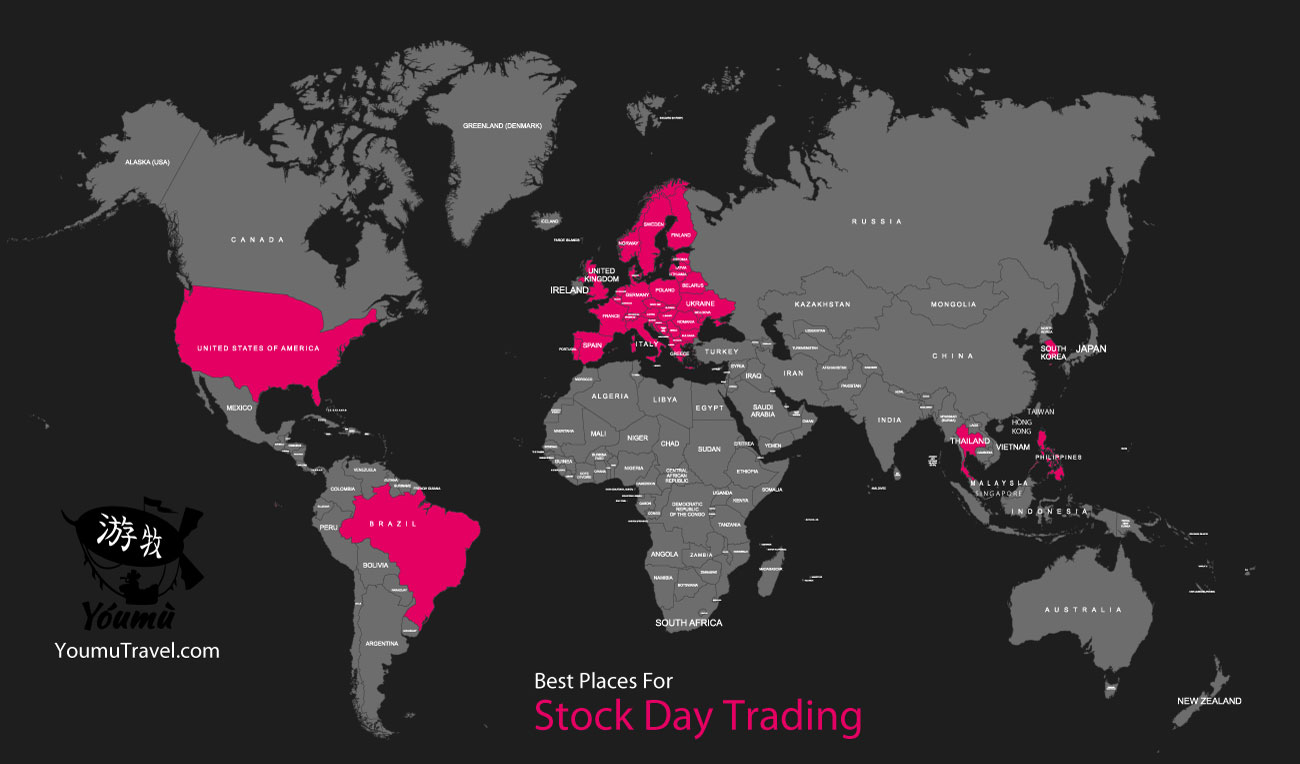
The Best Places To Be A Stock Day Trader
Most major countries throughout the world have opportunities for those looking to be a stock day trader. Here are some of the best places for stock day trader jobs.
- US
- UK
- Europe
- Ecuador
- Brazil
- Thailand
- South Korea
- Philippines
Start With the Basics
Start learning the trading basics. These items will be essential to a day trader’s success. Get a feel for what you would like to trade, and learn about the most popular strategies. Some strategies to become familiar with include:
- Fading
- Spread Trading
- Range/Swing Trading
- Trend following and momentum trading
Stay With the Trands
Once you know a little about the basics, you’ll need to keep up with any stock news and articles.
Events that affect stocks are also something you will need to pay particular attention to. Take a look at the Fed’s economic outlook, interest rate plans, etc.
Get all your ducks in a row and make your own list of stocks that you might want to trade and gain information on the relevant companies, as well as the general market. Popular financial websites are a good source to keep up-to-date with your favorite companies and markets.
Keep Separate Funds for Day Trades
Always place a limit on how much money you want to risk on a trade.
The most successful day traders will only risk up to 1-2% of their account on each trade. Ensure you have a surplus of funds that you use to make these risky trades and don’t dip into the other funds.
Be prepared to lose, because sometimes there just isn’t any way to predict what will happen!
Start With Smaller Trades
Don’t go too big and risk too much when you’re a beginner. One or two stocks per session might be a good way to start out.
One thing that has become even more popular lately is trading in fractional shares. This allows you to place a dollar amount on a trade, and not necessarily a per-stock method. For example, if you want to purchase, but you only want to invest $100, you can get one-fifth of a $500 share. This allows you to invest in companies that have higher value stocks.
Choose Your Market
Every market has the potential for profit. Because of this, it pretty much comes down to how much you are willing to invest, and how much capital you need to begin.
Don’t split your focus between multiple markets when you’re just starting out. Try to focus on one market while you’re learning. This will turn into faster, better profits in the long run because the knowledge from one market can usually be applied to others.
If you already have something in mind, then great! But if you need to know more before committing to a particular market, here are a few of the markets and their details:
- The foreign exchange market: In this market, you can trade using the Euro and the USD. This market is great for investors with little capital, and you can get going with just $50. However, it is certainly recommended to start with more if you can.
- Futures Market: Futures also don’t require as much capital to get started, however you should expect to have around $1000 to start. Futures are usually based on prices of certain indexes or commodities such as gold, S&P 500, and oil. Be sure to research different futures to get a good idea if this kind of trading looks right for you.
- Stocks Day-Trading: This option will require at least a $25,000 investment. This option is only useful for those who have the capital.
Pick The Right Time of Day to Trade
Both seasoned and new day traders need to learn to be consistent. A consistent trading schedule (such as trading during only certain hours of the day) is key for most day traders’ success, though some do trade during the full day’s session.
Here are some tips for each market:
- Stocks: Trading stocks is best at the beginning of the day, and just before closing. There is a 1-2 hour window during these times, where trading is optimal. 9:30 am-11:30 am is a great time to trade as this is when the market is most volatile, creating opportunities for the largest profits. Other big moves and shifts happen around 3-4 pm. If you’ve only got time to trade during one time of day, morning is your best bet.
- Futures: For futures, session open is also an optimal time to day trade. Though, the prime opportunities occur a bit earlier in the day than with stocks. Primetime for futures is around 8:30-11 am EST. Closing time for futures is a bit different than sticks, but similarly, the last hour of the day can provide opportunities for a significant profit.
- Forex: This market is a 24-hour market. USD and Euros are the most popular trading currencies in this market, and they will often have greater volumes of trades from the wee hours of the morning (1 a.m.) to around noon EST, with the most traffic and biggest trades happening between 7-10 a.m. EST. This is primarily due to the fact that both the NY and London markets are open during these hours.
Practice Trading Strategies with Demo Accounts
There are some websites out there that offer risk-free demo trading. This kind of simulator allows you to practice your trading skills and hone in on a strategy. You can’t try and learn everything all at once.
Try to pick a strategy, see if it works for you, and keep using it.
Transition From Demo to Live
Despite the appeal of demo trading, most traders notice a decline in their success in the real market versus the demo market. The main difference is that demo trading allows you to see if a strategy will work in theory, but it cannot recreate the real market exactly.
Another factor is the emotional decision making that happens when real money is at risk and not just virtual coin.
Be aware that when you transition from demo trading to live trading, there will be some failures. This is only natural, and if you have a sound strategy, you should have success.
As your comfort level rises dealing with real trading, you can work towards increasing your trade limit up to the 1% that was discussed earlier. Be consistent in focusing on your strategy. Precise implementation can help steer you away from making any emotional decisions.
Have Patience
Keep your eye out for opportunities that fit your strategy. If it doesn’t fit, don’t make the trade.
If nothing is looking good, remember that something will come along and you can simply wait for those golden opportunities.
Can you day trade one stock?
It is pretty rare nowadays to be able to day trade a single stock. Those who seek this type of trading out are making every effort to make the most out of their money, quickly, or just don’t have enough to trade in larger amounts.
Do day traders make money?
Day trading can be very lucrative, but it is also a very risky approach! Most folks who are day trading are trying to make a profit off of small changes throughout the day, and not necessarily holding onto their shares overnight.
How do I get into day trading?
Here are some tips and tricks for starting out:
- Plan your strategy ahead! A lot of people are so afraid of money that they will never take the risk and jump into things, but that doesn’t mean you should do so without a plan, otherwise you risk some serious losses. Be aware that you may have to lose some money to make gains.
Can I buy stock today and sell tomorrow?
If you are investing in retail you cannot purchase a stock and sell it same-day more than 4 times in a 5-day business-day span. This is called the pattern day trader rule. To work around this rule, you can buy at the end of a business day, and sell on the next business day.
Can you start day trading with $1000?
It is possible to start day trading with $1000 or less! However, this will not work in the United States market where $25,000 per day is the minimum. You can try trading in the forex market, where trading with amounts under $1000 is more doable.
Why do day traders fail?
Most day traders fail to make money in this market due to a simple lack of knowledge. Knowledgeable day traders will implement tools that allow them to strongly and easily manage their trading, such as position sizing and stop-loss. This allows the in-the-know trader to decrease risks while maximizing their profits! Do research on these money-management options before you start any kind of day trading.
Why do you need 25k to day trade?
Because day traders ultimately hold no leverage at the end of the day, they don’t have the collateral in their account to cover the associated risks. A minimum of $25,000 has to be firmly in your account before you can start day-trading, and you will need to keep this amount in your account at all times while making day trades.
How do I become a day trader with $100?
How to begin a day-trading side-gig with only $100:
- Choose a brokerage. Having a brokerage will allow you to trade in any manner you wish, and help with the organization of your trades.
- Pick which securities you wish to trade in.
- Develop your own strategy. Research different strategies ahead of time, and make sure you keep a close eye on changes throughout the day.
- Start trading!
Who is the richest day trader?
One of the most profitable day traders on the forex market is Paul Tudor Jones. His net worth has topped $4.5 billion. Paul holds a degree from University of Virginia in economics.
What is the day trading rule?
In the United States, there is a rule called the “pattern day trader” rule, established by FINRA. This rule stipulates that one cannot make more than 4 day trades within a single business day, for a 5 day period. Additionally, these trades must not account for greater than 6% of your overall trades.
Can you day trade from home?
Day trading from home is a viable option to earn some extra cash. Suggestions for trading stocks are to trade close to the market open and close (for US Markets) and to trade close to the US open or throughout the European session (in the forex market) for the best results.
Sell Products Online Guide
This job is all about selling items or services online to make a profit. This involves setting up an e-commerce site and launching an online store.

This job has a high demand but it takes considerable time and effort to succeed.
Demand
- High Demand
Experience & Degree
- No Experience Required
- No Degree Required
- Native English Speaking Preferred
Citizenship
- No Restrictions
This job is risky but can be a source of residual income.
Pay Range
- Hourly: $5-$60/hr.
Reliability
- Risky
- Requires startup time for your business.
- May require long hours.
Housing
- Room and Board Not Provided
This job has a flexible schedule and you can work almost anywhere in the world.
Location
- Very Flexible
- If you need physical stock for your store this will need to be taken into consideration.
Schedule
- Very Flexible
Language
- Can get by with English only
Who can Sell Products Online?
Anyone with some common sense and the ability to learn can do this job! It requires a lot of hard work and some long hours, but it can be worth it to own your own business.
There are no restrictions in your way. You can start this job today!
What are the responsibilities to sell products Online?
To sell products online, you will generally need to maintain inventory (or not if you’re selling digital items!) and sell products. This requires some research into your desired market and a bit of business savvy.
Below are some key responsibilities of those looking to sell products online:
- Setting up an online shop, including designing your website (whether you do it yourself or hire someone).
- Make it easy for your customers to purchase from your site.
- Set up a way to accept payments, and manage sales.
- Make sure the sales process is working, and fine-tune as needed.
- Keep track of inventory and ensure you have proper stock of all items.
- Research the market. Is the market full of similar items, what can you do to stand out?
- Planning out your own finances and working under a strict budget.
- Make plans for the future of your business.
- Develop a brand message, so you can build a brand community and retain customers.
- Create room in your budget for marketing, along with general operations, and increasing technological options.
- Develop a solid supply chain for consistency and to maintain price margins.
- Once the business is building, recruit talent to support the business and promote further growth.
- Ensure employee satisfaction and growth.
- Manage all operations and customer service to ensure the best customer satisfaction experience.
- Meet your profit and revenue goals.
What’s the typical schedule for someone selling products online?
This job is flexible in that it allows you to work from anywhere. However, you may be restricted by needing physical locations for your stock and employees if you have them.
The best part about this job is that you’re in control of your own schedule. You’ll need to keep up with sales and customer service, which are generally during the 9-5hour, but working for yourself offers some flexibility.
Income Reliability
In general, selling products online can provide a steady stream of income if you plan and put the work in.
Typical Job Duration
Selling products online can be temporary or long term.
Estimated Hours Per Week
It’s estimated that you can work full time, 40 hours per week, selling products online. However, this is the perfect side-job opportunity!
Room & Board
Selling products online doesn’t typically provide room & board.
Sell Products Online – Country Map
The Best Places to Sell Products Online
This remote job can technically be done anywhere in the world. However, you’ll want to make sure your clients or employer are okay with the timezone difference. Here are some of the best places to sell products online.
- USA
- UK
- Canada
- Australia
- Western Europe
Pick Your Market
Figuring out what to sell is the first, and most important step in the process. A good way to make this decision is, to begin with a broad concept of what you’d like to work with, like a particular type of item. Then, narrow it down to the point where you are selling for a particular niche. Choosing something specific will cut down on the competition and make it easier to succeed.
When you pick your niche, try to work with something that interests you. It’s much easier to sell something you are interested in or passionate about, and you will likely find it much easier to build your brand. Another thing you’ll need to consider is whether you will make the product yourself or source inventory from a wholesaler. You have to ask yourself these important questions in order to build your business plan.
Find Your Target Market
In order for your business to thrive, you will need to perform some market research. Identify your target market and scope out the competition. If you don’t take a look at your competition, you won’t be able to figure out the best pricing for your products to sell.
Through extensive research, you can get ideas for developing your brand, such as website design, marketing, and branding. It will provide insight as to how you can develop your customer base and showcase products to new customers.
Select the Perfect Domain Name
A domain name is the web address that your customers will type into the browser to get to your website.
You should choose your domain name when you name your business, that way they will align and make it easier for your customers to find your website. What if you chose your business name, only to realize that nothing like your business name is still available as a domain name?? You would then be forced to use something that doesn’t make sense for your business.
Here are a couple of tips:
- Make sure your domain name is easy to pronounce and can be easily reproduced by the average consumer if they heard it. Avoid complicated spelling and difficult to pronounce phrases. Try not to use words that might sound too similar to something else when spoken out loud. Don’t use digits mixed with letters, or anything that cannot come across properly when spoken aloud, such as hyphens. These things will hurt more than they help, no matter how clever they seem at first!
- Another thing you will need to avoid is using a domain name that can accidentally combine into another brand name. For example, consider creating a business called Bob’s Cameras. Seems innocent enough, until you combine it into one word and realize that the word “scam” is right in the middle! Choose carefully so as to avoid this situation.
Create An Online Shop
A lot of fresh business owners get flustered when it comes to creating and designing their own website. But, nowadays, it’s so easy. You can create a whole beautiful website, without having to do any coding. There are just so many web hosts out there that have options for the business owner to play with and make it their style.
The big thing is finding an eCommerce platform. This is where you will actually be making your sales, keeping track of revenue, and looking after your inventory. This is what your customers will use when they shop, add things to their cart, and check out.
Make sure you consider the future when choosing your eCommerce platform. You don’t want to be constrained by software setbacks while your business grows. You also want to make sure the platform has the features you need. Are you selling digital items? Then you’ll need to make sure you use a platform that has that option.
Set Up Ways To Accept Payment
There are tons of ways to accept payment online. The traditional route is to set up a merchant account, but other options such as PayPal, Stripe, and Square are becoming more and more popular for their ease-of-use. Most of them will easily integrate into your eCommerce site, though they do each come with their own processing fees, which should be kept in mind as well.
Most online shoppers today are using credit cards. Other online payment methods are also worth considering such as GooglePay, Apple Pay, Amazon Pay, Masterpass, and Visa Checkout. These options provide the customer with an alternative if they don’t wish to enter their credit card information online. They also provide an easy way to pay for customers who don’t want to enter their info every time.
Choose Delivery Options
Delivery options and shipping costs are crucial to online shoppers! It’s essential that you have a good way to get your product to your customer reliably. Unless you are selling digital items, in which case you’ve got this covered easily! Choose which shipping carrier you want to use and get a list of pricing so you can determine the correct rates to charge the customer for shipping and handling.
Even though free shipping is widely popular in eCommerce stores, you still need to pay for it. In the beginning, you may want to consider having the customer pay for the shipping costs, and use real-time rates. Real-time rates are calculated while the customer shops and adds items to their cart, and are calculated when they check out, ensuring you aren’t overcharging for shipping while not losing money on it either.
Develop A Marketing and Promotion Plan
Make sure to start marketing right off the bat, to ensure you get a steady stream of customers interacting with your store. This should include social media posts, email newsletters, SEO, and paid ads. Another marketing technique that is frequently used is running promotions and coupons. Discounts or group deals provide a nice incentive for customers if your eCommerce platform will support them.
- Facebook and other social media platforms are always perfect for getting your name out there. Make a Facebook Business site that contains all the relevant business information and link it back to your eCommerce site. Along with Facebook, Instagram and Pinterest are similarly great for exposure. In addition to the extra engagement you will get from these sites, you can sell directly on all of them as well! More information on this later.
- Search Engine Optimization (SEO) is the bread and butter of finding new customers. This is what allows customers to find your site through search engines like Google. Lift up your SEO by providing top-notch quality material on your website and include appropriate keywords for your products. These keywords should be included in both your page content, and in any other content such as your blog. There are more technical aspects of SEO that might seem like they are above you, such as URL structure, page speed, sitemaps, metadata, etc, but they are actually relatively easy to manage if your eCommerce software follows the best practices of SEO. Some platforms have full sets of tools at your disposal for SEO, so keep that in mind when choosing your platform.
Expand Your Business
The moment your business really takes off and the orders come rolling can be an exciting one!
But that’s when the real work starts. You have to be there filling orders and talking to customers. This can be a real challenge as order volume grows, and it can be difficult to manage all the different tasks of owning a business.
At this point is when many new businesses begin to struggle, so make sure to have any and all tools at your disposal before you get to that point. That way you can focus on growing your business and not get stuck on the small things.
What is the best product to sell online?
One of the more popular items selling online currently is backpacks! They are very popular simply because they’re easy to use and widely popular around the world. Backpacks have become a bestseller, especially in the summer months.
What is the best website used to sell stuff?
Some of the best options for selling online are the following websites:
- Etsy
- eBay
- CPlus (from Craigslist)
- OfferUp
- Carousell
- LetGo
- Vinted
What products are in high demand?
In 2019 the most popular online products were:
- CBD products and oils
- Ecologically friendly items
- All-Natural Skincare products
- Craft tea
- Fad diet products
- Food and cooking subscription boxes
- Probiotics
- Other subscription services
What is the best product to sell to make money?
Top 10 products to sell online and turn a profit:
- Phone charging pads, for wireless charging
- Dog products
- Watches
- Women’s shapewear
- Baby items, such as toys
- Headphones and earbuds
- Dresses, especially maxi style
- Phone Cases and accessories
- Intimates
- Drones
How can I make $100 a day online?
If you are trying to find ways to make extra cash in your spare time, consider some of these options, which could earn you $100 or more per day:
- Google Adsense
- Sponsored Posts
- Text Links
- Display Ads
- Affiliate Marketing
- Getting new Clients for your business
- Freelance Writing
- Selling Leads
- Coaching
- Digital Products
- Investment Gains
- Online Courses
- Crowdfunded real estate investing
- Peer lending
- Sponsored Social Shares
Is online selling profitable?
Online businesses are a great option, simply because they never close! They have the potential to make profits 24/7, without much involvement from the owner. You’ll just need to maintain the quality of your products to succeed.
Where can I sell things fast?
If you’re looking to part with some belongings and make some cash, the following sites can work for you:
- Amazon
- LetGo
- Craigslist
- VarageSale
- OfferUp
- Facebook Groups
- Poshmark
- Swappa
What is the best app to sell clothes on?
Some good places to sell clothes online:
- Mercari
- Vinted
- ThredUp
- Poshmark
- Grailed
- eBay
- The RealReal
Become A YouTube Vlogger-Influencer Guide
A YouTube influencer is simply someone who builds a significant following on YouTube, is able to set trends and provides information to others looking to purchase products or services.
This job is in high demand but takes a considerable amount of time and effort to succeed.
Demand
- HIgh Demand
Experience & Degree
- Basic Understanding Required
- No Degree Required
Citizenship
- No Restrictions
This job is somewhat risky but can be a source of residual income.
Pay Range
- $200 per post for a smaller following.
- $670 per post for accounts with larger followings.
Reliability
- Somewhat Risky
Housing
- Room and Board Not Provided
This job has a flexible schedule and you can work almost anywhere in the world.
Location
- Very Flexible
Schedule
- Very Flexible
Language
- Can get by with English only
Who can be a YouTube Vlogger-Influencer?
A YouTube influencer is simply someone who builds a significant following on YouTube, is able to set trends and provides information to others looking to purchase products or services. Creating videos on YouTube and sharing skills like performing, visual arts, athleticism, and making these skills more accessible.
What are the responsibilities of a Youtube Vlogger-Influencer?
Key Responsibilities
- Film specific videos for certain audiences at pre-determined periods of time.
- Edit clips to achieve constant, refined, and image idealistic videos.
- Promote and distribute your public videos.
- Making subscribers aware of predictable delays in uploads.
- Encourage purchases of channel memberships from subscribers.
- Releasing exclusive content for channel members.
- Attend important YouTube workshops.
- Follow YouTube and sponsorship-related policies.
What’s the typical schedule for an Youtube Vlogger-Influencer?
This work does not follow a typical schedule, as the amount of work you do each week depends on how much time it takes to create/edit/ and promote your videos.
Income Reliability
In general, YouTube vlogging that provides a constant stream of work.
Typical Job Duration
This work will be done as long as you are committed to it.
Estimated Hours Per Week
The amount of work per week will vary depending on the amount of content you have to work with from week to week.
Room & Board
Vlogging does not include room and board.
YouTube Vlogger-Influencer – Country Map
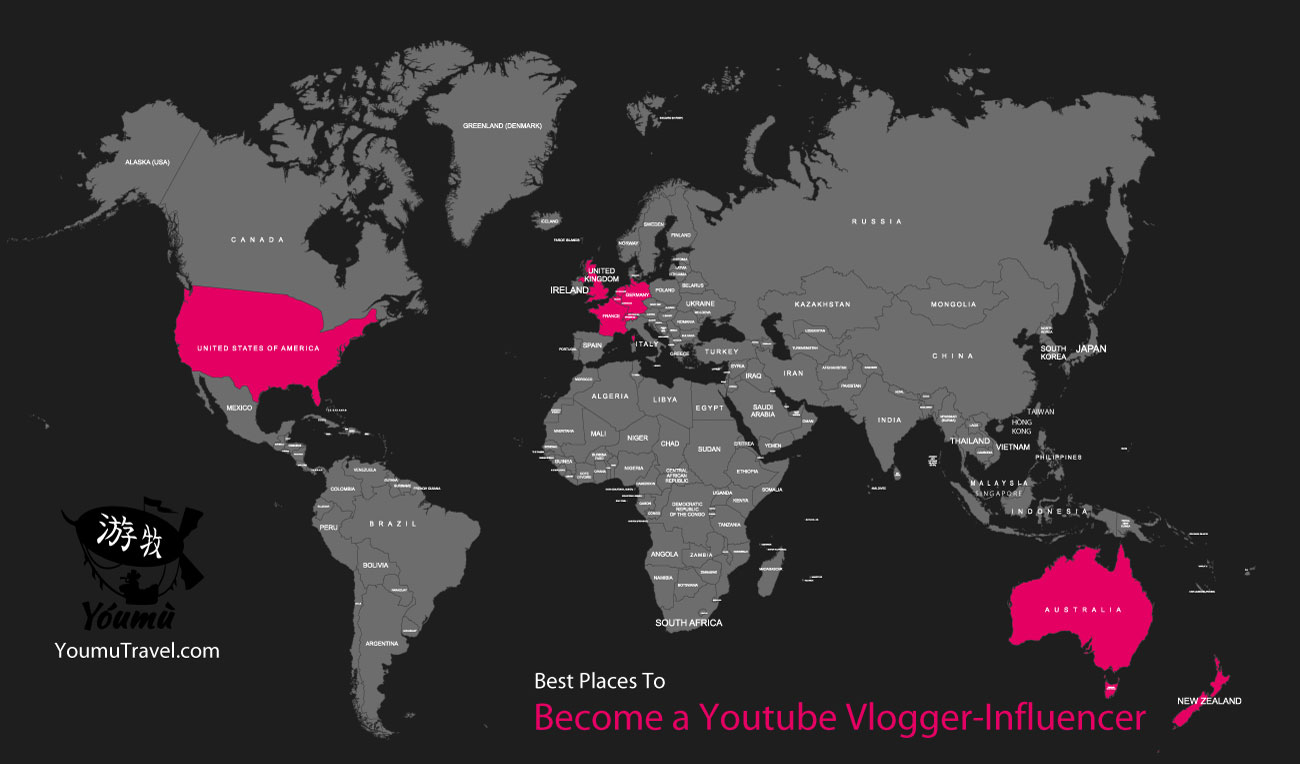
The Best Places to Become A YouTube Vlogger-Influencer
Most major countries throughout the world have opportunities for those seeking to become a YouTube vlogger-influencer. Here are the best places.
- US
- Western Europe
- UK
- Australia
- Worldwide
Gather information
Knowing how to be successful is crucial in your chosen field. You can begin by making notes on current vloggers you follow. Pay attention to their videos:
- How do the videos begin and end?
- Is music featured?
- Which videos have the most traffic?
- How long are their videos?
- What’s their audience interaction style?
- Do they appear scripted or spontaneous?
These details will help you gain a solid foundation for how you can set up your own vlogs and make decisions on content. Be sure to remember things like what you do/ don’t like about their videos. Don’t copy what they do, rather use them as a learning tool.
Define a purpose
Once you’ve completed your research, it’s time to focus on the decisions regarding your own vlogs. You need to decide what kind of content you want to create, and how you intend to keep the vlogs you’re filming interesting. Is your vlog going to be specific or broad?
Also decide on how often you want to upload your vlogs. When you have a sense of direction for your channel, you need to think about who you’re targeting with the vlog.
Determine your ideal viewers
The first thing you should focus on is the type of audience you are trying to draw for the vlog. Being able to understand your target audience’s likes and dislikes is incredibly important for starting any business venture, and that includes being a vlogger.
Build a YouTube channel
Seems a little obvious, but you need to have a YouTube channel in order to vlog and upload your videos. It’s a very simple task since it starts with creating a Google account and then using that to create a new YouTube channel selected from the menu of your newly created account.
Make the most of your channel’s description
This is one of the best ways to draw in your target audience. Be sure to use specific keywords so your channel will appear in search engines, specifically in the first few sentences on YouTube’s landing page.
If the vlog channel is only going to feature you, then you should describe yourself in a few lines, and introduce your viewers to who you are and your background.
The channel description needs to include the purpose of your channel, so viewers know what they can expect from you.
Having the right equipment
No matter what budget you have for your vlogs, having the right equipment for filming is incredibly important to ensure the quality and effectiveness of the videos. You don’t need to have thousands of dollars worth of equipment but a good camera is key.
For lower budgets: A vlogging camera is important to have and possessing a flip screen can be a great help, since it will allow you to see yourself. Quality sound for the vlogs is also key, so having a good microphone is a highly suggested tool.
For higher budgets: If you have a higher budget then you can seek to invest in additional pieces of filming equipment, such as a good camera, a microphone, tripods, or even artificial lighting.
Record your first vlog
Once you have everything you need to vlog, it’s time to get started. Here are some tips to remember when filming:
- Relax. Overplanning can ruin the natural feel and spontaneity that viewers expect from a vlog. Simply go about your day naturally and see what happens, you can always edit for content later on.
- Maintain good lighting and sound quality. If people can’t see or hear from you, then they don’t want to keep watching your vlogs. Speak clearly and calmly, and try to film in daylight if possible.
- Preview what the vlog is about. Use funny content or a sneak peek of the video’s theme to generate interest in the vlog’s content.
- Remember to interact with your viewers. Vloggers can connect with their audience on a more personal level. So every now and then, look into the camera and talk as if your viewer is right in front of you. Ask for advice on situations and answers to questions in the comments from the viewers.
- Make the farewell personable. Have a unique phrase, or gesture to say goodbye to your audience, to help personalize your videos.
Be interesting to watch
People watch vlogs for entertainment. You need to make your vlogs interesting if you want people to watch them. Here are some tips:
- Originality. No one wants to watch a vlog that talks about something that was already done exactly by someone else.
- Sincerity. YouTube audiences like when vloggers are authentic, you need to let your true colors shine. If you’re always putting on a show without being sincere, you won’t keep audience interest.
- Just be you. As a vlogger, you are trying to be unique, interesting and the best entertainment possible, but you need to be yourself! You are what ultimately makes your vlog and channel different from other vloggers, so be distinctly you and let your personality shine in your videos.
Learn how to use editing software
Once you have enough content and film to make a vlog, start editing the footage and put the clips together. There are several programs for editing: some computers nowadays even come with their own free video editing software. What programs are available to you will depend on what type of computer you have. You can even watch tutorials on YouTube to get started.
Editing
When you go to edit only use clips that are entertaining to avoid boring content.
The length of the vlogs will depend on how frequently you are uploading content. (Note: If your videos exceed 15 minutes, you will have to verify your YouTube account via phone.) But don’t be afraid to upload longer videos, in fact, longer videos will give you more opportunities for ads once you start monetizing your vlogs.
If you can afford to, hiring an editor will free up more time for you to create content and come up with video ideas. Editors will also help the vlog look more professional and have a better flow.
Export and Upload the finished product
Once the video is finalized you can begin uploading to YouTube. We highly recommend reading YouTube’s recommended upload video settings, before you export the video.
Things to note: Make sure your wifi is reliable, it can be very challenging to deal with slow internet while trying to export a video.
If you are using apps like Adobe Premier Pro then be aware that the app crashing at any point is a possibility. If it does, don’t worry! Simply troubleshoot the app and try again.
Then finally, upload your blog.
Promote the vlog effectively
- Share your vlog on social media. It’s the easiest way to promote your new vlog.
- Build an audience. Build a loyal audience through transparency with your audience, keeping a schedule, collaboration with YouTube and other brands, keep engaging with your audience on social media.
- Keep engagement levels high. Put effort into how you create the thumbnails, be consistent with posting, keep your vlogs short at first, promote the vlog endlessly, ask for comments from viewers, and reply to the comments.
- Work with other vloggers. You can collaborate with vloggers to help promote one another, but this is only effective after you’ve achieved a few thousand subscribers.
Don’t give up!
- Posting consistently. Having constant content to upload will eventually lead to gaining more subscribers.
- Have patience. Don’t expect to have two thousand followers within a week or two of uploading. Be prepared to have a slow and draining start. But don’t let yourself get discouraged if attention to your channel takes a while.
Start making money
- Apply to be a part of the YouTube partnership program. You can start earning money from ads by having more than 1,000 subscribers and more than 4,000 public watch hours from the previous twelve months.
- Affiliate marketing. Getting affiliate links from platforms like Amazon or Linkshare.com is a really good way to make money off your videos. Simply link the product you’re reviewing in the video description with a partnered affiliate platform.
- Get sponsored. Once you have a large enough following, companies may reach out to you for sponsorship. You can also reach out to them if you feel you’re not at that level yet.
- Create and market your own products. Once YouTubers have an established following, they will design and create their own merchandise. Loyal fans will want to have something that represents your channel.
- Create a Patreon account. This will allow your subscribers to support you and your channel as well as watch your videos, and you can create special content on the channel as a way of thanking them.
How much does a YouTube influencer make?
Influencers can make money depending on their following. Less than 1 million followers can make $10,000 a video, 1 million, and more can make up to $100,000 a video or more.
How many subscribers do you need to be an influencer on YouTube?
To be a part of YouTube’s Partner Program, creators must have at least 1,000 subscribers and 4,000 public watch hours on their videos for the past year.
How many followers do you need to become an influencer?
Smaller influencers can have anywhere from 6-10,000 followers.
Do YouTubers get paid monthly?
Yes, YouTube pays money monthly and it is mostly on the 21st of the month, once you have earned a hundred dollars. You don’t make money based on a video’s view count.
Do YouTubers get paid if I skip ads?
Skipped ads impact YouTubers’ revenue since YouTube does not count views when ads are skipped, and therefore YouTuber’s can’t get paid for them.
How much are 1m views on YouTube worth?
Per 1 million views a YouTuber, in the end, will make $1 per CPM of $1000, per million views. Ads, however, are not the only way for popular YouTubers to make money.
How many followers do you need to make money?
$200 per video can be made on average by accounts with 10,000-100,000 followers. Accounts with 100,000-1 million can expect to make nearly $670 per video.
Is YouTube a good job?
YouTube in of itself is not a “job” regardless of whether you make money or not, nor is it a ‘career’ it’s categorized as a platform/venue.
Can anyone become a YouTuber?
Yes, all you need to do to become a YouTuber is to simply start making videos regularly, enable monetization, and create a following. The question then becomes not if anyone can, but rather if they should.
Is it too late to become an influencer?
If you are a blogger or would-be influencer you can stay where you are because it’s not too late to become an influencer.
Remote Developer Jobs Guide
A developer creates and builds applications and software, they will write, fix, and carry out the source code for a software application. Developers can also be called software developers, computer programmers, software coders or engineers, or programmers.
This job is in high demand but requires considerable time and effort to succeed.
Demand
- High Demand
Experience & Degree
- Basic Understanding Required
- Bachelor’s Degree in Computer Science Required
Citizenship
- No Restrictions
This job is very reliable and pays well.
Pay Range
- Hourly: $40.62-$72.36/hr.
Reliability
- Very Reliable
Housing
- Room and Board Not Provided
This job has a flexible schedule and you can work almost anywhere in the world.
Location
- Very Flexible
Schedule
- Very Flexible
Language
- Can get by with English only
Who can get remote developer jobs?
The majority of computer software and development jobs will require a bachelor’s degree in software engineering or computer science. These programs will consist of extensive requirements in math such as calculus, linear algebra, and differential equations.
Anyone with the patience to complete the available coding boot camps as well as seek a degree in computer science is capable of finding a job as a remote developer!
What are the responsibilities for remote developer jobs?
As a remote developer, you will need to have quality management and leadership skills, be fast-thinking, lead and develop project teams, identify and resolve client tasks, and provide creative ideas to the project.
Key Responsibilities
- Drafting and implementing working code
- Train users
- Developing procedures for quality assurance
- Designing, researching, managing and implementing software programs
- Work closely with UX designers, business and systems analysts, and other developers
- Test and evaluate new programs
- Supporting and upgrading existing systems
- Locating areas for adjustment within existing programs and then developing said adjustments
- Executing processes and metrics, software tools
- Evaluating the practicality of operations
What’s the typical schedule for remote developer jobs?
The number of hours a remote developer will work depends heavily on the employer. In a full-time remote position, a developer will work the typical 9-5 workday five days a week.
If your employer has hired you in a part-time, freelance, or contract capacity you may have more freedom in your work schedule and can determine your own hours.
Income Reliability
In general, working as a remote developer is a reliable job that provides a constant stream of work.
Typical Job Duration
Work as a remote developer can be short-term or long-term.
Estimated Hours Per Week
It’s estimated that you can work full time, 40 hours per week, as a remote developer.
Room & Board
A remote developer position doesn’t provide room & board.
Remote Developer Jobs – Country Map
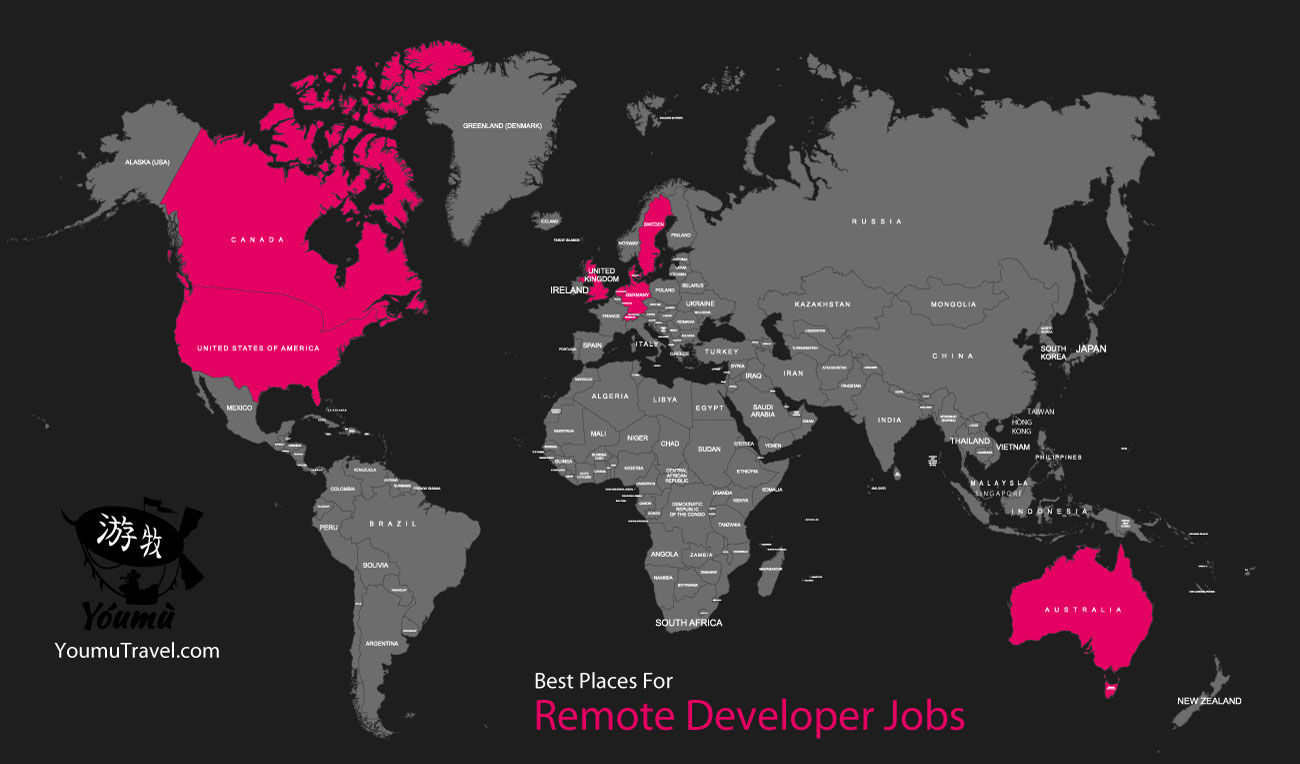
The Best Places For Remote Developer Jobs
This remote job can technically be done anywhere in the world. However, you’ll want to make sure your clients or employer are okay with the timezone difference. Here are some of the best places for remote developer jobs.
- Switzerland
- Canada
- Australia
- Netherlands
- Germany
- US
- Sweden
- Denmark
- Singapore
- UK
Learn the necessary skills
Your first step in becoming a remote developer is to find the best coding boot camp for yourself, there are over 75 to choose from! You don’t necessarily have to attend a boot camp, but there you will learn valuable skills in online web development which will be a huge advantage in working remotely. And now, most boot camps like Lighthouse Labs, DevMountain, and LearningFuze are completely online in response to COVID-19.
There are several options as to how you can attend these boot camps:
- SELF-GUIDED ONLINE COURSES
- IMMERSIVE REMOTE BOOTCAMPS
- FLEXIBLE MENTOR-LED ONLINE BOOTCAMPS
Research the different options and ask yourself which one is right for you.
Find a remote job
Remote positions are available in many forms, especially for developers; you can find part-time or full-time, freelance, and contract work. There are benefits like health care and paid vacation with full-time and part-time work which would typically indicate an in-house position. But contract and freelance work allows for more schedule and location flexibility as well as being your own boss and the one responsible for your pay and success. Your best environment to work in will determine the correct career path when becoming a developer.
The best way to find remote work is through effective networking and being available on remote job boards when positions become viable. Some of these boards include CareerBuilder, Linkedin Jobs, We Work Remotely, RemoteOK, AngelList, Digital Nomad Jobs, and many more.
Be aware of the differences between in-house and remote work before starting applying yourself to a position:
- Some employers will allow a flexible schedule and others will still expect a 9-5 workday.
- You have to find the right balance between life and work as a remote developer.
- The size of the company can determine if you will be provided with equipment or if you must supply your own.
- You don’t have the luxury of leaving an office space to indicate an ‘end of work’ time as a remote developer.
- Working remotely doesn’t mean independent, you will most likely be working with a team and communicating electronically with them.
Nail the online interview
When it comes time to interview for a remote developer position, after you’ve finished the online boot camp and have met all the necessary application requirements, there are some things to remember about interviewing.
Every potential employer will ask you different things during the interview, but the purpose of these questions is to assess your skills with problem-solving, how you communicate and what the balance between your work and life will look like.
Potential Questions:
- What tools do you use to collaborate?
- What will your work schedule look like?
- What is your style of communication?
- Why do you want to do remote work?
- Please describe the setup of your home office.
- How would you handle a time-sensitive issue if the rest of your team is unavailable?
There are also some important questions that you can ask them during the interview to showcase interest and professionalism:
- What does the current communication of your team look like?
- What do you expect for this position? During what hours am I expected to be online? Will I need to come into the office occasionally? Where will I be expected to live/work in?
- How will I be receiving feedback?
- Where are the other team members located, and will I ever need to be mindful of timezones?
- What does a successful remote team member look like to you?
When preparing for your interview, even though it will most likely be online, remember to dress professionally. Be mindful of the setup of your interview space, and make sure you won’t be distracted. Make sure to download and set up whatever platform the video conference will be done on ahead of time to ensure the interview runs smoothly. Finally, get set up 5-10 minutes before the interview begins so you won’t have to worry about being late.
Be a quality remote team member
When you have a position as a remote developer it is extremely important to be proactive. Employers will be looking for remote workers to join their teams who will be present and engaging with the other team members. Take the initiative to solve problems and do research to prove that you have put thought into your job’s responsibilities.
What does Remote mean in a job description?
A remote job is performed away from an office space in a remote location. Remote work can mean it is work done at home, or on the road.
How does a software developer remote work?
Three choices for becoming a digital nomad as a developer.
- Find a completely remote developer position
- Do freelance work
- Start your own business.
Can you work remotely as a programmer?
Yes, in fact, programmers are more likely to work from home than an office. An estimated 300,000 employees in computer science jobs in the US were working from home in 2015.
What is the best way to work remotely?
Ten helpful tricks for working remotely.
- Create a physical workspace
- Surround yourself in a comfortable atmosphere
- Establish boundaries
- If you have kids, keep them on a schedule
- Keep a constant routine for yourself
- Communicate too much
- Keep in contact with colleagues and team members
- Walk away from working every now and then
- Plan time for recreational and physical activities
- Don’t get caught up in every small detail
Is it hard to get a software developer job?
Yes, getting a software development job is difficult, however, if you take time to learn to program and do it often, then eventually you will learn everything you need to become a developer and you can even get a job without a computer science degree!
Can I work from home as a software developer?
Yes, software engineering is one of the most flexible careers because they can work from anywhere that has computers and Internet access.
Is remote a job good?
A remote job can be an excellent tool for moving into self-employment finding out how well you manage time, how you can remain productive and motivated while working from home, or workspace.
What skills do you need to be a software developer?
Necessary skills for software developers
- Being accurate and paying attention to detail
- Knowledge of programming languages
- Possess and aptitude for mathematics
- Have excellent time management and organizational skills
- Be able to solve problems
What can a developer do?
Developers design flow charts that programmers use to write computer code. They can develop applications that enable people to perform a specific task on a computer or similar devices. Others develop the underlying systems that control devices or run the networks.
Is a software developer a good job?
Between the personal autonomy of the work, flexibility, and pay, software engineers are usually very happy when comparing job satisfaction with other professions.

What is an expat community?
An expat community is usually defined by employees or craftsmen accepting jobs outside their home country alone or sent overseas by their supervisors. These can be communities within firms, educational institutions, governments, or non-governmental organizations. Pensioners, retired folks collecting a pension, are also considered to be expatriates together with all other people who have chosen to live outside their native country.
What is expat hiring?
Expat hiring involves relocating employees to another country for a certain period of time. An expatriate is required to move overseas, with or without family, for a brief period of time, usually between six months to a year. In spite of this, typical expat’s work duties usually last for two to five years.
What do expats do for work?
Expatriate jobs are often reserved for highly skilled, experienced, professionals. These people will usually be recruited or headhunted by employers in foreign countries. Other more common expat jobs abroad include teaching your native language, and English is particularly popular. But there are lots of other options including jobs in business development, sales, marketing, tourism, and translation.
Different Types & Examples of
Expatriate Jobs
There are a lot of U.S. expat jobs available around the world. Popular career fields among American expats include the hospitality industry, business/marketing services, the education sector, as well as science, technology, engineering, and mathematics (STEM) and research jobs.
Hospitality Jobs Overseas
The hospitality industry allows you to merge in a local culture and gives you the opportunity to work with customers from all around the world. So, if you enjoy a job where things happen quickly and continuously, then working in the hospitality industry overseas will give you a taste of la dolce vita.
Business/Marketing Jobs Overseas
Business and marketing jobs abroad are ideal for expats who are versatile and adept at many things. If you know a little about marketing and a little about management, or have some experience in finance or accounting, you could be a good candidate for expat jobs abroad in the business and marketing sectors.
Education Jobs Overseas
Education jobs overseas include teaching positions, both subject teachers and English as a foreign or second language (ESL) teachers, as well as educational administrators.
STEM/Research Jobs Overseas
Science, technology, engineering, and mathematics (STEM) and research jobs overseas provide numerous opportunities for American researchers. Whether your focus is on natural sciences, technology or space travel, it’s an evolving career field that appeals to many expats working abroad.
Mining Jobs Overseas
Expat mining jobs are available in many countries including Australia, South Africa, Zambia, Democratic Republic of Congo (DRC), Angola, and Liberia. Different types of mining take place in different areas, but popular types for expatriate jobs are mining for copper, diamonds, gold, and platinum.
British Expat Jobs
Whether you are interested in expat jobs, studying abroad, or breaking into a new career, there are tons of available jobs for British expats to work overseas. Popular jobs include: chef, nurse, volunteer, translator, freelancer, English teacher.
General Requirements for Expats
General requirements for those applying for expat jobs abroad include the necessary skillsets employers look for. A analysis of data from Aon’s behavior assessment test highlights the traits that are generally required to ensure an expat will succeed in a new job in a foreign country. It provides a list of skills that recruitment professionals ought to be considering:
- Emotional and mental stability
- Adaptability
- Cultural awareness
- Profound understanding of business practices
- Exceptional social and interpersonal skills
- Ability to accept new traditions and customs
- Respect for different perspectives
- Proof that you are flexible and resilient
- Professionalism
- Sense of humor
Education & Experience Requirements for Expat Jobs
The education and experience required to work as an expat abroad vary depending on the job and the country where you will be working. For instance, if you are looking at expatriate jobs that involve teaching, all countries have their own licenses and regulations for international schools. Some countries are very strict while others are flexible, and you might find you can teach in some countries but not in others. Similarly, the requirements for experience are also varied. You will need a visa in some countries and might need a couple of years of experience. Generally, employers’ needs are likely to be more flexible than government legislation.
Work Visas for Expat Jobs
When working in another country, you will need a work visa. Here is a list of countries which are easiest to acquire a work visa for:
- The Netherlands loves entrepreneurs.
- In Ireland, everyone’s welcome.
- Getting work visas in Australia and New Zealand is particularly easy for young U.S. citizens.
- Germany has stricter rules, but freelancers stand a good chance.
- Cambodia is recognized as one of the easiest countries for expats to get work visas.
How much can you make with an Expat Job?
Of course, this depends on the type of expat job, same as jobs back in your home country. In addition to type of job, location and cost of living matter a great deal. Use our travel job comparison chart and filter by expat jobs to see how much you can save per month around the world per expat job.
Do expats make more money overseas?
Expats are often paid higher than their colleagues back home or other local professionals. In addition to their income, expats occasionally receive perks such as a financial compensation for moving abroad and housing stipends. The life of the expat can be inspiring with great prospects for professional development and an exposure to the global business markets, but emotionally it can be a challenge to adapt to a foreign culture and workplace. Due to this, expats jobs tend to be high paying.
Reliability: Is working overseas a good career move?
There are many expats who will tell you that working overseas is a very good career move. But if you’re going to take the leap and move to a foreign country, you need to make sure that you’ve got a good job with a great employer who will offer you a favorable employment contract and good money. To ensure overseas is a good career move:
- Choose a job with an employer who will help you relocate, get the right visas, and do whatever else needs to be done to make this life-changing move.
- Get in tune with the new company’s culture, particularly the way your new employer balances life and work.
- Be sure you know what you’re getting into. For example, be certain you know what sort of notice you have to give if you decide to leave your new job. In Europe it’s normally three months rather than the one month notice in the U.S.
- Be clear about the conditions of your visa. If you decide to leave your job or you’re fired, you may not be permitted to look for another job in that country.
- You might find it difficult to get credit in a foreign country. In any case, you will need to research the way banks work in your temporarily adopted country.
- Language can create a barrier if you can only speak English. It’s usually wise to gain conversational skills in a foreign language.
How do expats pay taxes?
According to Greenback Tax Services: U.S. expats do have to file US taxes if they have an income or if they get paid interest, dividends, or receive rental income. There is a threshold of $400 for those who are self-employed. However, most expats can offset any foreign-earned money by claiming Foreign Tax Credit against income that has already been taxed in the country where they are now living and working. This ensures that they don’t have to pay tax twice. Expats can also put two important exclusions in place, the Foreign Earned Income Exclusion and the Foreign Housing Exclusion.
Pros & Cons of Becoming an Expat
The Pros
- The possibility of a lower cost of living, depending of course where you decide to move to.
- A growing international business sector that offers expats the opportunity to rebuild stagnant careers or launch new businesses.
- Tech and finance are growing sectors to consider.
- Accessibility to a wide range of international services including health insurance. Do a bit of research to find schemes that offer options tailored to expat life.
- The opportunity to engage in a new and different local culture. If you choose to you can learn a new language, start cooking the way locals cook, and start a vacation-like adventure in a totally new environment.
The Cons
- The chances of culture shock and possibilities of hitting culture barriers can be hard to handle. Even trying to read the body language of foreigners in a strange country can be a challenge.
- Systems in overseas countries can be fundamentally different to those you are used to. These range from foreign tax and social security systems to the way your new remote office works when compared to your traditional office at home. You may even find that some systems are inefficient or even corrupt.
- The standard of living in some countries might be a lot lower than the standards you are used to, particularly if you opt to move to a developing rather than a first-world country. If so, you’ll be exposed to economic disparities as well as possibly neglected or unreliable public services and amenities.
| Pros | Cons |
|---|---|
| – Lower cost of living | – Culture shock & cultural barriers |
| – Rebuild stagnant career | – Foreign tax & SS systems, etc |
| – Join growing sector | – Lower standard of living |
| – International services | |
| – New & different culture |
Steps for Getting an Expat Job
The job search process for expats can seem overwhelming. Whether you are in the process of searching for a new job or changing careers in another country. These steps will help make the job search process easier.
- Define your priorities and research the desired career path: Make sure you know what you want to do next and what type of a job you want to have. Once you decide your next move you can focus on researching the specific work industry you want to establish yourself in.
- Tailor your resume: Make sure that the first half page of your resume demonstrates the expertise and knowledge required by the job you are applying for, as it states in its job description.
- Connect with key contacts in your host country by searching Facebook, Meetup.com, or Internations.org for expat groups in your host country. They are also a good place to ask for possible job recommendations or advice on how to be connected to the local recruitment agencies that can help you with job searches and moving.
- Research recruiters & attend career conferences: Consider connecting with recruitment agents who typically have established relationships with companies hiring expats in various fields. Honestly, this is one of the best tactics. Let the recruiters do all the work, you don’t have to pay them anything as the companies pay them for each person they successfully place.
- Obtain work documents and research visa procedures: In case you need to change jobs once you are overseas, make sure you comply with transfer work visa requirements or get a new visa appointment scheduled by your new employer.
Example: How to Apply for a Job in Europe
There are certain criteria that need to be followed when applying for a job in Europe. While citizens of the European Union can get jobs without a work visa, others will need to apply for a work visa which involves visiting your local European embassy. Once you have a work visa you can apply for a job. But how do you apply for a job in Europe?
- First of all, consider all the employment opportunities that are available to you, focus on job options that suit your education, training, and skills.
- Try networking and building up contacts who can help you find suitable job openings.
- Research job listings on active online portals and then apply online.
- Target multinational companies that generally prefer to employ foreign workers and expats who speak fluent English.
- Explore job options offered by educational institutions and various non-government organizations.
- Ask the company you are currently working for if you can have a transfer. This will only work if they have a branch in Europe.
Common qualifications for acquiring a European work visa include:
- An application form
- Two identical pictures
- Valid passport
- Flight reservation
- Travel medical insurance
- Evidence of accommodation
- Work contract
- Academic record
- Language certificate
Best Companies to Work for as an Expatriate
The best companies for expat jobs versus traditional jobs are quite different, and there are loads of people who longingly search for the remote version. The good news is that there are some big, reliable companies out there that offer fantastic opportunities for expats. They include several that are related to travel and some that aren’t:
- HP (Tech)
- MediaCom
- Taboola
- BlackRock
- Booking-com
- Intel
- TripAdvisor
- OpenMarket
- Guidewire
Best Places for Expatriate Jobs
Most U.S. expats can be found in neighboring countries, specifically Mexico and Canada, but there are also 100s of 1,000s of Americans who have launched expat careers much further afield, in countries like Italy, the Philippines, and South Korea. Here are five of the best places to be an expat:
- Thailand is one of the top Southeast Asia locations for expats.
- New Zealand is regarded as one of the best places for a good work-life balance.
- Australia is regarded as one of the best expat locations for fair pay and ability to get a work visa.
- South Korea is one of the best places for expat english teachers outside of Thailand.
- The Czech Republic is said to be the expat’s best-kept secret.
- France is up there with the best of the rest.
- Germany is considered to be one of the best expat places to live for a year.
Expatriate Jobs Around The World
Expat Jobs In Asia
Three of the easiest ways to get expat jobs in Asia are:
- To get a company transfer, which will only work if the company where you are working at the moment has a branch somewhere in Asia.
- To volunteer or get an internship with the youth-run organization, AIESEC.
- To apply for jobs in Asia via companies that are based in Asian countries. In some countries there are many countries that like to hire foreigners.
Expat Jobs in Europe
Expat jobs in Europe vary tremendously, and the opportunities are changing all the time. Current featured jobs on EuroJobs.com include positions for data collection, test analyses, senior engineers, creative writers, and a quality assurance specialist in Java development. New jobs include positions for an automotive group quality manager and a group health and safety manager in the same company, a senior scientist, and a warehouse operative.
Expat jobs in Japan
Expat jobs in Japan are amazingly varied. Popular jobs on offer include IT, general business, hospitality (including hotel and restaurant jobs), sales, planning, and business development, as well as education, teaching, and training positions. But to be able to get a work visa in Japan, expats need to find a company that will sponsor them. Usually this means you will need an undergraduate degree or in some circumstances, at least 10 years of professional work experience in the field.
Expat Jobs in Africa
The best place to find Expats jobs in Africa is to search on portals that feature international jobs in Africa. JobnetAfrica is a site that is dedicated to jobs in Africa and constantly offers international vacancies that include managerial positions for general managers, impact and training managers, project managers, and project directors.
Expat jobs in the Middle East
Expat jobs in the Middle East are in high demand from Americans and Europeans who have been adversely affected by the current recession in their own countries. Even though jobs are not always easy to find, the capital of Saudi Arabia, Riyadh, is ranked as the having the most opportunities. The capital of Qatar, Doha, is second in terms of job possibilities, followed by another Saudi Arabian city, Jeddah. The biggest demand right now is for junior executives, and business management graduates are also highly sought after.
Expat jobs in Dubai
Expat jobs in Dubai advertised by the leading recruitment website Indeed.ae currently include several positions where some of the details of employment are confidential. Opportunities are varied but include several jobs that relate to drilling rigs. There are also jobs for a chief operating officer, an admin assistant, an experienced core assurance associate, an executive, and a head of finance.
Expat jobs Singapore
Expat jobs Singapore has to offer range from admin clerks and loan administrators to dentists. Indeed also has a Singapore specific portal that will appeal to anyone looking for expatriate jobs. In addition to those mentioned, there are currently jobs on offer for a human resources executive, a team secretary, and a shared services executive. So, whatever your field of expertise, there’s a good chance you will find a suitable job in your niche.
Expat jobs in Spain
Expat jobs in Spain are not limited to people who can speak Spanish. In fact there are lots of jobs available for English speakers and foreigners who have specialist skills. Many expats find that word-of-mouth and networking are good ways to find jobs in Spain, particularly jobs with smaller businesses. So, it’s sensible not to restrict your search for expat jobs in Spain to online agencies and adverts.
Expat jobs in the Netherlands
Expat jobs in the Netherlands can be found by going to a specialist English website like I am Expat, that is run by expats. This site has job listings as well as news and loads of information. The jobs on offer are varied in terms of sector and the age of employee required. The current featured jobs include two IT positions, one for a manager and the other for a full-stack developer, as well as two positions in real estate, one junior and one senior managerial position. There are lots of other engineering and IT positions but also others in marketing, packaging, customer service and other sectors.
Expat jobs in Germany
Expat jobs in Germany are not always easy to find, especially for expats who only speak English. But anyone who can speak a bit of German and who has a degree, or some other worthwhile qualification, stands a good chance of getting a job. Germany has a stable economy and foreigners with specialist skills can find jobs relatively easily. The automotive sector is particularly strong and there is a shortage of skilled workers in various health occupations as well as science, technology, engineering, and math (STEM) sectors.
The expat market is diverse and there are always new jobs available. Some of the best expat jobs rely on expatriates who have language or hard skills that are in low supply in that country. Some of the best expat careers in demand include:
- Teach English Abroad
- International Teaching Jobs
- Au Pair Jobs
- Professional Nanny Jobs Abroad
- Sell Timeshares Abroad
- Language Tester Abroad
- International Event Coordinator
- Retail Buyer Abroad
- Import Export Jobs
- Travel Nurse Jobs
- International Archaeologist Jobs
- International Geologist Jobs
- Traveling Hair Stylist Jobs Abroad
- International Model Jobs
- Online Personal Trainer Jobs
- Traveling Chef
Expat Tips
Here are some useful tips for expats living abroad:
- Don’t be quick to give up. It’s entirely possible that you have a bad experience in your new country. Before you jet back home consider moving to a different area of the city or country, consider different places to work within the city or country. Heck, consider moving to a nearby country or different region completely. Keep at it and you’ll find the right expat lifestyle and expat community for you.
- While English is widely spoken around the world, try to learn at least some common phrases of the local language. It shows you care about their culture.
- Be observant and notice what is different about local customs. You’ll soon pick up different types of behavior that you might want to consider incorporating.
- If you’re staying in a foreign country for a long time or maybe forever, save money to be able to go home on vacation.
- If you have kids and your adopted country has a different language, make sure your kids are bilingual and speak your home language as well as the new one.
- Assimilate local customs and learn new traditions.
Job Portals:
There are lots of job portals that offer expats and other travelers the opportunity to get jobs abroad. Thanks to these, landing a job in a foreign country is a lot easier than it used to be. Some of the top job portals for abroad jobs are:
- Indeed Worldwide – an international site that offers jobs in more than 60 different locations.
- Jooble – features jobs in more than 60 countries.
- CareerBuilder International – lists jobs in the US, Canada, and several other parts of the world including the UK, Germany, France, Sweden, Greece, Vietnam, and India.
- CareerJet – has job links to 60 different countries.
- Go Abroad – offers advice as well as job opportunities.
- Going Global – features job trends and job openings.
- Monster Worldwide – allows you to search in more than 40 countries for jobs.
- TEFL – teaching English as a foreign language – offers online certification as well as a job board which helps job seekers find pre-approved schools.
Expat Statistics
The cheapest and safest countries to live in:
In 2020, the cheapest country to live in, by population, is Pakistan, which has a cost of living index of 18.58 compared to the United States (cost of living index of 70.95). GoBankingRates is an organization that has used statistics to determine the cheapest countries to live in. The metrics they use are the rent index, local purchasing power, the consumer price index, and the groceries index. Overall, New York City is one of the most expensive cities to live in, while India is the cheapest. Pakistan is 75% cheaper to live in than NYC. The Global Peace Index rates Iceland as the safest country to live in.
According to the Annual Global Retirement Index published annually by International Living, Portugal is the cheapest and safest country to live in right now. The Index, published in January 2020, states that Portugal is the best-value destination and it’s one of the world’s most friendly countries. It’s also easy to live in and one of the safest, with excellent, low-cost healthcare and a pleasant, low-pace of life.
Expat Frequently Asked Questions (FAQ)
What jobs are in demand abroad?
International Teacher Jobs, especially Teaching English Abroad are the highest demand.
Healthcare and related professions are also high on the list for expat jobs that are in demand abroad. For instance travel nurses and doctors are needed extensively. Physiotherapists, who also figure in the healthcare industry, are in particularly high demand.
Why do expats return home?
Expats return home for many different reasons, some planned, others completely unplanned. Sometimes expats get homesick and miss their friends and family. Culture shock does sometimes result in expats finding it difficult to adapt to a life abroad. Some expats return home because they didn’t budget enough money for unforeseen circumstances, cost of living, and travel expenses.
Why do expats fail?
Expats may fail if they fail to budget properly for their destination. This includes travel, cost of living, and ideally six months of no work.
Another potential reason is due to culture shock. This can be because of language barriers, different laws, a dramatic change in routine, or even just a climate that is totally different to the one they have been used to. Expats don’t set out to fail, but the reasons that they sometimes do often relate either to personal reasons or insufficient support in their new role in a foreign country.
Becoming an expat is a life changing experience, so it’s not surprising that some do fail.
Employer POV: What are the pros and cons of using expatriates?
PROS
- Expats offer different perspectives, which is especially valuable insight considering that they understand a large potential audience with first-hand experience.
- Different skills to offer than local talent.
CONS
- Expats tend to be expensive, certainly more expensive than local workers.
- They tend to have a high burnout rate because working in a foreign country can be incredibly demanding.
Is it possible to get a job in the UK from India?
Yes it is possible for Indian citizens to get a job in the UK, particularly skilled professionals. The usual route is when there is a job offer for a skilled position that originated in the UK. But if you are going to move from India to the UK, you must also have a certificate of sponsorship from a company that is licensed to sponsor workers from India.
Teach English Abroad Guide
Teaching English abroad means helping students to learn English as a second language. Normally this involves moving abroad to work for an English language school. Pupils come in all ages and backgrounds, hoping to learn English for both personal and professional advancement.
This job is in high demand and easy to get.
Demand
- High Demand
Experience & Degree
- No Experience Required
- No Degree Required but Certification is Preferred
- Native English Speaking Preferred
Citizenship
- No Restrictions
This job is very reliable with reasonable pay.
Pay Range
- Weekly Average: $520
Reliability
- Very reliable
Housing
- Room and Board Sometimes Provided
This job has a somewhat flexible schedule and you can work almost anywhere in the world.
Location
- Very Flexible
Schedule
- Somewhat Flexible
Language
- Fluency in English
Who can Teach English Abroad?
To be an English teacher abroad, some employers will expect a bachelor’s degree in a relevant subject (English, Linguistics, Modern Languages) as well as a certification for teaching English as a foreign/second language (the TEFL or TESOL).
A degree will add prestige (and likely higher salary) to your qualification, but many schools across the globe will accept teachers so long as English is their native language and they hold a TEFL certification from an accredited program.
What are the responsibilities of someone teaching English Abroad?
As an English teacher abroad, you will assist students in acquiring English as a second language. There are two categories for English learning speakers:
- EFL (English as a foreign language): acquiring English for business or social reasons.
- ESL (English as a second language): will be speaking English day-to-day.
Whether teaching EFL or ESL students, your job will likely include:
- Presenting English lessons to various age groups
- Creating and grading tests, papers, and exercises
- Supplying feedback on both oral and written projects
- Offer/producing resources both audio and visual
- Helping with school activities like sports, parties, dinners, class trips
- Participating in teacher training sessions
- Assisting with advertisement ideas/events for the school
- Preparing for inspection visits/quality assurance
- Staying organized with registration lists and attendance sheets for students
What’s the typical schedule for someone teaching English Abroad?
Since you will likely be working for a school/institution or organization, your schedule will be determined by them. It will be similar to a teaching schedule in your home country, with 40+ hours of work a week split between teaching various courses and doing grading/prep work. Classes normally follow a standard Monday-Friday schedule.
Income Reliability
Teaching English abroad can be a secure source of income so long as the position offers a decent salary, and you are employed by a dependable institution/organization.
Typical Job Duration
Teaching English abroad can be short-term or long-term.
Estimated Hours Per Week
Unless working part-time/only a few classes per week, you will be expected to clock 40 hours minimum (oftentimes grading and course planning will require additional hours).
Room & Board
There are some teaching positions abroad that provide room & board at the school as part of the job offer.
Teaching English Abroad – Country Map
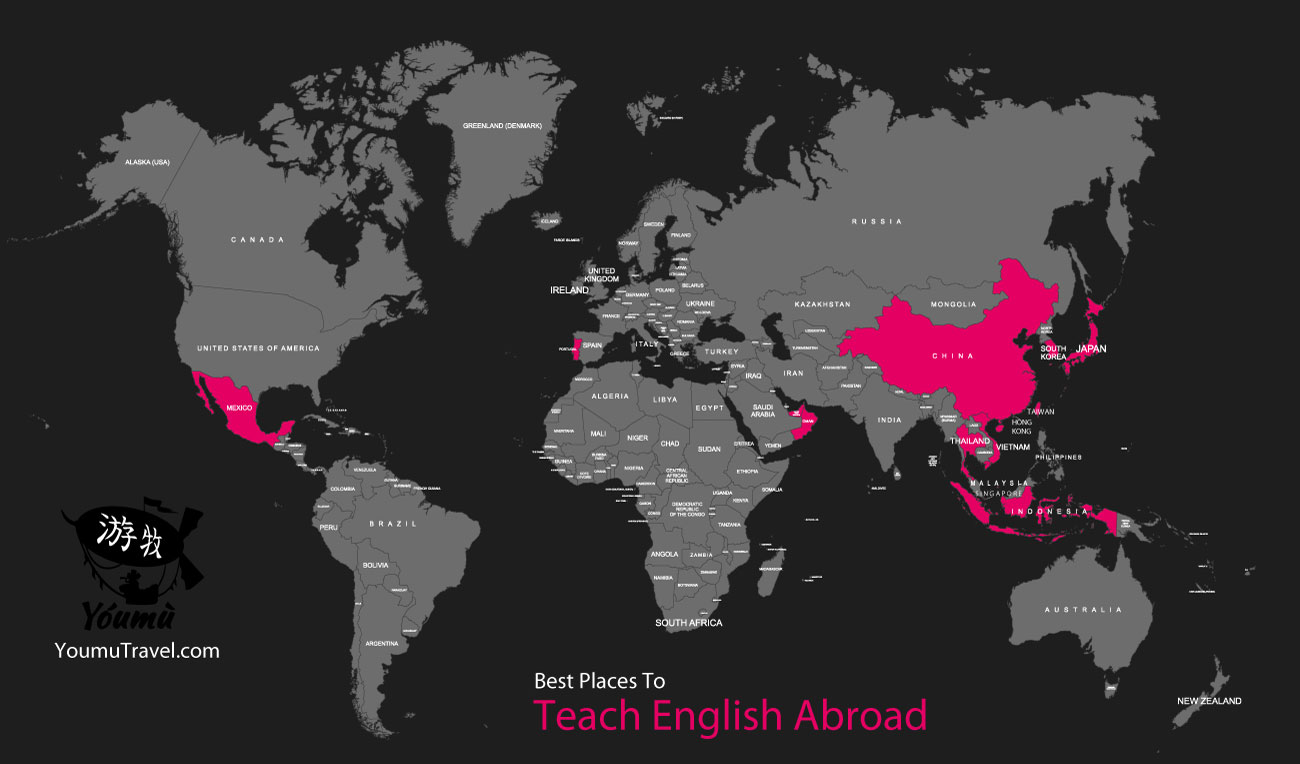
The Best Places to Teach English Abroad
Most major countries throughout the world have opportunities for those seeking to teach English abroad. However, U.A.E pays the highest for teaching English. Here are some of the best places to teach English abroad.
- China
- Thailand
- United Arab Emirates
- Japan
- Vietnam
- Taiwan
- Mexico
- Portugal
- Indonesia
How To Start Teaching English Abroad & Succeed: Step-by-Step From First-Hand Experts
Having the proper accreditation is important. Though earning a degree in English (or Linguistics/Modern Languages) is not always a job requirement, it is certainly helpful and will increase pay rate. It is necessary to hold a valid certification in teaching English from an approved course, such as the TEFL/TESOL (better for teaching youth) or CELTA (better for teaching adults).
These courses are offered at accredited centers across the globe, normally for both full (4-5 weeks) and part-time (courses vary from 3 months to 1+ year). Cambridge English, for example, provides a course that combines online study with in-person teaching practice.
Follow the steps below to begin your journey as an English teacher abroad:
How To Start Teaching English Abroad & Succeed: Step-by-Step From First-Hand Experts
Get a TEFL Certification
While there are many job opportunities to teach English online without a TEFL certification, there are far more opportunities to those that have their TEFL certification.
Therefore, it’s highly recommended that you consider getting your TEFL certification with one of the best courses below.
Two Best TEFL Courses to Teach English Abroad
- International TEFL Academy
2. International TEFL and TESOL Training
Compare pay & cost of living per location
Using our pay breakdown on this page to see what countries work best for Teaching English Abroad.
Move!
Make the move abroad and start teaching!
What qualifications do you need to be an English teacher abroad?
Requirements:
- Valid passport and stamp for work visa
- Bachelor’s degree
- Certification for TEFL or TESOL
- Relevant references
- Coursework plans
- Office supplies and stationary
How much do English teachers make abroad?
Income for an ESL teacher differs in response to where you are located; this variation can be from anywhere between $600 USD per month to $4,000 USD per month. Location will also dictate things like job expectations and lesson requirements, as well as length of your contract.
Is 30 too old to start teaching English abroad?
There normally aren’t age restrictions when it comes to teaching English abroad. You must be at least 21 years of age to apply, but it’s certainly never too late to begin!
Is teaching English abroad worth it?
Teaching English abroad offers both income and the unique chance to live abroad. You’ll experience new culture first hand, as you’ll be working closely with students from the area. Keep in mind it is best to get TEFL/TESOL certified, as employers will expect this.
Is TEFL hard to pass?
Certain factors help prepare you for certification; being a native English speaker and holding a bachelor’s degree will all but guarantee you can manage the course load. The grammar aspects of TEFL are the most challenging, but as long as you work hard and manage your time well, you should be able to pass. The knowledge you gain will ensure you are capable of teaching English as a second language.
How do I get TEFL certified?
Steps:
- Be prepared to fully commit.
- Write up a list of why you’re qualified.
- Research what the TEFL certification is.
- Find out where you can earn your TEFL certification.
- Communicate with around 3-5 different TEFL providers to learn more.
- Choose which TEFL program appeals most to you and apply.
What are examples of monthly incomes for English teachers abroad?
- The U.A.E. – $3,500-$5,500 USD (13,000-20,000 UAE Dirham)/month
- Japan – $2,200-$5,000 USD (230,000-530,000 Yen)/month
- Saudi Arabia – $3,000-$4,000 USD (11,250-15,000 Saudi Riyal)/month
- Kuwait – $2,600-$4,000 USD (800-1,200 Kuwaiti Dinar)/month
- Oman – $2,000-$3,500 USD (800-1,400 Omani Rial)/month
- Taiwan – $2,000-$3,000 USD (59.000-89,000 New Taiwan dollar)/mon
- South Korea – $1,600-$2,650 USD (2,000,000-3,000,000 South Korean wan)/month
- China – $1,400-$2,200 USD (9,700-15,000 Chinese Yuan)/month
What countries pay teachers the most?
Europe holds the top 5 countries with highest teacher salaries. Luxembourg is highest, then Switzerland (average yearly salary of $69,705), then Germany ($61,418), Norway ($47,313), and Denmark ($46,784).
What countries can you teach English without a degree?
Though a degree will increase your credibility and salary, here are some countries that don’t require one:
- Costa Rica
- Mexico
- Peru
- Cambodia
- South Korea
- Spain
- Italy
- Russia
International Teaching Jobs Guide
International teachers instruct students on various subjects at an educational institution abroad. This position will include both creating coursework/presenting lectures as well as interacting with your students for events and projects beyond the classroom.

This job is in high demand but requires some experience to get.
Demand
- High Demand
Experience & Degree
- At least Two Years of Experience Required
- Bachelor’s Degree Required
- Native English Speaking Preferred
Citizenship
- No Restrictions
This job is very reliable with reasonable pay.
Pay Range
- Hourly: $10-$25/hr.
Reliability
- Very Reliable
Housing
- Room and Board Sometimes Provided
This job’s schedule is not flexible, however, you can work almost anywhere in the world.
Location
- Very Flexible
Schedule
- Not Flexible
Language
- Fluency in English
Who can work International Teaching Jobs?
International teaching jobs are for passionate educators seeking a new experience in a foreign country.
Employers will expect prospective teachers to have (at least) a bachelor’s degree in the taught subject matter as well as an ESL teaching qualification (TEFL certification, for example). There is more information about the TEFL certification for teaching English abroad in the TEFL FAQ. Schools also typically require teachers to have 2+ years of previous teaching experience.
What are the responsibilities of someone working International Teaching Jobs?
As an international teacher, you will be responsible for the success of your students in learning the course material. Job duties will likely include:
- Building lesson plans, tests, and assignments
- Adjusting classes appropriately to create a safe and productive setting for your students
- Providing supplies/resources for lessons
- Generating interactive learning methods/activities and provide individual support/instruction for each student
- Providing regular report cards/feedback to ensure and record student progress
- Holding parent/teacher conferences
- Taking students on cultural outings/excursions
What’s the typical schedule for someone working International Teaching Jobs?
Your job schedule will be similar to that of a middle/high school teacher who teaches multiple courses for different age groups throughout the day. It is common to teach between 4-6 classes per day, Monday-Friday. The school will also probably be on a familiar 8/9am to 3/4pm schedule. You will have a lunch break and maybe a free period for grading/lesson planning. This of course is expected to be done outside of school hours as well in order to maximize preparation and feedback for students. In total, expect to be putting in at least 40 hours per week. Many teachers both international and in your home country clock between 50-60 hours a week.
Income Reliability
In general, teaching abroad is a reliable (salary-based) job so long as you are working for an accredited institution.
Typical Job Duration
Teaching internationally can be short-term or long-term.
Estimated Hours Per Week
It’s estimated that you will be working at least 40 hours per week, if not more.
Room & Board
Some international teaching positions may offer room & board at the institution. Seek these opportunities specifically if it is something you would like included in the job.
International Teaching Jobs – Country Map
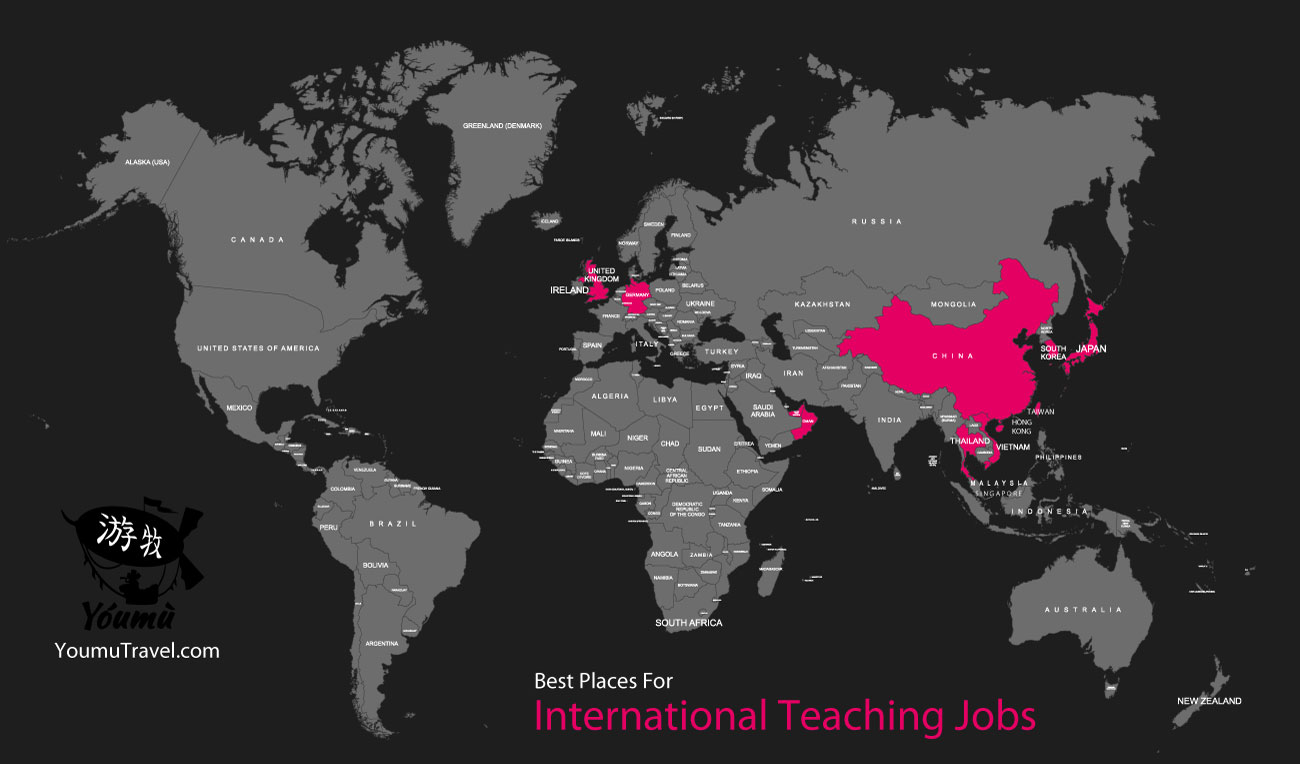
The Best Places to work International Teaching Jobs
Most major countries throughout the world have opportunities for those seeking international teaching jobs. The best opportunities for international teaching jobs are tied with institutions. Here are some of the best places for international teaching jobs.
- China
- Japan
- South Korea
- Germany
- UAE
- United Kingdom
- Thailand
How To Get International Teaching Jobs & Succeed: Step-by-Step From First-Hand Experts
Most positions will require teachers to hold the following accreditation:
- Bachelor’s degree in relevant subject area
- Valid teaching certification
- English language certification (TEFL, etc)
- Some institutions require “Qualified Teacher Status”
- There are two options for acquiring this:
- Graduate with a degree that grants QTS (BA in Education, for example)
- Complete either a PGCE (Postgraduate Certificate in Education) or PGDE (Professional Graduate Diploma in Education)
Though teaching abroad will have similarities to teaching in your home country, be sure to account for cultural disparities and the national curriculum for the foreign country.
Follow the steps below for how to get started as an international teacher:
Preliminary decision
Determine how you will apply (by program, recruiter, or independently).
Location
Pick a country that excites you and suits your qualifications.
Resume
Perfect your resume/CV to best reflect your capability.
Apply
Submit applications for appropriate teaching jobs.
Interview
Practice for/perform interviews.
Contract
Settle on your contract terms and salary.
Job offer
Accept the offered position.
Financial success
Be sure to save money before departure and have a budget plan in place for the future.
How do I get a job teaching at an international school?
International schools typically expect a valid teaching certificate and a bachelor’s degree in a relevant subject. They will also require 2+ years of full-time teaching experience.
How much do international/TEFL teachers make?
Income normally varies between $2,000 and $4,000 USD per month ($600/month on the lower end), depending on location and position (tax free salary for some).
Is teaching abroad a good career?
For those who love to teach, yes. Teaching abroad offers a unique chance to live in a different country and learn first-hand about another culture. It can be a good way to solidify that teaching is your chosen path in life.
What countries are in need of teachers?
Here are a list of countries in need of English teachers in particular:
- Brazil
- Cambodia
- China
- Colombia
- Mexico
- Morocco
- Russia
- South Korea
- Spain
Which is the best country for teaching English?
Per a study in 2019, Japan is the number one best country to teach English abroad; this is based on salary, unique culture, and a rising need for qualified English teachers. Here are additional countries considered a good option for teaching English abroad:
- China
- Taiwan
- Germany
- Mexico
- Portugal
- Indonesia
- Colombia
Au Pair Jobs Guide
An au pair is a young person from a foreign country that comes to help with housework and childcare in exchange for room and board.

This job is in high demand but requires some experience to get.
Demand
- High Demand
Experience & Degree
- At least one year of experience required
- Completion of secondary school or equivalent required.
- Good English skills
Citizenship
- Obtain a J-1 au pair visa.
This job is very reliable and pays well.
Pay
- Weekly: $195.75 minimum.
Reliability
- Very Reliable
Housing
- Room and Board Provided
This job’s schedule is not flexible However you can work almost anywhere in the world.
Location
- Flexible
Schedule
- Somewhat Flexible
Language
- Having good English skills is strongly encouraged.
Who can become an Au Pair?
An au pair is a young person from a foreign country that comes to help with housework and childcare in exchange for room and board. For their assistance to their host families in addition to free lodging and board, au pairs receive a weekly allowance for personal use.
An au pair must comply with their au pair recruiting agency’s guidelines for required experience and the completion of secondary education (high school) or equivalent.
What are the responsibilities of an au pair?
An au pair’s job description is multi-faceted and will differ depending on the host family’s needs.
Key Responsibilities
- Preparing the children’s meals and cleaning up the kitchen after they’ve eaten.
- Playing with the children and cleaning up the playroom once playtime is finished.
- Bathing the children and dressing infants/toddlers
- Waking the children up
- Look after children’s belongings
- Driving children to and from school, outings, appointments as needed by the host family
- Making the children’s beds and cleaning their rooms
- Staying at home with children when they are sick or on holidays
- Doing the children’s laundry.
What’s the typical schedule for an au pair?
This job entails taking care of the host family’s children as needed seven days a week, with one weekend free each month.
The hours of the day where any care for the children is performed is considered a ‘work hour’ and this typically amounts to 9-5 workdays.
Income Reliability
Being an au pair is a somewhat reliable job that provides a constant stream of work.
Typical Job Duration
Being an au pair typically has a duration of 12 months, but can be extended up to 24.
Estimated Hours Per Week
It’s estimated that you can work full time, at least 40 hours per week, as an au pair.
Room & Board
Au pairs receive room and board.
Au Pair Jobs – Country Map
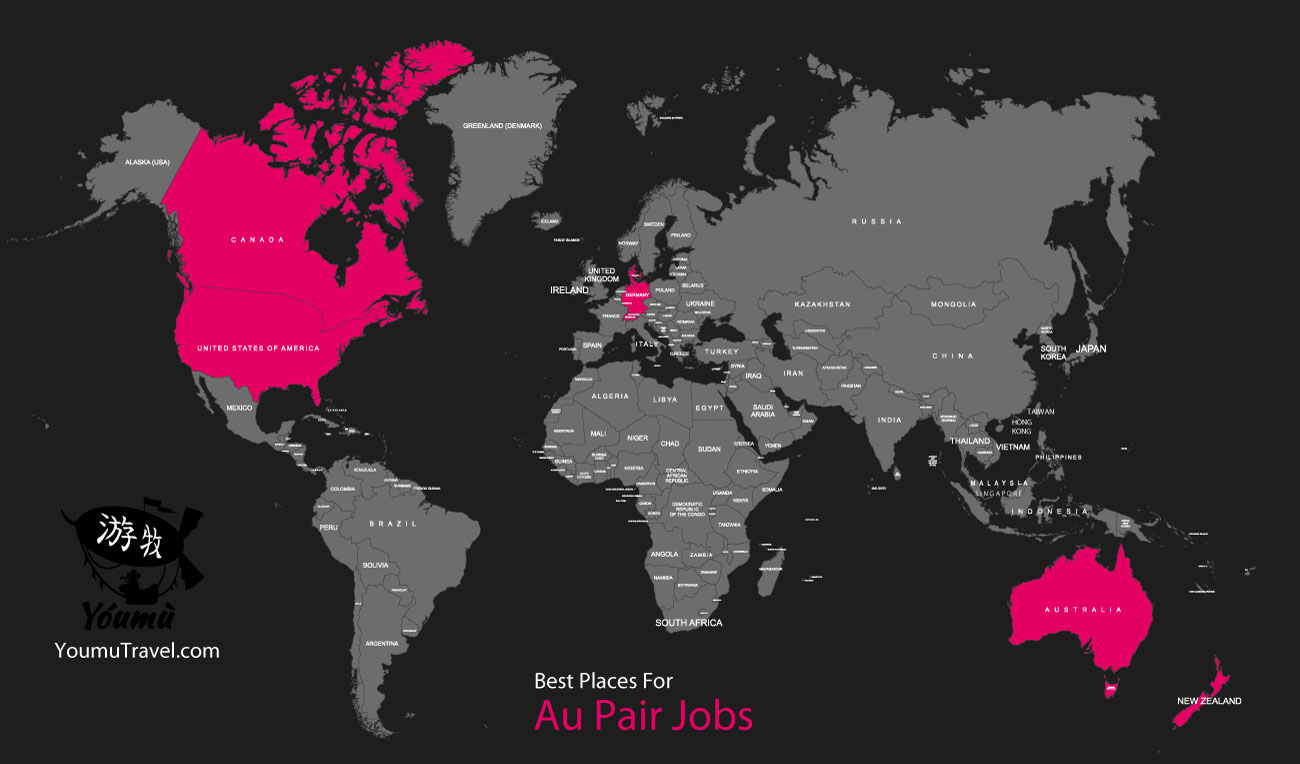
The Best Places for Au Pair Jobs
Most major countries throughout the world have opportunities for those seeking travel nurse jobs. Here are some of the best places for travel nurse jobs.
- USA
- New Zealand
- Canada
- Denmark
- Switzerland
- Australia
- Germany
Find out what’s needed to become one
Do the research and make sure you meet the requirements to become an au pair. These requirements can differ between agencies, however, the most important requirements are similar to these:
- Ages 18 to 26 years old, sometimes up to 30.
- Love children! And have over 200 proven hours of caring for them, which includes babysitting, working or volunteering for playschool or nursery, or any other kind of activity that benefits children.
- Be a proficient English speaker
- Have completed secondary school
- No criminal background!
- Possess a valid driver’s license
- Be a non-smoker, and overall in good health.
Choose an au pair recruiting agency
Find and perform an au pair recruiting agencies’ online platform registration. Complete your profile as correctly as possible. The most popular au pair recruiting platforms are:
Find a potential host family
Search for a prospective family and attend an online interview with said family- and negotiate the specific requirements and terms of what you will have to fulfill throughout the assignment. Make a deal with financial details and make sure the terms are understood by both parties.
Finalize all legal formalities
Sign the contract for your assignment and get your visa.
Prepare for your travels
Pack and prepare for your trip. Arrange all travel details, and finally meet your host family!
How much do au pairs get paid?
The minimum required payment from the host family is $195.75 per week, but host families and au pairs are welcome to negotiate higher compensation.
What does au pair job mean?
An au pair is someone between the ages of 18 and 30 with no children, that travels to a foreign country for a designated period of time to stay with a host family. Au pairs provide the host family with childcare and a little housework, but au pairs are not nannies or housekeepers.
Is Au Pair a job?
Technically, an au pair is defined as a helper from a foreign country that lives with and works for a host family. They take on a share of the family’s daily chores as well as the responsibility of childcare and receive a weekly allowance for personal use.
What’s the difference between the au pair and nanny?
A nanny does not take part in cultural exchange and earns a salary the same as any other job. An Au Pair is an individual between the ages of 18-30, who goes abroad to live with a family and to learn a language or culture in exchange for childcare services.
Do au pairs cook and clean?
The au pair is seen as a member of their host family, they will be prepared to take on some shared household chores. Au pairs, however, should not be asked to do extensive cleaning or chores that don’t fall into the family’s daily routine.
How long do au pairs stay?
An au pair will initially come to the U.S. on a 12-month J-1 au pair visa, but they can extend it for another 6 to 12 months. This means a host family could benefit from an au pairs live-in childcare for up to two years.
Is Au Pair safe?
It is completely understandable for a family to have concerns about someone they don’t know come from a foreign country to care for their children and live with them. However, the au pair agency’s thorough matching and interview processes can help parents feel secure in their au pair choice.
Can a man be an au pair?
Yes, au pairs can be female or male. Usually, male au pairs are known as au pair boys or bro pairs and can register on recruitment platforms to find host families in an international capacity.
Can an au pair look after a baby?
No. An au pair does not possess the qualifications or experience to be given complete charge of children under the age of 2. For babies, we recommend a more professional childcare solution like a nanny or a nursery.
Is it hard to become an au pair?
Being an au pair is a hard job, even if you believe you can do it and things work out alright, there will be days where you do not enjoy your life and want to go home. It can take a long time to be accepted by other au pairs and become connected abroad.
Do au pairs get weekends off?
Au pairs as part of the host family will adhere to the family’s schedule and might have to work weekends and evenings. But au pairs get a full weekend off each month, from Friday night to Monday morning.
What qualifications do you need to become an au pair?
- Past experience in childcare
- Availability for 12-month positions
- Be between 18 and 26 when your assignment starts
- Good English skills (They will improve during your stay!)
- Be a graduate of high school or equivalent
What language is au pair?
The official Swedish Migration Agency states: “An au pair is a person who lives with another family and is paid for childminding and light housework. The purpose of their stay in Sweden must be to obtain international experience and the opportunity to learn the Swedish language and culture.”
What is an au pair expected to do?
An au pairs’ responsibilities will differ according to the needs of the host family. Their primary job is to take care of the children and play with them. But as a temporary member of the family, the au pair is expected to perform light housework such as cleaning the table and folding children’s clothing.
What happens if an au pair gets pregnant?
In most instances, health insurance is able to bear the pregnancy and costs of birth so long as the au pair gets pregnant in the host country. But health insurance doesn’t typically handle the costs if the au pair chooses to abort.
Do au pairs have to live with you?
Yes, au pairs must live with their host family throughout their time in the U.S. It is an appropriate solution to have an au pair stay in a separate housing on the host family’s property intended for guests, provided they still have access to the main house at all times.
Are au pairs cheaper than nannies?
Actually, a domestic nanny is less expensive than hiring an au pair beyond their one-year placement. Nannies can be found to fit any family’s budget and they don’t have the same restrictions as au pairs for how many hours they can work each week.
Professional Nanny Jobs Abroad Guide
A professional nanny cares for children in a family’s home tending to childcare responsibilities, providing personal attention to each child in the family, lend support to parents as needed, and provide developmentally appropriate care and activities for the children in their care.

This job has a somewhat high demand but it takes some experience to succeed.
Demand
- Somewhat High Demand
Experience & Degree
- At Least One Year of Experience Required
- Easy Certification Required
Citizenship
- Some Restrictions
This job is somewhat reliable, pay ranges from reasonable to low but room & board is typically included.
Pay Range
- Average Weekly: $300-$713.
Reliability
- Somewhat Reliable
Housing
- Room and Board Typically Provided
This job provides a little freedom and flexibility outside of contracted hours.
Location
- Somewhat Flexible
Schedule
- Little Flexibility
Language
- Can get by with English only, but are strongly advised to know a foreign language.
Who can become a Professional Nanny?
Anyone who is certain they want to be a childcare worker, that is the most important thing. Those who do must have at least an Associate’s degree in Early Childhood Development as well as experience working in places with children.
After that, anyone who wants to be a nanny must complete certifications in CPR/First Aid, as well as the International Nanny Association’s two-part online examination and the CDA certification.
What are the responsibilities of a Professional Nanny?
A professional nanny cares for children in a family’s home tending to childcare responsibilities, providing personal attention to each child in the family, lend support to parents as needed, and provide developmentally appropriate care and activities for the children in their care.
Key Responsibilities
- Planning playdates and outings as well as indoor and outdoor play.
- Creating a safe and engaging environment for the children
- Bathing, dressing, changing diapers and potty-training if age appropriate
- Planning/preparing meals, and feeding the children
- Reading to the children and help with their homework
- Carpooling/ driving the children to school, activities, or playdates
- If necessary, administering medicine with parents’ consent
- Light housekeeping such as children’s laundry, organizing bedrooms/toys
- Keeping a log for the parents
What’s the typical schedule for a professional Nanny jJob?
This job is somewhat flexible in that you can negotiate how many days you work, but most positions will see the standard Monday-Friday work week and will average 8 hours per day.
Income Reliability
In general, being a Nanny is a reliable job that provides a constant stream of work.
Typical Job Duration
A job as a Nanny can be short-term or long-term.
Estimated Hours Per Week
It’s estimated that you can work full time, 40 hours per week, as a Nanny.
Room & Board
A position as a live-in Nanny does provide room & board.
Professional Nanny Jobs Abroad – Country Map
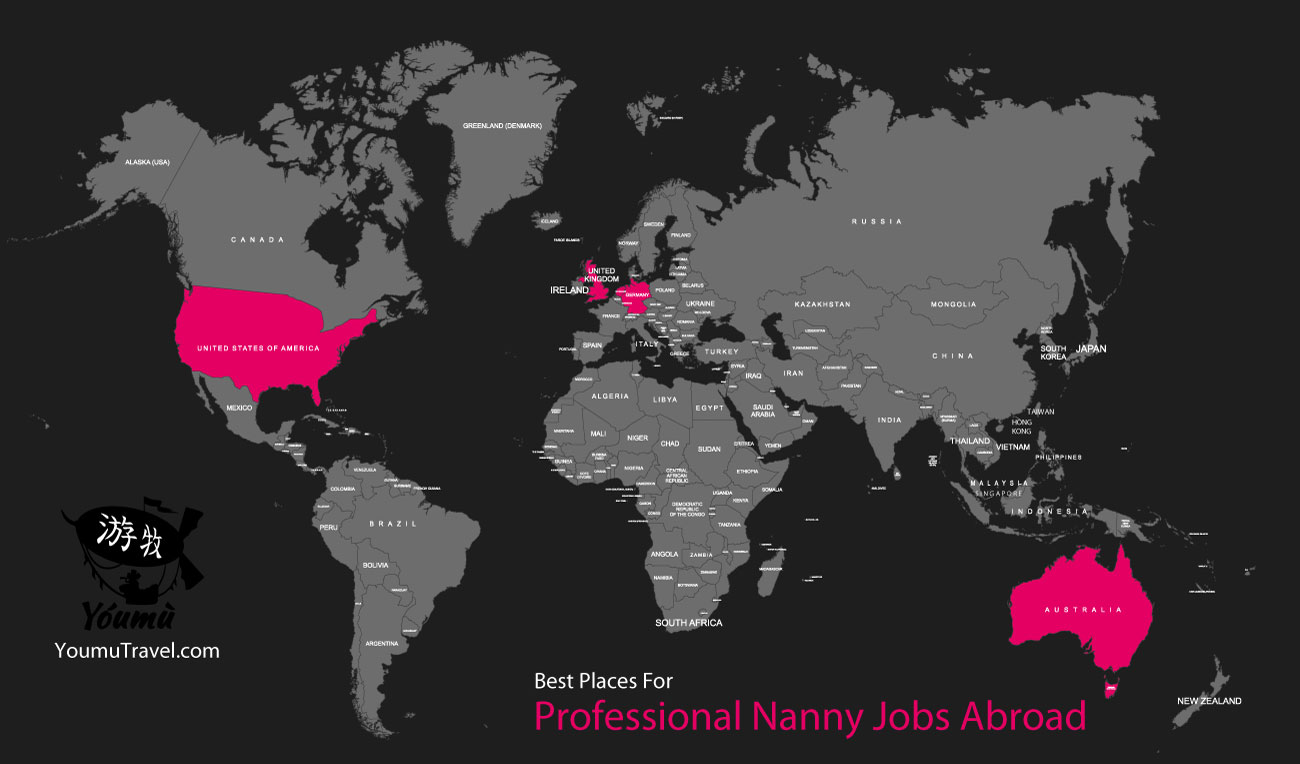
The Best Places for Professional Nanny Jobs Abroad
Most major countries throughout the world have opportunities for those seeking professional nanny jobs abroad. Here are some of the best places for professional nanny jobs abroad.
- US
- Australia
- UK
- Netherlands
- Germany
Do I want to be a nanny?
Before choosing a career path, make sure it is a pursuit you are willing to commit to. Don’t waste your time doing something you’re unsure about.
Become experienced in Childcare
Whether you are babysitting, working, or volunteering at a place with children such as a hospital, school, daycare, community center, gain as much experience as you possibly can. As you gain experience, gather references, letters of recommendation, from families, centers, and schools where you worked. Having all this information updated and organized will make it easier for potential employers to verify your background.
Earn an Associate’s or Bachelor’s degree
While this is not mandatory for this profession, many employers and families will be swayed by a candidate who has earned an undergraduate degree in early childhood education. By obtaining a degree, you are letting employers know that you understand how much more there is to be a nanny than looking after kids.
Extra Training and Certifications
Another form of training and education for preparing to be a nanny comes from additional certifications you can receive. Being trained and certified in these areas will increase your appeal to employers:
- Infant/ Child CPR and First Aid
- Water-Safety Certification
- Special Needs Care
- Foreign language
- Fitness
- Driver’s License
- Nutrition and Cooking
- Infant Care
Build a nanny profile
Advances in technology have made meeting nannies and families even easier, with various websites designed to connect the two parties. An effective nanny profile with a detailed resume and timeline of experience, references, a background check, and educational and medical certifications will make you stand out to potential employers.
Earn the necessary professional credentials
The International Nanny Association (INA) administers two levels of examinations: the first is an online Nanny Basic Skills Assessment, and the second is the INA Credential Exam. There is also the Child Development Associate credential, and the Connection Centered Discipline Nanny Certification.
Join international nanny agencies
Even though the opportunities may be exciting to join a nanny organization overseas, be sure to do research about the agency and what types of positions you will be getting. Do not expect a full-on salary. Ask how a position will support and benefit you in the long-run. Be sure to choose a position abroad where you are familiar with the native language.
Select the best opportunity for yourself
Once you decide that nannying abroad is a must for yourself, be sure to prepare yourself for the interview where you will have to charm the family into hiring you. Have an appropriate and professional photo in your nanny profile. Familiarize yourself with the expectations of the family you could be nannying for. Ask lots of questions! Stay calm and be sure to appear enthusiastic.
What other jobs can nannies do?
Experience as a hands-on childcare provider is the obvious advantage of working as a nanny. This experience can guide you into any other field related to childcare. For example: Working in a daycare, starting your own family care center, or even becoming a preschool teacher.
What is a nanny from another country called?
An Au Pair is a young adult from another country that lives with your family for about a year and provides in-home childcare. They work up to 45 hours per week.
How much do nannies make if you work for a celebrity?
Nannies who work for a celebrity can be paid as much as $185,000 for their services as well as their discretion.
What’s the difference between a nanny and an au pair?
A nanny does not take part in cultural exchange and earns a salary the same as any other job. An Au Pair is an individual between the ages of 18-30, who goes abroad to live with a family and to learn a language or culture in exchange for childcare services.
What is a nanny expected to do?
A nanny is responsible for anything that correlates to the care of her charges. For example: preparing meals, helping dress the children, interacting and playing games with them, doing the children’s laundry, and teaching the children appropriate behavior.
Why being a nanny is the best job?
Being a nanny allows you to watch the children you care for grow, celebrate the stages of their lives with them, and teach them new things. It’s kind of like a trial-run of the complete mommy experience before you have your own.
How can I bring my nanny to the USA?
To Qualify:
The applicant must possess at least one year of domestic work experience as a household caretaker.
Applicant must be offered a full-time, permanent position in the US.
The potential employer must apply for and receive approved Labor Certification from The Department of Labor.
Employers must prove that your position as a live-in household caretaker is a business necessity.
Employers must provide a written contract and the wage paid must meet the prevailing wage tests as established annually by the Department of Labor where the work will be performed.
All US employment laws, including the payment of employment taxes, must be followed.
Does a nanny cook and clean?
Usually, a nanny will take care of everything related to your child, including cooking their meals and cleaning up after the child’s messes. But is it NOT common for a nanny to perform other assorted chores and housework.
Can you make a living as a nanny?
Average nannies pay is $300 or less per week. Live-in nannies make an average of $713 per week, which would come to $37,076 annually.
Is nannying a real job?
Nannying is just a temporary job for some, and that is completely fine, but for others, it is an intentional career choice. Regardless of whether it’s long-term or temporary, it is important to remember that it is a real job that pays a real salary.
What is a professional nanny called?
The biggest difference between a live-in nanny and an au pair is that a nanny is a professional childcare provider who is usually from the US and has chosen a career of caring for children.
What do you call a male nanny?
Some nanny positions are filled by men. In the US and the UK, the term ‘manny’ is sometimes used.
Is an au pair cheaper than a nanny?
Nannies are actually less expensive to hire than an au pair being hired past the one-year placement. Nannies’ pay usually starts around $400/week. Averaging out the fees for the service agency, expected travel cost, you are left with $476 a week for everything.
Where do celebrities hire nannies?
There are staffing agencies across the country that specialize in putting nannies and babysitters with celebrities. The majority of these agencies are located in Los Angeles, New York City, and Chicago.
Sell Timeshares Abroad Guide
A timeshare sales representative is someone who sells, purchases, negotiates, leases, or exchanges timeshare developments.

This job has just an average demand and requires considerable time and effort to succeed.
Demand
- Average Demand
Experience & Degree
- No Experience Required
- No Degree Required
- Certification Preferred
Citizenship
- Some Restrictions
This job is somewhat risky with reasonable pay.
Pay Range
- Hourly: $14-$46/hr.
Reliability
- Somewhat Risky
Housing
- Room and Board Not Provided
This job’s schedule and location flexibility are somewhat limited but there are definitely great locations to choose to work from.
Location
- Somewhat Flexible
Schedule
- Somewhat Flexible
Language
- Can get by with English only
Who can Sell Timeshares Abroad?
To sell timeshares abroad, it is best if you have a four-year college degree in business, marketing, hospitality, or a similar field. Additionally, experience in the travel industry or real estate can be really helpful for a timeshare sales representative.
What are the responsibilities of someone selling Timeshares abroad?
A timeshare sales representative’s main function is to sell, purchase, and negotiate timeshares, but many tasks go into this.
Key Responsibilities
- Determine client needs via interview with strategic questions.
- Respond promptly to inquiries regarding timeshares.
- Foster referrals and leads.
- Fulfill client requests in terms of pricing, maps, descriptions, and network information.
- Schedule appointments and presentations.
- Provide ample information to clients in regards to features and advantages, financing options, and ownership plans.
- Thoroughly review loan applications and other financial documents to manage business transactions.
- Strategize to overcome timeshare management issues.
- Have completed summary worksheets.
- Minimize cancellations.
- Provide assurance to owners.
- Draw up contracts.
- Complete all paperwork on time.
What’s the typical schedule for someone selling Timeshares abroad?
Some timeshare sales representatives work in an office setting and will likely work 9-5 or a similar schedule. Those who work on-site might have more variability in their schedules depending on when the hotel/resort conducts tours and showings.
Income Reliability
In general, timeshare sales abroad is a reliable job that provides a constant stream of work.
Typical Job Duration
Timeshare sales abroad can be short-term or long-term.
Estimated Hours Per Week
It’s estimated that you can work full time, 40 hours per week, as a timeshare sales representative abroad.
Room & Board
Timeshare sales abroad doesn’t typically provide room & board.
Sell Timeshares Abroad- Country Map
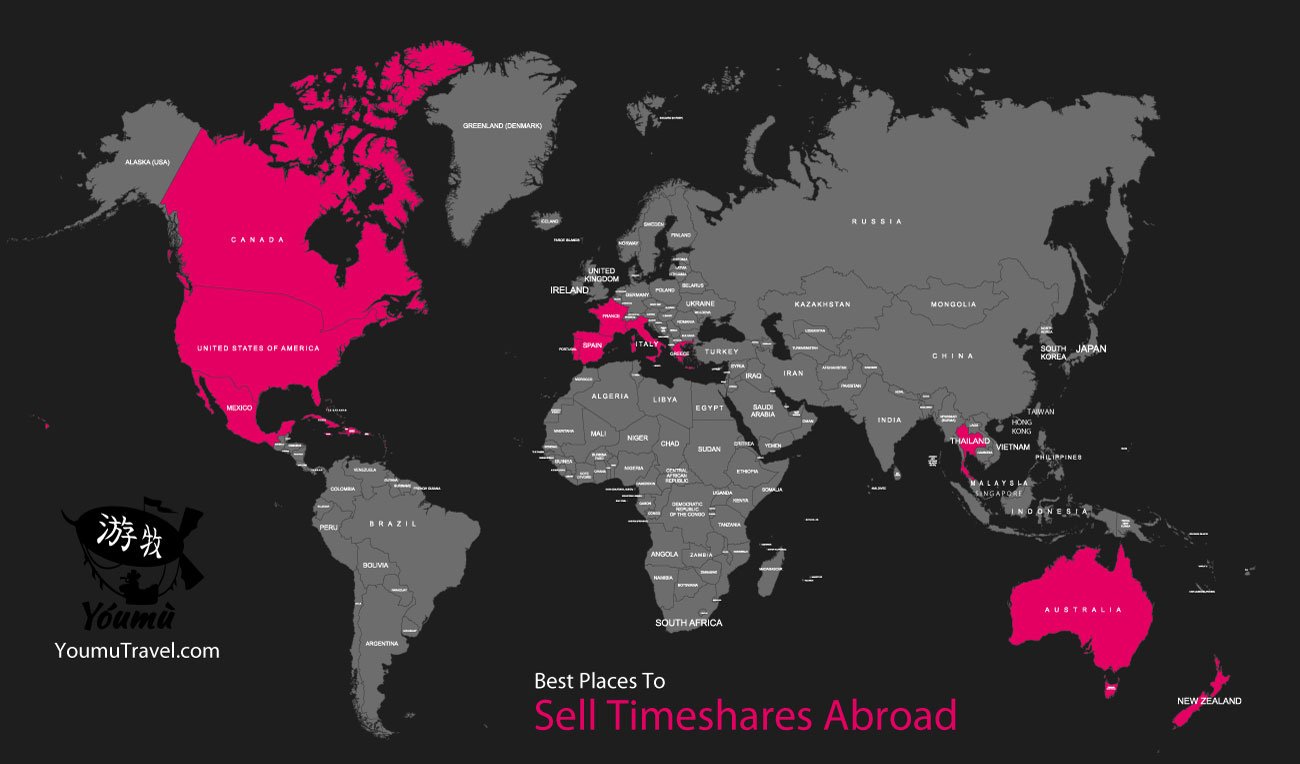
The Best Places to Sell Timeshares Abroad
Most major countries throughout the world have opportunities for those seeking to sell timeshares abroad. Here are some of the best places to sell timeshares abroad.
- The Caribbean
- Mexico
- USA (including Hawaii)
- Canada
- Spain
- Portugal
- Australia
- New Zealand
- France
- Greece
- Italy
- Thailand
Determine if this is right for you.
A timeshare sales representative should love working with people, be able to maintain energy, enthusiasm, and confidence, be comfortable with giving presentations, and be able to work long hours on their feet. They need to be able to accomplish this in the face of potentially reluctant customers. If that all sounds doable and enjoyable for you, then continue on with the following steps.
Get educated.
While a college degree isn’t necessarily required for some timeshare sales rep positions, it can give you a leg up in the industry. You should get a bachelor’s degree in business, hospitality, marketing, or a similar field. You’ll need to have a thorough knowledge in the art of sales, marketing theory, economics, and even psychology to help your persuasive abilities. Additionally, you are more likely to get hired with a college degree.
Garner experience.
Get work experience in the travel industry–such as a travel agent or in a realtor’s office–to get real life experience within your field. You’ll get real-world knowledge here that you couldn’t necessarily get from your textbooks. Additionally, familiarizing yourself with various travel destinations can be helpful as a timeshare sales representative. And last but not least, work experience will give you networking contacts which can help your career move forward.
Decide where you want to work.
Some sales representatives are able to work on-site at the resort that they sell for, and others work in offices and give thorough presentations about destinations. On-site sales rep positions are highly competitive, so it is recommended to work in an office first so that you have as much experience as possible before you apply for on-site jobs.
Get the appropriate documentation.
It is important that you have all the necessary legal documentation to work wherever you end up. Do ample research to see if you need a particular license such as a realtor’s license or timeshare license. If you do, some of these licenses require courses and exams.
Update your resume.
Before you start applying for positions as a timeshare sales representative abroad, make sure that your resume is professional and thorough. It should describe your education, experience, and objectives in one or two pages. Provide a description of your responsibilities at previous jobs and mention sales successes. Additionally, be prepared to write cover letters for each of the positions you apply to.
Apply!
Now you’re ready to send in your applications to your dream positions as a timeshare sales representative abroad. Once you have an interview, make sure to follow up with a thank you note to ensure that the hiring managers remember you.
Can you make money selling your timeshare?
It is unlikely for you to sell your timeshare at a higher price than you paid since timeshares typically lessen in value over time.
Where can I sell my timeshare legally?
Sites like eBay, Craigslist, and Timeshare Users Group can be really helpful for selling your timeshare.
How much do timeshare reps make?
Timeshare sales representatives can make between $70,000 and $120,000 a year.
How hard is it to sell timeshare?
It can be difficult to sell a timeshare because there are more timeshares available for resale than the demand for timeshares.
Is selling timeshare a good job?
This is up to you and your definition of a “good job.” If you want to work on commission like a real estate agent, enjoy amazing customers, and close transactions then selling timeshares might be a great opportunity for you.
How do you succeed in timeshare sales?
Some tips for success in timeshare sales include: work for the right company, do ample research on your target market, and time your endeavors well.
Language Tester Abroad Guide
Language testers conduct evaluations of test takers on their proficiency level in foreign languages.

This job has a somewhat low demand and requires considerable time and effort to succeed.
Demand
- Somewhat Low Demand
Experience & Degree
- Basic Understanding Required
- No Degree Required
- Certification Preferred
Citizenship
- Some Restrictions
This job is somewhat reliable with reasonable pay.
Pay Range
- Hourly: $17-$40/hr.
Reliability
- Somewhat Reliable
Housing
- Room and Board Not Provided
This job’s schedule is somewhat flexible but you’ll likely be stuck in one region of the world unless you’re a polyglot.
Location
- Little Flexibility
Schedule
- Somewhat Flexible
Language
- Fluency in English and Local Language
Who can be a Language Tester Abroad?
Anyone with a high level proficiency (near-native fluency or more) in a world language, as well as a working proficiency in English, can be a language tester abroad. Different companies and countries will require or recommend different certifications or test scores on top of that.
What are the responsibilities of a Language Tester Abroad?
The main function of a language tester is to evaluate a test taker’s skills in a particular language, but many other tasks can go into this.
Key Responsibilities
- Translation or localization of communications, functions, and features.
- Conduct tests in person, via video chat, or telephone.
- Provide information about the test taker’s performance to the examiner.
- Choose/prepare test materials.
- Create and test reading kits.
- Document and report any test defects.
What’s the typical schedule for a Language Tester Abroad?
The schedule for a language tester will vary depending on the institution they conduct tests for. It is possible that testing might be seasonal in one place, or year-round in another. The length of the test also depends on the type of test administered. It is difficult to hammer down a concrete schedule prediction.
Income Reliability
In general, language testing abroad is reliable.
Typical Job Duration
Language testing abroad can be short-term or long-term.
Estimated Hours Per Week
It’s estimated that you can work up to full time, 40 hours per week, as a Language Tester abroad.
Room & Board
Language testing abroad doesn’t typically provide room & board.
Language Tester Abroad – Country Map
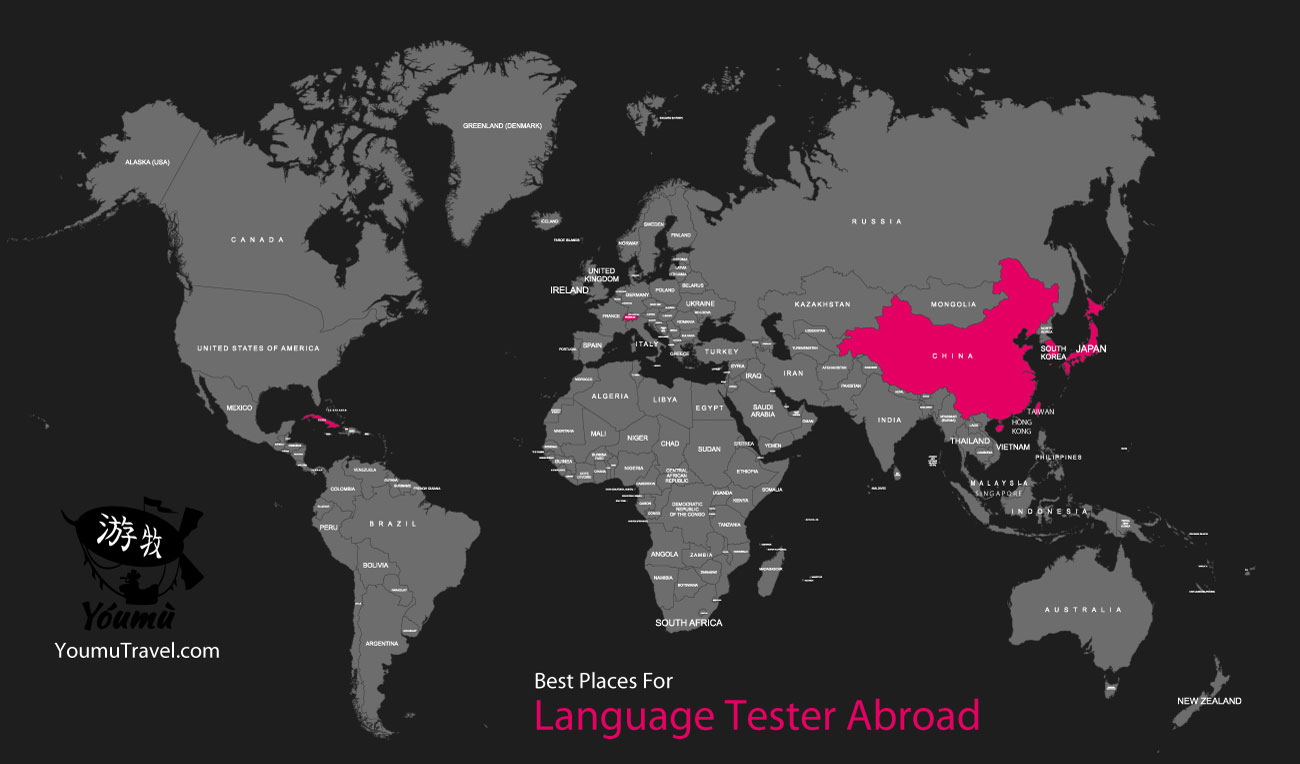
The Best Places to be a Language Tester Abroad
Most major countries throughout the world have opportunities for those looking to be a language tester abroad. Here are the five best places to be a language tester abroad.
- South Korea
- Cuba
- Japan
- China
- Switzerland
Become fluent in your chosen foreign language(s).
To become a language tester, you’ll have to be fluent in the languages you will be testing others on. It is recommended–if not required–that you score a 4 or above on the ILR proficiency scale. It is also important that you have a level 2 or higher proficiency in English, even if this is not the language you’ll be conducting tests on. You can also accomplish this by undergoing an accredited foreign language education program, which may ultimately help you land a language testing job.
Create your resume/CV.
You’ll want to include your languages and the level of proficiency on your resume, as well as any relevant language teaching experience–perhaps you were a tutor or a teacher’s assistant in foreign language classes. If so, include this information. It may also be beneficial to take language testing positions within your own country prior to seeking employment abroad to garner more experience.
Research.
Look around online for open language testing positions abroad–make sure the company or contractor you work with is seeking testers proficient in languages that you are proficient in. Also ensure that the position is located somewhere you are interested in traveling to and living in, as well as able to communicate there.
Apply.
Once you are educated in the necessary/preferred foreign languages, have a readable and comprehensive resume, and an understanding of the positions you’re hoping to get–send in your application!
Acquire necessary documentation.
Once you are offered a position, begin the necessary research and paperwork to get the necessary work visa so you can work legally abroad. Discuss with your new employer any aid or compensation in this task.
How do you get a foreign language certificate?
There are varying certification programs depending on what you want to do with your foreign language abilities. For example, if you want to be a translator, you’ll have to pass the ATA certification exam, which is a difficult, three-hour long test. You can also take accredited classes in foreign languages to become certified.
What are language proficiency tests?
Language proficiency tests evaluate how well a person can command the use of a foreign language in unscripted, real life situations.
How can I test my English language skills?
There are many popular tests you can take such as the TOEFL (Test of English as a Foreign Language) or the IELTS (International English Language Testing System).
What are the types of language testing?
There are usually five types of language tests: placement tests, diagnostic tests, achievement tests, proficiency tests, and aptitude tests.
How much does TEFL certification cost?
You know you need it, but how much does TEFL certification cost? Prices vary depending on some key factors, but expect to pay about $200 for very minimal online certification, and closer to $400-500 USD for online certification of enough hours to qualify for most TEFL jobs (at least 100).
Does duolingo give you a certificate?
No, Duolingo is great for casually learning a new language, but you do not receive a certification once the learning course is complete.
What are the different levels of language proficiency?
There are a few ways to score language proficiency. ACTFL Proficiency Guidelines has ten levels: novice, intermediate, advanced, and superior. Novice, Intermediate, and Advanced are all split into low, mid, and high as well. Additionally, ILR proficiency levels recognize five categories: 0 (No Proficiency), 1 (Elementary Proficiency), 2 (Limited Working Proficiency), 3 (Professional Working Proficiency), 4 (Full Professional Proficiency), 5 (Native/Bilingual Proficiency).
How can I pass a language test?
Study! Make sure you are prepared for the format of the test, practice the tasks you know that you’ll be tested on, and practice taking the test in a timed manner.
What is English level?
English levels are accepted standards for evaluating and labeling a person’s english language proficiency.
What is pre English test?
A Preliminary English Test is a program in Cambridge English. It will tell the taker what level of proficiency they have in english.
International Event Coordinator Guide
Event coordinators are in charge of every piece of event planning: choosing venues, arranging the event services, setting a price point for the event, keeping track of client approval.

This job has just an average demand and takes some experience to get.
Demand
- Average Demand
Experience & Degree
- At Least Two Years of Experience Required
- No Degree Required
- Easy Certification Required
Citizenship
- No Restrictions
This job is somewhat reliable with reasonable pay.
Pay Range
- Hourly: $15-$25/hr.
Reliability
- Somewhat Reliable
Housing
- Room and Board Not Provided
This job’s schedule is somewhat flexible but you can work in many parts of the world.
Location
- Somewhat Flexible
Schedule
- Somewhat flexible
Language
- Can get by with English only
Who can be an International Event Coordinator?
Anyone who can make connections and gain experience working with event vendors, as well as take an event course to learn more about industry trends and gain credibility can become an event coordinator.
What are the responsibilities of an International Event Coordinator?
As an instructor teaching English online you will be provided with a curriculum that outlines what you are to teach your students based on their proficiency level.
As an event coordinator, you are responsible for everything that happens before, during, and after the event.
Key Responsibilities
- Break down what is required of each event
- Plan with acknowledgment of time and budget limits
- Schedule the event and event speakers
- Choose best vendors for decor, catering, and entertainment based on research
- Bargain with vendors to accomplish most favored terms and hire personnel
- Manage operations of events such as the venue, invitations, etc.
- Perform day of checks to ensure everything has come together as planned
- Manage the happenings of the event and solve any issues that occur
- Do an evaluation report for the event’s success and submit it.
What’s the typical schedule for an International Event Coordinator?
This job requires a lot of long hours when preparing for an event as well as being available to take on new clients and events.
The schedule of an event coordinator is always changing, and therefore doesn’t fall into the 9-5 workday schedule of most jobs.
Income Reliability
In general, being an event coordinator is a reliable job that provides a constant stream of work.
Typical Job Duration
Being an event coordinator can be short-term or long-term.
Estimated Hours Per Week
It’s estimated that you can work full time, more than 40 hours per week, as an event coordinator.
Room & Board
An event coordinator position doesn’t provide room & board.
International Event Coordinator – Country Map
The Best Places to be an International Event Coordinator
Most major countries throughout the world have opportunities for those seeking to be an international event coordinator. Here are some of the best places for an international event coordinator.
- US
- UK
- Netherlands
- Germany
- Belgium
- Spain
- Portugal
- Canada
- Australia
Offer your time
Volunteer with companies and services that you will eventually be hiring as a coordinator. Being successful in planning events will be determined by your experience with caterers, florists, or another planner.
Become more responsible
Success as an event planner will require skills in all areas of the business, but when you’re learning your niche market being focused on certain areas will help you decide on the right vendors. Some things to keep in mind:
- What kind of events will you offer services for?
- Which companies do you like working with?
- What will your work budgets look like?
- Will you offer your clients full-service planning or day-of management?
Who you know is most important
Being able to network is key in event planning, so go to events and let people know who you are! Hand out business cards, and get contact information from the people you are meeting. Be sure to follow up with an email describing your event planning service as well as a simple “it was nice meeting you”.
Build an event portfolio
Show off your work with pictures, catalogs, and invitations of past events you were hired to plan. Put together each piece online to make your portfolio accessible and to easily present your stories to people.
Take a professional course
Your event knowledge and experience as an event planner are what will determine your success. Taking an event course will help you acquire credibility, learn more about trends in the industry, and even establish industry contacts.
Create a business plan
A business plan template can be found by simply searching in Google ‘event planning business plan’ if you are planning on starting an event business.
Legitimize your business
Register your event business by checking local government websites for the required licenses to run a business.
Plan a budget
It’s crucial to have finances in order while establishing yourself as an event planner.
Promoting
Use social media accounts, business cards, a website to help promote your event planning business, as well as a client contract.
Build your network of vendors
Focusing on networking with caterers, florists, photographers, suppliers, and entertainers among others.
What is an international coordinator?
The international coordinator is responsible for supporting the global operations of business and trade of the organization. They can work in a variety of commercial enterprises by meeting fiscal targets and solving the retention, manufacture, and dispersion problems.
What do event coordinators do?
An event coordinator executes events, by being in charge of everything from client meetings to the cleanup crew. They can be responsible for planning budgets, finding and reserving locations, controlling press outreach, hiring food and drinks, lining up sponsors, and inviting celebrity guests.
What does a roadshow coordinator do?
A roadshow coordinator is responsible for putting together and coordinating functions and roadshows to introduce to institutional investors and potential corporate clients.
What is the difference between an event planner and an event coordinator?
An event planner makes decisions about what is going to be done for the event, when and where it’s taking place and all the hows. The coordinator is responsible for making sure all the planned details actually come together and that all vendors perform appropriately.
What is another name for event coordinator?
- Event planner
- Convention planner
- Event manager
- Meeting planner
- Event facilitator
- Event moderator
What skills do you need to be an event planner?
- Able to communicate
- Solve problems
- Pay attention to details
- Be creative
- Bargaining and negotiating
- Budgeting
- Multitasking
Retail Buyer Abroad Guide
International retail buyers otherwise known as purchasing agents are people who research and buy various products for companies.

This job has a somewhat high demand but requires some experience to get.
Demand
- Somewhat High Demand
Experience & Degree
- At Least One Year of Experience Required
- Bachelor’s Degree Required
Citizenship
- Some Restrictions
This job is reliable with reasonable pay.
Pay Range
- Hourly: $11-$35/hr.
Reliability
- Reliable
Housing
- Room and Board Not Provided
This job’s schedule and location flexibility are decent.
Location
- Somewhat Flexible
Schedule
- Somewhat Flexible
Language
- Can get by with English only
Who can become a Retail Buyer Abroad
Anyone who has completed secondary education (high school) can find an entry-level position as a retail buyer, and anyone who has a bachelor’s degree in business with a specialization in retailing or retail management can achieve a higher position. With experience and knowledge, you can then get certified as a retail buyer.
Retail buyers should possess skills like purchasing expertise, decision-making, negotiation, analytical thinking, and be good with numbers.
What are the responsibilities of a Retail Buyer Abroad?
International retail buyers otherwise known as purchasing agents are people who research and buy various products for companies.
Key Responsibilities
- Keep track of stock levels
- Put together reports and predictions
- Noting what works and what doesn’t
- Finding and meeting quality manufacturers/suppliers
- Manage entry-level staff members
- Suggest ideas
- Looking for new products at trade fairs and fashion shows
- Discussing sales performances with other employees
- Settle terms of quantity, pricing, and delivery time.
- Financial administration
What’s the typical schedule for a Retail Buyer Abroad?
In this job, you can expect to work full-time 40-50 hours a week, and between traveling and negotiating you can also work overtime.
Income Reliability
In general, teaching English online is a reliable job that provides a constant stream of work.
Typical Job Duration
Teaching English Online can be short-term or long-term.
Estimated Hours Per Week
It’s estimated that you can work full time, 40 hours per week, as an online English instructor.
Room & Board
Teaching English online doesn’t typically provide room & board.
Retail Buyer Abroad – Country Map

The Best Places to be a Retail Buyer Abroad
Most major countries throughout the world have opportunities for those seeking to be a retail buyer abroad. Here are some of the best places for retail buyer abroad jobs.
- US
- Dubai
- Western Europe
- UK
- India
- China
Find out what it takes to be a buyer
If you want to be a retail buyer you make sure you know everything that’s expected of one, and if you have what it takes. Retail buyers are responsible for purchasing goods for stores, department chains, even corporate offices so they can sell these goods to customers.
A buyer is also responsible for visiting showrooms, training sales staff, thoroughly inspecting products, monitoring budgets, and will be expected to travel extensively. To do this, a buyer must possess great communication skills, be a gifted negotiator, a buyer has to understand the retail business and has to be excellent at math.
Complete secondary education
While most positions at companies will prefer a retail buying-related bachelor’s degree, most will require a high school diploma at a minimum. High schools can offer their students courses in merchandising, advertising, marketing, and business which could be extremely useful for preparing students for future careers.
Get a bachelor’s degree
Individuals who are hoping to become retail buyers can find work at an entry-level with a high school diploma, but the Bureau of Labor Statistics (BLS) states that more opportunities are available to those who possess a bachelor’s degree in business with a focus in retailing or retail merchandising and management. Most of these programs will require an internship, which will provide you with real-world experience.
Look for a job and become experienced
The easiest way to prepare for a career as a retail buyer is to work as a salesperson in retail in high school or college. The amount of jobs available is heavily dependent on the status of the retail industry. The BLS is predicting retail jobs in wholesale and non-farm products will see a 7% decline between 2018-2028, this is slower than average change for that period of time. If you get an entry-level retail job, you will more than likely receive training on-the-job, and this training period may last longer than a year.
Get a certification
Keeping up-to-date with the trends and conditions of the market as well as continuously taking education courses can give retail buyers an edge competitively, and help them advance in their careers. You can also stay alerted by joining a trade organization, like the National Federation or the American Purchasing Society which offers continuing education as well as opportunities for professional certification.
What does an international buyer do?
International Buyers are responsible for finding and purchasing products on behalf of companies.
What is a buyer position?
Buyers are mostly in charge of planning, choosing, and purchasing merchandise for retail businesses. This can include doing research on the market, testing and evaluating the products, analyzing competition, keeping track of purchasing orders, and building reports for management.
Is buyer a good career?
A professional buyer can be a powerful and glorious job in many ways, but all the glamour about the job hides the sharp intelligence and hard work needed to be successful in this very competitive field. Professional buyers inspect goods and operate within reasonable budgets to form competitive bids for items to resell.
What skills do you need to be a buyer?
Important skills for retail buyers
- Be confident
- Be able to make decisions and handle the pressure
- Possess skills in maths and IT
- Have quality team working skills
- Commercial awareness
- Possess effective organizational skills
- Possess interpersonal skills, especially in negotiating
How do I become a good retail buyer?
Retail buyers have to possess an idea of product and retail trends as well as significant experience with analytics. Buyers should possess a working knowledge of forecasting and resource planning as well as computer skills. Prior experience in retail is usually required, as well as excellent leadership, planning, and negotiating skills.
How do I get a job as a buyer?
You can get buying jobs with a high school diploma, however, bigger companies may see a bachelor’s degree in business or accounting as a necessity. Buyers can get some of the experience they need for their field through on-the-job training. Many organizations make certifications available also.
Do buyers make good money?
Buyers in an entry-level position with a year or less of experience can earn an average income (including bonuses, tips, and overtime pay) totaling $49,453 according to 299 salaries. A buyer with 5-9 years of experience can earn an average total income of $57,780 according to 2,408 salaries.
What is the difference between buyer and purchaser?
As descriptions, the difference between buyer and purchaser is that a buyer is a person who makes at least one purchase, and a purchaser is someone who purchases.
What is the difference between a buyer and a senior buyer?
A buyer is a trainee and the entry-level worker in the series of buyers and senior buyers are the individuals that are fully qualified within the buyer series.
Do buyers travel a lot?
Yes, Fashion buyers are either working indoors in an office or they are traveling, and visits to the retail establishment are also common. Since fashion buyers are expected to travel a lot and spend a lot of time searching for the greatest deals, they often have to put their professional advancement above their personal lives.
What are the four types of buyers?
The four types of buyers are popular styles from personality testing based on research done in the early 80s by David Merrill and Roger Reid to name the types of decision-makers: Drivers, Analytics, Expressives, and Amiable.
Import Export Jobs Guide
An Import/Export manager is in charge of the process and makes sure these processes comply with the laws and regulations of both US and foreign governments. They speed up the traffic flow both to and from destinations, this includes customs transportation and documentation.

This job has just average demand and requires some experience to get.
Demand
- Average Demand
Experience & Degree
- Basic Understanding Required
- No Degree Required
- Hard Certification Required
Citizenship
- Some Restrictions
The pay is somewhat low, but the job provides consistent work.
Pay Range
- Hourly: $10-$31/hr.
Reliability
- Reliable
Housing
- Room and Board Not Provided
This job is somewhat flexible and has many opportunities around the world.
Location
- Flexible
Schedule
- Somewhat Flexible
Language
- Can get by with English only
Who can get Import Export Jobs?
Anyone with the patience and determination to go through the extensive process of being qualified as an import/export agent can do so. There are several business contracts, certifications, and licensing needed to be successful as part of an import/export company.
What are the responsibilities of someone working Import Export Jobs?
As an import/export agent, you are responsible for ensuring quick and efficient processing of customs and import documentation.
Key Responsibilities
- Monitoring shipments to make sure regulations are being complied with
- Maintaining customer participation and relations in sales activities of the organization
- Carrying out a promise of effectiveness and efficiency of exports and imports
- Look for chances to reduce taxes
- Consulting clients with regards to insurance, duties, and taxes
- Assessing new sales opportunities and marketing, along with presenting these estimates to their respective managements
What’s the typical schedule for Import Export Jobs?
The schedule is changing and can be somewhat flexible, but the weekly hours can amount to full-time, at least 40 hours a week.
Income Reliability
In general, teaching English online is a reliable job that provides a constant stream of work.
Typical Job Duration
Teaching English Online can be short-term or long-term.
Estimated Hours Per Week
It’s estimated that you can work full time, 40 hours per week, as an online English instructor.
Room & Board
Teaching English online doesn’t typically provide room & board.
Import Export Jobs – Country Map
The Best Places for working Import Export Jobs
Most major countries outside the US will have many opportunities for those seeking import export jobs. Here are some of the best places for import export jobs.
- Brazil
- China
- Turkey
- India
- US
Become familiar with laws and rules
Each country has its own laws when it comes to importing and exporting, and you need to have a basic understanding of these laws if you want to make a career as an import/export agent.
At the very least you should know what products in a specific country are being restricted, how import and export procedures are being done, and possess resources to check the rules and customs duties and taxes readily.
(NOTE: Import-Export agents who are new, are recommended to have a professional customs broker to advise/tell you about procedures and regulations regarding importing and exporting.)
Learn international trade and important business disciplines
To be successful as an import-export agent, you will first need to know what your country is importing/exporting as well as prices and trends worldwide. Choosing the wrong sectors of import/export for your country will prevent you from finding buyers in the future. Details of your country’s trade data can be obtained from the International Trade Center.
International logistics and knowing the rates can be helpful to you when calculating prices for products, and to know what it will cost to ship something on a freighter. (Choose one freight forwarder as a partner for your firm to do future business with.)
Incoterms, the standard terms used by all exporters and importers are also very important to know! The most common are FOB, CIV, and EXW. International instruments and payments like a letter of credit (LC), documentary credit (DC), and TT-direct bank transfers are important to know about as well.
Specialize
There are innumerable amounts of products being imported and exported in each country around the world, and nobody knows all the sectors well. You have to choose one sector and locate one supplier that you will be representing. When selecting a supplier, it is best for the supplier to be somewhat familiar to you, and to find a dependable supplier who is sincere in their partnership with you.
Get necessary licensing and permits for your website and company
Once you know international trade and have chosen valuable sectors and business ventures, you need to establish the company. In order to set up the company, there will be some permits and licenses required to get started but typically the import/export agent won’t need an import/export license. Be sure to approach your country-trade related institution and find out all of the licenses that are required.
Form a commission agreement with the selected supplier
You must sign an agent-commission agreement with your supplier, within this contract you will lay out the terms for all potential buyers and establish your fee. You must come to an agreement about the following terms for your contract:
- Commission purchase price or % of sales, and agent details
- Details of suppliers
- Terms regarding how and when the commission fee will be paid to the agent
- Purchase price or sales of products that will be bought or sold
- Duration of the commission contract period
Keep in mind that the commission contract is the single tool of legality for protecting your fee, and so it would be beneficial to use the assistance of lawyers when drafting.
Try to find buyers of goods
Once you have a company and a supplier, it is time to find buyers and you can do this using online and offline methods.
Online resources:
- Sourcing agency services
- Social media
- Alibaba, Europages, Indiamart, or other international trading platforms
- Google and paid social media ads
Offline resources:
- Attending expos and trade fairs
- utilizing your personal relations and network
- The standard business meetings and trips
(NOTE: Offline methods are better for quality and online are better for quantity but the reliability for both is not too great.)
Analyze the purchase requests and buyers
After you have determined potential buyers for your clients, you have to calculate all the costs that concern exporting. Your goal is to find the best potential buyers for your supplier by taking into account the buyer’s reliability and length of cooperation as well as analyzing different buy-offers from various buyers.
Finally, you should ask for the letter of intent (LOI), and here the buyer will confirm that they are both willing and able to buy the product(s) with the offered conditions.
Introduce buyer to supplier
Once you have chosen a most promising buyer that may suit your supplier, you must formulate this presentation to the supplier as a way of communicating all relevant data and conditions stated by the buyer.
Try to have two or three offers from different potential buyers, this way your supplier can pick which offer will suit them best.
Assist with deal execution and get paid
After the supplier has chosen a buyer offer, you must execute the deal by letting the buyer know. You will assist with customs, logistics arrangements, packaging, and so forth. Once the supplier has been paid by the buyer, you will get the money for your commission fee as laid out in the contract that was signed previously.
Keep looking for new suppliers and buyers
Once you have finished one successful deal, it is time to grow. You can keep finding new buyers for new suppliers and sign new contracts. It will always be important to continue finding business opportunities since you will get more opportunities in business the more connections and experiences you possess.
How can I get an import-export license?
How to Build a Business with Import-Export License
- Pick your products.
- Choose a name for the company, if your firm hasn’t been registered.
- Register the firm, if you have not already.
- Apply for the Importer Exporter Code (IEC) with DGFT, and pay the fee of Rs.
How do import Exports work?
Here’s how to start an import/export company.
- Acquire your business essentials
- Choose a product to export or import
- Find your supplier
- Choose a price for your product
- Search for customers
- Get the logistics settled
Which product is best for Import Export?
- Export Organic Food
- Import Oil
- Export Sugar
- Export Spices
- Export Processed Food Items
- Export Tobacco
- Export Tea
How do I start Import-Export?
Here’s how entrepreneurs can start an import/export business.
- Lay the groundwork
- For the business, get a PAN card
- Open an active account
- Get the IEC issued
- Obtain required documents for IEC
- Get the Registration cum Membership Certificate (RCMC)
- Find available opportunities with exporters
What are the documents required for IEC?
Required documents for IEC registration
- The Individual’s, Company’s, or Firm’s copy of the PAN card
- The voter ID, a copy of a passport, or the Aadhar card for the individual
- Cancel cheque copy of the individual’s, firm’s, or company’s current bank account
- A copy of the electricity bill for the premises or a copy of the rent agreement
What is Bill entry?
A bill of entry is a legal document filed by customs clearance agents or importers at or prior to the arrival of imported goods. It’s sent to the Customs department as a step in the customs clearance procedure.
Is import-export a good business?
Yes, the import/export business is one of the high-profit enterprises. The low overhead means the majority of the money an agent makes on a commission is theirs. However, setting up a profitable business needs dedication and quality knowledge of the import/export business itself.
Is it better to export or import?
More exports provide more domestic activity for the economy, more production, revenue, and jobs. More imports mean that more money is leaving a country that is being brought in through export sales.
Do I need an export license?
The majority of the goods exported by the US do not require you to have an export license; they are allowed to be exported through the designation-no license required NLR. But, there are a few choice classes of goods that do require you to have an export license.
Can I export milk from India?
Several milk products are exported from India, including case in products, cheese, skimmed milk powder, ghee, curd, and cream.
What does India export to the USA?
In 2018, the highest export categories from India to the US were stones and precious metals (approx. $7.9 billion), aircraft ($2.9 billion), mineral fuels ($6.7 billion), machinery ($2.2 billion), and organic materials (approx. $1.6 billion).
How do I start an export business from home?
Starting an Import/Export business from home.
- Select your products
- Build a website
- Be proactive in finding people to work with online
- Do the paperwork
- Set up a method of shipment
What are examples of export?
Export by definition is a product that is sent or brought to another country to be traded and/or sold. One example of export is rice being shipped to many other countries from China to be sold.
How do I import goods?
Five basics for How to Import
- Choose a country
- Look for suppliers
- Research the taxes and duty
- Choose a dependable customs broker and freight forwarder
- Make sure the goods are shipped on time
Travel Nurse Jobs Guide
A travel nurse is a RN (Registered Nurse) who traverses the country and the globe working short-term roles in hospitals and other medical facilities to provide care where it is most in need.

This job is in high demand but takes a considerable amount of time and effort to become one.
Demand
- High Demand
Experience & Degree
- At least Two Years of Experience Required
- Hard Certification Required
- Native English Speaking Preferred
Citizenship
- No Restrictions
This job is very reliable and pays well.
Pay Range
- Hourly: $25-$45/hr.
Reliability
- Very Reliable
Housing
- Room Sometimes Provided
This job’s schedule is not flexible However you can work almost anywhere in the world.
Location
- Flexible
Schedule
- Not Flexible
Language
- Fluency in English Preferred
Who can Get Travel Nurse Jobs
Someone looking to be a travel nurse must be a registered nurse with at least one year of specialized care experience under their belt. To be a registered nurse, you’ll have to complete a college degree in nursing at an accredited program and pass the NCLEX.
What are the responsibilities for Travel Nurse Jobs?
Travel nurses provide healthcare to locations suffering from a nursing shortage, and many tasks go into providing quality care.
Key Responsibilities
- Perform examinations on patients and discuss with them their symptoms and medical history.
- Based on information ascertained from examinations and conversations, make decisions about the care they need and the care plan going forward.
- Confer information about patients with other healthcare professionals to outline how to achieve the goal of improving patient health.
- Administer medication and treatment.
- Conduct research.
- Collaborate and cooperate with other healthcare professionals to give quality care to each and every patient.
What’s the typical schedule for Travel Nurse Jobs?
Nurses work long, hectic hour domestically, and so travel nurses experience the same. Shifts can be long–sometimes 12 hours or more, depending on the situation–and variable. As for the timeline of an assignment, they usually last 13-26 weeks.
Income Reliability
In general, travel nursing is a reliable job that provides a constant stream of work.
Typical Job Duration
Travel nursing can be short-term or long-term.
Estimated Hours Per Week
It’s estimated that you can work full time, 40 hours per week or more, as a travel nurse.
Room & Board
Travel nursing typically provides room & board.
Travel Nurse Jobs – Country Map
The Best Places to work Travel Nurse Jobs
Most major countries throughout the world have opportunities for those seeking travel nurse jobs. Here are some of the best places for travel nurse jobs.
- USA
- Australia
- New Zealand
- China
- Middle East
- Netherlands
- Germany
- Switzerland
Get a nursing education.
You will have to have a high school diploma or equivalent to enter a nursing degree program. Once you have completed your accredited nursing school, you will be able to take the NCLEX exam. You can get an Associate Degree in Nursing, an Associate of Science in Nursing, or a Bachelor of Science in Nursing Degree–which program you choose will change which nursing positions you are eligible for.
Take and pass the NCLEX.
The NCLEX (National Council Licensure Examination) is an exam that, if you pass, qualifies you as a Registered Nurse or Licensed Practical Nurse in the USA.
Garner experience.
The minimum experience for a travel nurse is one year, so you’ll need one year of nursing experience at least before you can become a travel nurse. It is recommended to apply for jobs in Compact States–states that accept nursing licenses from other states that are a part of the Nurse Licensure Compact. There are 24 states that are part of the NLC, so there’s many options for you to choose from. This might allow you to get some travel experience as well, if you’re willing to relocate for positions in these states.
Maintain a tax home.
Most travel nursing pay packages include tax-free portions, but to qualify for these, you must have a legitimate tax-home. If you don’t, you’ll be required to pay income tax on the tax-free money.
Determine your job preferences.
It’s a good idea to decide where you want to work in terms of countries, states, and cities. It’s important to determine your preferences so you can apply for agencies that will provide you with positions that fill your personal requirements and preferences. Additionally, decide what you want from your pay package, as different agencies provide different benefits. Do research on what’s out there before applying to agencies, so you don’t apply to one that you won’t be happy at.
Research travel nursing agencies.
Do research online to see what agencies might be best for you. There are websites such as Highway Hypodermics and Travel Nursing Central that display reviews from nurses who have been employed by various agencies, so you can get real accounts of what agencies might be best. You can also try a Lead Generator, which will provide your information to agencies who can then contact you directly. BluePipes is also a great resource for people looking for jobs in the medical field–it’s a networking site specifically for healthcare professionals. Lastly, ask around! Your colleagues are likely to know of resources or people you can connect with to find the best travel nursing agency for you.
Create your travel nursing profile.
This includes the job application, skills checklist, and references. These submission profiles are a necessity to even be considered as a travel nurse.
Acquire appropriate documentation.
There is going to be a lot of paperwork involved in becoming a travel nurse, so make sure this is on your radar in advance. Make sure you have your licenses, certifications, recent medical records, and travel documents. Talk with your employer about compensation for the cost of acquiring these documents.
Acquire an assignment.
Once you’ve completed the above steps, you’re ready to apply, interview, and get hired. Negotiate the aspects of your contract that you want tweaked, and then you’re on your way!
How much do travel or nurses make?
It is entirely possible for a travel nurse to earn more than $3,000/week or over $50/hour, and often their employer pays for housing accommodations for the nurse. All told, a travel nurse is able to make over $100,000 per year.
Can I travel the world as a nurse?
Absolutely. Travel nursing is an amazing opportunity to see parts of the world you otherwise might not have had an opportunity to, as well as meet amazing people from all over the globe.
Is Travel Nursing worth the money?
This is up to you and your perspective. If you have a passion for helping people, and a love for traveling, then travel nursing might be the ideal job for you. If aspects of the job seem unappealing, then perhaps reconsider.
What states pay travel nurses the most?
Some states that pay travel nurses the best include California, Texas, Massachusetts, Washington, and New York.
Are travel nurses in demand?
Yes! So many people across the country and around the world need nursing care–travel nurses are highly sought after. For example, California has a law that requires a particular nurse-to-patient ratio, and so there is always positions available for travel nurses there.
Can you be a travel nurse with no experience?
No. Someone looking to be a travel nurse must be a registered nurse with at least one year of specialized care experience under their belt.
What is the hardest nursing specialty?
Every specialty is going to have its difficult aspects, but some of the reportedly most difficult specialties include (but are not limited to): oncology, hospice, medical-surgical, emergency room, and more.
Do travel nurses get free housing?
Yes, frequently. Travel nurses are able to enjoy prepaid accommodations while on assignments. There is also the option to receive a stipend that enables nurses to find housing that they might prefer over the provided accommodation.
Where do most travel nurses go?
Travel nurses are paid the best in states like California, Massachusetts, Texas, Washington, and New York, so there are likely many travel nurses who choose these locations. Often, the nurse is able to choose where they want to go.
What country needs nurses the most?
There are many countries who need nurses, and it is difficult to rank them. Some of the best countries for nursing careers include New Zealand, Australia, Denmark, and the USA. As for countries who might need more nurses than others, poorer countries top the list. Haiti, for example, needs many nurses because of political instability and frequent natural disasters.
International Archaeologist Jobs Guide
Archaeologists observe past human activity through excavation, dating, and interpreting items and sites of historical interest.

This job has a somewhat high demand but it takes considerable time and effort to succeed.
Demand
- Somewhat High Demand
Experience & Degree
- At Least Two Years of Experience Required
- Bachelor’s Degree Required
Citizenship
- Some Restrictions
This job is reliable, pays well, and can sometimes include room & board.
Pay Range
- Hourly: $19-$47/hr.
Reliability
- Reliable
Housing
- Room Sometimes Provided
This job’s schedule has little flexibility but you can work in some great locations around the world.
Location
- Somewhat Flexible
Schedule
- Little Flexibility
Language
- Can get by with English only, but it can be very helpful to be proficient in a foreign language.
Who can become an Archaeologist?
Archaeology is a field that is available to anyone who has completed at minimum, a master’s degree in Archaeology or Anthropology or similar science field of study. As well as achieving extensive fieldwork experience.
What are the responsibilities of an Archaeologist?
Archaeologists observe past human activity through excavation, dating, and interpreting items and sites of historical interest. They undertake excavation projects, commonly known as digs, preserve archaeological remains and gather data that informs their knowledge and understanding of the past.
Key Responsibilities
- Use different procedures to find quality sites such as geophysical surveys and aerial photography.
- Analyze, record, and preserve artifacts.
- Utilize computer applications to record and interpret sites and discoveries to create simulations of how it may have appeared in the past.
- Creating, maintaining, and combining written, photographic, and sketched records and electronic databases.
- Overseeing and instructing excavation/ research personnel
- Dating, interpreting, collecting, and analyzing data from finds.
- Drafting reports, papers, and other written forms for publication.
- Statistical, mathematical, and computational modeling.
- Assess building developers ‘ planning applications.
What’s the typical schedule for International Archaeologist Jobs?
This job can require weeks at a time of long hours while on an excavation, and maintaining the site. As well as documenting and preserving all finds before sending them for laboratory analysis.
This position does not guarantee a 9-5 workday like most jobs, and it can happen where you are not working for a time between projects.
Income Reliability
In general, Archaeology is a reliable job that provides constant work in some form or another.
Typical Job Duration
Archaeology is typically a long-term job.
Estimated Hours Per Week
It’s estimated that you can work full time, 40 hours per week, as an Archaeologist.
Room & Board
Archaeology doesn’t typically provide room & board.
International Archaeologist Jobs – Country Map
The Best Places for International Archaeologist Jobs
Most major countries throughout the world have opportunities for those seeking international archaeologist jobs. Here are some of the best places for international archaeologist jobs.
- UK
- US
- Mexico
- Peru
- Turkey
- Jordan
- China
- Cambodia
Complete a Bachelor’s Degree
Studying to be an archaeologist at an undergraduate level consists of a four-year, Bachelor of Arts (BA) in Archaeology as a focus, an Anthropology degree program, or a related program in the social sciences like Sociology.
Complete a Master's degree
Archaeology requires a master’s degree as a minimum, at the graduate school level students can pursue a Master of Arts (MA) in several focuses such as Archaeology/ Applied Archaeology, or Anthropology. While some Master of Science (MS) degree programs are an option, they might add another focus, such as a Master of Science in Archaeology and Cultural Resource Management.
Master’s degree programs are usually two years long and will require a final master’s thesis or project. (Note: Some programs might also include a foreign language requirement in which students will need to prove reading proficiency in a foreign language.)
Become experienced
To achieve a position in the field, future archaeologists typically need to possess significant experience in fieldwork, which can usually be obtained through opportunities during their undergraduate and graduate studies. These students can use internships, field training, research opportunities, or other lower-level positions as hands-on training.
Look for a position
Qualifications outside of education for archaeology and its required experience can include personality traits such as great communication skills and critical thinking. Depending on the position, some archaeologists may be required to demonstrate leadership skills, a strong work ethic, physical stamina, and be detail-oriented.
Moving forward in your career
Since some positions might prefer candidates with leadership skills as mentioned above, students can be encouraged to continue their education and earn a Doctor of Philosophy (Ph.D.) in Archaeology. This will provide students with advanced knowledge and could enable them to travel and work internationally.
A Ph.D. in Archaeology program typically takes more than four years to complete because of the requirements involved. Students will have to complete a dissertation, fulfill instructing responsibilities, and show proficiency in reading in two foreign languages.
How do I get a job in archaeology?
- Earn a bachelor’s degree in anthropology or a similar field.
- Work as an intern.
- Earn your master’s degree/ consider a doctorate.
- Find a job.
Do Archaeologists make a lot of money?
In 2018, archaeologists made a median annual salary of $62,410. With the highest 25 percent earning $80,230 that year, and the lowest 25 percent earning $48,020.
What qualifications do I need to be an archaeologist?
For entry-level positions such as a museum technician, a field assistant, or a surveyor, a bachelor’s degree is required. Aspiring archaeologists usually seek a degree in anthropology, which includes studies in biological anthropology and linguistics, cultural anthropology, and archaeology.
Is there a demand for archaeologists?
According to the Bureau of Labor Statistics, positions in archaeology will grow 21 percent between 2010 and 2020. However, because the field is small, growth will only create 1,300 new jobs through 2020.
How hard is it to get a job in archaeology?
Positions in archaeology are very competitive and usually low paid professions. You need a degree in archaeology, usually a master’s, a lot of experience which can be gained while earning your degrees.
Is an archaeology degree worth it?
In regards to financial worth to each archaeologist, having a degree is a great advantage as far as being able to find work in professional archaeology. The higher your level of academic qualification, the more the individual will usually earn.
Is Archaeology a good career choice?
It’s an exciting career if it’s something you are very passionate about. The satisfaction of a discovery is unlike any other. However, the job doesn’t pay very well and there are plenty of hardships in the job as well.
Does Archaeology require math?
Yes, archaeologists use math very often in their work, since measuring everything and calculating weights, distances, and diameters are important.
How long does it take to become an archaeologist?
For most archaeologists, you start training through an undergraduate degree, usually, a BA or BS which will typically take 3 years of study full-time. Next is for most students to do a one year Honours degree in an archaeological field.
Do archaeologists travel?
For archaeologists whose research areas are far from where they live, may have to travel to perform surveys, laboratory analyses, and excavations. However, many archaeologists don’t travel often.
How do archaeologists get paid?
The salary an archaeologist earns depends on many factors according to the Society for American Archaeology, such as education level, years of experience, and place of employment. A field work assistant who is just starting with a bachelor’s degree for example will typically earn $10-12 USD an hour.
How long to get a Ph.D. in anthropology?
A Ph.D. in anthropology will typically take 3- years to complete, but it may take longer. The amount of coursework will vary by specialization, but will usually emphasize ethnography, diversity, ethics, social analysis and action, history, psychology, and sociology.
Do archaeologists travel?
It depends on your position, but archaeological expeditionists do all over the world in order to find dig spots. Some travel to conduct surveys, excavations, and laboratory analyses, but most archaeologists do not.
What job can Archaeology get you?
Here are some positions you can get with an archaeology degree:
- Academic researcher.
- Archaeologist.
- Conservator.
- Heritage manager.
- Historic buildings inspector/conservation officer.
- Museum education officer.
- Museum/gallery curator.
- Museum/gallery exhibitions officer.
International Geologist Jobs Guide
Geologists are scientists who study earth’s materials, research earth processes, and analyze the earth’s history.

This job has a somewhat low demand and requires considerable time and effort to succeed.
Demand
- Somewhat Low Demand
Experience & Degree
- At Least One Year of Experience Required
- Master’s Degree Required
Citizenship
- Some Restrictions
This job is reliable and pays well.
Pay Range
- Hourly: $25-$90/hr.
Reliability
- Reliable
Housing
- Room and Board Not Provided
This job’s schedule has little flexibility but you can work in some great locations around the world.
Location
- Somewhat Flexible
Schedule
- Little Flexibility
Language
- Can get by with English only but a foreign language is strongly encouraged.
Who can Get International Geologist Jobs?
Geologists are scientists who study earth’s materials, research earth processes, and analyze the earth’s history. They observe the effect of natural processes on the earth, the natural environment is affected by the earth’s materials in order to try and understand the chronology of earth’s materials.
What are the responsibilities for International Geologist Jobs?
Geologists are scientists who study earth’s materials, research earth processes, and analyze the earth’s history.
Key Responsibilities
- Inspect construction projects and advise construction firms and government agencies to analyze engineering problems, foundation design, use test equipment, and drilling machinery, by applying geological knowledge and land use resource management.
- Discuss geological findings through written articles, participation in conferences, and teaching geological science at a university.
- Categorize construction material deposits and assess their characteristics and suitability for concrete aggregates, like road fill.
- Measure Earth’s characteristics such as gravity and magnetic fields using equipment such as seismographs, magnetometers, gravimeters, and torsion balances.
- Use aerial photographs, charts, and survey results to locate and estimate probable underground water deposits, natural gas, oil, and mineral ore deposits.
- Conduct geophysical and geological studies to provide information for use in site selection, regional development, and development of public works projects.
- Advise issues such as waste management, restoration of contaminated sites, and route and site selection by assessing surface water and ground movement.
- Testing industrial materials such as diamonds, abrasives, soils, and rocks using precision instruments, optical, x-ray, heat and acid for their geological characteristics.
- Identify risks of natural disasters and advise on how damage can be mitigated.
- Develop applied software for the interpretation and analysis of geological data.
- Plan/conduct geological, geophysical, and geochemical field studies and surveys.
- Study the composition, history, and structure of the Earth’s crust.
- Use results of lab research and fieldwork to prepare geological maps, cross-sectional diagrams, charts, and reports concerning land use, resource management, and mineral extraction.
What’s the typical schedule for International Geologist Jobs?
Geologists can spend five to fifteen hours a day outdoors reviewing land in the field or giving consultation on environmental issues, typically during the warmer months of the year.
Income Reliability
Being a Geologist is a reliable job that provides a constant stream of work.
Typical Job Duration
Geology is typically long-term.
Estimated Hours Per Week
It’s estimated that you can work five to fifteen hours per day for most of the year.
Room & Board
Work as a Geologist doesn’t provide room & board.
International Geologist Jobs – Country Map
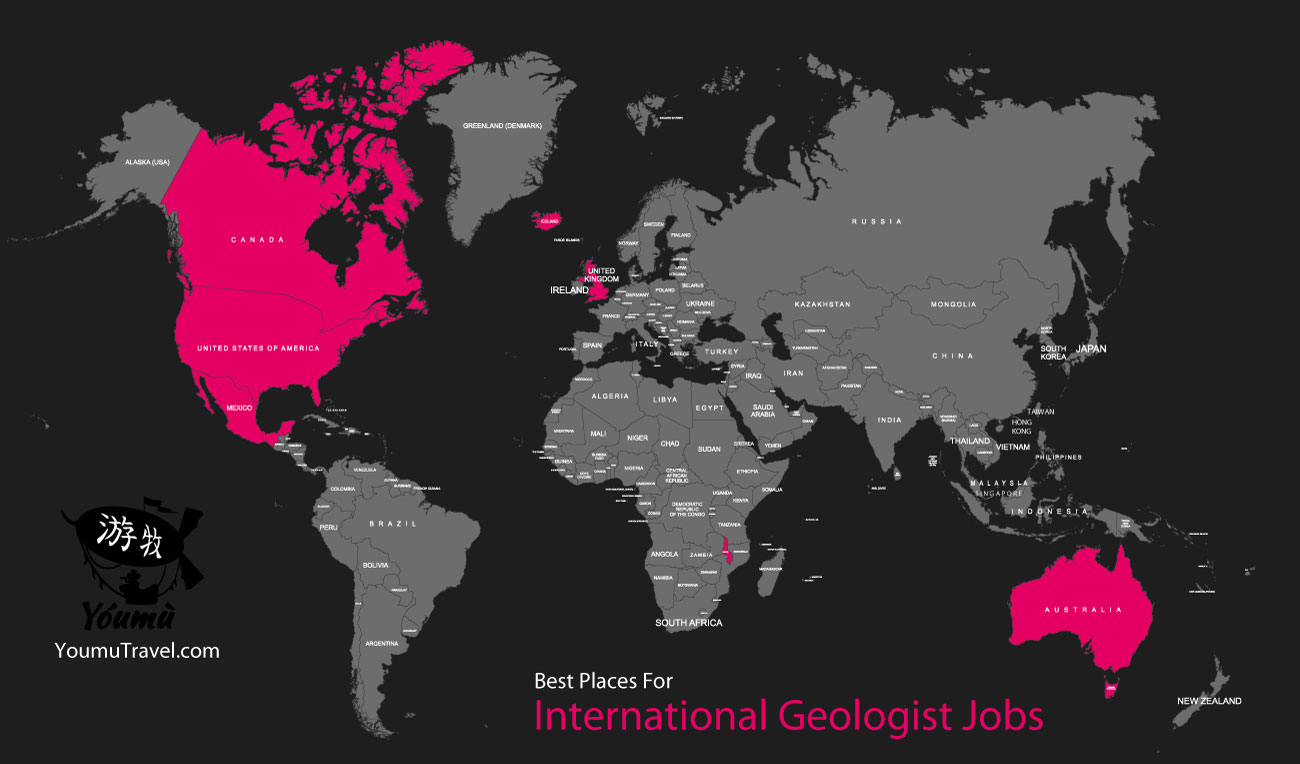
The Best Places for International Geologist Jobs
Most major countries throughout the world have opportunities for those looking for international geologist jobs. Here are some of the best places for international geologist jobs.
- USA
- Canada
- Malawi
- Australia
- Mexico
- Scotland
- Iceland
Learn basic computer science skills and GIS
In today’s world, geologists depend on computers and GIS (global information systems) to understand and map the earth. While in school make your resume stand out to employers and universities by building a strong understanding of GIS programs, basic computer coding, and scientific analysis.
(NOTE: If your chosen college/university does not offer computer science and GIS courses, consider a summer course at a community college before beginning your four-year degree.)
Make sure your school has a Geology program
Do your research and choose a school either local or out-of-state that is noted for their dedication to Earth Science and Geology programs.
(NOTE: It will be cheaper to attend a school in your state, but consider an out-of-state school if they appear to have a more dedicated geology focus.)
Earn a Bachelor of Science degree in Geology or related program
Nearly every university offers its students Mathematics and Physical Science programs, but you need to be sure your school offers a Geology-specific major that you can apply for. Once you’ve declared Geology as a major, you can choose a minor(s) that relate to your desired future in the geology field. For example: if you want to teach geology then minor in education, if you want to someday work with a GIS company then minor in computer science, etc.
Intern in a lab or apply for field research positions
The science department of your school can help you find job openings, and keep you connected to your professors who may need you for extra help in the lab. Check to see if your school has an online job board or career advisory center, and look for scientific entry-level jobs. While learning in a classroom is beneficial, an internship or lab position will help prepare you for a career.
Be a part of a local geology organization
The American Geosciences Institute (AGI) has many local geologist societies which the national organization runs. The American Institute of Professional Geologists (AIPG) focuses on service to the public. Both of these organizations require some kind of experience in the field and a BS for a geology-related major to join. Being part of a professional organization can improve your resume and is a great opportunity to network with professional geologists.
Consider educational and informative jobs
Universities that offer earth science, geology, or related fields of study could have job opportunities. Museums might be looking for geologists to catalog items and perform field research. High schools may need geologists to teach science courses.
No matter which you choose, it is encouraged to have a master’s or Ph.D. in geology to improve your credentials. Be prepared to discuss the ability to work in a team, your ability to analyze, and experiences with scientific principles as they relate to geology in an interview.
Look for a job in energy, international mining, or GIS
Mining companies use geologists all over the world to supervise and identify mining sites. Geologists with significant science and computer skills can be used by energy companies to find new sources of energy. Geologists can map out resources and geography in a specific area for GIS companies.
(NOTE: You might not need a master’s degree for these positions but it may help you to advance past entry-level positions.)
Begin a scientific career with college connections
If being a teacher, museum researcher, or a company worker does not sound appealing to you, you could always apply for a position in a private or university-run lab around the world. The jobs do not pay as well as other positions, but your career will be completely focused on research and learning.
No matter what your degree, your professors and internship contacts can be used to find the best position for you.
Become a licensed geology practitioner
If being a teacher, museum researcher, or a company worker does not sound appealing to you, you could always apply for a position in a private or university-run lab around the world. The jobs do not pay as well as other positions, but your career will be completely focused on research and learning.
No matter what your degree, your professors and internship contacts can be used to find the best position for you.
Are there specific types of Geologists?
- Database Geologist
A database geologist maintains and updates the database of drilling and assay results acquired during exploration and mining. This involves receiving incoming new data, uploading it, and constantly ensuring that data is correct and up to date.
- Engineering Geologist
An engineering geologist works with engineers to carry out detailed geological mapping before major construction work, assesses the qualities of building stone and quarry rocks used for building and road construction, and assesses geological structures for open-cut and underground mine stability and safety, and foundations for a building.
- Environmental Geologist
An environmental geologist studies the nature of ground and surface waters, soil movement, erosion and degradation, salinization and coastal erosion; the effects of pollution and human activity on rivers and seas; and the environmental effects of mining, nuclear energy, and waste disposal.
- Field/Exploration Geologist
A field/exploration geologist carries out surveys to determine the geological structure, distribution, and age of rocks and investigate where particular natural resources are likely to be found.
- Geochemist/Mineralogist/Petrologist
A geochemist/mineralogist/petrologist studies the mineral and chemical composition of rocks using equipment such as optical and electron microscopes, X-ray diffraction, atomic absorption, and mass spectrometry. They may also be involved in examining the transport of pollutants through rock masses.
- Geomorphologist
A geomorphologist studies the evolution and age of landforms and land surfaces.
- Hydrogeologist
A hydrogeologist evaluates and manages the quality, quantity, reliability, and sustainability of all aspects of water resources. They are concerned with groundwater and the soil-moisture variation, amount, speed and direction of groundwater flow, extraction and replenishment of groundwater, and water chemistry and pollution.
- Mathematical Geologist
Mathematical geologist models the outcome of geological processes by devising and applying the most appropriate data and computer models.
- Mine Site Geologist
A mine site geologist monitors and controls the grade (or quality) of the ore mined. They also advise on assessments of the areas of an ore body that should be mined at a particular time, and on defining the ore limits at the mine based on economic considerations.
- Paleontologist
A paleontologist examines, classifies, and describes animal and plant fossils found in sedimentary rocks. Understanding the evolutionary order of the fossil record is particularly important in oil exploration.
- Petroleum Geologist
A petroleum geologist explores and charts stratigraphic arrangement, composition, and the structure of the Earth’s surface layers to locate petroleum and natural gas. They estimate the size and distribution of reserves using seismic and geological survey evidence and recommend the most appropriate drilling and production methods.
- Stratigrapher
A stratigrapher deals with the order in which sedimentary rock strata have been deposited, their age, and the processes by which they were formed.
- Structural Geologist
A structural geologist studies rock structures in field mapping and in laboratory studies to reveal the history of folding and faulting, and how these structures can influence mine engineering and building foundations. They also conduct studies in water flow in aquifers.
- Geologist
Geologists study the nature, composition, and structure of the earth to locate materials and minerals and to increase scientific knowledge. They also advise on the extraction of minerals, as well as on environmental protection, the rehabilitation of land after mining, and on civil engineering projects.
What are the jobs of a geologist?
A Geologist studies processes in the earth such as landslides, floods, earthquakes, and volcanic eruptions to map and survey the land and sketch safe building plans. While investigating earth materials, geologists look for oil, natural gas, water, and procedures for extracting them, not just minerals and metals.
Do geologists make good money?
According to sources, the average salary of geologists comes to $59,147, with some graduate geology students starting as low as $50,000 and higher positions making between $90,000 and $230,000 annually.
Is there a high demand for geologists?
According to the Bureau of Labor Statistics, the employment of geoscientists is expected to grow 6 percent between 2018 and 2028, the average rate for all occupations. The demand for geoscientists in the future is being spurred by the need for energy, responsible resource and land management, and environmental protection.
What are the highest paying geology jobs?
Pay-wise, Petroleum geologists live in the exclusive height of the top of the 1 percentile, at least 99.9% of the time.
Is geology a difficult course?
The “hard rock” courses such as mineralogy, structure, and petrology can be difficult for most individuals, but the students who do well in these areas usually love it. Your department and your background with chemistry could have you lumping in geochemistry and carbonates with the ‘harder’ courses.
What skills do you need to be a geologist?
- Excellent communication and analytical skills
- Enthusiasm, perseverance, patience, and passion about the natural and geological environment
- Flexibility, versatility, and ability to work with people and teams from all backgrounds
- Mapping techniques
- Be able to understand the basics of engineering principles
Are geologists happy?
Geologists are average in terms of being happy, with ratings of 3.3 out of 5 starts, geologists are in the top 46 percent of careers for happiness.
How many hours do geologists work?
Geologists can spend five to fifteen hours a day outdoors reviewing land in the field or giving consultation on environmental issues, typically during the warmer months of the year.
Is Geologist a good career?
Geology has a good career outlook since it is expected that more jobs in the geology field will be available in the future. Job versatility is also another good career factor, while some study rock formations on Earth, others will study rocks and minerals from other planets.
Where do most geologists live?
- Houston-Sugar Land-Baytown, TX.
- Midland, TX.
- Anchorage, AK.
- Dallas-Plano-Irving, TX.
- Tulsa, OK.
Which country is best for geologists?
- Australia and New Zealand.
- Scotland.
- Norway.
Is it hard to get a job in geology?
It is actually easier to get a job as a geologist than one might believe if you know how to go about it effectively. Since the field of geology is so wide and there are many jobs available, outside the mineral resource division. To get a job in the field of geology competence is key.
Traveling Hair Stylist Jobs Abroad Guide
Traveling hair stylists will travel to meet their customers at the customer’s preferred location, such as their home, to provide hair cuts, colors, and styles.

This job has just average demand and requires some experience to get.
Demand
- Average Demand
Experience & Degree
- At Least One Year of Experience Required
- No Degree Required but Certification Preferred
- Native English Speaking Preferred
Citizenship
- Some Restrictions
This job is somewhat risky, typically full-time, with reasonable pay.
Pay Range
- Hourly: $13-$40/hr.
Reliability
- Somewhat Risky
Housing
- Room and Board Not Provided
This job’s schedule is flexible and can work in many parts of the world.
Location
- Somewhat Flexible
Schedule
- Flexible
Language
- Can get by with English only
Who can be a traveling hair stylist?
You should be a certified hair stylist with some experience in the business before you can embark on your career as a traveling hair stylist. You should also be prepared to handle the business side of your career, not just the hair styling.
What are the responsibilities of a traveling hair stylist?
The main function of a traveling hair stylist is to provide hair cuts and styles to customers at the customer’s preferred location. Many steps go into this task.
Key Responsibilities
- Recommend treatments to customers based on the condition of their hair, skin, and scalp.
- Discuss haircuts and styles with the client to determine what they are seeking in their appearance.
- Shampoo, condition, treat, color, cut, dry, and style hair.
- Process payments and tips.
- Ensure cleanliness of your equipment and work area.
- Travel to locations and arrive punctually, ready to work.
What’s the typical schedule for a traveling hair stylist?
In a salon, hair stylists can expect to work around six hours a day, but this may change for a traveling hair stylist, depending on how far you have to travel for each job. Additionally, if you’re self-employed, you create your own schedule.
Income Reliability
In general, being a traveling hair stylist is a reliable job that provides a constant stream of work.
Typical Job Duration
Being a traveling hair stylist can be short-term or long-term.
Estimated Hours Per Week
It’s estimated that you can work full time, 40 hours per week, as a traveling hair stylist.
Room & Board
Being a traveling hair stylist may provide room and board, depending on who/what you’re working for, but it is not common.
Traveling Hair Stylist Jobs Abroad – Country Map
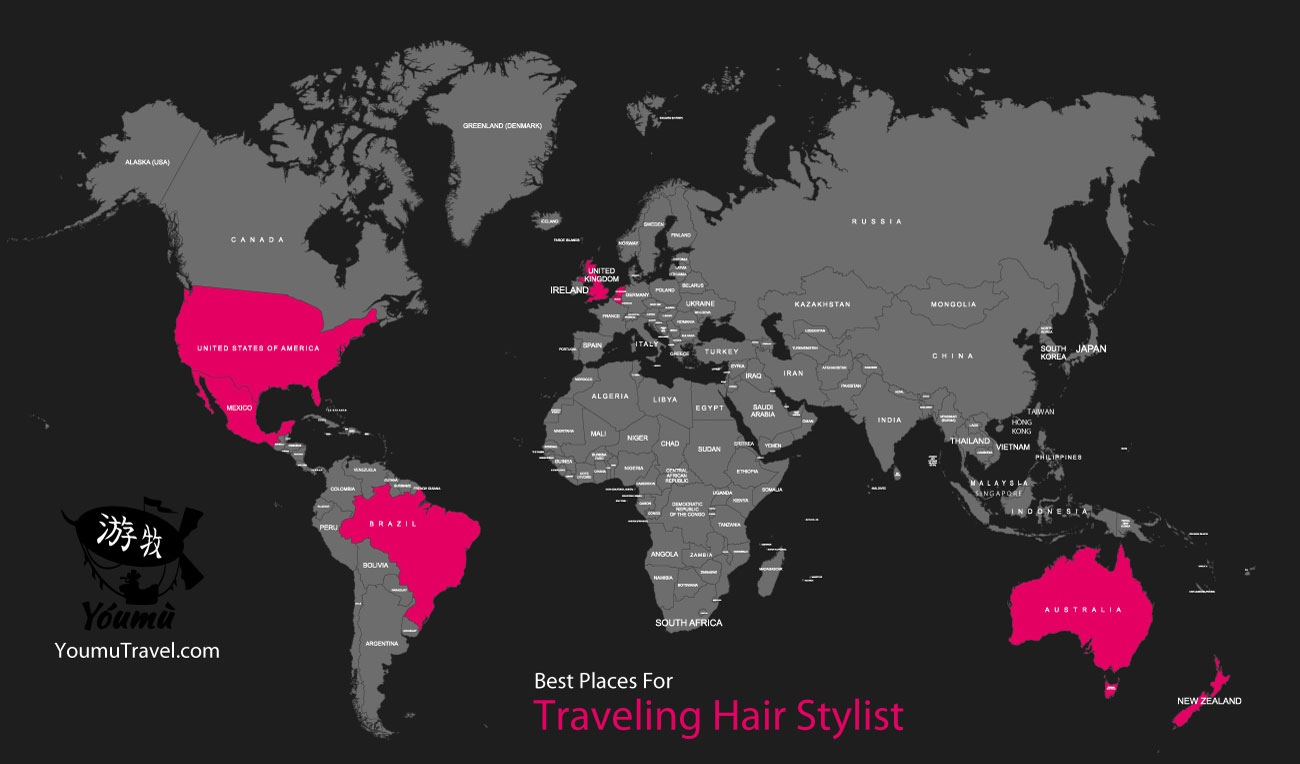
The Best Places to be a Traveling Hair Stylist
Most major countries throughout the world have opportunities for those seeking to be a traveling hair stylist. Here are some of the best places for traveling hair stylists.
- UK
- US
- Australia
- Netherlands
- Belgium
- Brazil
- Mexico
Get your licensing.
You’ll have to pass an exam and graduate from a specialized program to receive your hairstyling licensing in order to book any clients.
Register.
It’s imperative to register your business as a self-employed person. Make sure to look at your local laws to know what the specifics are for your business in your location.
Get a bag for your equipment.
There is so much equipment that a traveling hair stylist needs, and it needs to be easy to move around. Make sure you get a bag that can hold your equipment and give you easy, efficient access to everything you need. Ideally, it will be small enough to be a carry-on bag if you have to fly for your clients–you don’t want to risk arriving at a time sensitive job only to find that the airline lost your luggage.
Purchase the best tools.
By the time you’ve completed your training and established yourself as a hair stylist, you’ll know what kinds of tools work best for you and your clients. Stick to tools that you like and deem necessary for your work. You should obviously always have a good blow dryer, styling irons, combs, brushes, clips, etc. They don’t have to be luxury products–just whatever you find is best for your customers, and therefore what is best for your business.
Choose a niche.
Examples might include doing hair for black women and creating a thorough knowledge base about black women’s hair types so you can properly style and give advice, or working primarily with elderly people in nursing homes, who might miss feeling pampered and cared for. Whatever your niche, pick something that you have or can gain a thorough knowledge of.
Book your first job.
Now that you have your license, equipment, and area of expertise, you can put them all to use. It’s recommended to get some work in a stationary salon before you start traveling for work so that you can garner valuable experience. You can also begin this step while you’re still in training, though you probably won’t land a stylist position yet, but could start as a receptionist.
Boost your business.
A great way to spread knowledge of your business is through word of mouth, so suggest to your clients that if they know anyone looking for a new stylist, you’re the person they should come to. You should also have business cards that you can give out, put up on bulletin boards, or make a deal with other small businesses who might keep your business card in plain sight. Social media is also an essential step in gaining more business–you should have Facebook and Instagram to post pictures of your work, and coupon sites like Groupon will promote your business as well. Lastly, look into local organizations that will provide support for your business, even if it’s not completely related to the beauty business. Socialize and meet people so your business reaches more people.
How do I become a self employed hairdresser?
Creating a website, business cards, and pamphlets to market your service. Additionally, create social media profiles and post your work there.
What should I expect from a mobile hairdresser?
Mobile hairdressers should provide all the tools and products they will need to cut and style hair.
What are the disadvantages of being a hairdresser?
Disadvantages of being a hairdresser/stylist include ensuring the happiness of the client, but this is not always achievable and you may have to deal with upset customers. There are also plenty of other hairdressers, and so the business is fairly competitive.
How much do high end hairdressers make?
The top 10% of hairdressers earn around $25 an hour.
Do hair stylists make good money?
On average, hair stylists can make around $26,000 a year, but there can be a lot of variance in this depending on the business and location.
International Model Jobs Guide
Models are people who advertise, promote, and display clothing, accessories, and beauty products via photoshoots, fashion shows, commercials, advertisements, trade shows, conventions, etc.

This job has a somewhat high demand and requires considerable time and effort to succeed.
Demand
- Somewhat High Demand
Experience & Degree
- No Experience Required
- No Degree Required
Citizenship
- No Restrictions
This job is risky but can pay well with room & board sometimes included.
Pay Range
- Hourly: $15-$100/hr.
Reliability
- Risky
Housing
- Room and Board Sometimes Provided
This job’s schedule has little flexibility but can work in many parts of the world.
Location
- Somewhat Flexible
Schedule
- Little Flexibility
Language
- Can get by with English only
Who can Get International Model Jobs?
Anyone who wants to be a model and can get cast for various modeling jobs could be an international model–it’s just a question of getting the right agencies/jobs and experience. Models usually do have particular requirements for appearances, so keep that in mind when conducting your job search.
What are the responsibilities for International Model Jobs?
The main goal of a model is to promote a particular product by looking attractive while wearing/using that product, which inspires consumers to purchase the product. Many smaller tasks go into accomplishing this goal.
Key Responsibilities
- Enhance appearance with makeup, hairstyles, and clothing according to employer specifications (if any).
- Wear clothing or accessories provided for commercials, ads, or fashion shows.
- Adhere to health routines like diet, exercise, and proper sleep to maintain your appearance.
- Research agents/agencies.
- Pose, taking into account specific direction, for artists and photographers.
- Perform on camera for commercials, films, or videos.
What’s the typical schedule for International Model Jobs?
International models will not work a typical 9-5 like most jobs. Models might work anywhere from 4-10 hours a day, but rarely every day consecutively. There must be time off for the model’s body to recuperate to make sure they stay in peak physical condition. The schedule will also vary by type of job. For example, a runway model working in New York Fashion Week might have an extremely hectic schedule for that week, and then many weeks off afterward. A commercial model might be able to work more frequently, and a swimsuit model might work seasonally.
Income Reliability
In general, international modeling positions are not very reliable.
Typical Job Duration
International modeling can be short-term or long-term.
Estimated Hours Per Week
Hours per week will vary drastically week to week.
Room & Board
International model jobs sometimes provide room & board.
International Model Jobs – Country Map
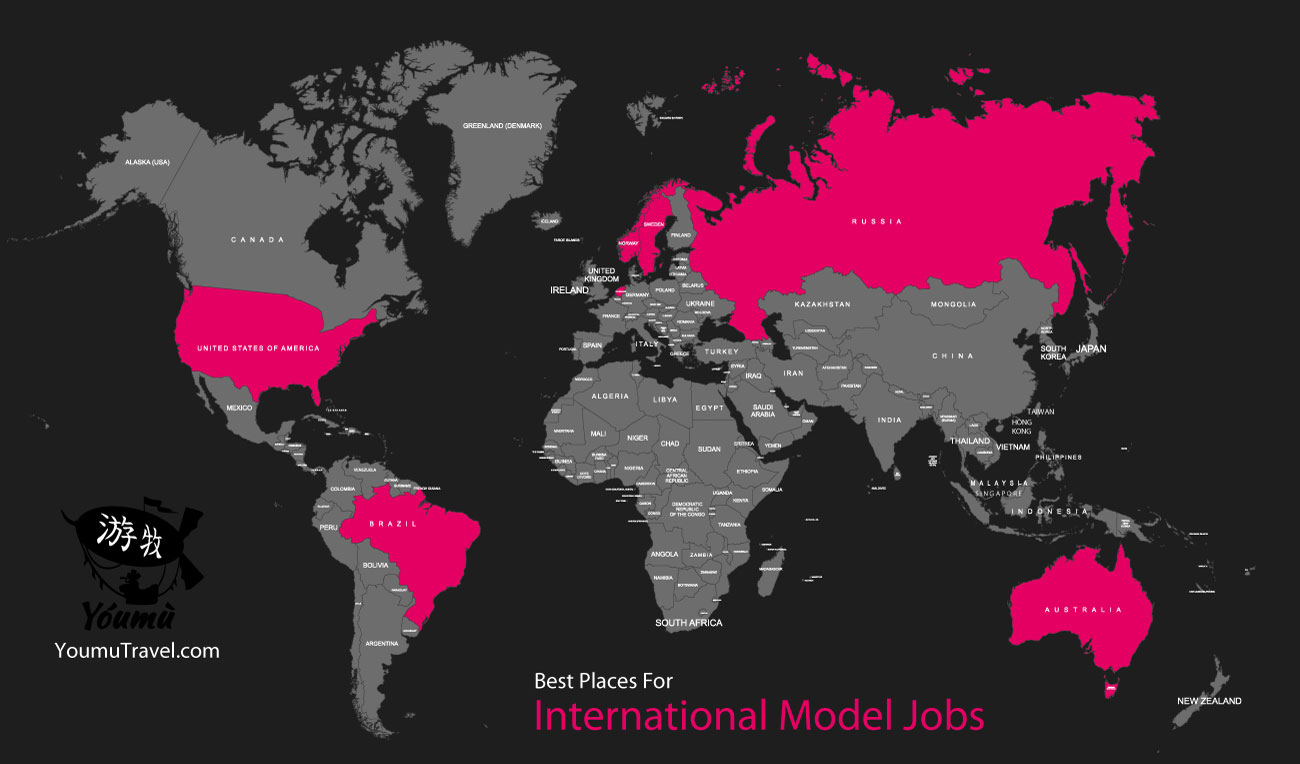
The Best Places for International Model Jobs
Most major countries throughout the world have opportunities for those seeking international model jobs. Here are some of the best places for international model jobs.
- US
- Russia
- Brazil
- Russia
- Australia
- Netherlands
- Norway
- Sweden
Choose a niche.
You’ll need to pick a particular market to be a successful model. There are many niches, but the main markets are catwalk, plus-size, commercial, and swimsuit/lingerie modeling. There are particular looks that each market is looking for, but there are always exceptions to these rules. Most female models are at least 5’8”. Catwalk models will usually be tall and thin with few curves, while plus-size models will be just as tall but generally wear over a size 10. Commercial models can be a little shorter with more variation in body types for catalogs and TV advertisements. Swimsuit/lingerie models (AKA glamour models) generally have larger bust measurements and smaller waists. Again, remember that there are always exceptions to these guidelines, so if you don’t fit some of the recommendations for your chosen market, don’t get discouraged.
Gather a portfolio.
A modeling portfolio is extremely important for getting cast. A portfolio will include photos and your previous work experience, and it is always the first thing casting agents, brands, and designers will look at when deciding to hire a model. Befriend some photographers and work together to build both of your portfolios, even if they are not professional grade. You just want agencies to have an idea of your unique look and range. The type of photos should vary based on your chosen niche. For example, if you want to model commercially, make sure you have plenty of smiling shots, whereas other types of models should be more straight-faced. Include full-length shots, and some swimsuit shots as well. Additionally, your portfolio should have your measurements and information about your hair and eye color.
Contact agencies and gain exposure.
Make sure you have done ample research on agencies within your chosen niche that might be a good fit for you, and ensure that they are reputable. Different agencies will have different preferred methods of receiving portfolios, so make sure you pay attention to that. Additionally, attend casting calls. Bring your portfolio, have a brief interview and inspection with the agents, and see what they decide. Casting calls can be a great way for personality to come through in a way that’s difficult with just a portfolio, and might give you a leg up in the industry. Lastly, make sure you bring composite cards that include a photo, your name, contact information, and measurement/appearance stats.
Don’t be discouraged if it takes a long time for your agency search to be fruitful. There are other ways to garner exposure and experience, such as modeling clubs at colleges and universities. These clubs are a place for aspiring models to share information and network with each other. Be wary of modeling schools and fake agencies–many of these are scams, so make sure to vet schools and agencies that you’re interested in. If they ask for money right away, it’s likely a scam.
How much do fit models get paid?
A fit model can make over $200/hour to model clothes, and some in-demand or experienced models can even make $400/hour.
How much does model make?
It can vary depending on location and the experience level of the model, but most salaries for models fall between $32,000 and $48,000 a year.
How do I apply for a modeling career?
Create a portfolio of photos and go to open casting calls and speak with casting agents as often as you can until you land a job.
How do I get into modeling with no experience?
Connect with some professionals who might be willing to help and give you tips for the business, create a portfolio to get exposure, and try to work with legitimate modeling agencies.
Do you have to be fit to be a model?
While some companies are branching out in terms of the body types they accept for modeling, there are still desired appearances in the modeling world. Models are usually required to have well-proportioned and symmetrical body types that fit into standard size measurements.
Do you have to be good looking to be a model?
Models don’t have to always adhere to conventional beauty standards, but female models are almost always at least 5’8” and male models are usually around 6’0”. The type of modeling–editorial, commercial, fit, etc.–will determine what the employer is looking for.
Do you get paid for modeling?
Yes! Models can make a lot of money depending on the type of modeling, their agencies/employers, and experience level.
How many hours do models work?
On a job, a model can work from four to eight hours, but it is unlikely that they will do this everyday. There are days off between to ensure that the model is always in peak physical condition.
What size do models have to be?
Runway models have to have very precise measurements to fit the designed clothes–usually these measurements are a 34 inch bust or less, 23 inch waist, and 34 inch hips.
How do you become a face model?
If you want to be a face model, you have to take good care of your skin, and know how to alter your facial expressions to get the desired results. Additionally, beauty brands are usually looking for particular types of facial features.
Can you get an agent with no experience?
Yes, though it may be difficult.
Online Personal Trainer Jobs Guide
An online personal trainer is someone who helps others improve their health and fitness via internet-based programs.

This job is in high demand but takes a considerable amount of time and effort to become one.
Demand
- High Demand
Experience & Degree
- At Least Two Years of Experience Required
- Hard Certification Required
- Native English Speaking Preferred
Citizenship
- No Restrictions
This job is somewhat reliable with reasonable pay but typically not full time.
Pay Range
- Hourly: $15-$35/hr.
Reliability
- Somewhat Reliable
Housing
- Room and Board Not Provided
This job has a flexible schedule and you can work almost anywhere in the world.
Location
- Very Flexible
Schedule
- Very Flexible
Language
- Fluency in English
Who can get Online Personal Trainer Jobs
Basically anyone can be a personal trainer as long as you can gain an audience. However, it is recommended that you get certified in the specific type of personal training you want to provide.
What are the responsibilities for Online Personal Trainer Jobs?
The main function of an online personal trainer is to improve the overall physical fitness and ability of their clients, but many tasks go into this. There are also additional duties unique to being an online trainer.
Key Responsibilities
- Record and set up a video archive of your exercises.
- Choose a payment software.
- Decide which personal training software you want to use, if any.
- Evaluate client physical needs and create routines based on observations.
- Provide demonstrations of exercises.
- Assist clients as needed to avoid injury.
- Modify exercises according to client needs/fitness levels.
- Keep track of client progress.
- Have information on fitness and health readily available.
- Foster a professional but positive and friendly relationship with your clients.
- Give advice on nutrition and lifestyle, but avoid providing meal plans unless you are a licensed nutritionist.
What’s the typical schedule for Online Personal Trainer Jobs?
You make your own schedule so it’s all up to you how many days and hours you work. You can live stream once every other day or upload 3 pre-recorded videos every day.
Income Reliability
In general, being an online personal trainer is a reliable job that provides a constant stream of work.
Typical Job Duration
Being an online personal trainer can be short-term or long-term.
Estimated Hours Per Week
It’s estimated that you can work full time, 40 hours per week, as an online personal trainer.
Room & Board
Being an online personal trainer doesn’t typically provide room & board.
Online Personal Trainer Jobs – Country Map
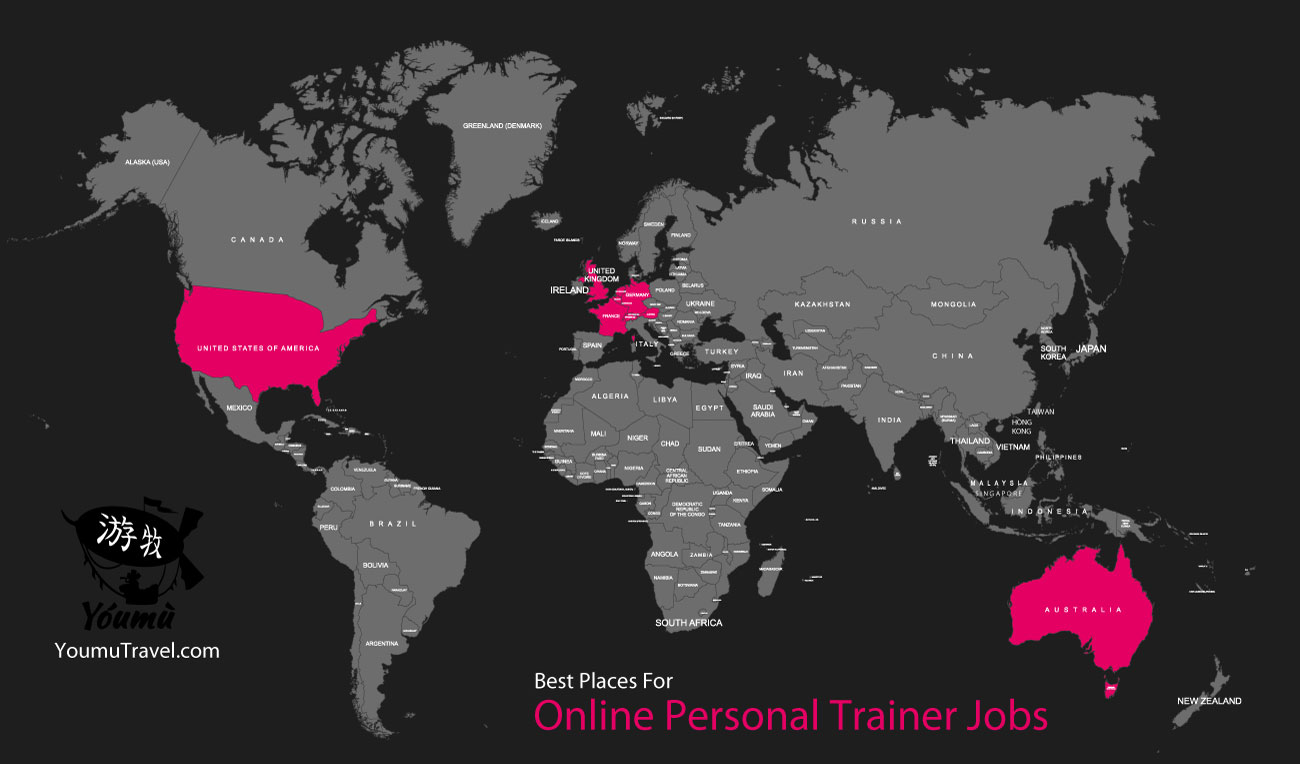
The Best Places for Online Personal Trainer Jobs
This remote job can technically be done anywhere in the world. However, you’ll want to make sure your clients or employer are okay with the timezone difference. Here are some of the best places for online personal trainer jobs.
- US
- Australia
- UK
- Western Europe
Get certified.
To be recognized and taken seriously as a fitness expert, you’ll want to obtain a fitness certification. This is vital for your success at becoming an online personal trainer. Becoming certified usually means passing a comprehensive exam and some will also require that you become CPR certified. Research into the different certification programs there are and choose the best one that fits your goals.
Some certifications to take into consideration are:
- Best for Additional Specializations: American Council on Exercise
- Best for Guided Study: National Academy of Sports Medicine
- Best for a Deep Science Dive: American College of Sports Medicine
- Best for Performance-Based Training: National Strength and Conditioning Association
- Best for Professional Support: International Sports Sciences Association
- Best for Continuing Education Support: National Federation of Professional Trainers
- Best for The Ccademic: National Council on Strength and Fitness
- Best for Self-Starters: National Exercise & Sports Trainers Association
Build your brand.
Although it seems like face-to-face training and online training would be the same, it’s a whole different experience. You’ll need to adapt or develop training strategies so they create a positive yet effective experience for your clients.
Some questions to ask yourself to do so include:
- How can your clients reach you when they have a question- phone, email, social media, web-based app?
- Will you live stream your workouts, pre-record workouts, or just provide a written blog-like program that lists exercises and meal plan recommendations?
- How will you monitor their progress since you won’t be meeting/working with them in person?
Market yourself.
One of the most important skills to develop to be successful online is digital marketing. You have to create an advertising plan so people can find you. Utilize social media and maybe consider starting a blog or even your own website.
Keep up-to-date with industry knowledge.
The fitness industry is always evolving so it’s vital to stay up-to-date with new exercises and develop new skills. Due to this, you’ll want to research the latest exercise routines and techniques especially to keep things fresh so your clients don’t get bored and stick with your program.
Get more revenue streams.
Don’t just stick to one program and expect that to work for you forever. You have to utilize other routines to engage with your clients.
- Private Personalized Online Training
- Non-Personalized PDF Fitness Programs
- Non-Personalized Video Fitness Programs
- Hybrid Online and In-Person Personal Training
- Live Video Chat Workouts Online
- Online Group Personal Training
How much do celebrities pay for personal trainers?
Annual salaries for a celebrity personal trainer vary because it depends on the number of sessions they offer and how many celebrity clients they work for, but the typical pay is $100 to $500 per session.
Can personal trainers give meal plans?
As a personal trainer, you should not give a client a meal plan. Many clients will come to you as a nutritionist, but it is not recommended that you provide them a meal plan because it can be seen as “prescribing” them one.
How do I start my own online personal training?
To begin as an online personal trainer, you first need to decide your target type of client, and construct a training template with phases for each type of client. Additionally, you should create a video archive of your various exercises, and determine if there is a personal training software you feel comfortable using. Of course, you’ll also need to decide how much you want to charge each client and how you’ll receive payment and create a questionnaire to determine client needs/goals.
Do online personal trainers make money?
Yes, online personal trainers do make money. A survey of more than 1,000 personal trainers showed that 1 in 5 trainers made at least $75,000 per year while 1 out of every 10 still made six figures or more.
How many clients do online personal trainers have?
It depends on what packages you offer and how much you charge. Once you have that figured out, you can take your current pay and divide it by your price. So if you earn $1,250 a month and you charge $160 per month, you’d only need 8 clients!
Which gyms pay personal trainers the most?
The following are the highest paying gyms:
- 24 Hour Fitness.
- Anytime Fitness.
- Crunch Fitness.
- Equinox.
- LA Fitness.
- Planet Fitness.
- YMCA.
How long does it take to get a personal training certification?
The programs are usually self-paced so finishing is fully dependent on how long you dedicate to it. However, most students complete the courses within 8 to 10 weeks if they only study about an hour or two a day.
Traveling Chef Jobs Guide
A traveling chef is someone who is hired by a client to cook for them in different locations. Your responsibilities vary depending on what type of work you were hired for. Some traveling chefs are hired to travel with their clients and prepare meals for them while other traveling chefs are purely freelance, working wherever they can get a job while they’re on the road.

This job is in somewhat high demand but takes a considerable amount of time and effort to become one.
Demand
- Somewhat High Demand
Experience & Degree
- At least Two Years of Experience Required
- Hard Certification Required
- Native English Speaking Preferred
Citizenship
- Some Restrictions
This job is somewhat reliable with reasonable pay.
Pay Range
- Hourly: $13-$45/hr.
Reliability
- Somewhat Reliable
Housing
- Room and Board Sometimes Provided
This job is somewhat flexible with its schedule and location availability.
Location
- Somewhat Flexible
Schedule
- Somewhat Flexible
Language
- Fluency in English
Who can become a Traveling Chef?
Anyone who can cook can become a chef. However, to be a successful chef, it’s recommended that you get formal training such as a diploma, certificate, or degree in the culinary arts. It also takes approximately a decade of experience to even become an executive chef which is the highest position in the culinary world.
What are the responsibilities of a traveling chef?
The main responsibility of a traveling chef is to prepare food and meals according to the specifications of their current employer, and many tasks can go into this.
Key Responsibilities
- Train and manage kitchen staff.
- Coordinate culinary activities.
- Purchase food based on consumption estimates.
- Choose/develop recipes.
- Standardize recipes to ensure the quality remains consistent.
- Create presentation/quality standards and uphold them.
- Create and price menus.
- Maintain equipment.
- Enforce safety and sanitation regulations.
What’s the typical schedule for a traveling chef?
It depends on what kind of job you take. If you are a live-in private chef for an individual or a family, you’re basically around the clock 24/7. However, if you’re a freelancer, you have the flexibility to make your own hours and schedule. If you work for a restaurant or hotel, you’re looking at 40 hours and a set schedule.
Income Reliability
In general, a traveling chef is a reliable job that provides a constant stream of work.
Typical Job Duration
Being a traveling chef can be short-term or long-term.
Estimated Hours Per Week
It’s estimated that you can work full time, 40 hours per week, as a traveling chef.
Room & Board
Depending on the position, a traveling chef is given room & board if you were to be a live-in chef for a client. Other than that, it usually doesn’t provide room & board.
Traveling Chef – Country Map
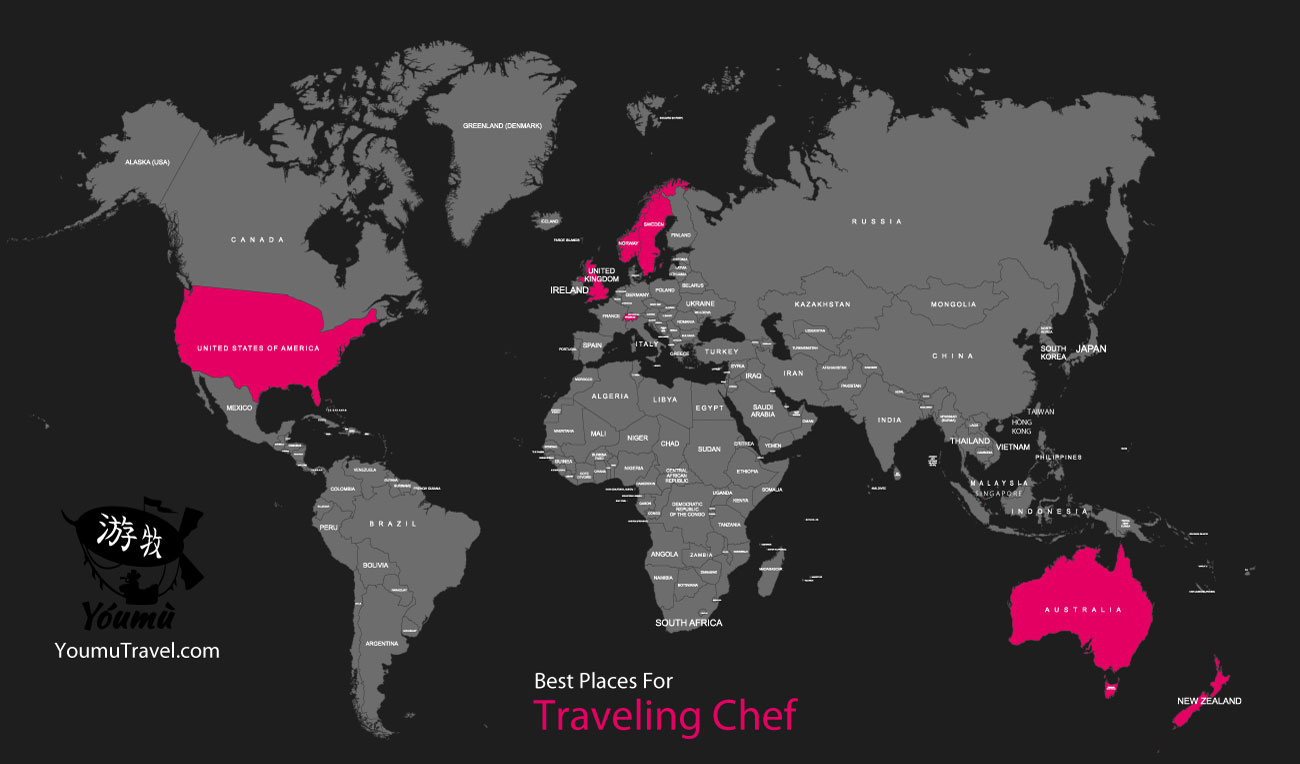
The Best Places to Be a Traveling Chef
Most major countries throughout the world have opportunities for those seeking to be traveling chef. Here are some of the best places for traveling chefs.
- USA
- Singapore
- Australia
- UK
- Norway
- Switzerland
- Sweden
Get educated.
Most chefs obtain a culinary arts diploma, certificate, or degree through community colleges, culinary schools, and some universities. Classes typically combine hands-on training with coursework that focuses on subjects like sanitation, baking, nutrition, food science, and global cuisine. It’s rare that a chef with just on-the-job training succeeds in the culinary career without formal education.
Practice makes perfect.
Experience is the most important aspect to be a successful traveling chef. With only a few years, it’s going to be highly difficult to land a reliable and serious job in reputable restaurants. In Asia, most culinary positions require you to be an executive chef. This means at least a decade of experience is needed to even be considered! However, Europe hires at all levels if you have the right visa. However, the pay depends on your skill level.
Decide which type of job is best for you.
There are 4 different types of positions you can get as a chef and you need to decide which one works best for you.
- Private chef. You are hired by an individual or family that you work for full-time cooking and serving them their every meal. This could even mean joining them in their travels but that’s if they need your services.
- Freelance chef. You work wherever and whenever you can and you decide the pay, but finding a job is way more difficult. You’ll want to maintain a good network of chefs who can recommend you and help you keep an eye out for openings.
- Full-time employment at a restaurant or hotel. This job is a fixed schedule with a maximum of only 4-5 weeks of holiday per year so it’s the least flexible option with little to no traveling. However, it has its perks- meals on duty, staff parties, discounts on hotel stays, and stability in terms of having the same schedule.
- Seasonal employment. If you’re okay with temporary work and want to explore a new place, you could land a position at a seasonal resort. Resorts are constantly looking for chefs to serve their guests during tourist seasons. American o Canadian ski resorts are great job opportunities if you like the cold from November to March. If you prefer the heat, summer camps in California to New Zealand are just as grand.
Consider your preferred client.
You need to consider what type of client you want to serve. With resorts, they’ll cater to tourists and with the variety of resorts, you’ll be working with every age group as well as types of people. Do you want to work for an individual, a couple, a family, elderly, youth, etc? You need to think about what inspires you to cook and follow that inspiration.
Gather tools.
No matter where you choose to cook or for how long, you’ll want to make sure you have the right equipment. Some things to consider packing include:
- Swiss-style vegetable peeler
- Sturdy can opener
- Medium-sized chef’s knife and a small paring knife.
- Thin, flexible cutting board.
- Server’s wine and bottle opener.
- Microplane zester.
- Collapsible salad spinner.
- Measuring spoons and cups.
- Professional knife roll.
Write your resume/CV.
Create a resume or CV that highlights the most relevant cooking experiences you’ve had and any cooking accreditations.
Apply.
Here are a few ways to help find the right job for you depending on your interests:
- Hospitality and catering staffing agencies such as:
- Private chefs hiring platforms
- Networking and connecting. This is vital for freelancing. You’ll need to get your name out there and make relationships with other chefs and restaurant owners. You should also attend industry events or even reach out to other chefs online.
Can you travel as a chef?
Yes, you can travel as a chef! It opens up plenty of opportunities to travel the country and/or the world and is a great way to make money for your travels, network/meet new people, and explore new locations to cook in.
Which country is best for a chef?
The top 5 countries that have been renowned for having the best food overall:
- Italy.
- France.
- Mexican.
- Spain.
- India.
What is the difference between a private chef and a personal chef?
The difference between a private and personal chef is the number of clients you work for. If you’re a private chef, you typically only work for an individual or a family full-time cooking them breakfast, lunch, and dinner. Usually, a private chef lives in the house with the family. A personal chef has several clients and prepares them multiple meals based on their request. You typically only serve one family/individual per day.
Why do chefs quit?
People who become chefs/cook usually have bad habits like alcohol, drugs, and smoking which causes health issues leading to them quitting. It’s time-consuming as well because you work full-time including holidays and can keep you from having a social life.
Do chefs have a social life?
The only chefs that have a healthy social life outside of work are corporate ones who work from behind a desk and work a 9-5 schedule. Being a traveling chef makes that even more difficult because you never stay in one spot long enough to create meaningful relationships and maintain those.
Is a chef a good career?
Being a chef is a great job for people who love food and to cook. You not only get job satisfaction but also the ability to progress to an executive chef.
How can you be rich as a chef?
When you think of being a chef, everyone immediately thinks of Rachel Ray or Gordon Ramsey and thinks being a chef is a high paying job. Realistically, you’ll end up working long hours with low pay and little appreciation/recognition while everyone else is socializing. If you’re passionate about cooking and can handle extreme stress, go for it!
Which country pays the highest salary to a chef?
Hawaii is the number one state who pays the best salary for chefs in 2019; they pay the highest in the country. The salary for chefs/head cooks in Hawaii also surpasses the average wage earned by a Hawaiian by a longshot!
Government & Contractor Jobs Guide

Contents
- What are Government & Contractor Jobs?
- Different Types & Examples of Government & Contractor Jobs Overseas
- Government & Contractor Job Requirements – Visa, Education, & Experience
- How Much Government & Contractor Jobs Pay & How Taxes Work
- Are Government & Contractor Jobs Reliable?
- Pros & Cons for Government & Contractor Jobs Overseas
- How To Get Government & Contractor Jobs Overseas
- The BEST Government & Contractor Jobs Overseas
- The Best Companies Hiring For Government & Contractor Jobs Overseas
- Where To Find Government & Contractor Jobs Overseas
- Tools & Resources for Government & Contractor Jobs Overseas
- Tips for Government & Contractor Jobs Overseas
- Interesting Statistics for Government & Contractor Jobs Overseas
- Government & Contractor Jobs Overseas – Frequently Asked Questions
Additional Travel Job Tools & Resources are included in the parent category of Travel Jobs Tools & Resources on this page.
What is an Overseas Contractor?
An overseas contractor is a civilian working in contracting jobs overseas for civil organizations, within government, or private military companies. These contractors are employed for specific tasks and are contracted to complete these projects within an established deadline.
Different Types & Examples of
Government and Contractor Jobs Overseas
There are a variety of types of government and contractor jobs overseas, and plenty of examples within each category. Whatever it is you’re looking for in a government and contractor overseas lifestyle and work experience, the options are explored below.
Civilian Government Contract Jobs Overseas
Civilian contractor overseas jobs are typically aligned with private security and military positions working in support of the Department of Defense (DoD). With these types of positions, you are usually responsible for traveling overseas when necessary, helping military and intelligence work, making sure your company carries out the obligations of its contract. For the most part, civilian contractors remain in one place for the duration of their contract but can be asked to travel often, and most of these positions are not advertised under that title and are referred to by a similar job description.
Government Jobs Overseas for Entry Level / No Experience
Government jobs overseas are available to U.S. citizens in several professional areas of expertise, these include fields like directory of overseas hiring agencies, participating in military exchanges, working with DODDS as an overseas teacher, administrative, accountants, technical. Specific government overseas jobs:
- Alcohol/drug abuse specialist
- IT Specialists
- Nurses
- Foreign Service/ Budget and Program/ Procurement/ Housing Officers
- Engineers
- Auditors
- Social Workers
- Management Analysts
Contractor Jobs Overseas for Entry Level / No Experience
Contracting jobs overseas at the entry-level span across several fields and include various types of training. The most popular categories for overseas contractor jobs are Entry Construction, Entry-Level Management, and Entry-Level Government jobs. Each category of contractor jobs will have their own requirements and training for the position involved. Some specific job titles for overseas contractor jobs include Customer Technical Specialist (CST), Technical Trainer, and Entry-Level Engineer positions.
Overseas contractor jobs with no required experience are positions that allow you to work overseas but do not expect or demand any kind of specialized expertise in a specific position. Some of these entry-level positions include jobs teaching languages, work in childcare, service, and domestic careers in tourism and hospitality.
Civilian Jobs Overseas
Opportunities for civilian jobs overseas are also aligned with assisting projects and missions for security and military purposes. Some of the specific titles include Budget Analyst, Supply Technician, Industrial Property Management Specialist, Supervisory Human Resources Specialist, and Human Resources Assistant (Military/oa).
Overseas Contract Jobs for Civilians
Civilian contractors overseas work in every possible field and career specialty. Every contractor is expected to have experience in their field when applying for these contract or temporary jobs because they are often assisting with military and security details that can be very dangerous situations. These fields include healthcare, construction, advising, truck drivers, security, education, telecommunications, food prep, interpreters, etc.
Canadian Government Jobs Abroad
Opportunities for Canadian government jobs abroad are available in several fields; these include Commission Technical Officer, Research Assistants, Detachment Services Assistant, Chief HR Officers, Integrative Services Officer, Administrative Assistant, Assistant, and Division Administrative Services Coordinator.
British Government Jobs Abroad
Opportunities for British government jobs abroad are primarily focused around legal and law enforcement positions. These include:
- Civil Enforcement Officer
- Business Support Administration
- Head of Legal
- COR SRV R Correctional Officer
- Program Manager-Cyber Security and Government
- Project Manager
- Senior Compliance and Enforcement Officer
OCONUS Jobs
OCONUS is used by branches of the military and several government agencies to identify the site of projects and jobs that might be considered overseas but are technically on U.S. soil. It is used to distinguish the U.S. territories and states that are not part of the continental U.S. or foreign countries. Specific job titles within OCONUS are:
- Information Assurance and System Administration-OCONUS
- OCONUS Mission Lead
- Oconus Aircraft Mechanic
- OCONUS Service Coordinator
- Oconus Contract
Online Government Jobs
In recent years, many positions have moved to a remote work model, and these include several online government jobs.
Top Online Government Jobs
- Grant Writer
- Government Sales Intern
- Coalition/ Campaign Coordinator
- Technical Writer-Government Services
- Associative Social Services Specialist
- Claims Investigator
Maritime Security Jobs
Overseas positions that work within private security can coincide with maritime security jobs such as these:
- Security Consultant
- Maritime Security/ Maritime Security- Anti-Piracy
- BUD/S Preparatory Instructor
- Special Operations Medic
- Maritime Static Security
Overseas Security Jobs
There are many opportunities for individuals to serve in overseas security jobs, and these positions range in ability and responsibility when contracted for private security or military operations. Examples include:
- U.S. Department of Defense Teller
- FBI Special Agent
- Security Forces Member
- Security Specialist/Professional
- Armed Security Officer
- National Reserves/Guard
Overseas Security Jobs for Ex-Military
Veterans have similar opportunities available to both them as well as civilians in security. Positions for overseas security jobs for ex-military include:
- Integration and Training Instructors
- Executive Protection
- Armed Security Guard
- PSS/PSD Paramedic
- Residential Security and Executive Protection
- Construction Surveillance Technician
- High-Threat Security Technician
Overseas Security Contractor Jobs
Contracted positions for security are available overseas in many capacities, and background does not always include prior military service, but civilian as well. Examples include:
- CTS Junior-Mission Support
- Travel Coordinator
- Commissary Contract Monitor
- Avionics Assistant (Co-op)
- Security Assistant
Private Security Contractors Overseas
Security contracts are often farmed out from private sectors and military operations. These contracts can be picked from candidates more discreetly and conduct a more in-depth background history. Some positions for private security contractors overseas are:
- Unarmed Security Officer/ TS with Polygraph
- Executive Protection Agent
- Information Systems Security Officer
- Network Penetration Tester
- Residential Security & Executive Protection
Overseas Jobs for Veterans
Veterans have the opportunity to work overseas in positions that do not involve quasi-military responsibilities and can be part of security in other capacities. Some of these overseas jobs for veterans include:
- Global Operations Agent
- Park Ranger
- Sports Specialist
- Operations Agent II
- Resource Assistant
- Program Officer. MC-301-4c/4b
- Travel and Transportation Specialist
US Federal Government Jobs Abroad
The U.S. government maintains a significant presence overseas, and the available positions of possible employment are spread across the entire spectrum of careers.
Top U.S. Federal Government Jobs Abroad
- Nurse
- Miscellaneous Clerk and Assistant
- Contracting
- Information Technology Management
- General Engineering
- Logistics Management
- General Business and Industry
- Security Administration
- Management and Program Analysis
Overseas Contractor Jobs for US Citizens
U.S. citizens have many opportunities to achieve foreign contract jobs, and these can be available in a number of fields. These are the most popular overseas contractor jobs for U.S. citizens:
- ARV-Program Scheduler
- Reports Officer/METRO
- Independent Contractor/Driver- Furniture Delivery
- Associate Editor
- Executive Assistant/ Business Coordinator
- Resource and Training Management Capacity Advisor
Overseas Contractor Jobs without Security Clearance
Since the majority of overseas contractor jobs are a part of the government or as a support for the military, there is a certain clearance in security required for these positions. But these are the overseas contractor jobs without security clearance:
- Administrative Assistant
- Registration Authority
- Task Manager
- Organizational Change Consultant
- Trainer
Feasibility
Are Government and Contractor Jobs Overseas Right For Me?
In this section we cover all the primary aspects of government and contractor jobs overseas to ensure they’re right for you. This includes government and contractor job requirements, pay, taxes, and reliability. We also provide an overall pros & cons comparison table.
General Requirements
Requirements for Overseas Contractor Jobs
- It depends on the type of overseas contractor job you get, but overseas opportunities frequently require at least two years of previous experience, as well as peak physical health conditions and a clean background check.
Requirements for Overseas Government Jobs
- Any individual who will be considered for a position has to be able to pass a comprehensive security clearance, checked out thoroughly for character flaws and suitability.
- Applicants must undergo a thorough and adaptable physical exam and continuous physicals to prove you are in good condition to hold the position.
- Some overseas government jobs will require a foreign language proficiency depending on your location and responsibilities.
Education and Experience Requirements
Government Overseas Contractor Jobs Education and Experience Requirements
A high school diploma and experience are required of anyone wanting an overseas contractor job. For some assignments and positions overseas, particularly with government and military contractor positions, an associate’s or bachelor’s degree in political science or some type of security-related study is preferable.
Are Overseas Contractor Jobs Reliable?
Financially, overseas contractor jobs are reliable and pay more than native company colleagues on average. In recent surveys for contractor positions in Iraq and Afghanistan, contractor jobs began at $91,000-$99,000. It is not easy to be an overseas contractor, but it’s a reliable and rewarding position in life. Though, keep in mind that contracts usually have an end-date, so getting one position doesn’t mean you’re done job searching for life. And don’t forget the dangers of contract work overseas when calculating the reliability of the job.
Pros & Cons of Government and/or Contractor Jobs Overseas
The Pros
For some people, living and working abroad is a dream come true, and there are plenty of realistic reasons why working abroad in government and contractor jobs might be a really good idea. There are the obvious pros of traveling abroad including seeing new sights, meeting new people, understanding new languages and cultures, etc. But there are other benefits as well–living and working abroad often improves your communication skills, as you have to learn to communicate with people through language and cultural barriers.
Apart from the benefits of being overseas in general, there are significant pros of working government and contractor jobs overseas as well. Some of the best parts of overseas contracting jobs include the monetary benefits. Not only do you get to travel, but you can get paid pretty well to do so. It isn’t uncommon to find positions in Iraq and Afghanistan that pay $100,000 in base pay alone. In addition, you might receive extra pay for working in a hostile or dangerous zone, housing and cost of living allowances, transportation and paid meals, paid vacations and time off, various insurance and retirement plans, and tuition reimbursement. There is, essentially, no shortage of monetary benefits to working government and/or contractor jobs overseas. Additionally, experience overseas can look excellent to future employers on your resume, so it’s an investment in your future.
The Cons
But while all of these pros are extremely enticing, it’s important for you to know the less attractive qualities of government and contractor jobs overseas so that you can make an informed decision about your career path. Some of the most obvious ones are counter parts to the benefits. While you receive Life and Death and Accidental Dismemberment Insurance, that indicates that the job runs the risk of death or accidental dismemberment. While you/your family will be taken care of in the case of these events, this is still something you must consider before taking government and contractor jobs overseas. Many of these positions will be based in dangerous zones in Iraq, Afghanistan, or other places, and you have to be willing to take on physical and psychological wounds as a consequence of the job. If, after consideration, you determine that you’re prepared for that chance, then we can move on to some of the more minor inconveniences of these jobs.
Working overseas might have you on a less-than-traditional schedule, especially if you’re communicating with people in a different timezone. It might be 5 PM where you are, but your counterparts in the US are just getting ready to start the day! Additionally, you’ll have to maintain a certain level of physical fitness as well as health, and depending where you are, you might have to restock your own malaria medication.
How To Start:
The Best Approach to Government and Contractor Jobs Overseas
In this section we provide a list of the best government and contractor jobs overseas. We also cover the basics on how to get a government and/or contractor job overseas and identify some of the best companies to work for. Finally, we’ll provide a list of the most popular countries and cities for government and contract workers.
Best Government Contractor Jobs Overseas
How To Get Government and/or Contractor Jobs Overseas
- The first step is to be sure you speak the primary language. It can be very beneficial for you to speak more than one language. You will need to be fluent in the native language but also be proficient in writing, reading, and speaking the language where you are working to be an effective contractor.
- The second thing to be aware of is the demonstration of cultural understanding. Starting a job or life in a new country can be very challenging, so it will be useful for you to showcase that you know about the culture and traditions of where it is you’re going to be working. An excellent way to gain cultural experience is working with the Peace Corps, and this can set you apart when applying for a position.
- Third, having previous contracting experience is a great way to be prepared for positions overseas, contracting experiences with USAID or possessing the DAWAI certification can help set you apart as a potential foreign contractor.
- Fourth, be sure to note any kind of military service or deployment experience in your resume and tailor it to better reflect the fit you would be for a contract position.
- Finally, determine what sets you apart as a person. Ultimately you are what will be the proving factor that you deserve a position.
- With all of these factors determined, include them in your resume and cover letter, or other required application materials, and apply to job openings that you’re interested in.
- Once an employer has reviewed your application and found you to be a good candidate, they will reach out to set up an interview. Accept the interview, and prepare accordingly.
Where to Find Government and Contractor Jobs
You can find government jobs on online job boards like with most other jobs, but there are some specialized job boards with specific governmental listings. Two great options are:
- USA Jobs. https://www.usajobs.gov/
- Federal Government Jobs. http://federalgovernmentjobs.us/
Government Job Recruitment
Additionally, you can go through government job recruitment sites as well. Below is a list of more websites that recruit for government jobs.
- Federal job listings
- Federal Resume and KSA Writing Service
- FIRSTGOV
- USAJOBS
- Post Office Jobs
- Federal government agency jobs
- Health Care Careers and Jobs
- Environmental Health and Safety Jobs
- Federal Employees Career Development Center
- Government Job Search
Agencies for Overseas Jobs
If you’re looking to find an agency to work with that can provide a job opportunity overseas, below is a list of various agencies to look into.
- Teaching Jobs with DODEA
- NPAworldwide Recruiting Network
- Hiring Agency Directory
- PeaceCorps, NSA, Foreign Service, and Others
What are the Best Overseas Contractor Companies?
Some of the best companies to work for as an overseas contractor are the CIA, the US Army, and the US Department of State. Each of these organizations has plenty of job opportunities, as they are vast companies that branch all over the world with various goals. These usually do require US citizenship. Additionally, you could work for a private military organization. These are great options for people who aren’t interested in working for the US government directly, or do not hold US citizenship. Examples of these organizations include:
- Vinnell Corp
- MAG Aerospace
- G4S
- Mission Essential
- AdvanFort
- Andrews International
- GK Sierra
- AKE Group
- Blue Hackle
- CACI
Best Places to Work Government and Contractor Jobs Overseas
While working overseas isn’t just a vacation that you’re paid for–it is still hard work, and you might not have much time to be a tourist–that doesn’t mean you can’t work in fantastic places. There are plenty of government and contractor jobs in obscure places, but some of the most popular work places double as cool tourist destinations–people who work government and contractor jobs abroad seek these types of places out to get the most benefit out of working overseas.
Top 3 Most Popular Places To Work A Government and Contractor Job
- Italy – Italy attracts plenty of tourists and people seeking to work abroad–there’s beautiful scenery, history, culture, and cuisine. On top of all that, there are plenty of opportunities for US Government jobs in Italy. Some examples found from the federalgovernmentjobs.us website are:
- Custodial Worker Leader NI Program
- ArmyNATO Security Investment Program Manager
- NavyCyp Teen Coordinator
- NavyHousing Manager
- Navy Installation Training Officer
- Navy Program Analyst
- Foreign Military Sales
- Army Information Technology Specialist
- Policy and Planning System Analysis
- Army
- United Kingdom – The UK is attractive to many people who want to work abroad because there are less opportunities for culture shock. Many native English speakers from the US visit or work in the UK to have the experience of working abroad, without the hassle of language barriers. Government jobs abroad in the UK range across security and policy positions. These are the top government jobs abroad in the UK:
- Pre-Litigation Executive,
- Policy Research Officer,
- Part-time Government Engagement Manager,
- Enforcement and Training Manager,
- Policy Advisor,
- Part-time civil enforcement officer
- Alaska – While technically Alaska isn’t overseas if you’re from the US or Canada, it is different enough from the continental United States in both landscape and culture that it still feels like visiting another country. Additionally, it has the advantage of US federal jobs. There are several titles for federal jobs in Alaska, and they include the following:
- Federal-Data Stewardship Officer,
- Criminal Investigator,
- Special Agent
Tools & Resources for Government and/or Contractor Jobs Overseas
- For job seekers, there is a website called Your-POC.com, (POC standing for Professional Overseas Contractors) which can connect you with overseas employers, enhance your resume, and grant you access to news postings that you otherwise might not have access to. Your-POC.com might be a valuable tool for your job search.
- Additionally, there is the Shadow Warriors Project, which is a charitable organization that provides support for private military security contractors after their service. The Project provides financial assistance for the families of deceased contractors, or for medical bills and PTSD treatment.
- Lastly, there is a Facebook group called Families and Friends of Deployed Civilian Contractors, which can be a great resource and community for your family and friends while you’re overseas.
Government and Contractor Overseas Worker Tips
- Be well informed. It’s important for you to understand all aspects of the job you’re going to be doing before you get there–the last thing you want is a huge surprise when you’re halfway around the world! Make sure you have a good relationship with your program managers, mentors, hiring managers, recruiters, or anyone else you’ve been in contact with at the company so that you feel comfortable asking any questions that may come up before you leave. Your colleagues and superiors are your greatest resource.
- Network. The contractor world is a small one, and so it can be extremely helpful to maintain friendships and professional relationships. While some contractor positions can last years, others are more limited, so it’s helpful to have connections to draw on when/if your contract comes to a close.
- Be flexible! One of the most important traits in a government contracting job is flexibility and adaptability. Your job is to satisfy the needs of your superiors, your customers, or your client(s), and to do that, you need to be able to adjust to their needs/wants. To be successful, make sure you’re able to think on your feet and change your plans at a moment’s notice!
- Figure out your banking in advance. Bank accounts while abroad can be really tricky. Some US-based banks have agreements with foreign banks, but these can come with fees and other hoops to jump through. Additionally, some of these agreements are set up with transient travelers in mind, not longer-term residents, so there may be additional hassle. Be sure to look into your bank’s policies well before you arrive at your destination so that you have your funds upon arrival.
- Mentally prepare for culture shock. All the preparation in the world won’t completely negate culture shock, but it can help to know what you’re walking into. Do as much research on the local customs of your destination as you can, so you don’t get caught trying to pay with a credit card in a market that only accepts the local currency!
- Pack well. You’re going to need more than a spare shirt and a toothbrush. Do not leave packing until the night before your flight–or even the week before. Make sure you think about everything you need in a day that you might have trouble acquiring overseas. Prescription medication? Stock up. Contact lenses? Make sure you have enough!
Interesting Government and Contractor Jobs Overseas Statistics
- Currently online, through job boards such as Indeed.com there are a total of 841 open overseas contractor jobs.
- There has been an unprecedented increase in the number of military contractors overseas working on behalf of the U.S. today. A spokesperson for the Department of Defense recently said in an interview that a total of 5,883 security contractors were actively working. The number of private security members is 2,567.
Government and Contractor Jobs Overseas Frequently Asked Questions (FAQ)
How does hiring overseas contractors work?
When it comes to hiring overseas contractors, a company in the U.S. should have its foreign contractors complete IRS Form W-8BEN. If a US company hires an independent contractor that’s a U.S. resident, they should fill out the W-9 form, but if not, then they need to file the W-8BEN form.
US Embassy Jobs
Embassies are offices maintained by one country within the borders of another. They exist to aid citizens both visiting and living abroad, and to promote friendly relations between the two countries. For US embassies, there are many jobs available at over 270 embassies and consulates worldwide. These are the positions that fall under the realm of Foreign Service Officers.

Demand
- Average Demand
Experience & Degree
- At Least One Year of Experience Required
- No Degree Required but Preferred
- Native English Speaking Preferred
Citizenship
- No Restrictions
This job is reliable with reasonable pay and sometimes offers room & board.
Pay Range
- Hourly: $16-$30/hr.
Reliability
- Reliable
Housing
- Room and Board Sometimes Provided
This job doesn’t have a flexible schedule but you can work in most parts of the world.
Location
- Flexible
Schedule
- Not Flexible
Language
- Can get by with English only
Who can get US Embassy Jobs?
US Diplomats must be between 20 and 59 years old. As for education, while a college degree isn’t required, having one (and being able to speak a foreign language) will boost your chances of being hired.
What are the responsibilities for US Embassy Jobs?
There are several positions that work within an embassy, some of them and their responsibilities are listed here:
- Ambassador
- The highest position in the embassy, the ambassador is in charge of supporting staff and is typically trained in foreign affairs. This position is usually given through political nomination rather than a typical job search.
- Economic Officers
- Part of the support staff, economic officers handle, well, economic issues, which include tax and tariff negotiation with representatives from the relevant nation.
- Political Officers
- Another part of the support staff, political officers are up to date with the political climate of the relevant nation, and report on it as needed. Dissension, terrorist violence, civil unrest are all issues these officers have to keep track of.
- Consular Officers
- One last part of the support staff, consular officers address the public in the relevant country, and they issue visas and other travel documents. They can also visit and advise native residents imprisoned in the relevant nation.
What’s the typical schedule for US Embassy Jobs?
Generally, FSO work is full time and highly dependent on the schedule of the peoples you’ll be interacting with both locally and abroad.
Income Reliability
In general, teaching English online is a reliable job that provides a constant stream of work.
Typical Job Duration
Teaching English Online can be short-term or long-term.
Estimated Hours Per Week
It’s estimated that you can work full time, 40 hours per week, as an online English instructor.
Room & Board
Teaching English online doesn’t typically provide room & board.
US Embassy Jobs – Country Map
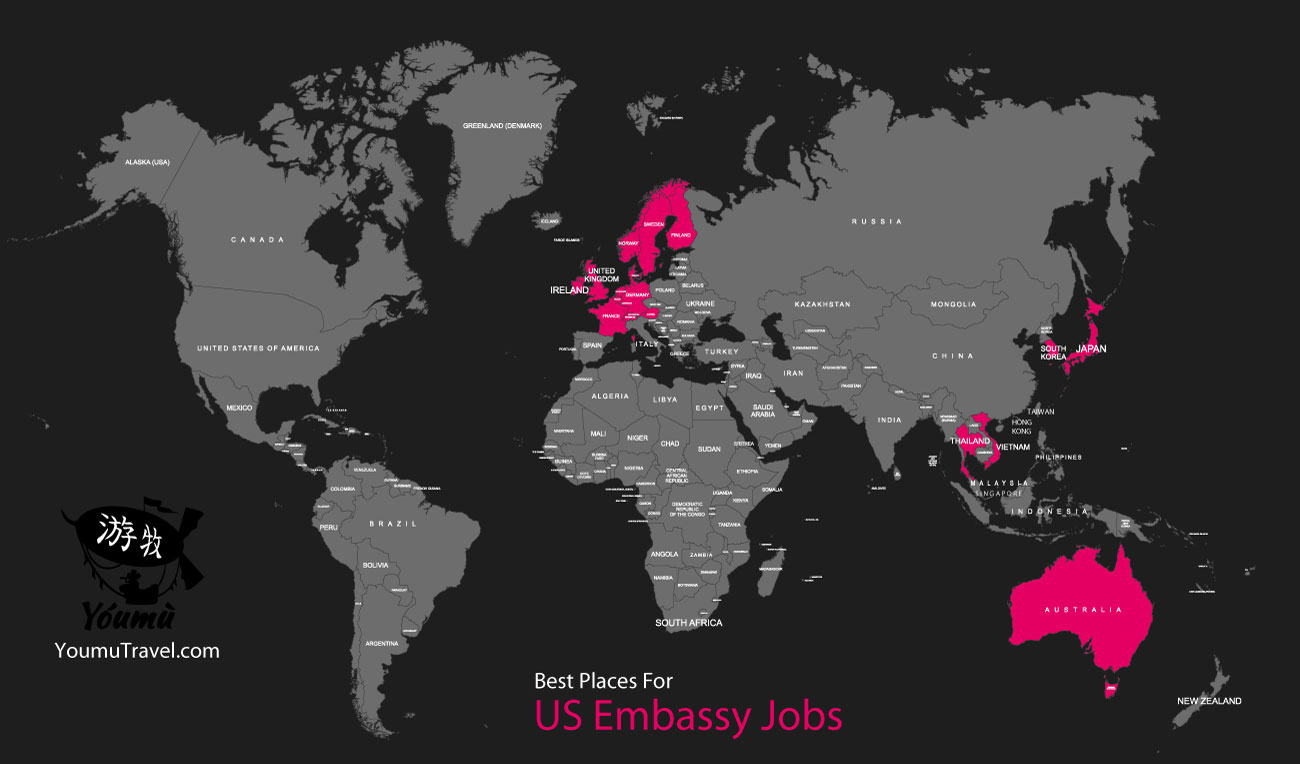
The Best Places to work US Embassy Jobs
Most major countries throughout the world have opportunities for those seeking US embassy jobs. Here are some of the best places for US embassy jobs.
- Ireland & UK
- Western Europe
- Northern Europe
- Australia
- Thailand
- Vietnam
- Japan
- South Korea
Reach the Service Foreign Officer (SFO) requirements
The US Department of state requires all US Embassy job applicants to fulfill SFO requirements. Applicants must be between 21 and 60 years old at time of appointment and must be willing to relocate. While there are no educational or foreign language requirements, having a degree and knowledge of a foreign language (particularly one relevant to the country you wish to work in) will exponentially boost your hireability for all embassy positions.
Determine if you align with their culture
The US Department of State has identified 13 characteristics (the 13 Dimensions, as they are called) that are expected across all embassy workers and are always considered for job applicants
- Composure
- Remaining calm and efficient in stressful, potentially dangerous situations, and quick thinking to adapt to ever changing circumstances
- Cultural Adaptability
- Are able to work with people of differing cultures, belief and value systems, political ties, and economic situations. Are able to communicate respectfully, effectively and show respect towards other cultures.
- Experience and Motivation
- Show skills and knowledge from previous experience and are motivated to join Foreign service to further the US Department of State’s interests.
- Information Integration and Analysis
- Ability to retain and use information taken from a variety of sources, and analyze, evaluate information with ease.
- Initiative and Leadership
- Assume responsibility for your own work, motivate others to meet the Department of State goals
- Judgement
- Can evaluate circumstances and decide what appropriate actions are warranted for real world scenarios
- Objectivity and Integrity
- Be fair and honest in your role as a US representative abroad under the Department of state, and never be deceitful, avoiding favoritism, nepotism, discrimination, or any personal bias in their line of work.
- Oral Communication
- Can speak professionally, well organized, and tailor their communication given whatever audience is before them
- Planning and Organizing
- Can prioritize tasks, manage large work loads in an efficient manner
- Resourcefulness
- Perform problem solving and troubleshooting for issues related to FSO issues
- Working with Others
- Are always expected to interact with other people (both within the embassy and outside it) in a professional and peaceful manner.
- Written Communication
- Are able to write grammatically correct prose, and write it concisely
- Quantitative Analysis
- Can evaluate, compile, and recognize data patterns, perform mathematical operations, and come to logical conclusions based upon that data
Comprehend, uphold the FSO values
Throughout all of the Dimensions and other responsibilities, US Department of State embassy employees are always expected to adhere and uphold their values and goals of the United States government. Fighting terrosism, protecting American interests, and implementing foreign policy all fall under this umbrella, along with the promotion of peace and stability internationally. These goals and values are provided through the policies made by the President of the United States.
Deciding your career
With the many available positions within an embassy, it can be tough deciding what role you wish to fulfill. Here’s a list of some more responsibilities certain roles have to consider.
- Consular Officer
- Consular officers are trained to resolve child custody disputes, oversee detentions, arrests, and issue travel advisories. They also fight human trafficking, froad, and help evacuate Americas abroad, among other international duties.
- Economic Officer
- Economic Officers are liaisons for issues of tech, science, energy, environmental issues, and especially economics and trade negotiations.
- Management Officer
- Management Officers keep the embassy office running smoothly. Fast thinking is required.
- Political Officer
- Political officers monitor the political climate of the relevant nation, and can efficiently communicate with representatives of foreign nations.
- Diplomacy Officer
- Diplomacy officers are engaged with both governmental and non governmental officials and groups, such as political think tanks and civil society members. They are skilled in cross cultural interests.
Take and pass the Foreign Service Officer Test (FSOT)
The FSOT tests your skills across the areas that the Department of State is looking for in potential employees. Candidates have to register for it before the deadline for that particular testing period, and the test itself is taken online at a designated testing center (many are located around the US), though tests are only administered three times per year. While there’s no cut-off score for the test, each candidate’s portfolio is put into the context of whichever position they’re looking to apply for. Job knowledge, English expression (reading and writing), biography, and an assigned topic for a 30 minute essay are all considered.
Drafting a Personal Narrative (PN)
This is the next step after doing well on the FSOT. You’ll receive an email from the Department of State asking for a Personal Narrative which will be submitted to the Qualifications Evaluation Panel within three weeks.
A Personal Narrative ought to convey concrete and positive examples of the candidate’s abilities and discuss how their learning experiences would bring success to their role as an FSO. This time around, there are 6 major qualities or talking points that are considered in the PN.
- Leadership
- Interpersonal Skills
- Communication Skills
- Management Skills
- Intellectual Skills
- Substantive Knowledge
Oral Assessment
Usually taken in Washington, DC, the Oral Assessment, run though the Board of Examiners, continues to narrow down the list of candidates through an all day evaluation which considers the 13 Dimensions, the candidate’s ability to meet the goals of the Foreign Service, and dissects a candidate’s skills and personal characteristics.
Getting medical, security clearance
After the Oral Assessment, good candidates are given a conditional offer of employment, reliant on the candidate’s ability to get medical and security clearance. Medical clearance is given by the Department of State or the Office of Medical Services and considers the limited medical resources available at particular embassies when compared to the candidate’s medical history. Security clearance is given through the Department of State, and considers a candidate’s background – employment, credit, criminal record, substance abuse, the works.
Suitability Review Panel Assessment
This keeps on going huh? Don’t worry, this is the last stage before the hiring process begins. After all the previous steps, a Suitability Review Panel evaluates all of a candidate’s materials (save for some medical info) and determines if the candidate is best qualified for an FSO position. Much like the security clearance, this panel reviews just about everything in your background, and considers how loyal you are to the US government, or instances of poor judgement, lack of discretion.
The hiring process begins!
Finally! If you’ve successfully gotten through allll the previous steps, you’ll be put on a hiring register, which is listed by a candidate’s tests and evaluations, though any candidate will only be on the register for 18 months total. If you don’t get a job by then, the name isn’t take off, but the application process has to start all over again.
Assuming you get a job, you’ll have to first relocate to DC typically, and other obligations need to be met as well depending on the position. You can only decline one job offer however, and if you decline the second offer your name is removed from the list. After this, you must take the A-100 course, a six-week training period, and afterwards you’ll receive specialized training for your specific position. It’s been a long process to get this far, but you’ve made it!!
How do you get a job in a US Embassy?
Having a degree in a political field then clearing the civil services exam, followed by the rigorous testing and evaluations stages put forth by the Department of State, is best way to get an embassy job. US Embassy jobs require a few other things. You have to be a US citizen, between 21 and 60 years old, and, obviously, are able to relocate globally.
What do you call someone who works in an embassy?
The term for an embassy / consulate worker is a consular officer. Above that, the person in charge is a consul or console general, and there’s a position called honorary consul who doesn’t work full time, often working in port towns to swiften the process of issuing documents.
Can anyone be a diplomat?
US Diplomats must be between 20 and 59 years old. As for education, while a college degree isn’t required, having one (and being able to speak a foreign language) will boost your chances of being hired.
What degree do you need to be an ambassador?
Obtaining a bachelor’s degree in fields like political science or international relations is the best step, potentially followed by postgraduate studies in public policy or public administration. Then, the foreign service officer (FSO) exam is needed. While these are the most basic steps, the path to becoming ambassador isn’t always straightforward.
State Department Jobs Abroad Guide
As a whole, the US State Department deals with promoting peaceful and prosperous relations to areas of the world vital to American interests. With numerous allies and partners globally, the State Department promotes democratic development, American businesses abroad, fair trade, and provides information and services for US citizens either travelling or living abroad, and they issue visas to immigrants.
As an employee of the US State Department, your goal would be to further those ideals, and you will help to sustain secure and democratic relations and aid with poverty and peace globally.

This job has just an average demand and takes some effort to get.
Demand
- Average Demand
Experience & Degree
- Basic Understanding Required
- No Degree Required but Preferred
- Native English Speaking Preferred
Citizenship
- No Restrictions
This job is reliable and pays well, and sometimes includes room & board.
Pay Range
- Hourly: $25-$55/hr.
Reliability
- Reliable
Housing
- Room and Board Sometimes Provided
This job doesn’t have a flexible schedule but you can work in most parts of the world.
Location
- Flexible
Schedule
- Not Flexible
Language
- Can get by with English only
Who can get State Department Jobs Abroad?
Americans who have a bachelor’s degree or greater in a field such as political science or cultural anthropology generally have a better chance of getting a job in the State Department than those who do not. Beyond that, the difficulties in getting a job in the State Department lie in the rigorous testing and application process.
What are the responsibilities for State Department Jobs Abroad?
Work in the State Department, particularly the Foreign Service, requires worldwide availability and adaptability. Assignments typically range from two to three years in length per designated country, and working in the Department requires motivation, intellectual curiosity, and cultural adaptability. You’ll be protecting American citizens abroad, aiding foreign nationals in their travel, evacuating refugees, help foster economic partnerships, manage embassies, promote democracy and diplomacy, analyze political happenings, and explain American policies to foreign citizens and leaders.
What’s the typical schedule for State Department Jobs Abroad?
As this job requires a ton of adaptability, hours are likely long and typically vary between assignments. At least a full work week can be expected.
Income Reliability
In general, teaching English online is a reliable job that provides a constant stream of work.
Typical Job Duration
Teaching English Online can be short-term or long-term.
Estimated Hours Per Week
It’s estimated that you can work full time, 40 hours per week, as an online English instructor.
Room & Board
Teaching English online doesn’t typically provide room & board.
The Best Places for State Department Jobs Abroad
The most popular country for U.S. State Department jobs is in the U.S. However, this job can enable you to travel to many parts of the world.
Steps to work in the State Department
Working under the State Department overseas generally means you’ll have to fulfill the obligations of a foreign service officer, and the steps to becoming one are quite rigorous.
Step 1: Reach the Service Foreign Officer (SFO) requirements
The US Department of state requires all US Embassy job applicants to fulfill SFO requirements. Applicants must be between 21 and 60 years old at time of appointment and must be willing to relocate. While there are no educational or foreign language requirements, having a degree and knowledge of a foreign language (particularly one relevant to the country you wish to work in) will exponentially boost your hireability for all embassy positions.
Step 2: Reach the Foreign Service Officer (FSO)’s Dimensions
The US Department of State has identified 13 characteristics (the 13 Dimensions, as they are called) that are expected across all embassy workers and are always considered for job applicants
- Composure
- Remaining calm and efficient in stressful, potentially dangerous situations, and quick thinking to adapt to ever changing circumstances
- Cultural Adaptability
- Are able to work with people of differing cultures, belief and value systems, political ties, and economic situations. Are able to communicate respectfully, effectively and show respect towards other cultures.
- Experience and Motivation
- Show skills and knowledge from previous experience and are motivated to join Foreign service to further the US Department of State’s interests.
- Information Integration and Analysis
- Ability to retain and use information taken from a variety of sources, and analyze, evaluate information with ease.
- Initiative and Leadership
- Assume responsibility for your own work, motivate others to meet the Department of State goals
- Judgement
- Can evaluate circumstances and decide what appropriate actions are warranted for real world scenarios
- Objectivity and Integrity
- Be fair and honest in your role as a US representative abroad under the Department of state, and never be deceitful, avoiding favoritism, nepotism, discrimination, or any personal bias in their line of work.
- Oral Communication
- Can speak professionally, well organized, and tailor their communication given whatever audience is before them
- Planning and Organizing
- Can prioritize tasks, manage large work loads in an efficient manner
- Resourcefulness
- Perform problem solving and troubleshooting for issues related to FSO issues
- Working with Others
- Are always expected to interact with other people (both within the embassy and outside it) in a professional and peaceful manner.
- Written Communication
- Are able to write grammatically correct prose, and write it concisely
- Quantitative Analysis
- Can evaluate, compile, and recognize data patterns, perform mathematical operations, and come to logical conclusions based upon that data
- Composure
Step 3: Comprehend, uphold the FSO values
Throughout all of the Dimensions and other responsibilities, US Department of State embassy employees are always expected to adhere and uphold their values and goals of the United States government. Fighting terrorism, protecting American interests, and implementing foreign policy all fall under this umbrella, along with the promotion of peace and stability internationally. These goals and values are provided through the policies made by the President of the United States.
Step 4: Deciding your career
With the many available positions within an embassy, it can be tough deciding what role you wish to fulfill. Here’s a list of some more responsibilities certain roles have to consider.
- Consular Officer
- Consular officers are trained to resolve child custody disputes, oversee detentions, arrests, and issue travel advisories. They also fight human trafficking, froad, and help evacuate Americas abroad, among other international duties.
- Economic Officer
- Economic Officers are liaisons for issues of tech, science, energy, environmental issues, and especially economics and trade negotiations.
- Management Officer
- Management Officers keep the embassy office running smoothly. Fast thinking is required.
- Political Officer
- Political officers monitor the political climate of the relevant nation, and can efficiently communicate with representatives of foreign nations.
- Diplomacy Officer
- Diplomacy officers are engaged with both governmental and non governmental officials and groups, such as political think tanks and civil society members. They are skilled in cross cultural interests.
- Consular Officer
Step 5: Take and pass the Foreign Service Officer Test (FSOT)
The FSOT tests your skills across the areas that the Department of State is looking for in potential employees. Candidates have to register for it before the deadline for that particular testing period, and the test itself is taken online at a designated testing center (many are located around the US), though tests are only administered three times per year. While there’s no cut-off score for the test, each candidate’s portfolio is put into the context of whichever position they’re looking to apply for. Job knowledge, English expression (reading and writing), biography, and an assigned topic for a 30 minute essay are all considered.
Step 6: Drafting a Personal Narrative (PN)
This is the next step after doing well on the FSOT. You’ll receive an email from the Department of State asking for a Personal Narrative which will be submitted to the Qualifications Evaluation Panel within three weeks.
A Personal Narrative ought to convey concrete and positive examples of the candidate’s abilities and discuss how their learning experiences would bring success to their role as an FSO. This time around, there are 6 major qualities or talking points that are considered in the PN.
- Leadership
- Interpersonal Skills
- Communication Skills
- Management Skills
- Intellectual Skills
- Substantive Knowledge
Step 7: Oral Assessment
Usually taken in Washington, DC, the Oral Assessment, run though the Board of Examiners, continues to narrow down the list of candidates through an all day evaluation which considers the 13 Dimensions, the candidate’s ability to meet the goals of the Foreign Service, and dissects a candidate’s skills and personal characteristics.
Step 8: Getting medical, security clearance
After the Oral Assessment, good candidates are given a conditional offer of employment, reliant on the candidate’s ability to get medical and security clearance. Medical clearance is given by the Department of State or the Office of Medical Services and considers the limited medical resources available at particular embassies when compared to the candidate’s medical history. Security clearance is given through the Department of State, and considers a candidate’s background – employment, credit, criminal record, substance abuse, the works.
Step 9: Suitability Review Panel Assessment
This keeps on going huh? Don’t worry, this is the last stage before the hiring process begins. After all the previous steps, a Suitability Review Panel evaluates all of a candidate’s materials (save for some medical info) and determines if the candidate is best qualified for an FSO position. Much like the security clearance, this panel reviews just about everything in your background, and considers how loyal you are to the US government, or instances of poor judgement, lack of discretion.
Step 10: The hiring process begins!
Finally! If you’ve successfully gotten through allll the previous steps, you’ll be put on a hiring register, which is listed by a candidate’s tests and evaluations, though any candidate will only be on the register for 18 months total. If you don’t get a job by then, the name isn’t take off, but the application process has to start all over again.
Assuming you get a job, you’ll have to first relocate to DC typically, and other obligations need to be met as well depending on the position. You can only decline one job offer however, and if you decline the second offer your name is removed from the list. After this, you must take the A-100 course, a six-week training period, and afterwards you’ll receive specialized training for your specific position. It’s been a long process to get this far, but you’ve made it!!
How do I get a job with the State Department?
For both branches of the state department, the Civil Service and Foreign Service, most jobs can be found at http://www.state.gov/careers/
Is the state department hiring foreign service officers?
There is just about always a foreign service officer job the Department of State is looking for, especially with how many embassies America has around the world.
How can I work in an embassy overseas?
While embassy work does not require a degree, it could be considered an unofficial requirement. Getting a bachelor’s or master’s in a political science field or related is the best first step, then the whole process to becoming an FSO, all the exams and reviews and interviews, come next, which is a long process.
Is it hard to get a job at the state department?
Getting a job in the State Department is not the same as any other type of employment – their tests are rigorous, and you as a candidate have to have a lot of personal initiative to be considered. If you were previously in the military, you’ll have a higher chance of getting in.
Do you need a college degree to be a foreign service officer?
No, but it helps. A bachelor’s degree or higher in a relevant field boosts your chances of being selected, and the higher type of degree you have the more you’ll get paid.
How much does a State Department job pay?
Anywhere from $39,159 to $147,029 per year, and $14.74 to $56.09, depending on position and experience.
How difficult is it to become a foreign service officer?
It is quite difficult. On top of the unofficial requirement of a college degree, there’s a multitude of tests, clearances, interviews and assessments to take, and before you can begin the application process you have to pass the Foreign Service Officer Test. You must also be between 20 and 59 years old when you apply.
How do you get a job as a diplomat?
Diplomats are generally appointed positions, so your career up till that point is what matters. A degree in political science, international relations, cultural anthropology or other related fields helps.
How do I get a job at an embassy or consulate?
While embassy work does not require a degree, it could be considered an unofficial requirement. Getting a bachelor’s or master’s in a political science field or related is the best first step, then the whole process to becoming an FSO, all the exams and reviews and interviews, come next, which is a long process.
Ex Military Jobs Overseas Guide
Ex-Military jobs contain many different positions, both overseas and abroad, such as security, contracting, law enforcement, and unexpected fields like business law, mechanical tech, management, and healthcare support.

This job has just an average demand and takes some effort to get.
Demand
- Average Demand
Experience & Degree
- At Least Two Years of Experience Required
- No Degree Required but Preferred
- Native English Speaking Preferred
Citizenship
- No Restrictions
This job is risky but pays well and can include room & board.
Pay Range
- Hourly: $13-$60/hr.
Reliability
- Risky
Housing
- Room and Board Sometimes Provided
This job’s schedule has little flexibility but you can work in most parts of the world.
Location
- Flexible
Schedule
- Little Flexibility
Language
- Can get by with English only
Who can get Ex Military Jobs Overseas?
Anyone who has had previous military experience can qualify for overseas ex-military positions. In many of these jobs, you’ll need to know how to operate security equipment and, in some cases, weapons.
What are the responsibilities for Ex Military Jobs Overseas?
There are plenty of different overseas positions ex-military can get, and the responsibilities of each will vary by job title.
Key Responsibilities
Law Enforcement
- Many military veterans become police officers, and so their job responsibilities will be that of a police officer’s: responding to reports of crimes and emergencies, helping people, deescalating tense situations, etc.
IT Specialist, Manager
- There is a lot of variation within IT jobs, but some commonly expected responsibilities include: managing databases, networking, and providing technical support.
Vocational or Practical Nurse
- Military vets who go into nursing can expect the job responsibilities of a nurse, including but not limited to: providing care to patients, administering medication, evaluating patient conditions, preventing further injury, and ensuring safety.
Medical Assistant
- Veterans who work as medical assistants will provide administrative aid to nurses, doctors and other medical facility staff, help patients with insurance paperwork, provide comfort to patients, and even take a patient’s vitals.
Dental Assistant
- If nursing isn’t for you, but you still want to help others as a veteran, you can become a dental assistant who aids in patient care, takes x-rays, schedules appointments, and organizes records.
Veterinary Technician
- If you’re a veteran who loves animals, consider becoming a vet tech. Vet techs have numerous responsibilities–in fact, the only things they don’t do are diagnose ailments, prescribe medications, or perform surgery.
Business Admin
- Business administration can be a great route for ex military personnel. The job responsibilities will vary depending on the employer, but some common responsibilities include the development of business contracts, find new customers, and the creation and giving of presentations.
Business Management
- If you want to utilize the management skills you learned in the military, consider business management. In these jobs, you can expect to manage different facets of a business including HR, logistics, retail sales, and systems analysis.
HVAC
- People who work in HVAC can expect to perform installation, maintenance, and removal of heating, ventilation, and cooling equipment.
Electrical Mechanic
- If you learned to fix electric systems while you were in the military, electrical mechanic jobs might be a great way for you to transition into veteran life. You can expect to read blueprints, read circuit diagrams, repair or replace particular electrical components, and more.
What’s the typical schedule for Ex Military Jobs Overseas?
The typical schedule will vary greatly depending on the type of position and the employer, but some jobs will be very demanding in terms of hours–some private contractors work over 85 hours each week.
Income Reliability
In general, most ex-military jobs overseas provide a stable income.
Typical Job Duration
Ex-military jobs overseas can be short-term or long-term depending on the job and contract.
Estimated Hours Per Week
It’s estimated that you can work over full time, more than 40 hours per week, in ex-military overseas positions.
Room & Board
Ex-military positions sometimes provide room & board.
The Best Places for Ex-Military Jobs Overseas
These types of jobs are interesting as it may be possible for ex military to find jobs in various countries, depending your employer. Of course, it’s always easiest to find ex military jobs in the country you served.
Go to a transition assistance program workshop.
TAP was made specifically to help ex-military transition into civilian work. Within your first 180 days of separation or retirement, you can attend one of these three-day workshops that’ll cover exploring your career, job hunt strategies, and stuff for the interview–resume, cover letter, interview prep, etc.
Consider your transferable skills.
Skills you had in the military can still apply to various positions in civilian work, sometimes in ways you might not expect. A trainer position for a military vehicle can be relevant for a corporate classroom position. Of course, for many overseas positions, such as contracting and private security, there are more obvious applications of military work.
Discover military-friendly employers.
Ex-military qualities are appealing to certain civilian employers, and many companies have other ex-military who can help you out in your transition.
Adapt to corporate life.
Some of the things you get used to in the military will have to be adjusted. Military time, for instance, will generally have to go in favor of “regular” timekeeping in most situations. Calling others by their first name rather than Sir or Ma’am and recognizing that some abbreviated terms will not be recognizable are also good tips.
Find recruiters who can help with the transition.
Groups such as the Lucas Group and Bradley Morris, who combined have aided 25,000 officers and technicians in the military to civilian job transfer. It’s good to bring up that you’re looking for jobs overseas, these resources will help you tailor your job hunt to it.
Showcase your ex-military strengths.
We don’t just mean combat skills. Precise communication, accountability, execution, leadership and other skills acquired or enhanced from military work are all phenomenal qualifications for numerous jobs both native and abroad.
Networking!
Ah yes, a cornerstone for getting many jobs, building a network among other veterans in civilian work is a good way to both broaden your own horizons and get your name out there, as well as figure out how they made the transitions themselves. Don’t rush to ask if they know of any job openings, though, wait till the end of the conversation to do that.
How do I become a private military contractor?
To become a private military contractor, you’ll have to get the proper education, some security experience, and the proper training.
How much do armed security guards make overseas?
Depending on the job and the level of danger involved, the salary can range from around $50,000 to $200,000.
How do I become an overseas security contractor?
Of course, a background in the US military helps, and a minimum of a high school diploma or GED is required, but an associate’s degree, bachelor’s degree, or higher in a related field can aid you in landing positions.
How much do contractors make in Afghanistan?
The salary for a contractor in Afghanistan will vary based on your personal qualifications, previous experience, and the prospective employer. With that said, it is possible to have a starting salary of $99,000 in Afghanistan.
How much do private military contractors get paid?
Pinning down exact numbers is difficult as many aspects of these jobs are confidential, but pay can range from $300 to $750 per day.
Do you need military experience to be a private contractor?
While it’s not necessary, military experience certainly helps you get hired and understand the job.
Is overseas contracting worth it?
This is highly subjective and depends on what you consider to be “worth it.” While the pay is pretty good, you can expect to work extremely long hours–over 85 a week–and it is a demanding job. The pay isn’t hourly, so those long hours don’t affect how much you get paid. If you’re willing to put in this amount of work, then overseas contracting might be a great option for you.
What is the best security company to work for?
Some great security guard companies include Epic Security Corp, Spear Security, American Hawk Security, National Security and Protection Services, Brinks, Inc., G4S, and Allied Universal among others.
What is the largest private military company?
There are many huge private military companies, but one of the largest is G4S.
How much does DynCorp pay in Afghanistan?
On average, a DynCorp employee can expect to make $65,000 a year.
How much does KBR pay to work in Iraq?
It depends on the position held, but some examples include food-service workers who make $70,000 per year, or truck drivers who make $100,000 per year .
How many contractors have died in Afghanistan?
According to the US Department of Labor, 1582 civilian contractors were killed by December 31, 2013. Of these deaths, 260 were private security contractors, and they died between June 2009 and April 2010.
Civilian Military Jobs Overseas Guide
Civilian military jobs overseas include people who work for the United States Army without being an active-duty member of the military. Civilian military employees fill roles in the Department of Defense that are critical to the military’s operations.

This job has a somewhat high demand but takes some effort to get.
Demand
- Somewhat High Demand
Experience & Degree
- Basic Understanding Required
- No Degree Required but Preferred
- Native English Speaking Preferred
Citizenship
- No Restrictions
This job is reliable with reasonable pay and sometimes includes room & board.
Pay Range
- Hourly: $10-$35/hr.
Reliability
- Reliable
Housing
- Room and Board Sometimes Provided
This job doesn’t have a flexible schedule but you can work in most parts of the world.
Location
- Flexible
Schedule
- Not Flexible
Language
- Can get by with English only
Who can get Civilian Military Jobs Overseas?
Many civilian military employers prefer candidates who have previously been enlisted, or who have family members who have been enlisted. These people are usually preferred over candidates who have no military connection, but it is possible for someone with no military experience or connection to get a position.
What are the responsibilities for Civilian Military Jobs Overseas?
With such a wide range of civilian military career opportunities, it is difficult to pin down the exact responsibilities you might have in these positions. Outlined below are some potential routes to take and some of the expected responsibilities of these careers.
Key Responsibilities
Budget and Finance
- Ensure military leaders and managers consider cost in their decisions.
- Report truthfully.
- Oversee good use of allocated funds/resources in accomplishing Army goals.
- Manage the budget process.
Contracting
- Conduct research to find sources of supplies.
- Create/ensure contracts are the ideal business solution.
- Negotiate terms and prices.
- Evaluate proposals.
- Make decisions regarding contract awards.
- Promote competition between businesses, educational institutions, and not-for-profit organizations.
Cyber security
- Investigative analysis of cyber risk, malware/vulnerability, intelligence, cyber-related infrastructure interdependency, etc.
- Handle and respond to cyber incidents.
- Manage programs.
- Security of distributed control systems.
- Facilitate and manage cyber exercises.
- Engineer networks and systems.
- Conduct enterprise architecture.
Medical
- There are many varying job options within this field of civilian military jobs including nurses, physicians, surgeons, administration, etc., and the responsibilities will change respective to each position.
What’s the typical schedule for Civilian Military Jobs Overseas?
The typical schedule will vary drastically depending on what field you go into and then the position within that field. It is very difficult to narrow down the hours, but they will be similar to the equivalent position irrelevant to the military. For example, nurses in military unaffiliated hospitals in the US work very long hours, so it can be expected that nurses in a civilian military setting would as well.
Income Reliability
In general, civilian military jobs are reliable.
Typical Job Duration
Civilian military positions can be short-term or long-term.
Estimated Hours Per Week
It’s estimated that you can work full time, 40 hours per week, in a civilian military job.
Room & Board
Civilian military jobs sometimes provide room & board.
The Best Places for Civilian Military Jobs Overseas
Naturally, your home country is the best place to start with these jobs. Your country’s international relationships will dictate the potential opportunities for civilian military jobs overseas.
Determine your eligibility.
The hiring process for civilian military work is rather complicated, so you must determine if you’re eligible to work a civilian military job. There’s some preference to hireability–former military members, civilians with a spouse or family member in the armed forces, vets, and federal employees will get first pick over anyone with no military affiliation.
Comprehend the hiring process.
An RPA (Request for Personal Action) is always required to be made by managers whenever a new position becomes available. This includes the job’s title, duties, pay grade and other important information. It is sent to the appointment authorities, who create a candidate pool for the hiring managers to choose from.
Utilize your prior experience.
- Whatever previous experience you might have in the military provided you with marketable civilian skills. Use these skills to your advantage in the civilian job market. Every military branch has resources to consider for employment in their bases overseas. Here’s a few to get you started:
Create your resume.
This is the same as any other job field. A good resume should summarize and highlight your skills, work experiences, and qualifications for the job. It’s always a good idea to tailor your resume for a specific job, highlighting skills and experience more relevant to it than to others. Also, make sure to acquire your VMET document that verifies any prior military service you had, which may look attractive to civilian military employers.
Choose the right position and apply.
Through the sites and services listed above, and other resources such as job fairs and starting to build your network, then as you start to narrow down your desired options, start applying! You’ll usually need to have a fair amount of documentation for these kinds of jobs, including forms that you’ll likely need to fill out. Other helpful tips include networking–find people in your desired field and make connections to help you better understand the field and, hopefully, an open door into a job. Also, look for companies that are veteran friendly when conducting your job search. Once you have found jobs you want, be prepared with all the necessary documents for the application process.
Can you join the military as a civilian?
While enlistment is required to join the military proper, there are plenty of jobs in all branches of the armed forces a civilian can do. Nearly 750 jobs are offered through the DOD.
Can military spouses work overseas?
Yes, military spouses can work overseas, particularly through civil service careers through the Military Spouse Preference Program.
Can you work on base without being in the military?
Civilians generally are not allowed to live on base, though several civilian jobs allow you to work in a military base without being in the military.
Do Army civilians wear uniforms?
There are certain rules for civilians wearing military uniforms, but for army jobs it depends on the position.
What are the best careers for military wives?
Jobs in fields like software development, market research, and HR specialists are popular among military wives.
Can military spouses work in Germany?
Yes. The Status of Forces Agreement says that military (active duty) spouses can seek employment locally in Germany.
Can a girlfriend live on army base?
No, a girlfriend (nor boyfriend) can live on an army base, you must be married to live on post.
Can civilian nurses work on military bases?
Yes, just about every military base uses civilian nurses.
Travel Industry & Tourism Jobs Guide

Contents
- What are Travel Industry and Tourism Jobs?
- Different Types & Examples of Travel Industry and Tourism Jobs
- Travel Industry & Tourism Job General Requirements – Visa, Education, & Experience
- How Much Travel Industry & Tourism Jobs Get Paid & How Taxes Work
- Are Travel Industry & Tourism Jobs Reliable?
- Pros & Cons of Jobs in the Travel Industry & Tourism Industry
What are Travel Industry and Tourism Jobs?
Opportunities within the travel industry and tourism range from basic operational positions to management and executive positions in a variety of diverse fields such as food and beverage, transportation, and accommodation. Alternatively, you could work as a travel agent.
What jobs are related to tourism?
The food industry, as well as the recreation and amusement sectors are industries that can be combined with the travel industry and tourism. Hotel jobs are also on the increase for business and leisure travelers. Additionally, ecotourism is leading to an increase in more sustainable tourism job opportunities.
Types of jobs in the travel industry
The types of jobs in travel industry sectors are amazingly varied and the options are growing exponentially. Areas with the biggest growth are food industries, recreation and amusement, followed by hotel jobs. Ecotourism is expected to grow substantially in the coming years as the demand for sustainable travel choices grows. In addition to the myriad of career paths in the travel/tourism industry, these careers offer opportunities to all different types of workers, such as people who prefer to work from home, senior citizens, entry-level workers, or more experienced people seeking management or executive positions.
Travel Industry Jobs Work From Home
Many people dream of traveling and exploring exciting, unfamiliar places and having novel experiences, and more people still are required to travel frequently for their work. Because of this, the travel industry is doing well and there are many positions for people seeking careers in this industry. While in these jobs you will interact with and help many travelers, and have knowledge of distant destinations, you may prefer to work in the comfort of your own home. Good news for you–there are many employers within the travel industry who are able to offer remote positions. You could work from your home office as a travel agent, trip planner, and more.
Top 5 Most Popular Remote Jobs From Home:
Travel Industry and Tourism Jobs for Seniors
There are some great travel industry jobs for seniors including travel agents or event planners. If you’re spending a lot of time on the road, you could stop off for a while and be a campground worker and get some extra cash along the way. History buffs and educators make excellent tour guides, as long as you have a mind for memorizing facts and good walking shoes. Additionally, you could join the peace corps–of course this is not your everyday, run-of-the-mill travel job, but it can be a great opportunity for active seniors who want to travel and do good while making a living.
Top 5 Most Popular Non-Customer Service Remote Jobs
Travel Industry Management Jobs
Travel industry management jobs are available in a wide range of travel and hospitality industries. They often involve working with agencies and associations that are directly involved with tourism services. There are certainly opportunities to travel and meet people within these jobs. Some example positions include hotel managers, restaurant managers, and more.
Top 5 Most Popular Non-Tech Digital Nomad Jobs
Sustainable, Ecotourism Jobs
The sustainable tourism industry doesn’t have established career paths or procedures, being a relatively new industry. But if you want to get your foot in the door, the first step is communication, particularly with stakeholders. It’s also important to learn to listen, engage, and motivate to create solutions. If you’re looking to combat the enormous strain the tourism industry puts on the environment, then careers in this sector may be a great option for you. There are many job opportunities within companies designed to be eco-friendly within the travel industry and tourism industry.
Top 5 Most Popular Non-Tech Digital Nomad Jobs
Entry-level jobs in the travel industry
Entry-level jobs in travel industry companies appeal to people who don’t want to stay in one place all the time. Most are seeking adventure and the opportunity to see the world. The good news is that there are lots of entry-level jobs available if you look in the right place. You can work as a server in distant restaurants or hotels, become a flight attendant, and so many other positions that don’t require any previous experience.
Top 5 Most Popular Non-Tech Digital Nomad Jobs
Feasibility
Are Travel Industry and Tourism Jobs Right For Me?
In this section we cover all the primary aspects of travel industry and tourism jobs to ensure they’re right for you. This includes travel industry and tourism job requirements, pay, taxes, and reliability. We also provide an overall pros & cons comparison table.
What are some general requirements for jobs in the travel industry and tourism industry?
General requirements for travel industry and tourism jobs include a range of skills. You’ll need to have strong communication skills, critical thinking abilities, and ample creativity. Additionally, it’s helpful in most travel/tourism careers to be well-organized, since travel in itself is a complicated process.
General Visa Requirements for Travel Industry and Tourism Jobs
If you’re working a job in the travel industry, tourism, then your employer should help you with all the necessary paperwork required to apply and obtain a work visa in a specific country. Your employer should be an established business of the country and therefore will be your sponsor, allowing you to work in a particular country.
How much money do travel industry and tourism jobs make?
The range of possible income is extremely wide because of the varied types of jobs within the industry. That said, tourism jobs salary stats show annual figures of between $18,000 and $122,500. The salary range for people getting tourism management jobs is $35,500 to $62,500. However, the average salary in tourism management is around $27,000. There may not be many opportunities in tourism jobs to increase income based on skills, but experience can lead to more money.
What are the best paying travel jobs?
US Bureau of Labor stats show that there are three jobs that pay over $70,000 a year. Airline and commercial pilots make an average of $115,670 a year and the job growth is predicted to grow 6% by 2028. Gaming managers make an average $74,700 and the predicted job growth is 7%. Some make as much as $134,490 working at popular tourist spots.
Top 5 highest paid digital nomad, remote jobs
What can I do with a bachelor’s in tourism?
There are many job opportunities for people with a degree in tourism. Your degree doesn’t limit you to only travel careers, it also allows you to hone your communication and business skills as well as customer service and event planning. You could start a tourism office, or manage events and customer services, or find a career in outdoor education.
Is tourism a good career choice? Are they reliable?
This is, of course, subjective and dependent on your personal goals and preferences. According to the London-based World Travel & Tourism Council (WTTC) the industry offers more than 10% of all global employment opportunities. You can make good money, particularly in the many supporting services that are associated with tourism, as well as in ecotourism, the airline and transport sectors, conferences and conventions, and in F&B and hotels, and jobs that relate to outdoor recreation. If this sounds like a good fit for you, then tourism just might be your ideal career move!
Pros & Cons of Jobs in the Travel Industry and Tourism Industry
The Pros
Travel industry and tourism jobs have a lot of good qualities that can be attractive to a job seeker. There is an innate flexibility to these jobs in terms of location and duration, as well as the ability to work remotely. These careers also provide the employee with the opportunity to travel–many positions are located overseas, and others provide discounts on travel expenses. Additionally, the nature of travel work allows you to promote cultural collaboration, sustainable travel, and places/experiences you love.
The Cons
Of course, there is no job or industry in the world that doesn’t have its drawbacks. For travel industry and tourism jobs, some common complaints from those in the industry include pressure and high demands from clients, difficulty getting full-time management positions, and low pay. The travel industry is a fickle business, and when the industry is not doing well, it directly impacts those employed in the industry. Additionally, there are some moral, ethical, and ecological quandaries to consider. While you can work for a sustainable travel company, travel industry and tourism is undoubtedly bad for the environment. Additionally, the commercialization of cultures can be damaging for the people and places within that culture–a tourist’s exotic vacation is another person’s daily reality. These are important qualities to consider when deciding if travel industry and tourism jobs are right for you.
| Pros | Cons |
|---|---|
| – Work as you travel the world! | – Harder to find work while in a different timezone |
| – No messy office politics | – Less team dynamic |
| – Far less pointless meetings | – Potential for more miscommunication |
| – An overwhelming sense of freedom | – Feelings of loneliness |
| – The endless unique experiences that await | – To succeed you still have to schedule normal working hours |
How To Start:
The Best Approach to Travel Industry and Tourism Jobs
In this section we cover the basics on how to get travel industry and tourism industry jobs, identify some of the best companies to work for, as well as best freelancer platforms for remote work. In addition we’ll provide a list of the most popular countries and cities for travel industry and tourism jobs and finally we provide a list of the best travel/tourism jobs, where each job is linked to a comprehensive guide.
What are the best travel industry and tourism jobs?
The travel, tourism, and hospitality industries are vast, which is great if you’re looking for work opportunities within these fields. There is a wide range of possibilities for entry-level workers to advanced professionals, and the travel industry and tourism jobs often overlap with other industries and skills, from food service to marketing, creating even more opportunities for job seekers.
The best jobs in the travel industry range from travel agents, tour guides, and team leaders within travel agencies to ticketing agents and cruise consultants. Wholesale consultants work with travel agents and wholesale providers. There are also jobs in recruitment within the industry. Flight attendants and airport check-in officers also have good jobs, and travel writers and travel bloggers can make good money if they do it right.
How to get a travel industry and tourism job
Since the travel industry and tourism are so vast and varied, there isn’t a completely comprehensive guide on how to get jobs within the industry, but there are some basic tips and steps to take that can provide a basis for how to start.
- Get Qualified
- To get a career in the travel industry, you’ll need to first complete your high school education or equivalent. It can be helpful to take geography, history, and foreign language classes, or to join any extracurricular activities that strengthen these skills, such as a foreign language club.
- If you know in advance that travel and tourism are the industries for you, then consider getting a bachelor’s degree in tourism or a related field. The chosen major can vary–if you want to work in international hotels and resorts, consider majoring in hospitality. If you want to work in restaurants around the world, get a culinary education. If you’re unsure about the specifics of your travel/tourism career goals, major in something that can be used in a variety of ways, such as business.
- Additionally, if you do choose to continue your education into college, consider finding internships within the tourism industry. Internships are a great way to get college credit as well as garner invaluable experience. They can also get your foot in the door for after your graduation and create a potential career opportunity for you.
- Travel
- Even before you begin working in the travel/tourism industry, it’s a good idea to do some traveling yourself. That way you’ll know just how much goes into planning and executing a trip, and which aspects could be made into a viable career option for you. Additionally, make connections wherever you go. If, for example, you want to work in hotels and resorts, make friends and network at hotels and resorts when you travel. If these connections don’t directly provide a career opportunity, they can provide references and career help in the future. Make note of all the types of working people around you when you travel–flight attendants, hotel managers, chefs, etc., and try to picture yourself in their shoes–where do you fit into this industry? Determining that will help you seek out the right opportunities and niches for your career.
- Optimize your Resume/CV and cover letter for international travel
- Be sure to list any proficiencies in foreign language on your resume, as well as travel experience when applying to jobs in the travel/tourism industry. Employers will want to know that you have some travel experience. Include any relevant high school or college courses on your resume to underscore your qualifications to the potential employer.
- Hone your customer service skills
- In the travel industry and tourism jobs, it is important for you to both understand your customer and be able to serve your customer according to their individual needs/desires for their trip or accommodations. If you work, for example, as a travel agent, you’ll be dealing with the smallest minutiae of the client’s requirements and schedule, so you need to develop a strong understanding of your customer and an aptitude for customer service.
- Don’t shy away from entry-level positions
- Consider starting as a host or a tour guide in your own home city. These jobs help improve your resume for future job applications, hone your experience and skills, and may provide connections for your next career move. As you get better at your job and garner more skills, the more likely you are to be hired for a job that is closer to your ultimate travel industry career goals.
Best travel industry and tourism companies likely hiring and have job openings now
The travel industry and tourism industry are naturally changeable, and so it is difficult to predict exactly what companies and positions are hiring at a given moment. We recommend keeping tabs on job boards like Indeed, Monster, LinkedIn, Glassdoor, etc., to see what positions are posted. Additionally, In 2019, Glassdoor came up with a list of four companies offering some of the best travel industry and tourism jobs: Southwest Airlines, Delta Air Lines, Omni Hotels, and Kimpton Hotels & Restaurants. All four had lots of openings for people wanting to pursue careers in travel, from front desk agents and flight attendants to national accounts managers, content marketing coordinators, and catering sales managers.
Some of the biggest companies may be the first to be hiring for new positions as well. Travel Weekly did research in 2019 and published the fact that the biggest travel company in the world is the Expedia Group. In 2018, the company, which is based in Bellevue Washington, had 24,000 employees and boasted sales of $99 billion. Companies in the Travel Weekly 2019 Power List had to have recorded at least $100 million in sales.
Travel industry companies make a lot of money as the annual Travel Weekly Power List proves. The top 19 in their 2019 list made more than $1 billion! With the Washington-based Expedia Group in first place boasting sales of $99 billion in 2018, Booking Holdings, which is based in Norwalk, Connecticut, was a close second with sales of $92.7 billion. American Express Global Business Travel lagged behind in third place with sales of only $33.7 billion.
Here are some more of the biggest tourism industry and travel companies:
- BCD Travel, based in Utrecht, Netherlands
- CWT, based in Minneapolis, MN, USA
- Flight Centre, based in Brisbane, Australia
- Travel Leaders Group, based in NYC
- American Express Travel, based in NYC
- Direct Travel, based in Centennial, CO, USA
- Corporate Travel Management North America, based in Denver, CO, USA
Travel Industry Recruitment Agencies
It’s important not to forget the usefulness of travel industry recruitment agencies in helping you achieve your travel industry and tourism job career goals. Travel industry recruitment agencies can usually be found online. Some specialize in global travel, events, and hospitality recruitment, focusing on travel and leisure careers and hospitality and tourism jobs. Some specialist recruitment agencies prefer to hire people who have worked in the hospitality and travel industry too. Other recruitment agencies have search options that enable you to filter by specific travel industry and tourism jobs so you can find the best option for you.
Some particular travel industry recruitment sites include:
Best places for travel industry and tourism jobs
The nature of the travel industry and tourism allows people to work all over the world–from sprawling metropolises to more remote areas. Of course, there will be a greater frequency of opportunities in big cities and popular tourist destinations. The best place to work may be dependent on your preferences, qualifications, and personality, so do some research to see what countries and cities you’re interested in living and working in.
The good news is that there are many countries in the world that offer amazing beauty, unique experiences, and cheap cost of living – perfect for someone in the travel industry and tourism business. Some popular options are listed below.
Top 5 Most Popular Countries To Work in Travel Industry and Tourism
- USA – Even if you are from the USA, consider finding travel industry and tourism jobs here. The country is vast with plenty of opportunities for travel agents, tour guides, hotel managers, etc. Additionally, many travel companies may be based here, so taking a travel/tourism job in the USA doesn’t rule out the opportunity for you to travel. You can find travel industry and tourism jobs in USA states by searching internet sites with job boards. Many of these are contractor positions, so decide if freelance/contract work is right for you. There are many remote travel agent contracts available including travel industry and tourism jobs that involve booking air and ground transportation or customer service. There are also numerous jobs for traveling registered nurses.
- There are many tourism jobs in Hawaii ranging from lecturers and university management jobs relating to the industry, to dive shop positions where the job involves training. While these constantly change, there are always jobs available on the many jobs boards found on the internet. Right now, Indeed is advertising jobs at Hawaiian Airlines, the University of Hawaii, and in various private companies.
- Tourism jobs in Florida are varied, ranging from teaching positions at colleges and universities to positions offered by businesses that provide travel industry and tourism services. Job opportunities come and go, but at the moment, Indeed is advertising several jobs for instructors, lecturers, and professors at colleges and Florida International University. There are also positions as leisure and marketing manager, meeting and events manager, excursions director, and activities supervisor available.
- Iceland – Plenty of people flock to Iceland for the unbelievable natural beauty–from the black sand beaches to the chance to see the northern lights. Such an influx of tourists creates opportunities for the travel/tourism industry. There are various tourism jobs in Iceland including freelance tour guide positions. Nordic Visitor, a company that specializes in custom package tours for groups and individuals, is currently head-hunting people to work for them. While their head office is in Reykjavik in Iceland, they also have offices in Edinburgh, Scotland and Stockholm, Sweden.
- Dominican Republic – If you’re looking for a more tropical experience, the Dominican Republic might be the right place for you. Tourism jobs in the Dominican Republic can be found on the many online job boards that indicate who’s hiring right now. Jobs are available in various sought-after tourist locations including Punta Cana, Cabarete, and La Romana. Travel industry and tourism jobs include child care, assistant managers, and guest relations positions at hotels, receptionists at various places including diving resorts. Some jobs require fluent English and Spanish.
- Norway – The allure of winter landscapes and the legendary vikings brings many people to visit Norway. There are all sorts of tourism jobs in Norway including those in hotels and the hospitality industry. It’s an international destination and there’s lots to see from the old buildings in Bergen to the fjords and the world-famous northern lights. But the tourist industry is seasonal and anyone applying for tourism jobs must be able to speak English and at least one other language – if not Norwegian, then German and/or Spanish.
- Japan – Japan is an extremely popular tourist destination–people are called from all over the world by the amazing food and pop culture. As such, tourism jobs in Japan for English speakers are reasonably varied although a lot of them involve teaching English to both adults and children. English speakers living in Japan can also get jobs as tourism taxi drivers, or doing office work in hotels. There are full-time jobs for English-speakers residing in Japan, contract work, and some remote positions.
Additional Tips, Tools, & Resources for Travel Industry and Tourism Jobs
In this section we provide additional tips and go over the latest tools & resources we’ve uncovered for travel industry and tourism jobs. In addition to the travel industry and tourism job tools, we have a number of interesting statistics related to travel industry and tourism jobs. Of course, what guide would be complete without FAQs? We have a number of FAQs pertaining to travel industry and tourism jobs to complete this travel industry and tourism jobs guide.
Travel Industry and Tourism Job Worker Tips
The 3 Most Important Tips For Travel Industry and Tourism Jobs
- Be a tourist first
- Being an experienced tourist in the travel industry and tourism industry can really help bring your career to the next level. As a tourist, you know first hand what it takes to execute a vacation, business trip, or extended stay abroad. It takes organization from the big ideas all the way down to the minutiae. Seeing this first hand as a tourist will help you understand what tourists need from professionals in the travel/tourism industry, and you can provide these needs with your work.
- Travel to the places you want or expect to work, so that you know them on an intimate level. You will be an infinitely more useful and productive travel industry and tourism job professional if you have first hand knowledge of the place(s) you work in/for.
- Find jobs with travel industry recruitment agencies
- Travel industry recruitment agencies can be found on the internet. Some specialize in global travel, events, and hospitality recruitment, focusing on travel industry and leisure careers and hospitality and tourism jobs. Some specialist recruitment agencies prefer to hire people who have worked in the hospitality and travel industry too. Other recruitment agencies have search options that enable you to filter by specific travel industry and tourism jobs.
- Learn a second language
- You don’t have to become entirely fluent in a second language, but it can be extremely helpful to pick up some key phrases in the language(s) of the places you work in, work for, or visit frequently. You can also pass this knowledge along to your clients, which establishes your own credibility, and makes them feel better to arrive in a new place knowing how to say Hello, Goodbye, and Where’s the bathroom?
Travel Industry and Tourism Job Tools & Resources
Travel Industry and Tourism Work Resources
Flight and Itinerary Management Resources
Flight Track 5:
- Flight Track 5 is a mobile app that can be exceedingly useful for travel agents, especially with VIP clients. The app allows travel agents to know if a plane’s departure is delayed before the client even knows, and can expedite the process of getting a new flight for a client on an extremely tight schedule.
Axus:
- Axus is an itinerary management platform that displays the travel agency’s logo front-and-center on the itinerary, guaranteeing that the client will remember who created their perfect trip! It also provides a client-to-agent messaging service, driving directions, and flight notifications. It does cost $35/month or $319/year, but it is a helpful option for travel agents.
Interesting Travel Industry and Tourism Job Statistics
There are some very interesting statistics for the travel industry and tourism jobs. According to the US Department of Commerce, the travel and tourism sector accounts for 2.8% of the US GDP (2018) and supports 7.8 million jobs. Here are some snippets:
- Countries with the highest employment stats in travel and tourism globally in 2019 were China and India. Figures show China providing 29,089,000 jobs and India 27,404,000.
- According to Statista, the US provides 5,905,000 jobs, the Philippines 5,798,000, Indonesia 4,750,000, Mexico 4,668,000, Germany 3,131,000, Vietnam 2,566,000, Thailand 2,482,000, and the UK 1,734,000.
- Statista also reports that in 2019 travel and tourism contributed about $2.9 trillion to the global GDP.
- In 2019, the travel and tourism industry in the US contributed a total of $580.7 billion GDP.
- Of all the global economies, the special administrative region of Macau generated the highest share of GDP via the travel and tourism industry.
Travel Industry and Tourism Jobs Frequently Asked Questions (FAQ)
Can you make money as a travel agent?
Yes, and here’s how:
- Cruises generally pay a 10% commission if you book clients on their mass-market cruise lines. But there are non-commissionable fares that can reduce your income. Right now river cruises are popular and some provide the opportunity to earn a nice commission.
- Tours offer the possibility of at least 10% commission, some tour companies offer even more, particularly those that offer tours to very special destinations.
- All-inclusive resorts are very popular and if you specialize, you could earn big money – even a 7-figure annual income.
- Group travel can be very lucrative especially if you deal with international companies that pay a good commission. If you negotiate net rates with suppliers you’ll earn even more money. Complex niche-specific options are particularly lucrative.
- Niche travel, mentioned above, is a very good way to make money as a travel agent. But you need a complex niche that relies on special knowledge you can provide.
Which country is best for tourism study?
A study undertaken by CEOWORLD Magazine shows that of the top ten schools for tourism, eight are in the United States and one in the United Kingdom. Ecole hôtelière de Lausanne (EHL) in Switzerland is ranked top of the list. The top two in the US are Cornell University’s School of Hotel Administration and the William F. Harrah College of Hotel Administration. Tourism and Travel Management majors teach students how to manage the full spectrum of businesses in the tourism and travel markets. Topics include management of travel agencies, tour and travel planning, events management, and travel industry law, which are ideal for travel industry and tourism jobs.
Is tourism a hard course?
Generally, a bachelor of science in tourism management is not considered difficult, though writing feasibility studies and a thesis can be challenging. If you remain motivated and prioritize your studies, you’ll get the marks to pass, which will make it all worthwhile. Hospitality and tourism jobs provide the opportunity to earn a living in a less conventional manner. Once you have a degree in tourism you will have transferable skills that offer global opportunities. Learning about sustainable tourism will teach you to mitigate the many negative effects of travel industry and tourism on the environment. And it’s fun at the same time! So even if you find your tourism courses to be difficult–don’t give up! There are plenty of benefits to studying tourism.
What are the best courses in tourism?
If you’re aiming for a bachelor’s degree, one of the best is hospitality management. You might even opt for a master’s degree in hospitality management and tourism. These degrees will give you a cultural education combined with the necessary business skills to work in the tourism industry in any specialty. Hospitality Management ensures that students have the necessary knowledge to run travel agencies, organize and plan large events and cultural attractions, run a food service business, facilitate the operation of hotels, theme parks, resorts, and casinos, as well as promote tourism and organize travel arrangements for individuals or large groups.
International Flight Attendant Guide
Flight attendants work aboard aircraft–they make sure that passengers are safe and cared for.
This job is in high demand but requires some experience to get.
Demand
- High Demand
Experience & Degree
- No Experience Required
- No Degree Required but Certification is Preferred
- Native English Speaking Preferred
Citizenship
- No Restrictions
This job is very reliable and pays well.
Pay Range
- Hourly: $18-$40/hr.
Reliability
- Very Reliable
Housing
- Room and Board Sometimes Provided
This job has little schedule flexibility and the locations are somewhat flexible.
Location
- Somewhat Flexible
Schedule
- Little Flexibility
Language
- Fluency in English
Who can become an International Flight Attendant?
Anyone over 21 (or in some cases 18) with a high school diploma can apply to be an international flight attendant. You will have to get through a rigorous training program to land the job.
What are the responsibilities of a International Flight Attendant?
The main task of a flight attendant is to ensure the safety and comfort of the plane’s passengers, but many tasks go into this.
Key Responsibilities
- Guide passengers on and off the plane, and help them find their seats or the bathroom.
- Make thorough safety checks prior to take off.
- Greet each passenger and make them feel comfortable.
- Take drink and snack/meal requests and administer accordingly.
- Give thorough emergency safety presentations to passengers.
- Secure the safety and function of the cabin.
- Follow all aviation rules strictly.
- Assist passengers and crew in the event of an emergency.
- Aid passengers with special needs.
- Write and submit flight incident reports.
What’s the typical schedule for a International Flight Attendant?
Schedules for international flight attendants are constantly changing and unpredictable. Shifts can be as long as 14 hours, but there will always be a few days off between jobs. Those working shorter flights may work multiple in a day.
Income Reliability
In general, being an international flight attendant is a reliable job that provides a constant stream of work.
Typical Job Duration
International flight attendant jobs can be short-term or long-term.
Estimated Hours Per Week
It’s estimated that you can work full time as an international flight attendant.
Room & Board
International flight attendant jobs typically provide room & board when the attendant is away from home.
International Flight Attendant – Country Map
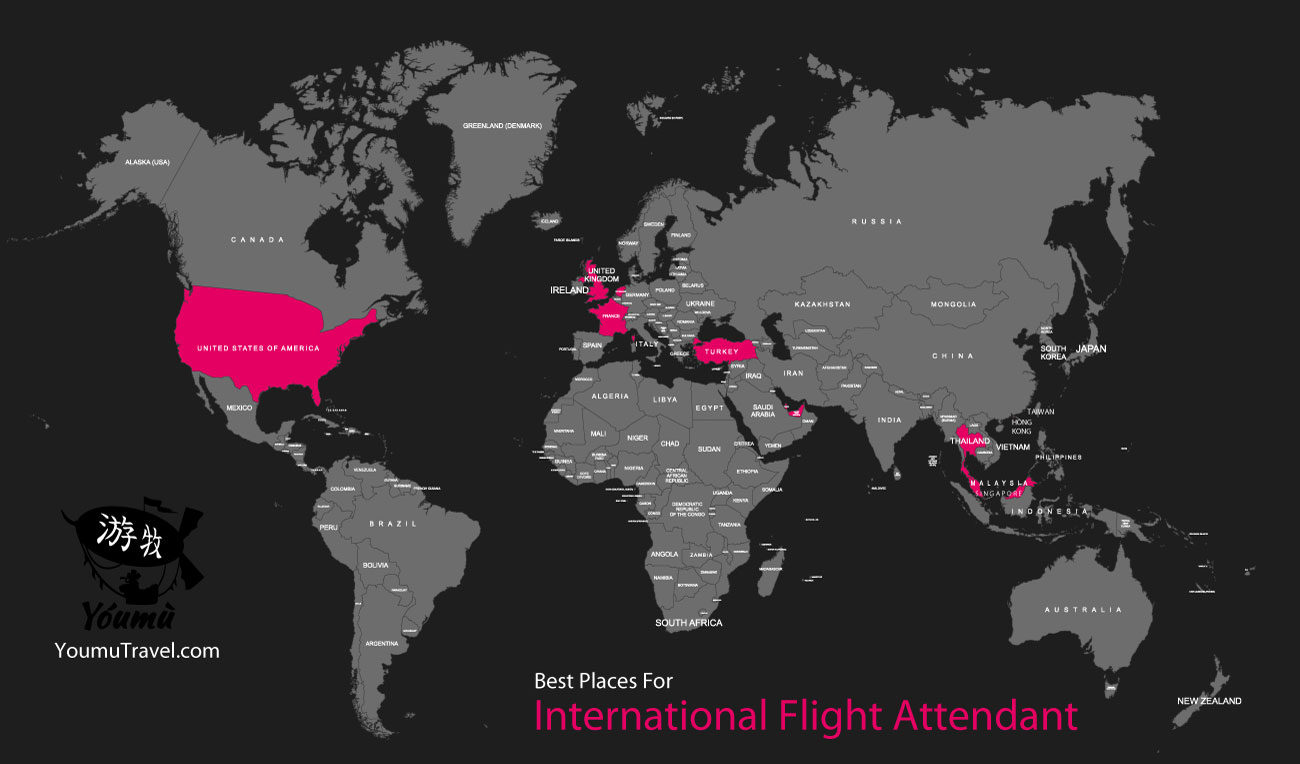
The Best Places for an International Flight Attendant
Most major countries throughout the world that host major hubs of airline companies will have opportunities for international flight attendants. Here are some of the best places for an international flight attendant.
- Turkey
- Netherlands
- France
- Qatar
- United Arab Emirates
- UK
- Hong Kong
- Singapore
- Thailand
- Malaysia
- US
Research.
You should have a thorough understanding of the ins-and-outs of being an international flight attendant, so you understand exactly what you might be signing up for. Once you have a grasp of that, research job opportunities at various airlines.
Write your resume.
Your resume should highlight previous customer service experience, as well as travel, leisure, and luxury dining or retail experience. Make sure you also mention any relevant education you have undergone.
Fill out the application.
Make sure to attach your resume. If there are other documents required, make sure to put the same care into them that you put into your resume.
Interview.
These are often done via video chat such as Skype, Facetime, Zoom, etc. Dress appropriately. Elaborate on the experience you outlined in your resume. Make sure you communicate with confidence, and make good eye contact. After this interview, you may be asked for an in-person second interview at the airline’s main offices. If you ace that interview, you’ll be invited to the next step.
Go to training.
This is called flight attendant boot camp, and it’s where you will learn all the safety regulations you need to know to be a successful flight attendant.
How do I become an international flight attendant?
To become an international flight attendant, you must be at least eighteen years old for some airlines, and twenty-one for others. It is also necessary that you have a high school diploma.
What is it like being an international flight attendant?
Being a flight attendant is fast paced and tiring because of jet lag–but there is ample opportunity to rest and recuperate on long flights or between journeys. You also get ample opportunity to travel and a dynamic work experience, as well as the ability to meet hundreds of new and interesting people.
How can I teach English online at home?
What You’ll Need to Teach Online. To teach online successfully, you’ll need a good broadband speed, Skype, a webcam and headset, and a TESOL/TEFL certificate. Generally, it’s also important to be a native English speaker. Finally, most important is a friendly, patient and punctual personality.
Do flight attendants sleep on international flights?
Yes. Flight attendants have designated sleeping times and areas–usually bunk beds or a row of seats–on longer flights.
How many flight attendants are on an international flight?
The number of flight attendants should always complement the seating capacity of the plane, in increments of fifty. If there are 100 possible passengers on a plane, there should be two flight attendants.
Do flight attendants fly for free?
The airline that the attendant works for will often offer free flights during their time off, but this is on a stand by basis and they may be removed from the flight if the flight is full of paying customers. Guests might also get free or reduced rates.
Do flight attendants make good money?
On average, a flight attendant makes $56,000/year, but the lowest could be $28,000 and the highest could be over $80,000.
How many hours does a flight attendant work?
The length of the shift often depends on the length of the flight. Usually, the shift length is limited to 12 hours where possible, but some limitations are as high as 14 hours. Per month, a flight attendant might spend between 65-90 hours in the air and 50 more prepping the aircraft.
Do flight attendants pay for hotels?
No–airlines will pay for accommodations in hotels during layovers, as well as transport. Additionally, the airline will pay a certain amount per day that the attendant is away from home to cover their cost of living such as meals.
Do flight attendants go home every night?
No, due to the nature of their career, flight attendants cannot go home every night. They may spend time in a hotel away from home most nights per week, depending on their schedule.
What do flight attendants do after landing?
Once the plane has landed, flight attendants help passengers safely exit the aircraft.
Do flight attendants get days off?
On average, a flight attendant gets between 12 and 18 days off a month–but these are not always at home.
Is flight attendant training difficult?
It can be difficult, yes. For Delta airlines, for example, it’s very difficult to gain admission to the training program and it’s extremely difficult to graduate. The program is eight weeks and requires that the attendant learn every safety requirement from the FAA in that time.
At what age do flight attendants retire?
This depends on the person and the airline. For example, United airlines allows employees who are 50 years old with 10 years of experience to retire early.
How many days do flight attendants work monthly?
Flight attendants get between 12 and 18 days off per month, so the remaining days are work days.
Is 55 too old to become a flight attendant?
Not at all–there is no maximum age to become a flight attendant.
How many flights a week do flight attendants do?
This depends entirely on the length of their scheduled flights and varies greatly.
What flight attendants should not wear on a plane?
Don’t wear anything too tight or constricting–you want to be comfortable and able to move around. Don’t wear heels that are too high or sandals without a back–you want your shoes to be comfortable and secure as well as stylish. Don’t wear metal jewelry, as you don’t want an issue with security. Also, be sure to consider easily removable or additional layers in case the plane gets too cold or warm for your liking.
Do family members of flight attendants fly free?
It depends on the airline, but most flight attendants get free or discounted flights for family members.
Work On A Cruise Ship Guide
There are a myriad of positions on a cruise ship that provide a wide variety of goods and services to passengers. Workers might help operate the ship, serve food and beverages, tidy and perform maintenance in passenger cabins or other areas, manage activities, and entertain passengers.

This job is in somewhat high demand and is easy to get.
Demand
- Somewhat High Demand
Experience & Degree
- No Experience Required
- No Degree Required
- Native English Speaking Preferred
Citizenship
- No Restrictions
This job is reliable with room & board included but is slightly lower pay.
Pay Range
- Hourly: $5-$25/hr.
Reliability
- Reliable
Housing
- Room and Board Typically Provided
This job provides little schedule freedom and some location flexibility.
Location
- Somewhat Flexible
Schedule
- Not Flexible
Language
- Can get by with English only
Who can work on a cruise ship?
Do you like working with and meeting diverse and varied groups of people? Are you flexible and able to succeed in a changeable work environment? A cruise ship worker should be prepared to bounce between locations quickly, seven-day work weeks, and split shifts. If you have a passion for traveling and working hard, then life on a cruise ship is ideal for you.
Additionally, most cruise lines require 1-2 years of applicable experience. For example, if you apply to work in a retail store onboard, you should have previous retail experience on land.
What are the responsibilities to Work On A Cruise Ship
There are hundreds of positions aboard a cruise ship all with their own respective daily tasks and required skill sets. Every single employee is required to participate in safety and lifesaving drills to be prepared for the low chance of a disaster at sea. There are usually six different departments, broken down below.
Key Responsibilities
Deck
- Navigates the ship.
- Supervises maintenance of hull and deck.
Engine
- Work and maintain equipment.
- Specific jobs might include: carpenters, electricians, engineers, repairmen, plumbers, etc.
Radio
- Videographers: maintain and operate broadcast booth (radio and news.)
- Telephonists: aid passengers seeking to make phone calls.
Medical
- Treat ailments such as seasickness or other serious health issues.
- Give general first aid.
Steward
This department includes a huge range of specialized jobs that focus on passengers’s comfort, some of the tasks might include:
- Chefs: Prepare meals.
- Waiters/waitresses: Serve guests in dining rooms or room service.
- Wine stewards: Help passengers choose wines based on your own expertise.
- Bartenders: Mix and responsibly serve alcoholic beverages.
- Sculptors: Create dazzling ice sculptures.
- Housekeeping: Keep cabins tidy, give fresh linens, keep public areas clean and safe.
Pursers
Also a large department, pursers complete a huge variety of different specialized jobs like:
- Chief purser: acts as the head of the department, and is the primary contact for passengers about the ship policies and procedures.
- Assistant pursers: assist the chief purser as needed. Could be equated with the front desk duties at an on-land hotel.
- Cruise director: plans ship entertainment/activities.
- Youth staff director: plans entertainment/activities for children.
- Casino workers: dealers, cash handling, slot machine attendants.
- Sound/lighting technicians: provide audio and visual effects for entertainment put on by the cruise director.
- Entertainers: sing, dance, act, etc. to keep passengers entertained.
- Dance instructors: teach a variety of dance styles.
What’s the typical schedule for a cruise ship employee?
Cruise ship employees should expect 7 day work weeks with over 45 hours per week. Many cruise ship employees have described the job as fairly demanding in terms of time and effort, but long-term contracts offer breaks of up to two months so you can get your land legs back.
Income Reliability
In general, working on a cruise ship is as reliable as a land-based job and provides a constant stream of work.
Typical Job Duration
Working on a cruise ship can be short-term or long-term, depending on what your position is.
Estimated Hours Per Week
It’s estimated that you can work 45 hours per week or more on a cruise ship.
Room & Board
Working on cruise ship will provide room and board on the ship.
Work On A Cruise Ship – Country Map
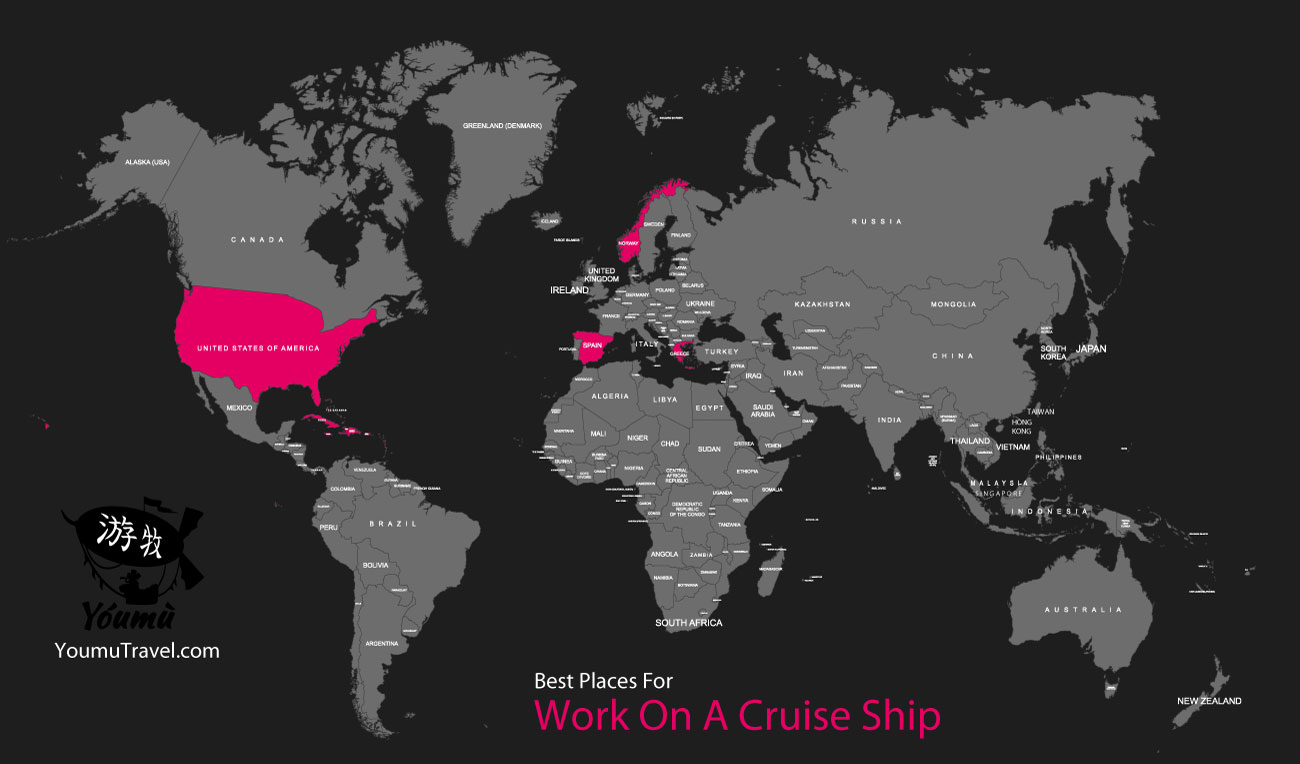
The Best Places to Work On A Cruise Ship
Most major countries throughout the world have opportunities for those seeking to work on a cruise ship. Here are some of the best places to work on a cruise ship.
- USA
- The Caribbeans
- Norway
- The Bahamas
- Greece
- Galapagos
- Spain
- Seychelles
- Hawaii
- Tahiti
- Antarctica
Determine if life at sea is right for you.
You should consider the following things: Do you like working with and meeting diverse and varied groups of people? Are you flexible and able to succeed in a changeable work environment? You should be prepared to bounce between locations quickly, seven-day work weeks, and split shifts. If you have a passion for traveling and working hard, then life on a cruise ship is ideal for you.
Decide which cruise line to work for.
Every cruise line is different, so make sure you do ample research to decide which one is the best fit for you. Larger cruise lines will have long itineraries and a lot of staff, which provides a variable and dynamic work environment for you, while smaller lines could provide a sense of community with shorter itineraries and less staff–decide which you like better. Next, go to each line’s website and read up on their employment pages to see which might fit you and your work ethic best.
Pick a position.
You should consider all of your past experiences when deciding which department/position you want to work on a cruise ship. Generally, cruise lines will require 1-2 years of applicable experience–on or off shore. If you’re unsure which position is best for you, you could contact a cruise ship employment specialist to help you determine what fits you best.
Write your resume and CV.
Cruise line recruiters will skim your resume very quickly when going through applications, so make sure it stands out and looks polished. Make sure to optimize your cover letter to be specific to each cruise line so you stick out as a prime candidate.
Apply.
Information on how to apply can be found on each line’s website and the process could vary by line. Applying for cruise work isn’t as simple as firing off applications for on-shore work, and it might require that you use a concession agency or a hiring partner.
Interview.
It’s common practice for interviews to be conducted via video chat, so make sure you include your Skype contact information on your cover letter and that you know how to use Skype well.
All aboard!
When you are offered your first contract, make sure you do the following before you embark:
- Ask the recruiter any questions that weren’t answered in the interview or contract.
- Read every document sent to you thoroughly, paying special attention to your contract.
- Make sure you have all the necessary documents required by the specific cruise line.
- Ask your recruiter or admin about getting reimbursed for required medical checks, visas, luggage fees, and transportation to the ship.
What qualifications do you need to work on a cruise ship?
The requirements to work on a cruise ship include: being 21 or older, pass a criminal background check, have a current passport, have a US C1/D visa if you’re not a resident of the US or Canada, have a certificate that shows you were medically examined prior to employment, and have proficient english fluency.
Is it hard to get a job on a cruise ship?
Cruise ship jobs are fairly competitive, so do ample research and planning to be able to compete with other applicants.
How much do you get paid to work on a cruise ship?
Most cruise ship positions are paid hourly–most people can earn between $1,200 and $1,500 a month, though some positions can make up to $2,500 per month.
What kind of jobs are available on a cruise ship?
Cruise ships need all different kinds of professionals from entry-level retail sales persons, housekeeping positions, food and drink management, HR positions, IT positions, nursing positions, and more.
Can I get a cruise ship job with no experience?
You don’t necessarily need prior experience on a cruise ship to get a cruise ship position, but you’ll probably need relevant experience in the same field on land. For example, if you are applying to sell jewelry in a retail store on a cruise ship, it pays to have prior retail experience. Look at your past experience–work, volunteer, or educational–to see what positions would best suit you and which you’re most likely to be hired for.
Do you get days off working on a cruise ship?
Many people who have worked on a cruise ship have said that the job is demanding and there’s little time off. Workers usually sign a contract which can last up to nine months, but long contracts will include a two month break to get away from life at sea.
What is the best job on a cruise ship?
Some popular cruise ship positions include: ship captain, gentleman host, general entertainer, shore excursions managers and workers, youth counselors, bartenders, and fitness instructors among many others.
Do cruise ship workers get free food?
Food isn’t free for cruise ship workers and food is not allowed in the cabin–all food must be contained within particular crew dining areas.
Do cruise ships have jails?
Yes, most cruise ships have a jail cell in the bottom of the boat near the crew’s quarters.
Do cruise employees hook up with passengers?
There are strict guidelines that ban staff from having relationships with passengers–if caught, the staff member will be immediately fired.
Is working on a cruise ship good money?
The upper limit for a cruise ship worker is $2,500/month, and a cruise ship worker should expect to work more than 45 hours a week.
What is the highest paying job on a cruise ship?
Usually, officers, department heads/chairs, and people working on commission are likely to make the most on a cruise ship.
International Tour Guide Jobs – Guide
A tour guide’s primary function is to guide tourists around unfamiliar areas and provide extensive knowledge on those places.

This job is easy to get and can be available to a wide range of people.
Demand
- Average Demand
Experience & Degree
- Basic Understanding Required
- Easy Certification Required
- Native English Speaking Preferred
Citizenship
- No Restrictions
This job is somewhat reliable with reasonable pay.
Pay Range
- Hourly: $8-$20/hr.
Reliability
- Somewhat Reliable
Housing
- Room and Board Not Provided
This job is somewhat reliable and it’s likely you’ll only get part-time hours but the hourly rates are reasonable.
Location
- Little Flexibility
Schedule
- Somewhat Flexible
Language
- Can get by with English only
Who can get International Tour Guide Jobs?
Anyone who has a love of traveling, meeting new people, and learning new things can be a tour guide. It is recommended for a tour guide to have a second language, but not required. Additionally, the hours of a tour guide are highly variable so the guide must be flexible.
What are the responsibilities for International Tour Guide Jobs?
The primary function of a tour guide is to lead a group of tourists around unfamiliar landmarks in a city, explaining the significance as they go, but many things can go into this.
Key Responsibilities
- Do ample research to plan your tour route and information
- Prepare presentations
- Give advice on other places to sightsee after the tour
- Lead excursions, making sure not to lose people in your tour
- Problem solve if your route is interrupted or other unforeseen circumstances
- Translate and interpret for your group or others
What’s the typical schedule for International Tour Guide Jobs?
A tour guide’s schedule is highly variable and depends on the tour company they might work with and where they guide. Shifts may be very long–sometimes over 12 hours–with multiple tours, but guides working like that are often allowed 2-3 days off between.
Income Reliability
In general, being an international tour guide has a variable income, as some of it depends on tips.
Typical Job Duration
International tour guidance can be short-term or long-term.
Estimated Hours Per Week
It’s estimated that you can work full time, 40 hours per week or more, as an international tour guide.
Room & Board
Being an international tour guide sometimes provides room & board.
Teaching English Online – Country Map
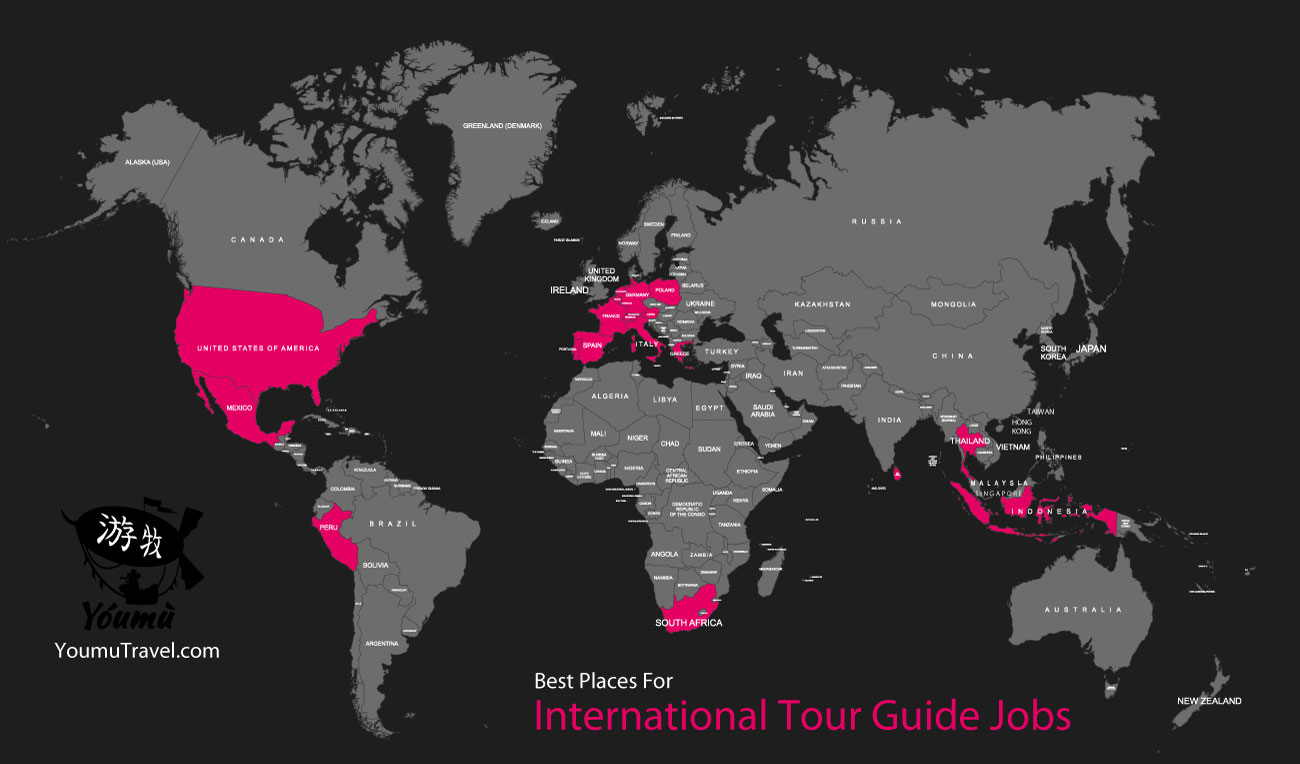
The Best Places for International Tour Guide Jobs
Most major countries throughout the world have opportunities for those seeking international tour guide jobs. Here are some of the best places for international tour guide jobs.
- Indonesia
- Thailand
- Portugal
- Sri Lanka
- South Africa
- Mexico
- US
- Peru
- Greece
- US
Travel.
It’s a good idea to travel a lot before becoming a tour guide. Being a tourist yourself will help you understand the perspective of the people you’ll be guiding–what information you want to know is likely the information they will want to know as well.
Understand what the job entails.
Prior to deciding to be a tour guide, you should understand that a life of constant travel requires a love of learning, optimism, and hard work. Being a tour guide requires you to be available whenever and wherever, so it becomes difficult to schedule time for your own needs or for your friends and family.
Look for jobs online.
Once you’ve decided that the tour guide life is right for you, think of what environment you’d like to conduct tours in. Parks? Museums? Historic buildings? Cruise ships? Once you’ve decided, look for relevant job postings. Additionally, do research on tour operators in your area of interest. There are various kinds of tours–slower, history-based tours with mature audiences, or exciting night-life tours for young people–so decide what kind of environment you would do well in and do research to find the best ones.
Write your resume/CV.
Make sure to include any relevant experience, including previous leadership positions and examples of your charismatic people skills. Experience in the service industry or teaching people anything should also be included.
Interview.
The interview process varies greatly depending on the tour company, so be prepared for anything. It might be one meeting or multiple. Prepare examples in advance, and understand that there may be random questions designed to gauge how well you think on your feet. It’s also a good idea to have a foreign language or a PCV driver’s license–though they aren’t necessary for every position. First aid is also a great thing to list on your resume. Lastly, make sure you have a thorough answer to the question: “What would make you a good tour guide?”
You’re on your way!
Once offered a job, negotiate the terms and agree on a beginning date. Pack your bags with everything you’ll need and set off!
How do I become a tour guide in Europe?
Network with existing tour guides in the countries/cities you’re looking to work in and see if anyone is looking to take on an intern or have short term help. This is a great way to get real life experience, and once you’ve done that you can register on various tour guide marketplaces.
Is a tour guide a good job?
This is subjective, but for many, being a tour guide is extremely rewarding. It allows you to have an intimate knowledge of exotic and interesting locations, meet a variety of people from all over the world, and you get to sight-see every day.
How do I become an international tour guide?
The steps vary depending on where you’ll be a tour guide, so look into the local laws where you’re interested.
What qualities does a tour guide need to have?
The best tour guides should be highly knowledgeable, have great communication skills, be charismatic, be flexible and able to improvise on the spot, be an engaging storyteller, and have a strong sense of empathy.
Why do I want to be a tour guide?
Being a tour guide allows you to learn new things every single day and meet new and fascinating people while you do it. Tour guides also need to be good at organizing large groups of people, communicate well with people with various different backgrounds, and be able to deal with unexpected issues without delay. If this all sounds like a fun and dynamic job, then being a tour guide might be right for you.
How do tour guides get paid?
On average, a tour guide gets paid $50-$150 each day as their base salary, but most guides can expect tips from the people they guide. With tip, the daily income could range from $250-$350 a day.
What is the salary for the travel and tourism industry?
Entry level positions can expect around $27,000/year, whereas more seasoned guides can make around $121,600/year.
How can I make the most money teaching English online?
Generally speaking, online English teachers typically make anywhere between $10 – $40 USD per hour depending on their level of qualification. Platforms such as VIPKID offer base rates plus incentives. Incentive bonuses may include things like an extra $1 of pay per class if you complete more that 45 classes per month.
What should a tour guide say?
Over time, you’ll develop a thorough script as a tour guide, but a good place to start is an introduction of yourself–including your name, where you’re from, and perhaps a fun fact–and a brief overview of the things you’re going to see on the tour.
International Hospitality Jobs Guide
There are so many options in the international hospitality industry–from hotel jobs, tourism, nightlife, and food service, but the common denominator in all of these is customer service and sales.
This job has just average demand but is easy to get.
Demand
- Average Demand
Experience & Degree
- Basic Understanding Preferred
- No Degree Required but Certification Preferred
- Native English Speaking Preferred
Citizenship
- No Restrictions
This job is reliable but is lower pay.
Pay Range
- Hourly: $6-$25/hr.
Reliability
- Reliable
Housing
- Room and Board Sometimes Provided
This job’s schedule is somewhat flexible and you can work in many parts of the world.
Location
- Flexible
Schedule
- Somewhat Flexible
Language
- Can get by with English only
Who can get International Hospitality Jobs?
It is recommended that you have a relevant degree–such as hospitality or business–to get into the international hospitality industry, but it is not always necessary. Anyone who has excellent customer service and communication skills, as well as a love for traveling and willingness to work hard, can work in international hospitality.
What are the responsibilities for International Hospitality Jobs?
There is such an array of potential hospitality careers that it’s difficult to sum up, so the various circles of hospitality are broken up below.
Key Responsibilities
- Recreation:
- Responsible for the organization, promotion, and leadership of activities for guests–sports, games, crafts, hobbies, excursions, and children’s activities, taking into account group desires/needs.
- Experience and expertise in sports, games, crafts, music, and theater are a bonus.
- Waitstaff:
- Responsible for taking accurate food and beverage orders.
- Deliver ordered items.
- Ensure happiness of guests.
- Prepare bills.
- Handle payment in cash, check, credit, and debit.
- Many sectors of the hospitality industry need waitstaff, such as hotel restaurants, cruise ship dining, bars/clubs/pubs, cafes, and more.
- Hotel/motel/resort front desk:
- Ensure great guest experience.
- Greet guests and make them feel comfortable.
- Accommodate guest needs and desires.
- Organize and assign guest rooms and distribute keys and other necessary materials.
- Keep accurate guest records, such as their charges and correspondence.
- Create and confirm reservations.
- Handle payment in cash, credit, check, and debit.
- Food service:
- Prepare food according to health and safety standards as well as guest preference/necessities.
- Keep track of inventory such as food and equipment.
- Ensure proper storage of food items.
- Keep equipment sanitized.
- Utilize house recipes when necessary.
- Housekeeping:
- Clean rooms, hallways, and public areas. This includes but is not limited to: disinfecting, vacuuming, sweeping, mopping, etc.
- Stock linens such as sheets and towels.
- Replace toiletries like shampoo, conditioner, soap, and lotion.
- Make beds.
- Empty trash.
What’s the typical schedule for International Hospitality Jobs?
This depends on the position within the international hospitality and can vary greatly. It is likely that you’ll work between 6 and 10 hours per day depending on the position.
Income Reliability
In general, international hospitality is a reliable job that provides a constant stream of work.
Typical Job Duration
International hospitality jobs can be short-term or long-term.
Estimated Hours Per Week
It’s estimated that you can work full time, 40 hours per week, working in international hospitality.
Room & Board
International hospitality jobs sometimes provide room & board.
International Hospitality Jobs – Country Map
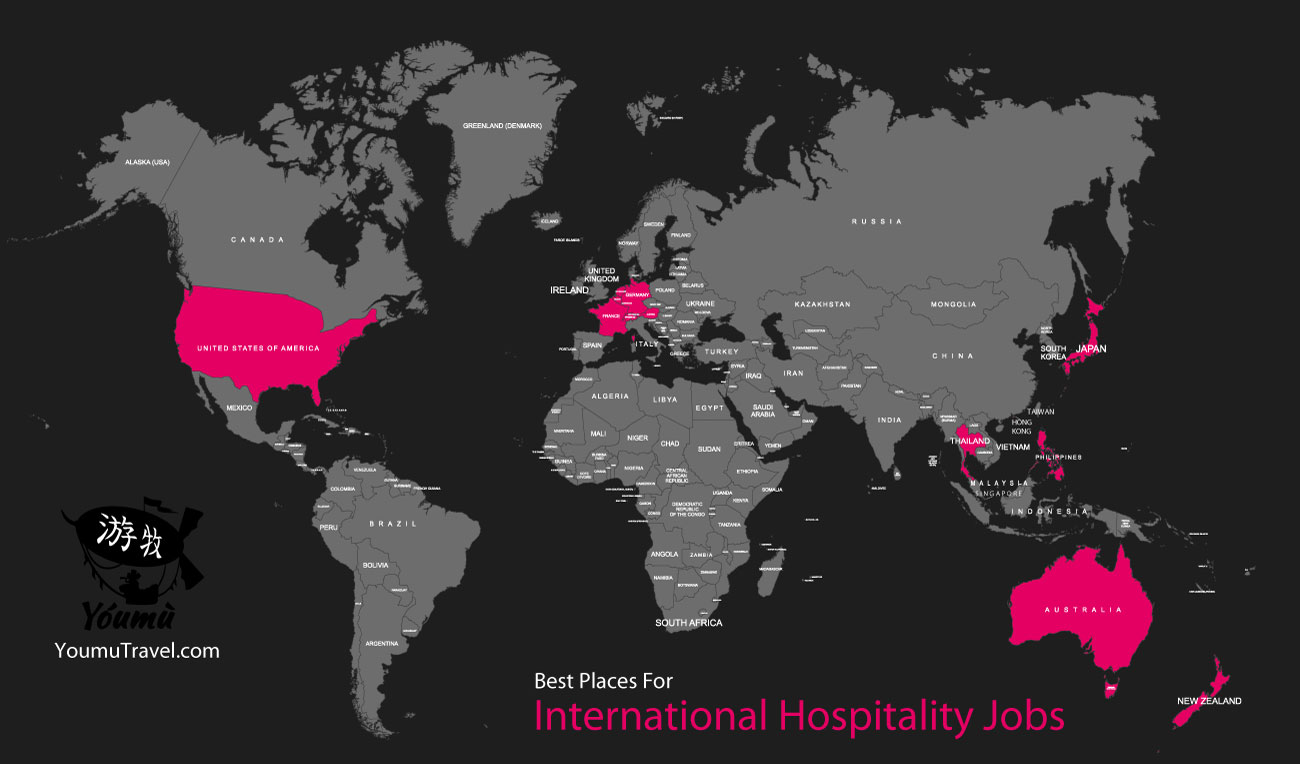
The Best Places to work International Hospitality Jobs
Most major countries throughout the world have opportunities for those seeking international hospitality jobs. Here are some of the best places for international hospitality jobs.
- Australia
- New Zealand
- US
- Western Europe
- Thailand
- Philippines
- Hong Kong
- Japan
Determine your skills.
Figure out your best skills–are you a great cook? Do you have a passion for customer service? Do you love planning activities? Whatever your skills may be, find them, hone them, and then determine what sector of hospitality might be right for you based on that information.
Decide where you want to travel.
Are you interested in a tropical climate? Ski resorts? Do you love historical cities or new and bustling urban areas? Decide what kind of place you want to work in and look for opportunities in those locations. Also, do research into visa requirements in that place and start making the appropriate arrangements.
Practice your language skills.
Whether you need to improve your oral English skills or begin learning Italian, consider this in advance and start learning. You can use popular apps like Duolingo to brush up, or take in-person or online classes. You can also try applying for jobs in places where people are likely to speak the same language as you, even in an international setting. Also, find people who know the language you’re learning and try to practice by conversing with them–since the natural flow of conversation presents unique challenges that it is difficult to prepare for in a controlled setting.
Hone your communication skills.
Similarly, once you’ve started learning any language you might need, you should learn how to communicate effectively. This is especially important for customer service so that you can help guests with any issues or questions they might have. Additionally, there might be cultural differences that you’ll have to understand and get used to. Some cultures and languages sound and seem more aggressive than others, but it doesn’t always indicate that the guest is upset.
Create your resume/CV.
Make sure to highlight previous hospitality experience of any kind, or any other experience that is relevant to the position you’re applying for. Make sure to mention your educational background, especially if you went to a hospitality school that is globally recognized.
Begin your job search.
There are plenty of websites and agencies that specialize in hospitality careers, so do some research and send your resume out.
Interview.
Be prepared to explicate in greater detail your experiences and education, and make sure to demonstrate your communication skills!
Negotiate and begin.
Once offered a position, negotiate the terms such as salary and visa help, and once you come to an agreement, start packing!
Which country is best for hospitality jobs?
In terms of job market growth, some of the best countries for hospitality positions include Spain, Japan, USA, Australia, Canada, UK, Italy, Switzerland, Mauritius, and UAE, but of course there are many opportunities in other countries as well.
What kind of careers are in the hospitality industry?
Some examples of hospitality careers include hotel general managers, hotel clerks, bellhops, convention planners, concierges, chefs, ticket agents, housekeepers, and game dealers.
How do I get a job in a hotel?
First look at company websites to find career options, or try visiting hotels you’re interested in person to inquire face-to-face about open positions.
What is the highest paid job in hospitality?
Some of the best paying hospitality jobs include director of housekeeping; executive positions such as executive chefs, pastry chefs, and casino hosts; flight attendants, hotel managers, event managers, and restaurant general managers.
Which field is best in hotel management?
The best course depends on your skills and preferences, but some great options include food and beverage production, front desk positions, housekeeping positions, customer service positions, and hotel management routes such as PR, HR, marketing, and finance.
Why should I study hospitality?
Studying hospitality can be a great option because there are plenty of career options for you to choose from after getting your hospitality education.
Are hotel managers rich?
Hotel managers can certainly make a nice living–salaries usually range from around $60,000/year to $200,000/year. Additionally, being a hotel general manager offers a score of interesting and unique opportunities–meeting people from all around the globe, attending fun events, and working internationally.
What do hotels look for when hiring?
Hotel hiring managers look for employees who are familiar with point-of-sale systems, inventory management, and are comfortable with numbers. Additionally, they should be comfortable asking guests for details and data.
How much money can you make in the hospitality industry?
This depends on where you work, how much experience you have, and the type of position you hold, but people can earn over $100,000 as seasoned general hotel managers.
How hard is hotel management?
This is subjective as it depends on your own proclivities and skills, but with practice, hotel management isn’t difficult to do–there are just many things to keep track of.
Backpacker Jobs Guide

Contents
- Backpacker Requirements – Visa, Education, & Experience
- How Much Backpackers Get Paid & How Taxes Work
- Are Backpacker Jobs Reliable?
- Pros & Cons of Being a Backpacker
What is a backpacker?
A backpacker is a budget traveler looking to reduce cost where possible. For example, a backpacker may choose public transportation, walking, or biking to get from place to place instead of a car rental; they might stay at a hostel or with a family instead of a hotel room. Backpackers normally pack light and visit multiple locations during their travels.
Gap Year Jobs
A backpacker is a budget traveler looking to reduce cost where possible. For example, a backpacker may choose public transportation, walking, or biking to get from place to place instead of a car rental; they might stay at a hostel or with a family instead of a hotel room. Backpackers normally pack light and visit multiple locations during their travels.
What is a backpacker?
A backpacker is a budget traveler looking to reduce cost where possible. For example, a backpacker may choose public transportation, walking, or biking to get from place to place instead of a car rental; they might stay at a hostel or with a family instead of a hotel room. Backpackers normally pack light and visit multiple locations during their travels.
Why do backpackers travel?
Backpackers travel to satiate a desire for discovery. Backpacking allows adventurers to go to new places for a lower cost than traditional vacationing. It is a unique way to see the world, and due to the nature of cheap, shared living spaces and public transportation, backpackers meet new like-minded friends from all over!
What is a gap year?
A gap year refers to when someone takes an extended period of time (6mo-1yr) off to evaluate where they are in life. This is typical for people before college or after college or prior to joining the workforce. However, it’s becoming increasingly more popular for established professionals of all ages to take a gap year. These are technically career gap years.
What is a career gap year?
A career gap year is different from a standard gap year (which applies to students who take a year off from their studies); employed adults may take a ‘career gap year’ in order to reevaluate career goals and overall life plans. Traveling during this time allows for a new perspective on your life at home. Unless you have a job willing to hold your position for a year, however, a career gap year may mean leaving your job to travel, then finding a new one when you return.
What is a working holiday?
A working holiday differs from a normal vacation in that a tourist is able to stay for an extended amount of time, typically 6 months to a year. You can work any job in the country but it’s very likely that short-term jobs, opposed to career-level jobs, will be the only obtainable jobs. The term ‘working holiday’ may also refer to a type of visa required for this type of trip abroad.
What is a work exchange program?
Work exchange programs are those which offer accommodation as payment for work. In other words, you will be provided a place to stay in exchange for your labor. There are many different types of work that offer this: farm work, au pair, cleaning, teaching, etc. Food and other benefits may be included as well.
Different Types & Examples of
Backpacker, Gap Year, and Work Exchange Jobs
There are many types of jobs you can do in your gap year, both at home and abroad. Most of the examples in this section are jobs abroad/while backpacking. Whether you’re curious about what kind of jobs students taking a gap year do or seeking inspiration with backpacking job ideas, we cover both in the section below.
What Backpacker jobs can you do in a gap year?
How you spend your gap year will depend on whether you’re planning on traveling or sticking around to make money before starting school. Gap years give students the chance to consider where they want to go in the future; this may mean doing an internship related to an interest of yours, or volunteering somewhere that does work you’re passionate about. On your year off, work on developing your resume and cover letter. Consider increasing your qualifications beyond a high school diploma; earning a TEFL certification or completing an apprenticeship are two examples of this. Temp jobs and entry level positions are easier to get with minimum experience, and may turn into better positions at the company after a period of time and hard work.
Job Examples of Work Exchange Programs
There are many different types of work exchange programs. For example, working as an au pair will provide you with accommodation and food (normally extra spending funds as well) in exchange for childcare and housework; check out interexchange.org/au-pair to explore different countries and potential families. Farm work exchange opportunities can be found at WWOOF. If you aren’t sure what type of program would be best for you, check out gooverseas.com and worldpackers.com for extensive lists of programs. Additionally, the Bureau of Educational and Cultural Affairs provides links to many work exchange and scholarship programs that will look excellent on a college or job application; it can be found at exchanges.state.gov.
General Requirements for Backpackers
General requirements for backpacking include the freedom and commitment to travel to multiple locations. Backpackers are normally over the age of 18 due to school obligations and potential age restrictions on booking. For packing, the idea is more is less. Pack the essentials in a bag or two: passport (if going out of the country) and wallet, clothing appropriate for multiple climates, hygiene products, hiking boots/shoes, emergency/repair kits, water bottle (and water treatment supplies). If you will be camping for any duration, then pack the necessary materials (tent, sleeping bag and pad, stove and fuel, kitchen and food supplies).
Education & Experience Requirements for Backpacking Jobs
Any education or experience requirements will be dependent on what you plan to do/where you plan to work while backpacking. Most won’t require a particular level of education, but some career-specific programs (for med students or future teachers, etc.) will expect you to have an interest in that field. Expect any job abroad to have the same requirements they would have at your home. If you’re planning on being an au pair, for example, the family may prefer childcare experience. If you’re working as a bartender at a hostel, it will be helpful to have bartending experience. For teaching English abroad, you’ll need to be fluent in English. You’ll also want to get a TEFL certification. It’s cheap and easy to obtain and the best teaching english jobs will require it.
Do backpacker jobs need work visas?
When backpacking in another country, you may need a travel visa issued by that country. This may be given to you at the airport when you land, or it may require an application prior to departure. To find out more information on travel visa requirements, check cibtvisas.com. If you plan on working, you will again need to research in advance. Any employer who hires you in advance should help you apply for a work visa.
Can I become a backpacker with no money?
There are many tried and true ways to travel on a tight budget. Short-term apartments, international house sitting, hostels, pet sitting positions in the location you want to travel; you’ll have a free place to stay and most employers or families pay for the sitting in advance, which provides you with spending money for food and transportation.
Farm work is another option – farm owners provide accommodation in exchange for your labor; check out WWOOF (World Wide Opportunities on Organic Farms) for opportunities.
Working as an au pair for a family is another way to have somewhere to stay (with the family) and get some spending cash in exchange for childcare and helping out around the house. Listing your house on Airbnb can be another way to fund your trips, as you’ll essentially make money to be away from your home.
What are the best paying backpacker, gap year jobs?
There are lots of possible gap year/backpacker jobs abroad, but the following are considered to be the best paying: working at a resort or hostel, freelance photography (or working for a magazine/journal), blogging/vlogging with sponsorship from clients, working as an au pair for a family, or working on a cruise ship. Any of these positions should help fund your travels.
How do backpackers pay taxes?
If you’re an employee of a company located in a different country then you or the company will have the obligation to pay taxes to that country and local region. It’s a good idea to ask the company, in an email, how taxes will be handled in your situation. The most common scenario is that the company automatically deducts the amount from your pay and it’s clearly broken down on your pay stub.
How much does it cost to travel as a backpacker for 1 year?
Though the cost for traveling the world during your gap year can vary greatly depending on flight destination, accommodation decisions, and activities, the estimated cost is somewhere between $20,000 and $30,000. This includes everything: flights, accommodation, transportation, food, activities, visas, etc. Depending on where you go and what you do, it could be more or less expensive.
Are backpacker jobs reliable?
Pros & Cons of Backpacking – Taking a Gap Year
The Pros
There are many benefits to taking a gap year. Lots of students feel they need a bit of time to discover themselves and their life goals before heading straight into college or the workforce. Your year off will allow you to get to know yourself better and grow your confidence before taking the big step of choosing your future career. Traveling away from home will give you perspective on your life at home and help you determine where you want to end up. Any sort of internship or program will also strengthen your resume and application.
The Cons
When deciding whether or not to take a gap year, you of course should consider possible disadvantages. Common cons associated with gap years include the following: expenses, being alone, losing motivation for school, the sensation of lagging behind your peers, losing touch with friends, and all the advance planning required to take a gap year. Remember that there is also a positive way to look at these potential issues. For example, you can budget or work while traveling, you’ll make friends along the way, you will mature and boost your resume before returning to school. If a gap year feels right for you, take it!
| Pros | Cons |
|---|---|
| – Time to discover yourself | – Expenses of traveling |
| – Gain new perspective and grow inside | – Sensation of lagging behind your peers |
| – Earn more confidence | – Loosing motivation for school |
| – Can gain work experience | – Feelings of loneliness, losing touch with friends |
| – The endless unique experiences that await | – Planning required in advance |
How To Become a Backpacker
To become a backpacker, you should first ensure you have accurate expectations. Most backpackers travel alone or with someone. If going alone, be prepared to look after yourself. You’ll be doing all the planning, packing, finding a place to sleep, arranging transportation and meals for yourself. Be ready to test your navigation and budgeting skills; prepare for extended periods of travel and inclement weather. After considering all this, remember why you’re doing this: for the amazing experience! You’ll encounter different places and people, you are leaving the monotony of your home behind to explore new worlds!
How to Find Backpacker Jobs
If you don’t line up a job in advance before your trip, then here are some tips for finding a backpacker job: prepare a resume to bring with you, keep an eye out for notice boards or ads at the hostel you stay at and around town, chat to staff and make friends with everyone you encounter (they might know places hiring temporary employees!), and be willing to take whatever job you get offered. If you’re willing to do anything (cleaning, busing at a restaurant, etc.), it shouldn’t be too hard to find someone who wants to hire you.
Planning Your Gap Year & Choosing a Job
Gap Year Ideas & Inspiration
Though of course you may choose to spend your gap year traveling to various locations for views, activities, and food, also consider using your gap year to help make a difference in the lives of local peoples and animals. For example, look into marine conservation projects in Thailand; this is especially rewarding for those interested in biology and/or environmentalism. Or perhaps you want to work with elephants in Namibia and help conserve beautiful wildlife. For those interested in teaching, volunteering with kids in South Africa is an amazing option to gain experience helping others learn English as well as have fun with social activities.
When planning your gap year, start by brainstorming what you’re hoping to accomplish. Are there skills you want to acquire? Experiences you want to gain? Places you want to see? Think as big and as grand as you like before figuring out the logistics. It’s your year to do what you want to do! After you’ve got a list, take into consideration any college plans and plans for after college. Ideally everything will be mutually beneficial to your career goals, but if you just want to have fun traveling during your gap year that’s okay too!
Best Backpacker Companies To Work For
Where to Find Gap Year Jobs Abroad
There are a plethora of resources to help find jobs abroad during your gap year. Companies hiring right now:
Best Places to Backpack & Spend Your Gap Year
The possibilities for where to travel during your gap year and/or your backpacking adventure are endless. Go wherever interests you! And of course, if you find a specific job type or program that is in a certain location, that may drive where you go as well. Here are a few recommendations for popular backpacking destinations:
- Thailand: Thailand is famous for its beautiful temples and shrines, rural life, and tasty, spicy food. Check out smaller, less touristy towns and get to know the locals at bars or cafes. They’ll be happy to recommend local wonders and fun activities.
- Australia: Australia offers amazing outdoor activities, incredible landscapes, fascinating wildlife, and kind locals. Experience all the outback has to offer; the beautiful, vast desert and endless, starry skies. Be sure to check out surfing at the beaches, swim under waterfalls, or even swim with sharks!
- New Zealand: New Zealand is known for its gorgeous nature reserves, ancient volcanoes, surfing beaches, and other outdoor activities such as kayaking and yoga. You’ll have no shortage of incredible scenery here.
- Indonesia: Indonesia offers breathtaking beaches, cliffs, and caves. Swim with manta rays, watch beautiful sunsets, eat cheap and tasty local food, and even travel via moped!
- Slovenia: Slovenia is full of medieval buildings and narrow streets, cheap local wine, and friendly locals. The country is the very first to be declared a ‘green destination,’ meaning they commit themselves to supporting sustainable tourism!
- France: We all have dreams of French cafes, sipping coffee and snacking on a pain au chocolat! Or maybe sitting by the sea with a bottle of red wine, cheese, and a fresh baked loaf of bread. Do all this and more: France offers plenty of hiking, surfing, and bike riding in addition to their classic delicacies.
- Norway: Norway is a great destination for beautiful architecture such as gothic cathedrals and colorful, minimalistic waterfront buildings. Meet locals over a pint of local craft beer and, if you go in between September and March, you can see the Northern Lights!
- Costa Rica: We’re all familiar with Costa Rica’s famous, easy-going lifestyle. Visit a small, beach town and rejuvenate with some beach yoga and vegan meals. Take a riverboat out and spot crocodiles, monkeys, and plenty of exotic birds.
- Philippines: Often underrated, The Philippines has some of the most exquisite islands on the planet. Experience endless lagoons, waterfalls, jungle, and jaw-dropping beaches. For fans of a good nightlife, it’s also known to have amazing casual bars and parties that last late into the evening.
- Spain: Spain is known for its beautiful scenery, laid-back environment, and delicious food. Expect lots of sunshine and friendly locals. Spain has incredible beaches as well as lush-green regions; visit both, consuming plenty of cider and tapas as you go!
For finding the best backpacking, gap year jobs or programs, it really will depend on you and what you think will best fit your interests and goals. A med student, for example, will likely seek different gap year jobs or programs than an art major.
Backpacking Tips
- Pack medication. When traveling for an extended period of time, you are bound to get sick at least once. Obviously you should pack any prescribed medication and supplements you take, but it also doesn’t hurt to bring along the meds you’d normally use when you feel under the weather or have a cold. It may be more difficult than you’d imagine to find the equivalent of NyQuil in a foreign country.
- Take advantage of accessible WiFi when you find it. Unless going off paper maps, use WiFi to download ‘offline’ Google Maps for your location. By opening Google Maps when you have WiFi, it will be stored in the app and you can plug in destinations without WiFi. There are other navigation apps that have this ability as well. Note places with accessible WiFi in case you need to come back and look something up.
- Let your bank know when and where you are going. If they aren’t informed you’ll be charging the card overseas, your account will likely be suspended until they can get in touch with you and confirm it is in fact you charging the card. You won’t want to end up half-way across the world with no way to purchase food or accommodation.
- Your backpacking wardrobe should be different from your vacation wardrobe. Backpacking is about essentials only and simplicity. Keep in mind you’ll be the one hauling everything you bring; pack adaptable clothing that will work for many activities. Plain shirts and comfy pants will be your best friend.
- Locate public restrooms early on. Presumably you’ll be spending a lot of time outside your hostel, and therefore for your own comfort you’ll want to know where the nearest restroom is. Shopping centers and markets are normally reliable, and many cities offer a building used only as a public restroom.
- Bring some waterproof ‘wetbags’ with you for any swimsuits, wet towels, or wet clothes you need to pack. You’ll also probably want to use them to separate dirty clothes from clean clothes. Plastic bags also work, but aren’t very reusable or sustainable.
- Though you don’t have to plan every second of your trip, it doesn’t hurt to do some research in advance for cool sights and fun activities. You can also chat with locals for recommendations that you may not have found online.
- Know how much money you have to spend, but don’t be consumed with careful budgeting. Odds are you will spend more than you planned (unless you overestimate on purpose). Don’t blow your money for basic food accommodation, but if you can afford it then welcome any last minute adventures or fancy dinners and enjoy yourself!
- Plan for the weather. Look up the average weather for the time of year you’ll be at a certain location so you are able to pack appropriate clothing and plan outdoor vs indoor activities.
- Bring items for downtime. Though you’ll be off climbing mountains and swimming with sharks, it’s nice to spend relaxing time, too. Not to mention the time spent in transport (plane, bus, etc). Pack books, games, journals, art supplies, etc.
Backpacking Tools & Resources
For backpacking resources, there are plenty of online sources and helpful books that can help you pack and plan meals. A few top recommended apps and sites for trail maps are AllTrails and Trail Finder. For outdoor clothing and gear, REI is renowned. Check out World Nomads for help with travel insurance. HostelWorld is the top choice for many backpackers when it comes to arranging accommodation. For budgeting your trip, look into an app called Trail Wallet.
Gap Year Statistics
Information taken from Student Conservation Association:
In a 2015 study by the American Gap Association and Temple University, students who had chosen to take a gap year were interviewed about their decision. 92% were looking to grow from the experience, 85% were excited to experience other cultures, and 50% of students mentioned considering future academic options as motivation for the year off from school.
Upon returning, the students were asked about their year off. The responses were overwhelmingly positive. 98% confirmed the experience assisted in personal growth, 96% felt more self-assured and confident, and 93% noticed an improvement in communication skills. A majority also mentioned they believed it aided them in developing skills for their future careers as well as expanding their appreciation for different cultures worldwide.
Research has also revealed that gap-year students seem to outperform their fellow students who went straight from high school to university; research points to gap-years providing increased mental stability. Additionally, 90% of gap-year students do return to college directly after completing their year off. To avoid losing motivation to go to school, consider first getting accepted to your desired college and deferring for a year. Some schools even offer gap year opportunities for students to volunteer abroad, and others consider deferring students for financial aid during their gap year to help them travel.
Backpacker & Gap Year Frequently Asked Questions (FAQ)
Do employers like gap years?
Employers like candidates whose gap years show constructive, relevant experience. In fact, according to a study a majority of employers said work experience is just as valuable if not more valuable than a degree. Spending a year of independent travel, volunteering, or working abroad is a great way to improve your sense of self. You’ll come back with more skill and more confidence; potential employees will be impressed with the new you!
How can I get a job at hostel?
Getting a job at a hostel can be a great option for making money while traveling. It is of course convenient if you work at the hostel you’re staying at, but even if it is another hostel nearby you’ll find comfort in working around fellow backpackers. Hostels tend to be relaxed and welcoming, allowing you to make friends and expand your connections along the way.
That being said, hostel positions are coveted. When you apply, be sure to highlight any skills that will stand out. Knowing another language, musical/performance skills, restaurant/kitchen experience, etc. If planning your trip destinations in advance, be sure to look into job availability at hostels in the area to secure a position before you arrive.
How old do you have to be to take a gap year?
A typical gap year refers to an 18+ year old who has graduated high school and is taking a year off before attending college. However, there are some touring companies and volunteer programs that offer opportunities to 17/16 year olds for travel and volunteer work. The ability to do this will of course be dependent on school obligations.
Gap year options for pre-med students?
Good gap year options for pre-meds include clinical research and publication, teaching, being an EMT, working as a medical scribe, being an MA or even volunteering/shadowing at a hospital or medical clinic.
How easy is it to get a backpacker job in Australia?
There are plenty of backpacker/temporary jobs available all over Australia. Just a few examples of possible jobs are working as an au pair for a family, hotel and hostel positions, fruit picking jobs, gardener jobs, jobs at cafes or restaurants, etc.
How to travel the world for a living?
Traveling the world for a living is doable with either a remote job or a job that is benefited by/requires travel. For example, travel vloggers are able to get sponsorships from clients that send them from place to place in exchange for advertisement. Some English tutors are able to book private lessons in different locations around the world in order to have an income while traveling. Take into account what you are good at, what you are passionate about, and let that determine how you can fund your travels.
Deliver Packages Abroad Guide
A peer to peer deliverer is a traveler, internationally or domestically, carrying a package to its recipient while on a trip they were already taking and receiving compensation to put towards relevant travel costs.

This job has just an average demand but is easy to get.
Demand
- Average Demand
Experience & Degree
- No Experience Required
- No Degree Required
Citizenship
- No Restrictions
This job is somewhat risky and is part-time but has reasonable pay.
Pay Range
- Hourly: $18-$40/hr.
Reliability
- Somewhat Risky
Housing
- Room and Board Not Provided
This job has a flexible schedule and you can work almost anywhere in the world.
Location
- Very Flexible
Schedule
- Flexible
Language
- Can get by with English only
Who can Deliver Packages Abroad?
Basically anyone can deliver packages because there are no formal education requirements. However, you will need a valid driver’s license and a few months of training.
What are the responsibilities for someone to Deliver Packages Abroad?
Getting paid to deliver packages abroad while traveling is different from being a delivery truck driver in that, this is something you are contracted for delivery to delivery.
Key Responsibilities
- Helping to load and unload packages from vehicles
- Reviewing deliveries to make sure the item(s) are all present, all charges are in order, and the recipient is pleased
- Loading, carting, and finally delivering packages to the client or business safely and timely.
What’s the typical schedule to Deliver Packages Abroad?
This job does provide a flexible schedule and can amount to full-time of 40 hours. You’re looking at around a few hours a day and up to 7 days a week.
Income Reliability
In general, delivering packages is a mostly reliable job that provides a constant stream of work.
Typical Job Duration
Delivering packages can be short-term or long-term.
Estimated Hours Per Week
It’s estimated that you can work full time, 40 hours per week, delivering packages.
Room & Board
Delivering packages doesn’t typically provide room & board, but fees for delivering abroad can be put toward paying for traveling expenses.
Deliver Packages Abroad – Country Map
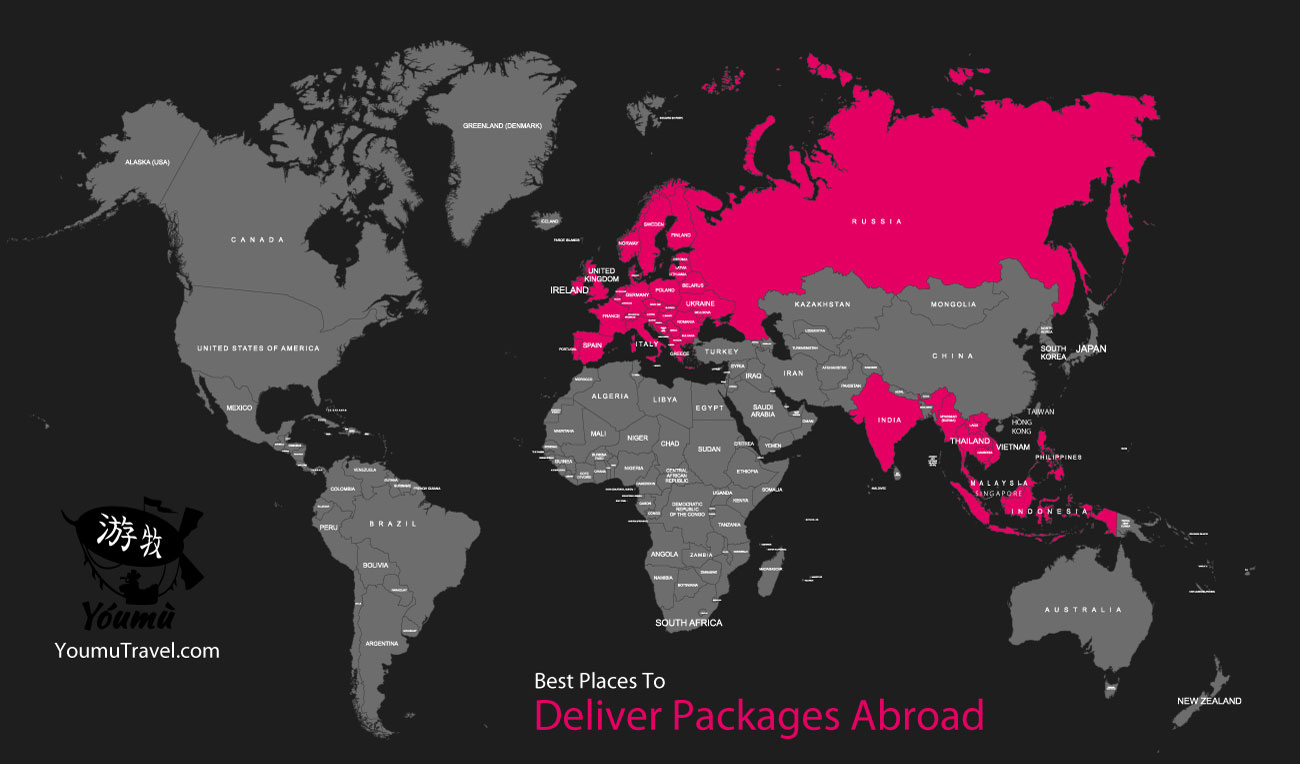
The Best Places to Deliver Packages Abroad
Most major countries throughout the world have opportunities for those seeking to deliver packages abroad. Here are some of the best places to deliver packages abroad.
- India
- SE Asia
- US
- UK
- Most of Europe
Search for delivery platforms
Many apps and companies use peer to peer delivery and you will need to find out which company you best qualify for, and that pays you well enough for your financial situation.
Perform a background check
Many courier platforms and companies will require you to submit to a background check of your criminal and driving history (if you are delivering domestically) to make sure you are a reliable hire.
Start delivering!
After you have finished the company’s requirements, you are ready to start traveling and delivering parcels on behalf of your courier service.
What is peer to peer delivery?
Peer to Peer or P2P delivery is a new economic trend in the business of delivery. It is when a person traveling takes with them a package from the sender to the client, all while on a trip they were already taking. P2P deliverers can receive a fee to put toward their travel expenses.
Can I have uber deliver a package?
In order to make deliveries, you have to sign up using the email link you received or through Work Hub in the Driver app, and accept the new accompanying terms.
What is Roadie delivery service?
Roadie is a courier program app that sends people packages using drivers that are already heading in that direction.
How do deliveries make money?
Ways to Make Money Delivering Groceries and Food
- Burpy
- Caviar
- Delivery Drivers Inc.
- Doordash
- Favor
- GrubHub
- Instacart
- Postmates
Is Roadie in Chicago?
Yes, Roadie is available in Chicago, IL As a driver for Roadie, you are able to pick up and deliver any packages to their intended destination.
What is UberRUSH?
UberRUSH is defined as ‘on-demand delivery’ available through Uber. It is a kind of courier service where you can request delivery and an Uber driver will accept the request and deliver the package to your location.
What companies use roadie?
Roadie deals with individual senders as well as companies such as Macy’s, Home Depot, Delta, and many others.
How do I start a delivery service?
9 steps for starting a delivery service.
- Plan out the business
- Create a legal entity
- Tax registration
- Open a bank account and credit card for the business
- Establish business accounting
- Get all necessary licensing and permits
- Obtain business insurance
- Distinguish your business brand
- Set up your presence on the web
What is crowd-shipping?
Crowd-shipping, also known as crowd logistics, means to apply the idea of crowdsourcing to the personalized delivery of freight.
Which delivery jobs pay the most?
5 Highest Paying Grocery Delivery Apps
- Doordash
- Shipt
- Uber Eats
- Instacart
- GrubHub
WWOOfing Guide
World Wide Opportunities on Organic Farms (WWOOF) is an organization that provides opportunities for volunteers to find work on farms around the world in exchange for room and board and food. The volunteer can expect to perform whatever household tasks the host needs them to do.

This job is in high demand and easy to get.
Demand
- High Demand
Experience & Degree
- No Experience Required
- No Degree Required
- Native English Speaking Preferred
Citizenship
- No Restrictions
This job offers basic room & board for part-time work but doesn’t pay wages.
Pay Range
- Volunteer
Reliability
- Somewhat Risky
Housing
- Room and Board Typically Provided
This job is somewhat flexible with its schedule and location availability.
Location
- Somewhat Flexible
Schedule
- Somewhat Flexible
Language
- Can get by with English only
Who can WWOOF?
Due to the nature of the labor involved with WWOOFing, people who have a disability or illness that inhibits them from physical labor probably shouldn’t get into WWOOFing. There is a wide variety of physical tasks you might be asked to do.
Additionally, someone interested in WWOOFing needs to be open-minded and willing to learn and experience new things from wine making to cultural exchange. If you’re going somewhere where you don’t know the language, be willing to put in the work to learn at least the basics.
Other than that, you don’t need an extensive resume or even prior farming experience–just be willing to work hard and learn a lot!
What are the responsibilities for WWOOfing?
At a base level, WWOOFing requires the volunteer to complete household tasks that the host asks of them, but this might include various tasks.
Key Responsibilities
- Small scale gardening and large scale planting.
- Subsequent harvesting.
- Chopping wood.
- Caring for animals–feeding, milking, cleaning enclosures, etc.
- Composting.
- Small construction jobs like fencing or creating mud-bricks.
- Food production like wine, cheese, or bread making.
- Most importantly: be open minded, kind, and respectful to your host and their culture!
What’s the typical schedule for WWOOfing?
Daily tasks can vary greatly in timing or duration, but a WWOOFer should expect to work no more than six hours a day. Days or time off should be scheduled with the host prior to arrival on the farm.
Income Reliability
WWOOFing does not provide any kind of monetary income, but the accommodations you receive should be reliable and consistent throughout your stay.
Typical Job Duration
WWOOFing usually lasts for a few weeks, but can be as short as a couple days or several months.
Estimated Hours Per Week
You are likely to work around 40 hours a week as a WWOOFer, but it all depends on the particular experience.
Room & Board
WWOOFing always provides room and board, but the particulars will vary by host.
WWOOfing – Country Map
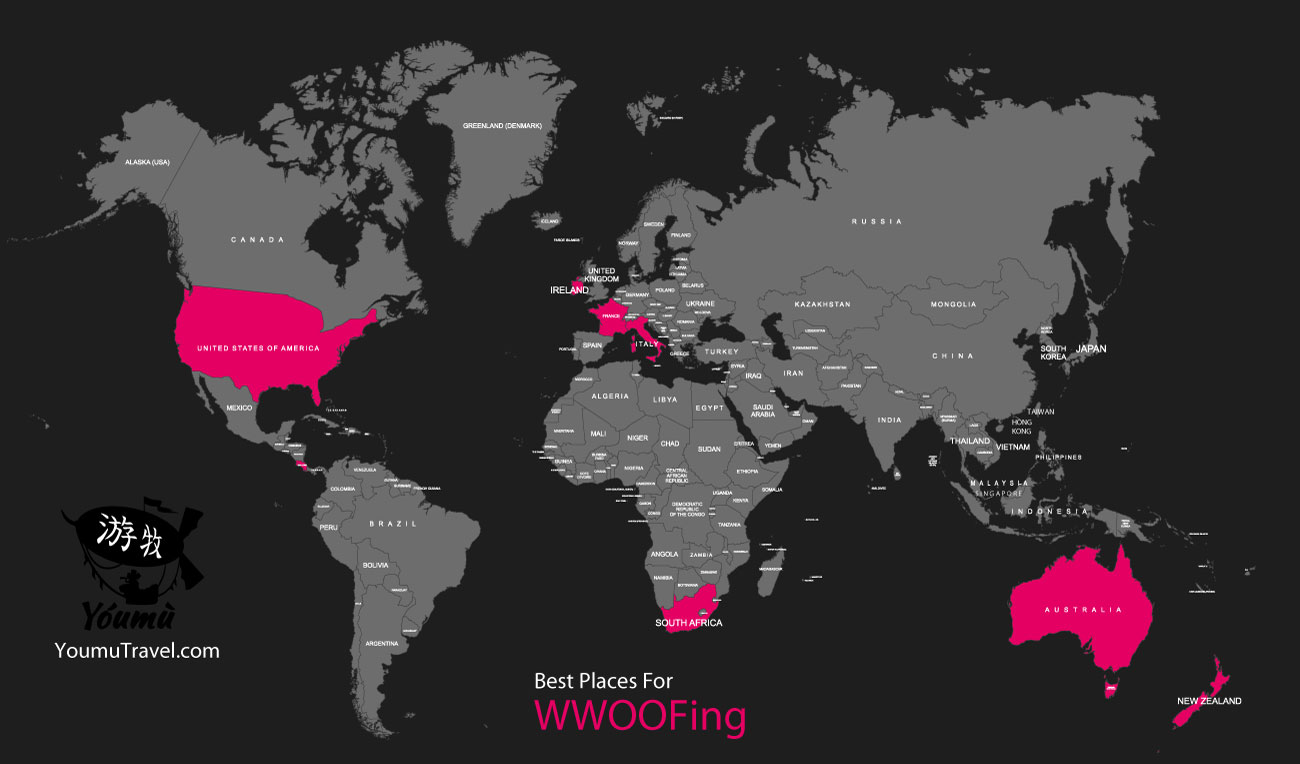
The Best Places for WWOOfing
Most major countries throughout the world have opportunities for those seeking WWOOfing. Here are some of the best places for WWOOfing.
- Ireland
- Italy
- Costa Rica
- Australia
- New Zealand
- France
- South Africa
- US
Choose what country to go to.
This choice depends on a variety of factors, but one to consider first is language. Choose a farm in which at least one of your hosts has a language in common with you. If you really want to go to a country where there are no farms with people that speak your language(s)–start studying their language. Communication is necessary, and language immersion will help strengthen that skill as well. Also remember to consider what type of environment you want–if you’ve decided you want to WWOOF in a particular country, consider whether or not you want to work/live near a city or in a remote place. Make sure to look at the farm’s location before you sign on!
Become of a member of the appropriate WWOOF organization.
You have to choose a country and pay the membership fee before you can see all the opportunities and contact the hosts. Membership lasts for a full year and is usually between $30-$40 USD equivalent.
Prior to contacting a host, consider:
- The kind of work you’re seeking. What are your agricultural interests? What kind of climate do you want to work in? What kind of animals do you want to work with, if any? What skills and processes do you want to learn? Make sure you have a solid understanding of your goals before you message potential hosts.
- Immediate environment and amenities. Where will you be sleeping and living? Is there a mode of transportation (e.g. a bicycle) you could borrow to explore while you’re there? Do you need to bring any particular amenities like a tent? Can you expect heat, electricity, or plumbing? You should have a realistic vision of the living situation before you embark on your journey–don’t expect to be pampered, but don’t let yourself suffer a dismal situation either.
- Daily work schedule/tasks. Your host shouldn’t exploit you unfairly, but it’s also partially on you to ensure that you’re treated fairly. Understand and agree to an average day’s work schedule and tasks before you commit to that experience. You shouldn’t work over six hours a day in a WWOOFing experience, so make sure you’re not getting overworked.
- Visas. You’ll have to do a lot of research to understand the visa requirements in the country you want to go to. You don’t want to be in trouble with immigration, so make sure to understand and follow visa requirements.
Contact hosts.
You should introduce yourself and thoroughly discuss daily schedule, amenities, duration, location, food, travel, etc. Make sure you have a thorough knowledge of the experience you’re about to embark on!
Be on your way!
Now that you’ve done all the research, picked a host, and agreed to the terms of your work, get your visa, buy your travel tickets, and have fun!
How much does it cost to Wwoof?
The membership fee for WWOOF is about $30-$40 per country every year.
How long should I Wwoof?
This can be negotiated between you and your host. Most commonly, WWOOF stays are around one or two weeks, but some could be a few days or several months. Negotiate whatever stay feels right for you and your host.
Where is the best place to Wwoof?
If you’re seeking a classic, pastoral farm experience you can check out places like Ireland, Portugal, or New Zealand. If you’re interested in a tropical farming experience you can look at places like Costa Rica. Additionally, there are terraced hillsides in Nepal that might suit you. There are so many options for you to choose from–pick an environment that feels like a good fit for you and your work.
What qualifications do you need to teach English online?
Whether teaching K-12 students completely online or in a blended classroom-online environment, most public school teachers need to meet basic educational requirements, which include earning bachelor’s degrees, completing teacher training programs, gaining supervised teaching experience and earning licensure.
Is Wwoofing safe?
As with any experience, there are risks. But keep in might that hosts must go through a rigorous application/vetting process to be approved. Safety, in these situations, is subjective as well. What might feel insecure to you could feel perfectly safe to another candidate–make sure you know what you’re looking for in your WWOOFing experience so that you can feel as comfortable as possible, and make sure you provide feedback.
What is better Workaway or Wwoof?
It’s difficult to rank these sites as they provide different functions. WWOOF is great for someone who is focusing on farming/permaculture in one particular country. Workaway and sites like it, on the other hand, have a variety of options for volunteer work in a multitude of countries. If you know specifically what you want, WWOOF might be best, but if you want to see what’s out there, check out Workaway, Helpx, or Worldpackers.
Is Wwoof free?
There is the $40 membership fee to remember, as well as the taxing labor you will be doing.
Can you make money Wwoofing?
You won’t get paid with actual money, but you are provided with food, accommodation, and the experience of a lifetime–all of which could be expensive if you weren’t paying with your own labor.
Can you Wwoof in your own country?
Sure! You can WWOOF in any country that has a WWOOF organization–if your home country does, then you can sign up for that nation’s membership.
Can you do Wwoofing with a dog?
Definitely check if the host lists that they are “dog friendly.” It is possible to WWOOF with a dog, but it depends on the host family. Hosts might be concerned that your furry friend will remember his predatory roots and terrorize their livestock, so this will require communication between you and the prospective host.
Do you need a Visa to Wwoof in New Zealand?
There is a particular type of visa required to WWOOF in New Zealand, since the “payment” of food and accommodations does not meet the minimum wage requirements in New Zealand, a standard work visa can’t be issued. However, a potential WWOOFer could get an “open” work visa, like a Working Holiday Visa.
What do you wear to WWoofing?
You should bring particular items of clothing to work on a farm. You will definitely need sturdy shoes like work or hiking boots. Lightweight shirts that you’re okay with getting dirty, long loose pants for protection against insects and rough grass, a hat or two, work/gardening gloves, and lightweight shorts if you’re going somewhere hot.
Traveling Bartender Guide
Traveling bartenders are people who take their bartending abilities from place to place as they travel, creating drinks for people in local bars and restaurants as they move.

This job is in high demand and easy to get.
Demand
- High Demand
Experience & Degree
- Basic Understanding Required
- No Degree Required
- Native English Speaking Preferred
Citizenship
- No Restrictions
This job is somewhat reliable with reasonable pay.
Pay Range
- Hourly: $8-$24/hr.
Reliability
- Somewhat Reliable
Housing
- Room and Board Not Provided
This job’s schedule is somewhat flexible and you can work in many parts of the world.
Location
- Very Flexible
Schedule
- Somewhat Flexible
Language
- Fluency in English and Basic Understanding of Local Language.
Who can be a traveling bartender?
Anyone with a desire to be a traveling bartender who has previous bartending experience can do it. There are certifications you can get, but they are not necessary for the position. Employers might like to see that you have an outgoing personality and good dexterity, as well as knowledge of a second language, but again–none of these things are prerequisites.
What are the responsibilities of a traveling bartender?
The main task of a bartender is to provide drinks to customers, and there are a few things that go into this task.
Key Responsibilities
- Learn recipes for various alcoholic and non-alcoholic beverages.
- Take orders quickly.
- Create drinks according to the recipe/customer specifications.
- Process payments and tips.
- Ensure safety of customers and responsible drinking practices.
What’s the typical schedule for a Traveling Bartender?
The hours can be full-time or part-time, but generally you will work at night. Be prepared to become nocturnal if you bartend in bars or clubs, but restaurants might have you working more of a day time schedule.
Income Reliability
The income of a traveling bartender is variable as it largely depends on tips.
Typical Job Duration
Traveling bartending can be short-term or long-term.
Estimated Hours Per Week
It’s estimated that you can work full time, 40 hours per week, as a traveling bartender.
Room & Board
Being a traveling bartender sometimes provides room & board, especially at American, English, Irish, or Australian pubs abroad.
Traveling Bartender – Country Map
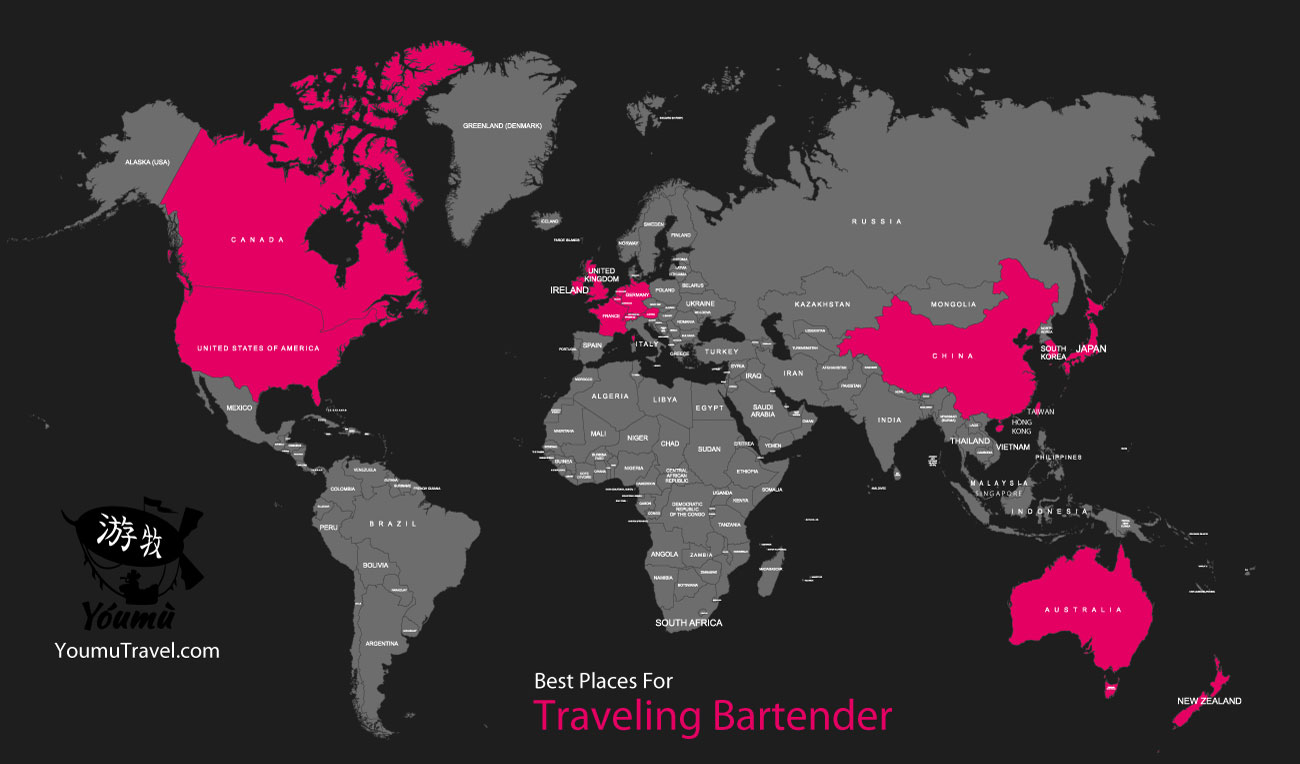
The Best Places to be a Traveling Bartender
Most major countries throughout the world have opportunities for those looking to be a traveling bartender. Here are some of the best places for traveling bartenders.
- Australia
- Canada
- USA
- New Zealand
- United Kingdom
- Ireland
- Japan
- Parts of China
- South Korea
- Most of Western Europe
Garner experience.
Before you start traveling, you’ll need to have some relevant bartending experience so that bars and restaurants will hire you when you travel. It’s also a good idea to save some extra money before moving abroad, so having part-time bartending experience on top of another job can be great before you embark on your journey.
Keep your resume up to date.
Make sure your resume concisely lists your relevant experience.
Do ample research.
Make sure you have done a bit of research on places you might want to work at before you go abroad. That way you have a place to start and you’ll know what’s available. Additionally, look for English, Irish, American, and Australian pubs abroad, as they like to hire English speakers. If they don’t hire you, you at least have a connection in the local scene who speaks English and can recommend other places for you to look.
Socialize and network.
As a bartender, one of your strengths will be your ability to meet and connect with a lot of people. These connections can help you find different jobs in the places you visit.
Patience is key.
Bartenders are always in demand, but you might have to wait a little for a position to open up. Bartending has a quick turnover rate, so there is always an opportunity right around the corner. Double check places you’ve already looked into to see if something opened up in a couple weeks.
What should every bartender know?
There are hundreds of different cocktails that a bartender could know how to make, but some of the most important include Aperol Spritz, Bloody Mary, Cosmopolitans, Dirty Martinis, Daiquiris, and Mai Tais.
What is a freelance bartender?
A freelance bartender is someone who is self-employed and serves bar or restaurant clientele.
Do you need a bartender license to be a bartender?
The laws vary by location, but in general, it is not required to be licensed to become a bartender. Your state or city might require certain permits or other documentation, so look up your local laws to determine what you need.
Why is bartending a bad job?
Bartending isn’t necessarily a bad job, but like all occupations, it has its downsides. It requires a balance of physical, emotional, and mental ability.
Is bartending a good side job?
Yes! Bartending a great side job for people who have another job or have school in the day time. The schedule shouldn’t conflict with your daytime commitments, and it can be a lucrative side job.
How many drinks should a bartender know?
Usually, a knowledge base of around 100 drinks should cover most of what you’ll be asked for as a bartender.
Can you make a living as a bartender?
While you can make a living as a bartender, it isn’t necessarily a stable income. Much of your pay relies on tips from patrons, which can vary greatly by the shift and the customers that walk in.
Is it hard to learn bartending?
Bartending might be daunting at first, but after a few weeks of experience and getting the basics down, it becomes more simple. While the knowledge is specialized, as long as you have a willingness to learn and a fairly good memory, you should be just fine.
How long does it take to learn to be a bartender?
Generally, bartending classes can be completed in just a few weeks, but it is up to you as a student. If you have scheduling conflicts that require you to space out your classes, it’s okay if it takes up to a year to get your certificate.
What is the name for a female bartender?
Generally, female bartenders are just called bartenders, but you could also use the term “barmaid” if you want to, but it is not commonly used.
Waiter or Waitress Jobs Abroad Guide
The main function of a server is to take customer orders and deliver the requested item(s) to the customer.

This job is in high demand and easy to get.
Demand
- Somewhat High Demand
Experience & Degree
- No Experience Required
- No Degree Required
- Native English Speaking Preferred
Citizenship
- No Restrictions
This job is somewhat reliable, low pay with the chance of reasonable pay via tips, and typically full-time.
Pay Range
- Average Weekly: $301.
Reliability
- Somewhat Reliable
Housing
- Room and Board Not Provided
This job’s schedule is somewhat flexible and can work in many parts of the world.
Location
- Flexible
Schedule
- Somewhat Flexible
Language
- Can get by with English only
Who can be a waiter or waitress?
There aren’t any particular qualifications you need to have before becoming a waiter or waitress, but you need to make sure you can handle the stressors of this demanding job. The ideal server is on time, polite, knowledgeable about the menu/establishment, perceptive and attentive, has a superb memory, and has a polished appearance.
What are the responsibilities of a waitperson?
The main function of a server is to take customer orders and deliver the requested item(s) to the customer, but many steps go into completing this function.
Key Responsibilities:
- Greet customers, introduce yourself, and give out menus and other necessary materials.
- Take food and drink orders and communicate them to the kitchen.
- Be prepared to make recommendations.
- Memorize specials/other non-menu information.
- Deliver requested items to the table.
- Ensure that customers are happy with their food and experience.
- Accurately prepare the check.
- Ensure that the bill was paid correctly.
- Give change to patrons who need it.
What’s the typical schedule for a waitperson?
Waitstaff can expect to work shifts between 4 and 10 hours–depending on that particular establishment’s work schedule. The time of the shifts may vary, but again, this depends on you and where you work.
Income Reliability
In general, the income for a waitperson is variable because it depends on hours and tips.
Typical Job Duration
Being a waiter/waitress can be short-term or long-term.
Estimated Hours Per Week
It’s estimated that you can work full time, 40 hours per week, as a server.
Room & Board
Being a server doesn’t typically provide room & board.
Waiter or Waitress Jobs Abroad – Country Map
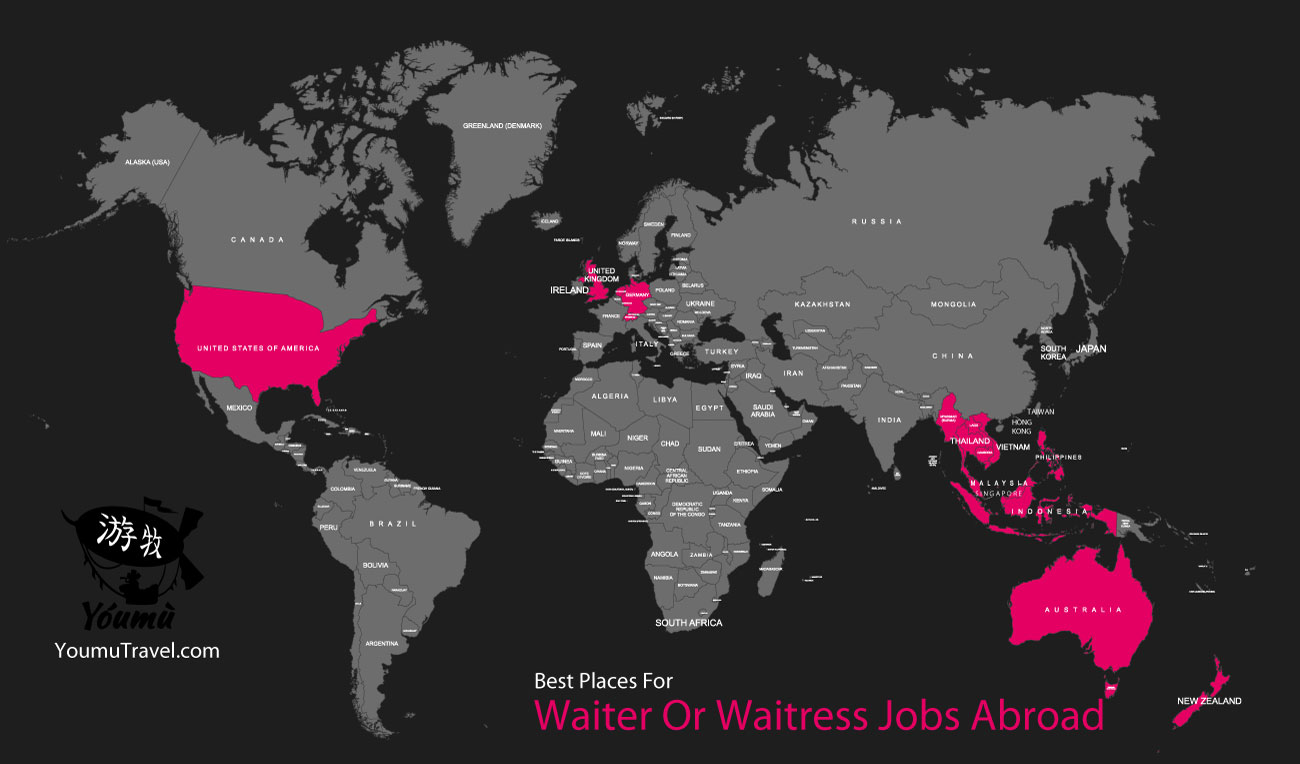
The Best Places to work Waiter or Waitress Jobs Abroad
Most major countries throughout the world have opportunities for those seeking waiter or waitress jobs abroad. Here are some of the best places for waiter or waitress jobs abroad.
- US
- Australia
- New Zealand
- Netherlands
- UK
- Germany
- Switzerland
- SE Asia
Hone your service skills.
You should feel fairly confident as a server in your home country before you dive into a serving job abroad, as customs and language/accent barriers can be an additional challenge. If you haven’t had previous service experience, that’s okay, just be aware of the unique challenges working abroad can pose.
Look for service jobs in your chosen destination.
You should consider language, environment, and what types of restaurants/establishments you want to work in. You can use a job board or staffing agency to find jobs abroad, so that by the time you arrive in the destination, the job is waiting for you.
Interview/travel.
The order of operations here depends on the job. If you can interview via video chat or long distance phone call–then great! You can avoid unnecessary travel. If not, you can travel to your destination and job search and interview in person. This might be beneficial as you can take a look at the restaurant to decide if you want to/are able to work there.
Acquire appropriate documentation.
This will all depend on where you go and where you work, so make sure you confirm that you have all the necessary documentation, such as a valid passport and work visa, to work abroad legally.
What is the difference between a waiter and a waitress?
The only difference is the gender of the subject. Waitresses are female waiters, and the word “waiter” can be used to indicate a male waiter or as an umbrella term if you prefer not to differentiate.
Is waitress an occupation?
Yes. Waiters and waitresses take patron’s orders, deliver food and drink to the table, prepare the bill and handle payments in cash, debit, credit, and check.
How are waiters paid in Europe?
The wage for a waiter will vary widely by the country within Europe, but to use France as an example, waiters in France can make a bit more than minimum wage and then get additional tips.
Do attractive servers make more money?
Research indicates that the more attractive the server, the higher the tip, without having anything to do with the quality of service.
How much does a waiter make per month?
On average, a full time waitress can earn just over $2,000/month, and a full time waiter will make slightly more due to wage gaps.
What is another word for waitress?
Some synonyms could include server, attendant, carhop, footman, etc.
What do you call a female waiter?
The usual term for a female waiter is waitress, but gender neutral terms like server or waitstaff could be used to refer to any person employed in service.
How can I make the most money teaching English online?
Generally speaking, online English teachers typically make anywhere between $10 – $40 USD per hour depending on their level of qualification. Platforms such as VIPKID offer base rates plus incentives. Incentive bonuses may include things like an extra $1 of pay per class if you complete more that 45 classes per month.
What are the qualities of a waiter?
The ideal server is on time, polite, knowledgeable about the menu/establishment, perceptive and attentive, and has a polished appearance.
How do waitresses get better tips?
Some pointers for better tips for waitstaff include: introduce yourself with your first name, repeat the order back to the customer, and provide efficient and attentive service.
How much does a waitress make per hour?
This completely depends on your location–the wages by state vary vastly. For example, the base wage (without tip) in Arkansas is $2.63/hour, whereas in California it could be up to $13/hour. Look up your local laws to determine what your wages as a waitperson could be. The wage is also variable for servers in other countries.
Summer Camp Counselor Abroad Guide
Camp counselors ensure that their campers are safe, healthy, and happy while they participate in camp activities. Counselors can help plan activities, lead them through events, and can be trained to emotionally support children who are away from their families.
This job has just average demand but is easy to get.
Demand
- Average Demand
Experience & Degree
- No Experience Required
- No Degree Required
- Native English Speaking Preferred
Citizenship
- No Restrictions
This job is reliable, room & board is sometimes included, part-time, and somewhat reasonable pay.
Pay Range
- Hourly: $7-$20/hr.
Reliability
- Reliable
Housing
- Room and Board Sometimes Provided
This job’s schedule is somewhat flexible and can work in many parts of the world.
Location
- Flexible
Schedule
- Somewhat Flexible
Language
- Can get by with English only
Who can be a Summer Camp Counselor Abroad?
Generally, camp counselors are young adults and older teens–usually they are required to be at least 15-18 years old. A good counselor has upstanding moral character, ample patience and maturity, as well as excellent leadership abilities. It is also helpful if counselors have some expertise or knowledge about the activities they might be conducting, like kayaking, theater and performance, music, or sports. It is best if counselors are physically fit and have good health to keep up with their young campers.
What are the responsibilities of a Summer Camp Counselor Abroad?
The main role of a camp counselor is to supervise and support their campers, and many different tasks can go into this.
Key Responsibilities
- Conceive and oversee camp activities
- Keep campers safe
- Keep track of camper progress and report back to parents or senior counselors
- Schedule camper’s daily activities
- Take attendance
- Enforce rules
- Accommodate campers with special needs
- Greet and make campers comfortable as they arrive
- Keep facilities running smoothly
- Befriend and provide individual support to campers
What’s the typical schedule for Summer Camp Counselor Abroad?
The work of a camp counselor is never done. While, theoretically you’ll be off-the-clock once the campers have gone to bed, there may be night time emergencies or mischief you’ll have to contend with. Be prepared for early mornings, jam-packed days, and potentially interrupted nights.
Income Reliability
Income only comes during the summer, and is usually around minimum wage, so it is not the most reliable.
Typical Job Duration
While you can return for consecutive summers, camp counselors only work for the season.
Estimated Hours Per Week
Camp counselors will work at least 40 hours per week.
Room & Board
Being a camp counselor abroad typically provides room & board.
Summer Camp Counselor Abroad – Country Map
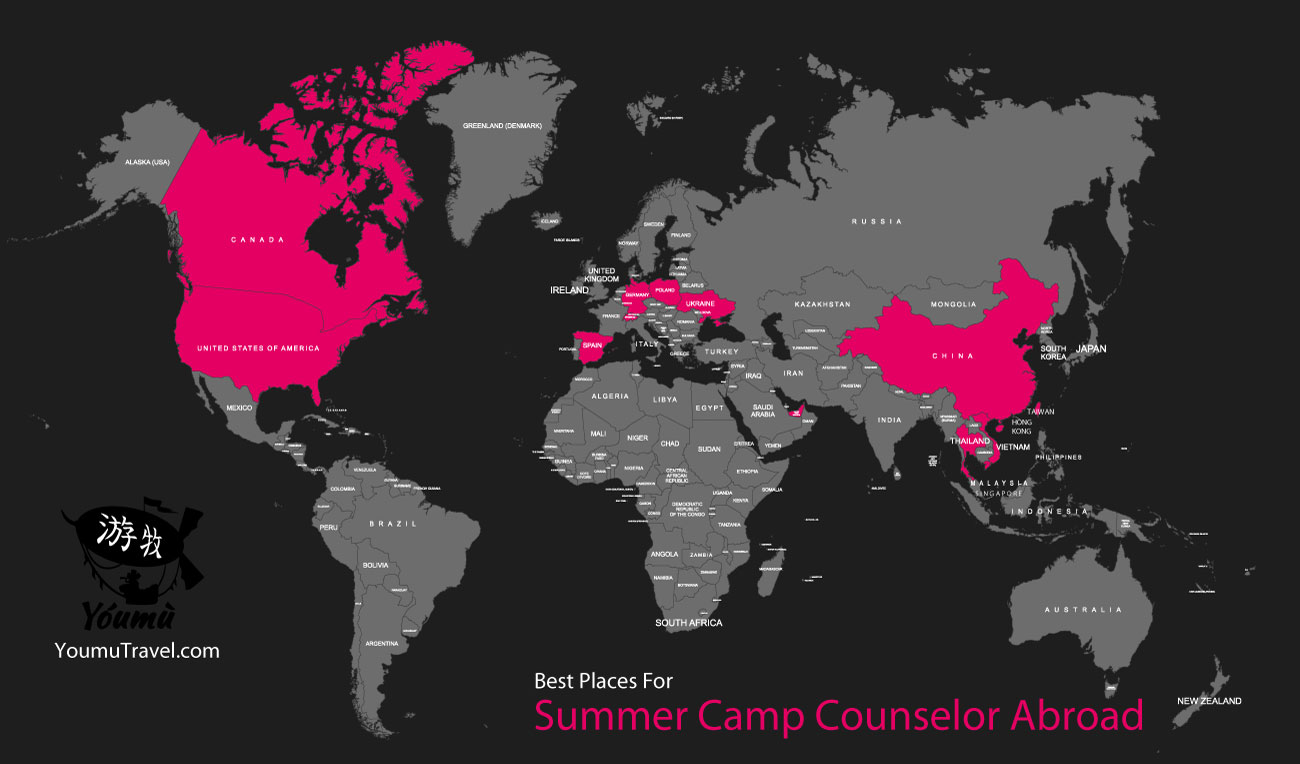
The Best Places for a Summer Camp Counselor Abroad
Most major countries throughout the world have opportunities for those seeking to be summer camp counselors abroad. The United States is the best place for summer camp counselor jobs, but some Asian countries are also increasing in popularity. Here are some of the best places for a summer camp counselor abroad.
- US
- China
- Ukraine
- Poland
- Thailand
- Vietnam
- Switzerland
- Taiwan
- Spain
- UAE
- Germany
- Canada
Choose an agency.
Do some research on different agencies that send counselors abroad, but if you plan on traveling before or after the job as a counselor, consider just applying directly instead of through an agency. If you don’t want to use an agency, make sure to do research on which camps interest you.
Pick a talent/speciality.
Are you great at theater? Tennis? Kayaking? Arts and crafts? Whatever it is, pick your speciality so you can create and run activities related to that specialty. If you don’t have one, that’s okay! Many camps have general counselors without a particular focus.
Apply.
Now that you know what you want to do at camp and have research agencies and summer camps, you can apply for the position. Deadlines are generally in March, and most require references, so know who you want to list in advance.
Interview.
Dress like you would for a job interview, and be prepared to answer questions about your past experiences working with children, or to answer to hypothetical questions like, “What would you do if a child disrespected your rules?”
Get a CRB check.
When you get accepted for a job as a camp counselor, you’ll need a CRB check. This is just a document that states that you have a clear criminal record.
Prepare.
The camp you’re going to work at will provide you with a list of things to prepare ahead of time, pack, and consider, so be sure to follow these guidelines. There also might be pre-camp activities, so check to see if there’s anything you can participate in.
Orientation.
Orientation is a great opportunity to meet and befriend your fellow camp counselors and exchange contact information. Since you’ll be working together closely for a long time, it’s a good idea to get these relationships started so you’re comfortable working together. Orientation will also be a more thorough guide of what you need to know before you get to camp.
You’re on your way!
Try to arrange, if you want, someone else from the camp to sit with you on the journey for companionship. Make sure to get to the airport with ample time, and don’t forget any of your necessary belongings.
What skills are needed to be a camp counselor?
Ideally, a camp counselor likes children, has good leadership, communication, and problem solving skills, has ample patience and stamina, as well as the ability to be a good role model and a fair person.
What is the role of a camp counselor?
The main role of a camp counselor is to supervise campers and ensure that they remain safe, healthy, and happy in their camp experience.
Does Australia have summer camps?
Yes, but most run for about a week versus American summer camps, which can range for the entire season.
How would you describe a summer camp counselor on a resume?
The duties of a camp counselor that you could list on your resume are activity organization, child care, rule enforcement, etc.
How much does TEFL certification cost?
You know you need it, but how much does TEFL certification cost? Prices vary depending on some key factors, but expect to pay about $200 for very minimal online certification, and closer to $400-500 USD for online certification of enough hours to qualify for most TEFL jobs (at least 100).
What do you do as a summer camp counselor?
Camp counselors ensure the safety, health, and happiness of campers, and might design and organize activities for them.
How long are American summer camps?
Most summer camps in the US can run for 9 to 12 weeks, usually beginning in May or June.
What is Ccusa?
CCUSA works within the International Culture Exchange community, as well as the American Camping Association and World Youth Student Travel, helping camp counselors from the US and Canada find international opportunities.
International House Sitting Guide
House sitters take care of property, possessions, and pets while the home owners are away.

This job has just average demand but is easy to get.
Demand
- Average Demand
Experience & Degree
- No Experience Required
- No Degree Required
- Native English Speaking Preferred
Citizenship
- No Restrictions
This job is somewhat risky with no pay but offers room & board for easy part-time work.
Pay Range
- Hourly: $0/hr.
Reliability
- Somewhat Risky
Housing
- Room and Board Typically Provided
This job has a flexible schedule and you can work almost anywhere in the world.
Location
- Very Flexible
Schedule
- Very Flexible
Language
- Can get by with English only
Who can do International House Sitting?
Anyone who has a passion for international travel and a willingness to care meticulously for other people’s property, possessions, and pets can be an international pet sitter. There are no prior qualifications necessary other than a commitment to following the homeowner’s directions and requests.
What are the responsibilities of International House Sitting?
The basic function of a house sitter is to take care of the home owner’s property, possessions, and sometimes pets. Many tasks go into this.
Key Responsibilities
- Make sure the property is secure each day–lock doors, set alarm systems, close windows/curtains, etc.
- Keep the house clean–mop, sweep, vacuum, dust, etc.
- If there’s a pool, keep it maintained.
- Water household plants and outdoor gardens, keeping to instructions.
- Clean bedding before you leave.
- Contact service providers if there’s any issue with plumbing, air conditioning, etc.
- Care for pets–providing food, water, exercise, vet appointments, and lots of love.
What’s the typical schedule for International House Sitting?
House sitting internationally is kind of a 24/7 gig. You can obviously leave the home to go grocery shopping, go to restaurants, socialize, etc., just the way the homeowners would, but it’s important you follow the owner’s directions meticulously about when you need to be inside the home.
Income Reliability
International house sitting can be a great side job or a way to travel, but doesn’t provide a consistent living salary.
Typical Job Duration
International house sitting can be short-term or long-term.
Estimated Hours Per Week
It’s estimated that you’ll be “working” more than 40 hours per week since you will live where you work.
Room & Board
International house sitting always provides room & board.
International House Sitting – Country Map
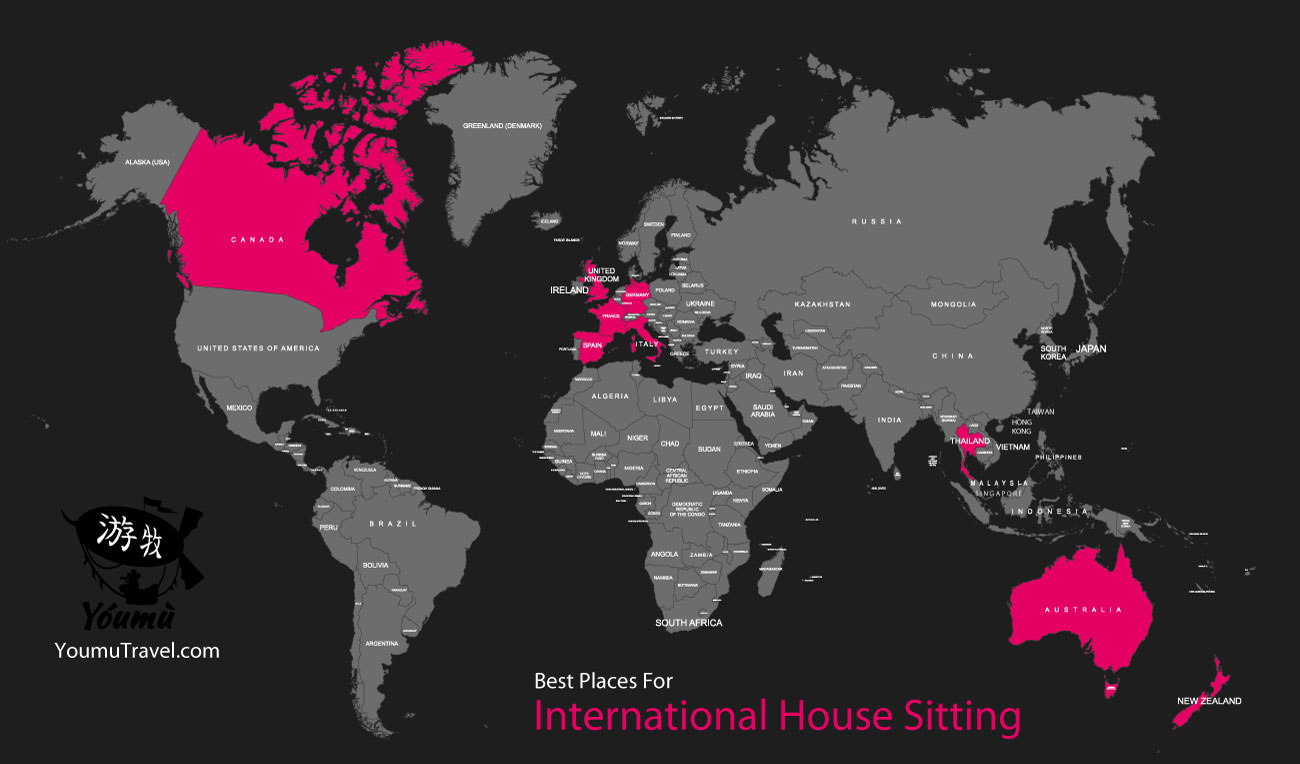
The Best Places for International House Sitting
Most major countries throughout the world have opportunities for those looking to do international house sitting. Here are some of the best places for international house sitting.
- Australia
- New Zealand
- UK
- Germany
- France
- Italy
- Thailand
- Spain
- Canada
Understand the job.
It’s important that you have a full grasp of the expectations on you as a house sitter. There are general expectations, listed above, and there will be more specific tasks that the home owners will discuss with you. Be prepared to be asked to complete these tasks.
Sign up for a house sitting platform.
It’s a good idea to sign up for sites that can easily connect you with potential hosts, so you can get an idea of what’s out there. All of these sites have membership fees, so be prepared for that. TrustedHousesitters is one of the most commonly used, but also consider housecarers.com, housesitmatch.com, nomador.com, mindmyhouse.com, aussiehousesitters.com.au, or happyhousesitters.com.au.
Design your profile.
You want your profile to look trustworthy, so include a good quality photo of yourself, a description of your relevant past experience and abilities, and include references from trusted sources. Your relevant experience should include any previous house sitting experience and your experiences as a homeowner yourself. Add in your love for pets–dogs, cats, lizards, fish, snakes, etc.–if that’s true for you. There will generally be pet care of some sort in a house sitting arrangement. If you have any special skills such as a foreign language, gardening abilities, or you’re handy with a hammer, highlight that on your profile as well. Make sure to sound enthusiastic and ready to set off!
Contact prospective homeowners.
You can send messages to homeowners on the house sitting platform that you signed up for in step 2. Introduce yourself briefly, and highlight the most important information and your excitement. Try to tailor your message based on the job posting–if they have snakes they need tending to, make sure to mention how you think snakes are such cute pets, or if they have a big garden that needs to be tended to, make sure to mention your green thumb.
Come to an agreement.
Once you have spoken with the homeowner(s), have a video call on Skype, Zoom, Facetime, etc. If it’s a local job then you can go visit in person and get your bearings in the home, but if you’re looking for international jobs that’s not as feasible. Make sure to ask a lot of questions about the house, pets, and routine when on these calls.
Get your documentation together.
You’ll need to ascertain whether or not you need a travel visa, and how long it will last for. You don’t want to risk having to leave early and leaving the homeowners without someone to care for their property and pets.
What is the best house sitting website?
Some great international house sitting sites to check out are: TrustedHousesitters, Nomador, HouseCarers, MindMyHouse, and HouseSitMatch.
How much should you pay a house sitter?
On average, house sitters charge between $25-$45 a day. This depends on the area in which the house is, and if there are any particular extra services that might be required.
Are house sitters safe?
Obviously this depends on the particular house sitter, but there are also risks involved for the house sitter. Make sure to have an interview so that all parties can feel safe.
What qualifications do you need to teach English online?
Whether teaching K-12 students completely online or in a blended classroom-online environment, most public school teachers need to meet basic educational requirements, which include earning bachelor’s degrees, completing teacher training programs, gaining supervised teaching experience and earning licensure.
Where do house sitters sleep?
It depends on where the owner offers you. If there’s only one bed in the house, it’s likely you’ll sleep in the home owner’s bed. If there’s more than one, you’ll likely sleep in a guest bed room.
Do trusted house sitters get paid?
Yes! House sitters should always be paid for their time, unless there has been some other agreement made.
Do you provide food for house sitter?
It is not necessary for the owner to leave food for the house sitter, but they can if they want to. Perhaps leave a recommendation of local grocery and convenience stores for them, though.
Can you make a living as a house sitter?
It’s unlikely for you to make a livable salary by international house sitting alone, but it’s a great way to travel while earning a little extra money. It can be an ideal side job for someone who works remotely for their regular job.
Is house sitting a good job?
This depends on your point of view! If you like to travel to interesting places and prefer the atmosphere of a furnished home over a hotel, and you are a responsible caretaker, then housesitting might be just right for you.
Is trusted house sitters worth it?
This is also pretty subjective. While trustedhousesitters is the largest international house sitting site there is, the problem with that is the amount of competition you face. Sometimes using a big site like that can be disheartening for a burgeoning house sitter, but it’s also a great place to find jobs.
Do house sitters get paid in Australia?
In Australia, house sitters don’t usually get paid.
Can I house sit with my dog?
This depends entirely on the home owners. If they say it’s fine for you to bring your dog (and make sure you tell them a bit about the dog–if he eats furniture, you should be frank about that) then go for it. But if the home owners don’t want you to bring your own pet, then don’t.
Do house sitters get paid in the UK?
Yes, but only a little (around 10 pounds/day) and not always. Travel expenses are often covered though, and obviously you get free accommodation.
Pet Sitting International Guide
Pet sitters are tasked with the care of household animals (dogs, cats, fish, birds, hamsters, etc.) while the owners are away, either at work or on extended absences.

This job has just average demand but is easy to get.
Demand
- Average Demand
Experience & Degree
- No Experience Required
- No Degree Required
- Native English Speaking Preferred
Citizenship
- No Restrictions
This job is somewhat risky with no pay but offers room & board for easy part-time work.
Pay Range
- Hourly: $0/hr.
Reliability
- Somewhat Risky
Housing
- Room Typically Provided
This job has a flexible schedule and you can work almost anywhere in the world.
Location
- Very Flexible
Schedule
- Very Flexible
Language
- Can get by with English only
Who can do Pet Sitting International?
Anyone with a love for animals and traveling can pet sit internationally. It’s best if you have had previous experience caring for animals–whether it be pets you’ve owned in the past, animal shelter volunteer work, or caring for the animals of friends and family.
What are the responsibilities for Pet Sitting International?
The primary function of a pet sitter is to ensure the happiness and well being of someone else’s pets, and various tasks go into this.
Key Responsibilities
- Provide food and water according to owner specifications–always follow instructions given.
- Clean litter boxes, or walk dogs and pick up after them, or clean cages.
- Play with the animals to provide exercise.
- Report strange behavior, injuries, or illnesses to the pet owners.
- If pet sitting in the owner’s home, respect their space and clean up any pet messes.
- Comply with additional owner requests as agreed, such as bringing in the mail, turning the lights on or off, closing windows, or taking pictures of pets and sending them.
- Make sure you follow the instructions left by the owners closely.
What’s the typical schedule for someone Pet Sitting International?
The schedule of a international pet sitter completely depends on the pet owner’s specifications and the animal. If you are caring for a very sick, anxious, or dependent animal that requires 24-hour care, then you can expect to be working most of the time. But if you’re caring for independent cats and a dog that only needs to be walked every few hours, then you have free time in between tasks.
Income Reliability
Pet sitting internationally does not provide monetary income, but compensates with a free place to stay.
Typical Job Duration
Pet sitting internationally is usually short term.
Estimated Hours Per Week
It’s estimated that you can work full time, 40 hours per week, as an international pet sitter.
Room & Board
Pet sitting internationally typically provides room & board.
Pet Sitting International – Country Map
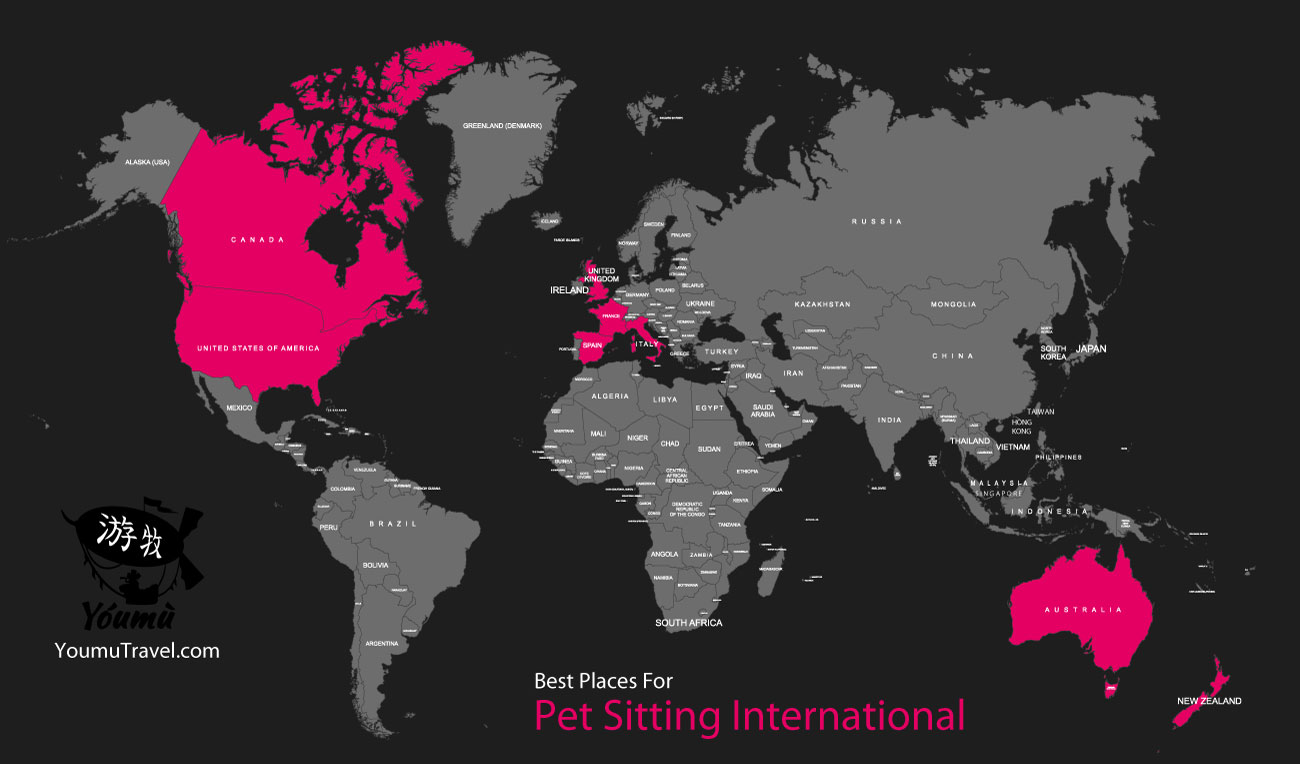
The Best Places for Pet Sitting International
Most major countries throughout the world have opportunities for those seeking pet sitting international jobs. Here are some of the best places for pet sitting international jobs.
- US
- UK
- France
- Spain
- Italy
- Canada
- Australia
- New Zealand
Get experience.
It’s great to get experience with animal care–offer care to family, friends, and neighbors to garner experience, or volunteer at animal shelters. This helps you gain the necessary skill set to work with many different animals while also providing you with references who can recommend you to a potential employer.
Try a subscription.
There are a few websites that can connect you, the pet sitter, with prospective hosts. Some of these include trustedhousesitters.com, nomador.com, and mindmyhouse.com. All of these require a nominal membership fee every year, but they can help get your international pet sitting career underway.
Build your profile or resume.
Make sure to list all your qualifications and previous experience, as well as list references who can vouch for your character.
Provide verification of identity.
Linking your social media to your profile is a great way for prospective employers to know that you are a real person that they can trust to care for their furry friend. If you can, link your Airbnb guest reviews as well.
Talk to hosts.
When first talking to a prospective host, ask as many questions and get as much detail as you can about the pet, what might be expected of you, and the house/location. Try to build a friendly connection with the host so that communication is easy throughout your stay and beyond.
Decide on an assignment.
Once you’ve done enough looking, choose the pet sitting assignment that works best for you. Keep in mind that while you are provided with room and board, transport is not included, so make sure to realistically calculate those costs.
How much is a dog sitter per day UK?
Dog sitters are paid roughly 25 pounds per day in the UK.
What is the average cost for pet sitting?
Depending on the services required and the particular pet sitter, it could be between $20-$40–usually around $25 for a half hour visit, or around $80 for an overnight stay.
What is a pet sitting service?
Pet sitting services provide pet care–food, water, walking, litter box, play, etc–for another person’s pet for a set amount of time. Generally, pet sitting is at the owner’s home, but can sometimes be at the sitter’s home if that is preferred by the client.
How much should I charge to dog sit for a week?
The average rate for a week long pet sitter is usually between $250 and $375, but may vary if there are any special services or additional pets.
How many dogs can you walk at once UK?
The NARPS (National Association of Pet Sitters) recommends a maximum of four dogs at one time. Local authorities may have their own restrictions, so check your city’s laws.
How much should I charge for overnight pet sitting?
Generally, an overnight visit should be around $75-$80, but can vary if there are additional services or other pets.
Do you tip a pet sitter?
Tipping isn’t expected for pet sitters like it would be for a waitress, but if your pet sitter has done a great job with your pet or has had to contend with extra services or unforeseen circumstances while you were away, consider tipping them.
Can you make a living pet sitting?
Depending on whether you’re working part- or full-time, pet sitters can make between $1000 and $4000 a month.
Is pet sitting profitable?
Pet sitters can make a fairly good living, but keep in mind travel expenses to and from various pet homes. Pet sitting makes a great second job as well.
How much should I charge for a 30 minute dog walk?
Dog walkers usually charge around $20-$30 per half hour walk, but it may be more if there’s more than one dog.
What are the duties of a pet sitter?
Pet sitters take care of cats, dogs, and other household pets while the owners aren’t home. This means giving food and water per owner instructions, giving medicine when necessary, walking dogs, cleaning litter boxes, and giving lots of love and play time. They may also be responsible for keeping the home tidy–sweeping up tracked cat litter, lint rolling dog hair, etc, but this is up to the owners.
How do you describe a dog sitter on a resume?
On your resume, highlight the care you provided the dog: grooming, feeding and water, walking, vet appointments, medicating, giving love and attention, and following particular owner instructions for care.
Hostel Worker Jobs abroad Guide
Hostel workers are people who work in a hostel and make sure that guests comply with the particular rules of the hostel, and that the establishment runs smoothly.
This job has a somewhat high demand and is easy to get.
Demand
- Somewhat High Demand
Experience & Degree
- No Experience Required
- No Degree Required
- Native English Speaking Preferred
Citizenship
- No Restrictions
This job is somewhat reliable with low or no pay but room is typically included.
Pay Range
- Hourly: $10-$17/hr.
Reliability
- Somewhat Reliable
Housing
- Room Typically Provided
This job’s schedule is somewhat flexible but you can work in many parts of the world.
Location
- Flexible
Schedule
- Somewhat Flexible
Language
- Can get by with English only
Who can get Hostel Worker Jobs abroad?
There are no requirements for a hostel worker other than a love of travel and the relevant skills such as organization, communication, and cleaning. It might help to have a second language, but is by no means required. Be willing to work and prove yourself.
What are the responsibilities for Hostel Worker Jobs abroad?
Hostel workers are responsible for making sure that a hostel runs smoothly, and many tasks go into this.
Key Responsibilities
- Make sure all guests follow rules and regulations
- Book rooms/beds
- Maintain equipment, or report necessary repairs to appropriate people
- Distribute materials to guests such as keys and bedding
- Complete administration and financial reports
- Explain safety procedures to guests, and follow them yourself
- Offer information to guests
- Make sure customers are comfortable
- Promote equality and diversity within the hostel–both in terms of business and guests
What’s the typical schedule for Hostel Worker Jobs abroad?
This is likely to vary by hostel and your position within the hostel. Unlike an office job, there is still work to be done at night, so shift lengths and times will be variable.
Income Reliability
In general, hostel worker positions abroad are not the most reliable in terms of income.
Typical Job Duration
Hostel work abroad can be short-term or long-term.
Estimated Hours Per Week
It’s estimated that you can work full time, 40 hours per week, as a hostel worker.
Room & Board
Hostel work abroad sometimes provides room & board.
Hostel Worker Jobs abroad – Country Map
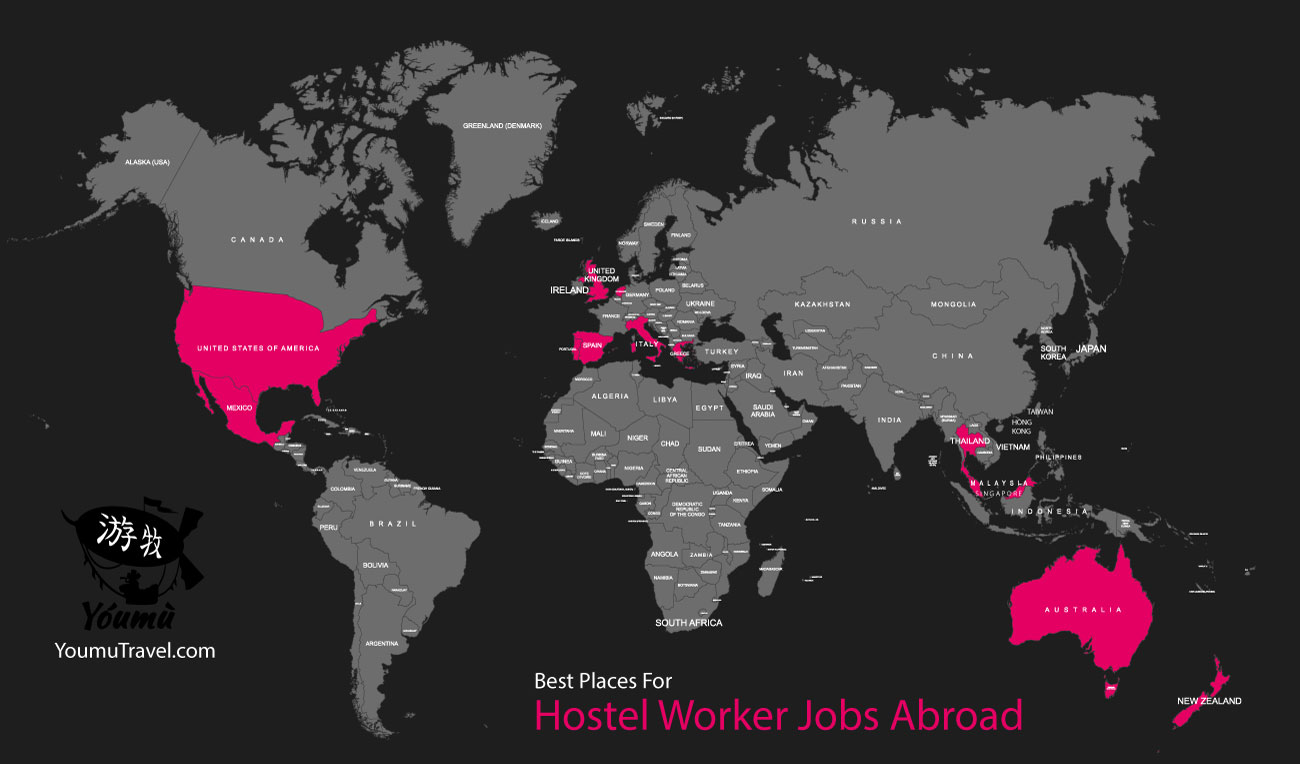
The Best Places for Hostel Worker Jobs abroad
Most major countries throughout the world have opportunities for those seeking hostel worker jobs abroad. Here are some of the best places for hostel worker jobs abroad.
- Australia
- New Zealand
- US
- UK
- Netherlands
- Spain
- Portugal
- Italy
- Greece
- Thailand
- Malaysia
- Mexico
Prepare resume/CV.
Regardless of whether or not you plan to get a position ahead of time or find one while you’re traveling, it’s a good idea to write a comprehensive resume or CV to give to potential employers. Make sure you include any relevant experience you have and highlight relevant skills such as organization, communication, cleaning, etc.
Look for jobs.
If you’re looking to secure a job before you start traveling, it’s a good idea to look at online job boards to see if there are any open positions. Send your well written CV out, and a cover letter to show your enthusiasm for the job.
If you plan on finding a position while you’re on the road, stay in various hostels and ask if there are open positions. If asked, provide your resume/CV. But make sure you don’t needle the existing staff–they won’t want to hire you if you sit around and beg for the position. Also, while staying in hostels, perform some cleaning activities or help other guests with their bags, or provide travel advice. The current staff will take notice of this and determine that you’re a good candidate for the job.
How do you get a job at a hostel?
Start by showing that you’d make a great employee–stay in a hostel and befriend as many other guests as possible. Help them with their bags, show them fun places around where they’re staying, and generally show that you would be a great addition to a hostel’s team.
Are hostels profitable?
Hostels can be profitable even though the profit per guest is lower than a more expensive hotel, there are less maintenance and service costs.
How do I start a ladies hostel business?
The first step is a lot of planning. Make sure you design a hostel that is in a good location, provides safe, secure, and sanitary accommodations to guests, and still allows you to make a profit.
What is a hostel worker?
A hostel worker is someone who works in a hostel. They might work at the front desk, distributing room keys and other organizational duties, or as part of the cleaning crew or food service if there is any.
How do you manage a hostel?
There’s a lot that goes into managing a hostel that you’ll learn over time, but some tips include: offer to guide guests to help get your name out there and perhaps returning customers, create space for social gatherings, keep rooms constantly booked, lower prices when possible, and rent bikes for guests to use (for a fee.)
Movie Extra Or Foreign Film Star Jobs – Guide
An extra is a person who performs in production usually in the background, as a nonspeaking role. They help make the scene look and feel more realistic. Extras may be working on sets for several weeks instead of months. A movie star will perform in production as a speaking role or character prevalent in the production’s storyline. They will work for months on sets and in various locations.

This job has a somewhat high demand but takes some effort to get.
Demand
- Somewhat High Demand
Experience & Degree
- Experience Preferred
- No Degree Required
Citizenship
- No Restrictions
This job is somewhat risky, typically part-time work.
Pay Range
- Hourly: $10-$20/hr.
- Daily for Extras: $145-$160.
Reliability
- Somewhat Risky
Housing
- Room and Board Not Provided
This job’s schedule is somewhat flexible but you can work in many parts of the world.
Location
- Flexible
Schedule
- Somewhat Flexible
Language
- Can get by with English only
Who can get Movie Extra Or Foreign Film Star Jobs?
Anyone can become an actor/ movie extra.
What are the responsibilities for Movie Extra Or Foreign Film Star Jobs?
As an extra/ or a movie star you will be working in productions of varying styles and scales.
Key Responsibilities
- Perform as a nonspeaking member of a scene if you are an extra. You will stand, sit, or walk in scenes as background for the stars’ actions.
- Extras will rehearse or perform pantomime, and portraying points necessary for the staging of scenes.
- Stars will perform as parts of scenes as the main action and speaking roles for productions.
- Workers can be designated according to registration in union as General Extra; Special Ability Extra; Silent Bit Extra.
What’s the typical schedule for Movie Extra Or Foreign Film Star Jobs?
This job does not follow the typical nine-to-five of most careers, some days you are on set before the sun rises and after the sun sets. You can be away from home working in a production for several weeks or months at a time.
Income Reliability
In general, being an actor or extra does not provide reliable income or consistent work.
Typical Job Duration
Time spent on a production can range from several weeks to several months depending on your job.
Estimated Hours Per Week
It’s estimated that you can work full time, sometimes more than 40 hours a week when shooting a production.
Room & Board
Being an movie star/extra doesn’t provide room & board.
Movie Extra Or Foreign Film Star Jobs – Country Map
The Best Places for Movie Extra Or Foreign Film Star Jobs
Most major countries throughout the world have opportunities for those seeking movie star extra or foreign film star jobs. Here are some of the best places for movie star extra or foreign film star jobs.
- US
- UK
- Australia
- China
- India
- France
- Germany
Learn to become an actor
Even if you think you are a natural talent when it comes to acting, you will be going up against others who believe the same thing. You need to master acting, by exploring the various acting styles and techniques and figure out what works best for you.
Research casting agencies
Go on Google and search for casting agencies in any city/ or international location where you would want to film. Check out their websites and find out the kinds of films they’ve worked on.
(Note: Typically, agencies will hold open casting calls for new actors once a month, so find out the when/where and show up with a great big smile!)
Register
You need to file all the right paperwork like applications, proof of citizenship, tax forms, and all that other fun stuff. They’ll take your headshot and you’ll need to pay to register with a casting agency. (NOTE: Don’t ever pay more than $30 to register, if a casting agency is asking for more, then something isn’t right!)
Make sure acting is what you want to do
As an actor or extra, the days on a set can be long and at times boring. This is not a nine-to-five workday and the amount of time or conditions of when you are working can be very challenging at times. Once filming begins it can be months at a time where you are working before you can go home, and being at home could be spent learning new lines, or trying to understand a character. Being an actor can be very hard on friendships, relationships, and financial security. So be prepared to choose commitment to your craft over other aspects of your life.
Wait for a phone call
You can expect a phone call within a few days, because they will be anxious to feel you out. When they call, get the details of when/where to show up, how much they’re paying, what they want you to wear, etc.
Shooting time
The fun stuff, go to your shoot on time, stand around, be your beautiful self.
Be a good person!
Use each shoot, and casting call as an opportunity to make friends and contacts in the business. Don’t be rude or a diva with people as you might need them in the future, and you might not have a next film, TV show, or ad if you are rude.
Break away from reality
Being an actor means taking on roles that you might not have much in common with, or has traits that you don’t agree with. The ability to let yourself go, and become someone else is the most important and skilled part of being an actor. It takes sensitivity, courage, and being self-aware to do this and that is why classes on acting are such a powerful tool for learning how to do just that.
Make sure you’re available
If you don’t put yourself in the right position or place to get acting jobs then you won’t be very successful. Don’t wait around for someone to scout you out. Being a famous actor internationally is not going to happen overnight, for some it doesn’t happen at all. But one thing you can be sure of is if you don’t try then you won’t know if life as a famous actor is a possibility.
Get paid, and do it all again
The best part, getting your check in the mail. If you were a good fit, and acted professionally, the agency will use you more often. Now you’re officially a movie star/extra!
What is an extra in a film?
An extra is a performer in a television show, film, stage, opera, musical or ballet production in a nonspeaking/non-singing role, typically in the background.
Do you need experience to be an extra in a movie?
Depending on the director and the film, you might. Usually, you don’t need experience, what you need to do is arrive on time, do whatever it is you’re told, be respectful to the others, and when on set PAY ATTENTION.
Do extras have to audition?
Usually, being an extra doesn’t require an audition. Call for extras can be found on sites like Backstage.com, ActorsAccess, NYCasting, CentralCasting, etc. You need to provide your own transportation and multiple costumes.
Can being an extra lead to acting?
Working as an extra won’t necessarily lead to an actor being noticed by casting directors or agents, but it is a valuable way of getting experience on a set. Sometimes, it can lead to an actor being upgraded to a speaking role.
Are background actors really talking?
When shooting a scene, the only people talking are the main actors with lines of dialogue and anything secondary that interact with them. The extras are pantomiming so they don’t interfere with sound recordings on the set.
How do you get roles in movies?
How to audition for a role in a film:
- Choose your role.
- Look for smaller productions
- Look for any background work
- Watch out for audition notices
- Be prepared for competition at auditions
- Work to get into the union
Are extras paid?
Payment for extras is broken down into two ways of pay: per hour which is rare, and per day which is the most common. They are not paid much, but if you are working on a regular basis, you can make a living as an extra.
How can I make the most money teaching English online?
Generally speaking, online English teachers typically make anywhere between $10 – $40 USD per hour depending on their level of qualification. Platforms such as VIPKID offer base rates plus incentives. Incentive bonuses may include things like an extra $1 of pay per class if you complete more that 45 classes per month.
How do I get a job as an extra?
How to find jobs as a movie extra:
- Look for ads in newspapers that mention needing background talent
- Visit your state’s tourism office
- Check out entertainment and industry websites
- Reach out to directors
- Find reputable agencies.
How do you become a star in a movie?
- Start acting young
- Learn as much as possible about acting
- Gain as much experience as possible
- Connect with people you meet
- Audition for all roles that you can, but expect some rejections
- Be ready to work extremely hard.
How do I get into acting with no experience?
7 Tricks to help become an actor in the most efficient way without any experience.
- Study and read up on roles.
- Don’t move to another location right away.
- Start with local training and auditions
- Practice any special skills you have
- Work on your marketing
- Be prepared for rejection
- Have patience and be consistent.
How can a foreigner become a Hollywood actor?
You will need training, and classes can be expensive. Some choose to go directly into a university theater arts degree out of high school, but that doesn’t guarantee you a career. Out of everyone in those classes with you, maybe two of you will receive regular work as an actor.
How do you get noticed in Hollywood?
Tips on How to be Noticed in Hollywood
- Start young.
- Be disillusioned with success early on
- Remember that film school isn’t your only option
- To a point, try and intern whenever and wherever possible.
- Consider the benefits of working as a PA
- Try making your own films.
How do child actors get started?
Get involved in school productions or local theater companies. Try saving up money for acting classes or books, and make sure your parents know that you want to try acting. Do tentative research on local talent agencies.
Where do you audition for Netflix?
Backstage is the best source for finding casting calls and auditions for Netflix.
How much do actors get paid?
The most recent statistics from SAG, show the average member earns $52,000, a year. Meanwhile, the vast majority of actors make less than $1,000 a year from jobs.
Can I become an actor?
There’s no formal education required to become an actor, however, a bachelor’s degree in either theater arts, acting and performing, or drama can help you learn technical skills.
How do you get big in Hollywood?
Here are some short cuts for being successful in Hollywood.
- Find an inside job
- Try to earn favors with the studio
- Try entering beauty pageants
- Wait on the perfect role
- Try to be on a magazine cover
- Accept any role offered to you.
- Wait on the sidelines for your big break.
How hard is it to become an actor?
It’s not especially hard to become an actor if you study and practice your craft, keep strengthening your skills, and look for any opportunity to act. It IS hard, however, to become a professional actor.
What age is too late to start acting?
It’s never too late to start anything, that includes acting! There’s no age where you can no longer begin an acting career.
At what age should you start acting?
Acting is such an unpredictable and universal profession, and the most amazing part is you can start acting at any age.
Make Money Recycling Abroad Guide
People who work within recycling process the recyclable materials by separating and sorting or operating recycling equipment.

This job has a somewhat low demand but is easy to do.
Demand
- Somewhat Low Demand
Experience & Degree
- No Experience Required
- No Degree Required
Citizenship
- No Restrictions
This job is risky with low pay.
Pay Range
- Hourly: $11-$17/hr.
Reliability
- Risky
Housing
- Room and Board Not Provided
This job’s very flexible but has limited potential to work in many parts of the world.
Location
- Somewhat Flexible
Schedule
- Very Flexible
Language
- Can get by with English only
Who can make money Recycling Abroad?
Anyone with a passion for recycling and a willingness to travel can recycle abroad. Remember that many of these positions are physically demanding, so keep that in mind when you apply.
What are the responsibilities of Recycling Abroad?
There are a few different types of positions within recycling and the responsibilities will vary. The key functions of each are broken down below.
Key Responsibilities
Drivers
- Gather bins and empty them into the vehicle.
- Conduct inspections of vehicles.
- Unload recyclable materials from the truck.
Sorters
- Remove unrecyclable materials.
- Sort various types of recyclables.
- Make sure that the types don’t mix.
- Remove potentially harmful items from the conveyor belt.
Technicians and Mechanics
- Observe and operate the machines such as balers.
- Inspect machinery to diagnose and repair any problems.
- Repair and perform maintenance of trucks.
- Make emergency calls if recycling trucks encounter issues while out collecting.
Facility and Route Management
- Oversee improvements to the site.
- Submit budgets on time.
- Create long-term goals for the facility.
- Identify new clients to purchase recyclables.
- Recruit, hire, and train employees.
- Brief employees regularly on safety briefings.
- Review technician inspection and maintenance reports.
- Evaluate employee performance and give feedback.
Sales Representatives
- Act as a liaison between the community and recycling company.
- Make sales pitches.
- Do presentations.
- Research prospective clients and convince them to use recycled materials.
What’s the typical schedule for Recycling Abroad?
The typical schedule will vary depending on the position you hold within recycling. For example, recycling truck operators might have early schedules, and people who sort might not have to arrive to the site until the recycling trucks have dropped off the recyclables.
Income Reliability
In general, recycling abroad is a steady job, but doesn’t pay a hefty sum.
Typical Job Duration
Recycling abroad can be short-term or long-term.
Estimated Hours Per Week
It’s estimated that you can work full time, 40 hours per week, as a recycler abroad.
Room & Board
Recycling abroad doesn’t typically provide room & board.
Make Money Recycling Abroad – Country Map
The Best Places to do Recycling Jobs Abroad
Most major countries throughout the world have opportunities for those seeking recycling jobs abroad. Here are some of the best places for recycling jobs abroad.
- Austria
- Germany
- Taiwan
- Egypt
- Brazil
- Singapore
- South Korea
- United Kingdom
- Italy
- France
Get educated.
Not all recycling positions require a lot of education or experience, but some specialist jobs might prefer a bachelor’s degree. About a quarter of recycling specialists have a bachelor’s degree, and 4% have a master’s. Most require a high school diploma or equivalent. If you decide to go the higher education route, major in things like business, general studies, environmental science, or even criminal justice.
Garner experience.
Recycling specialists perform best when they have had customer service experience as representatives, sales associates, or cashiers.
Consider volunteering.
Volunteering at a recycling site or other environmental clean up activities could look great to a potential employer.
Create your resume/CV.
Include your experience and education on this resume. Make sure it is easy to read, well-formatted, and relevant to the position. Remember, you don’t have to have a lot of experience to get into recycling, so don’t be discouraged.
Apply!
You’re ready to send in your applications to various recycling positions. All that’s left is to get hired!
How can recycling create jobs?
There are positions in the collection, sorting, reprocessing, and in the supply chain of recycling.
Is recycling an essential job?
Yes, positions within the recycling industry are considered essential.
What are people who recycle called?
You can call someone who recycles products a “recycler” or “salvager.”
Are all recycling centers closing?
No, but California’s largest recycling operator shut down all of its centers.
Why is recycling important US?
Recycling is incredibly important to reduce the amount of waste we produce. Garbage releases chemicals and gasses that are harmful to the environment, and landfills/dumps take up precious land. Additionally, using recycled materials lowers the demand for raw materials, so less trees need to be cut down to produce paper products, which keeps our planet healthy.
What are the 3 types of recycling?
Primary, secondary, and tertiary. Primary recycling is also known as closed loop recycling which turns something back into a new version of the same thing–such as paper into more paper. Secondary recycling takes a material and turns it into a similar product, such as paper into cardboard. Lastly, tertiary recycling uses chemicals to break down a material to turn it into something completely different.
What are the benefits of recycling?
Recycling reduces landfill waste, conserves natural resources, increases economic security, prevents pollution, and saves energy.
Upload Local Job flyers Abroad – Guide
Uploading local job flyers abroad is an option for those traveling around hoping to make a few extra bucks on their way. By using an app called Job Spotter, you are able to photograph help wanted signs posted outside of companies and upload them to the app for payment in Amazon gift cards.

This job has a somewhat low demand but is easy to do.
Demand
- Somewhat Low Demand
Experience & Degree
- No Experience Required
- No Degree Required
- Native English Speaking Preferred
Citizenship
- No Restrictions
This job is risky with low pay.
Pay Range
- Hourly: $5-$8/hr.
Reliability
- Risky
Housing
- Room and Board Not Provided
This job’s very flexible but has limited potential to work in many parts of the world.
Location
- Somewhat Flexible
Schedule
- Very Flexible
Language
- Fluency in English and Local Language
Who can Upload Local Job Flyers Abroad?
Anyone can do this job, all you need is your smartphone and the Job Spotter app!
Job Spotter was created by Indeed to help widen their backlog of job postings. Though it won’t make you much in terms of revenue, there is absolutely no harm in exploring cities and making some extra money for food or drinks, etc, along the way. In fact, it may lead you to destinations you never would’ve thought to visit!
What are the responsibilities to Upload Local Job Flyers Abroad?
The Job Spotter app is pretty straight forward. It requires two photos: one of the hiring sign, and one of the front of the store/company that includes the business name. 10 seconds of your time can get you somewhere between $0.05 and $1.50. The photos are taken via the Job Spotter app camera feature, and the images should be free of any people in the frame. Unless you’re hoping to be making $8.00/$10.00 per hour (though it is unlikely you will consistently find help wanted signs), all that is required for this job is to remember to get out your phone when you do see help wanted signs during your exploration of the place you’re currently traveling in. Keep in mind the Job Spotter app is only available in the USA, UK, Canada, Australia, and select European countries. Check in advance to see if you’ll be able to use the app where you’re traveling.
What’s the typical schedule to Upload Local Job Flyers Abroad?
This job is super flexible and requires a minimal amount of time and effort to make a few dollars; how many or how little photos you upload will depend on the amount of time you spend wandering through town spotting help wanted signs. It can be used any day of the week, though obviously for photo quality you will want to hunt during daylight hours. It will take you under a minute per upload.
Income Reliability
Job Spotter will provide you with a few extra bucks a week, but it is nothing more than that.
Typical Job Duration
You can use the app for as long as you like, both in your travels and at home.
Estimated Hours Per Week
You’ll be spending a few hours a week at most hunting for signs and uploading them, depending on the destination of your travels and how big the area is. London, for example, will be teeming with opportunities for uploads as it is a massive city.
Room & Board
The Job Spotter app does not offer any Room & Board options.
Upload Local Job Flyers Abroad – Country Map
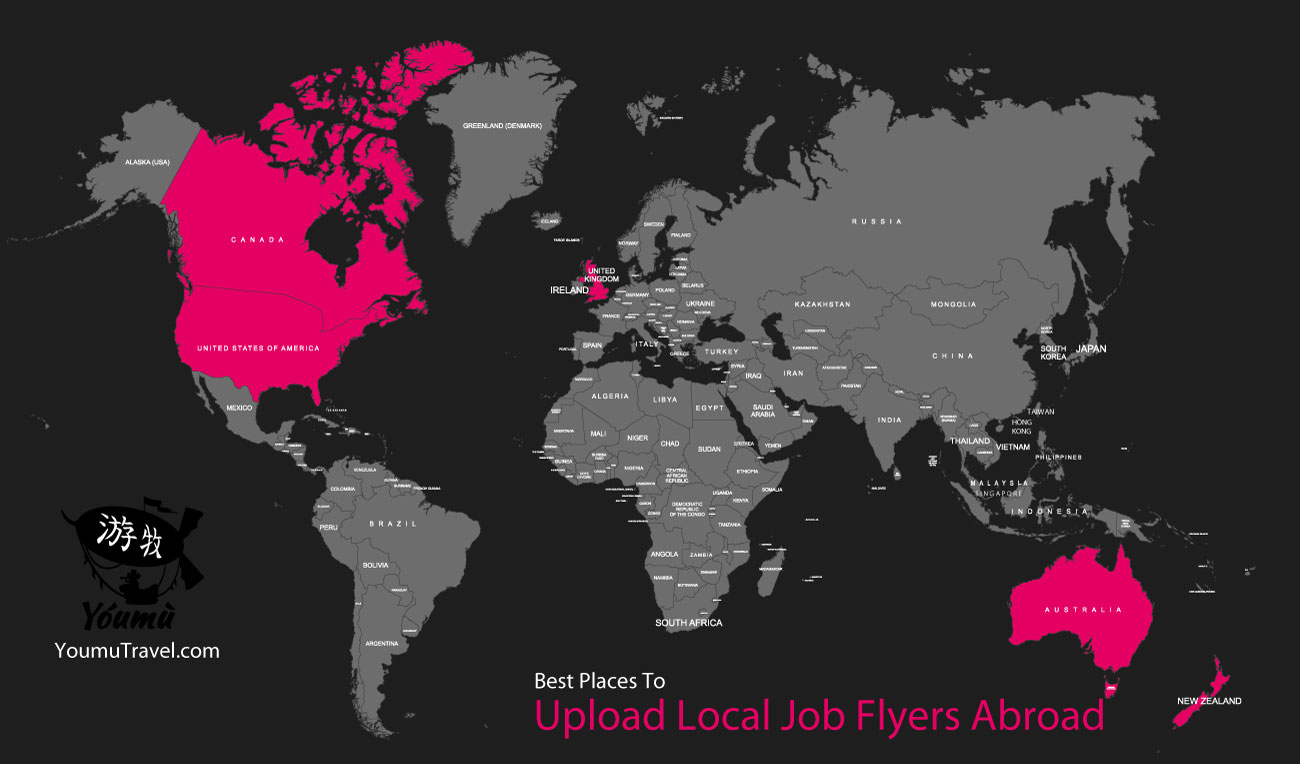
The Best Places to Upload Local Job Flyers Abroad
Most English speaking countries throughout the world will have opportunities for those seeking to upload local job flyers abroad. Here are the best places to upload local job flyers abroad.
- USA
- UK
- Australia
- New Zealand
- Canada
Take payment method into consideration
The payment on Job Spotter is through ‘points’ which equal cents (50 points = $0.50) and you’ll be paid via Amazon gift cards rather than direct deposit to an account, so keep that in mind.
When considering this app for a way to make a little extra during your trip abroad, you’ll need to be staying in one spot for a long enough amount of time to actually receive your gift cards (you’ll probably need a week for your uploads to process and for the gift cards to be mailed to your location). This job isn’t a possibility for those who are camping or staying in vans with no mailing address, etc. Plus, in order to utilize the Amazon gift card, you’ll need to have time to receive the package from Amazon. This job is best for those staying in one place for a few weeks or more.
Head downtown
Your best bet will probably be walking or biking through a downtown area with lots of buildings, companies, and stores. You’ll make more money in cities with high populations rather than rural areas.
Find small businesses
The more specific the sign, the better chance you have to get more ‘money.’ You’ll likely have no luck with big businesses such as Walmart or Starbucks who are always hiring ($0.30 at most if the help wanted sign hasn’t been uploaded to the app yet, but go ahead and take the photos just in case!). The highest value goes to the job signs that won’t already be posted all over the web. Keep an eye out for those old-fashioned printer paper signs or even hand-written help wanted signs! Though more difficult to come by, you will be doing a huge favor for the small, local businesses in the area by expanding their prospective employee applicants!
Keep it local!
Plus, just think about how this app will assist you in finding those awesome little restaurants, coffee shops and co-op grocery stores that are unique to where you’re traveling. What better way to explore and support the local community!
How much extra money will I make on Job Spotter?
You won’t be making a fortune but hey, who would turn down easy money no matter the amount! You’ll discover the city as you go! Expect about $10-$20 a month if the app is used here and there on a regular basis. Not bad for a little extra spending cash during a trip abroad, especially considering how easy it is! And if you save the Amazon gift cards, you can eventually make enough to get yourself something worth $100 just for taking some photos!
Can I do this job anywhere?
Job Spotter is predominately available in English-speaking countries (USA, UK, Australia, Canada, and some other European countries). If you’re traveling to one of these places, you can easily use Job Spotter so long as you have your smartphone with a working camera and GPS capabilities, and of course data/wifi to load the app. You’ll likely have to provide a W-9 form so Job Spotter can report your income to the IRS as well.
Can I lose my points on Job Spotter?
It is possible for your account to be shut down for violating terms, meaning you’ll lose any points you haven’t submitted for payment through Amazon gift cards. Users have complained of getting blocked for “spamming” the same help wanted signs, and of course the app does not appreciate any uploads of obscenity or of a defamatory nature, etc. But if you adhere to the guidelines and seek genuine companies looking for job applicants, you can’t go wrong!
Edit Menus and Signs Abroad – Guide
Editing menus and signs abroad can be an easy way to make a quick buck while helping out local businesses, especially small businesses.

This job has a somewhat low demand but is easy to do.
Demand
- Low Demand
Experience & Degree
- No Experience Required
- No Degree Required
Citizenship
- No Restrictions
This job is risky with low pay.
Pay Range
- Hourly: $3-$20/hr.
Reliability
- Risky
Housing
- Room and Board Not Provided
This job’s very flexible but has limited potential to work in many parts of the world.
Location
- Somewhat Flexible
Schedule
- Very Flexible
Language
- Fluency in English and Local Language
Who can Edit Menus and Signs Abroad?
Anyone that knows English and the local language!
There are no restrictions in your way. You can start this job today!
What are the responsibilities for Editing Menus and Signs Abroad?
Key Responsibilities
- Correcting translation errors
- Fixing grammar and spelling issues
- In some cases, editing digital graphics
What’s the typical schedule for editing menus and signs abroad?
This job is flexible in that it allows you to work from anywhere. However, given the small business clientele, you’ll likely need to physically be there and during regular business hours.
Income Reliability
Editing menus and signs abroad isn’t a reliable source of income but it can be an easy way to earn a quick buck.
Typical Job Duration
Editing menus and signs abroad is short-term.
Estimated Hours Per Week
Editing menus and signs abroad will likely only take up 5-10 or so hours in your week, if you’re lucky.
Room & Board
not included.
Editing Menus and Signs Abroad – Country Map
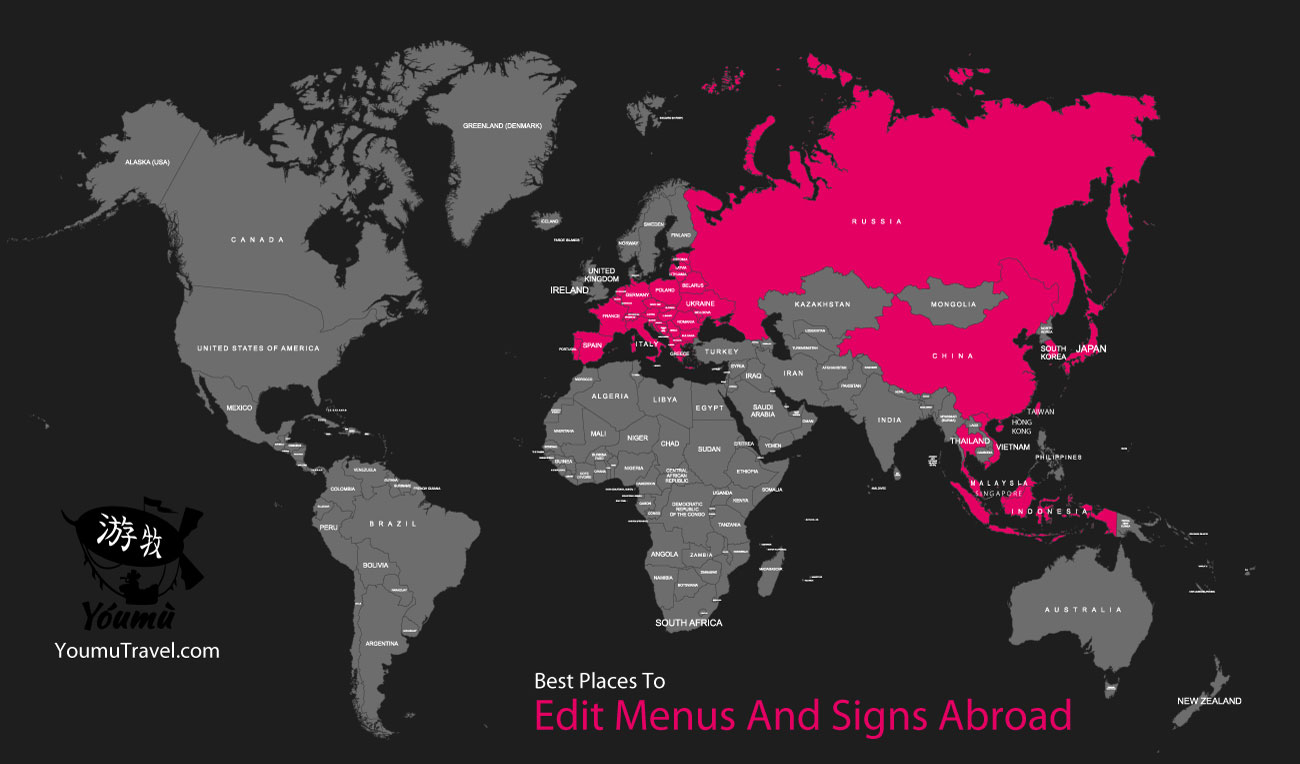
The Best Places to Edit Menus and Signs Abroad
Most non-English speaking countries such as China, and surrounding areas will have the best opportunities for those looking to edit menus and signs abroad.
- Taiwan
- Hong Kong
- South Korea
- China
- Japan
- Vietnam
- Thailand
- Indonesia
- Malaysia
- Western Europe
- Eastern Europe
- Southern Europe
Fly and try
Fly to any non-English speaking country, buzz around the tourist areas looking for restaurants and small businesses that have translation, spelling, or grammar errors on their menus, and offer to fix them for a reasonable price or a free meal or two.
Is it possible to make a living editing signs and menus abroad?
Highly doubtful but it’s an easy way to make a quick buck.
Housekeeper Jobs Overseas Guide
Housekeepers are responsible for cleaning or supervising the cleaning of the client’s home.

This job has a high demand and is easy to get.
Demand
- Somewhat High Demand
Experience & Degree
- Experience Preferred
- No Degree Required
Citizenship
- No Restrictions
This job is somewhat reliable, lower pay but room is sometimes included.
Pay Range
- Hourly: $10-$14/hr.
Reliability
- Somewhat Reliable
Housing
- Room Sometimes Provided
This job’s schedule is somewhat flexible but you can work in many parts of the world.
Location
- Flexible
Schedule
- Somewhat Flexible
Language
- Can get by with English only
Who can get Housekeeper Jobs Overseas
It is best if you have a high school diploma or equivalent so that more options are open to you, and there is a certification (the CEH: Certified Executive Housekeeper) you can acquire to add to your resume. Other than that, only a strong, comprehensive knowledge of the skills needed to clean and run a household are needed.
What are the responsibilities for Housekeeper Jobs Overseas?
The essential function of a housekeeper is to oversee the cleaning and function of a household, and many tasks go into this.
Key Responsibilities
- Light cleaning for upkeep.
- Washing dishes.
- Laundry.
- Replacing linens.
- Take out the garbage and recycling.
- Restocking cleaning and other household supplies such as toilet paper, paper towels, etc.
- General organization.
- Running errands such as grocery shopping.
- Cook, serve, and clean up after meals.
- Light maintenance like replacing light bulbs.
- Pet care such as scooping the litter box.
- Other various duties as agreed upon by the housekeeper and the client.
What’s the typical schedule for Housekeeper Jobs Overseas?
Expect to work fairly long hours. In a hotel setting, shifts are usually 8-10 hours long. Hours are more variable in a private household and would likely be negotiated upon hiring.
Income Reliability
In general, housekeepers are in high demand and there is a constant stream of work available. The pay is variable.
Typical Job Duration
Housekeeping overseas can be short-term or long-term.
Estimated Hours Per Week
It’s estimated that you can work full time, 40 hours per week, as a housekeeper overseas.
Room & Board
International housekeeping might provide room & board, but it depends on the position.
Housekeeper Jobs Overseas – Country Map
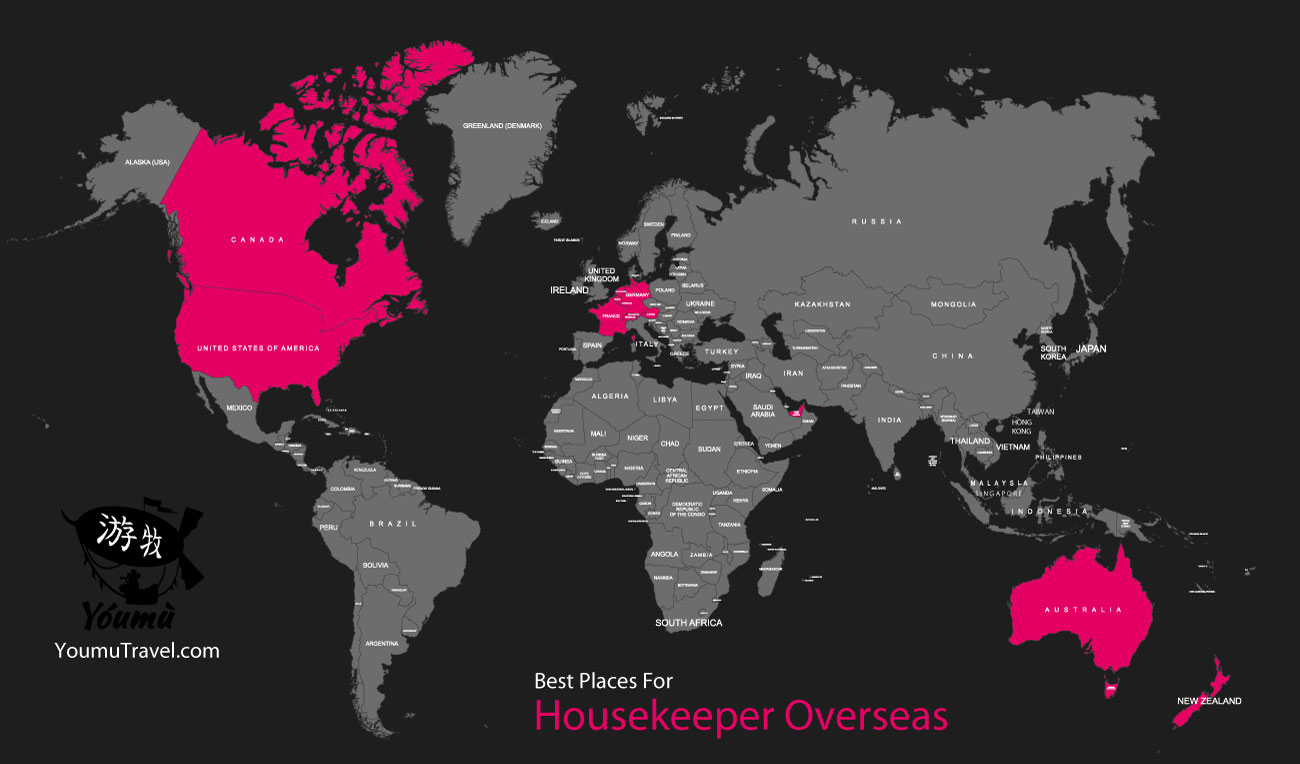
The Best Places for Housekeeper Jobs Overseas
There are opportunities throughout the world for those seeking housekeeping jobs overseas. These are the best places for housekeeping jobs abroad.
- US
- Australia
- New Zealand
- Canada
- Western Europe
- United Arab Emirates
Hone your abilities.
Housekeepers must have a thorough knowledge of cleaning products and appliances and how best to use them. They also should be able to withstand the physical requirements of the position, which include long hours on their feet, bending over, lifting various sized objects, kneeling, etc.
Garner experience.
Before seeking jobs in hotels, try entry level positions in private homes, hospitals, or places of business. This will help boost your resume for a hotel housekeeping job. You’ll also get to work with other seasoned housekeepers to learn the tricks of the trade and become better yourself.
Move up the ladder.
Getting something higher than an entry level job will, in most cases, require a high school diploma or equivalent. Once that has been completed, apply for the Certified Executive Housekeeper certification to improve your abilities and your chances of being hired in a higher position.
Create a resume/CV.
Make sure to highlight any previous relevant experience and your marketable abilities. Don’t over-design your CV–you want it to look clean and professional–but maintain a clear structure that is easy to read.
You’re ready to apply.
Start applying by looking online at various job boards such as Indeed.com to find open positions that interest you. Send your resume/CV out to the jobs that look good to you.
Create a profile
Building an online professional profile as a housekeeper allows potential employers to view your professional history, read through personal information you’ve chosen to share, contact previous employers, and can set you apart as a candidate.
What are the 3 qualifications of the housekeeper?
The ideal housekeeper has a high school diploma or equivalent, a comprehensive knowledge of cleaning supplies and their best uses, great perception and attention to small details, as well as the physical ability to work for long periods of time.
What is the difference between a housekeeper and a cleaning lady?
A housekeeper will do light cleaning on a consistent and frequent basis, whereas a house cleaner will do a thorough, deep clean on a less frequent basis.
How many hours does a housekeeper work?
Housekeepers in hotels can expect to work 8-10 hours a day.
How much is the salary of housekeeping in Israel?
In Israel, an entry level housekeeper can expect to earn around ₪ 63,598. A more seasoned housekeeper might earn around ₪ 93,556.
Is hotel housekeeping a good job?
This is entirely subjective and depends on what you want out of your job. Housekeeping can certainly be demanding, but it can also be extremely rewarding when guests appreciate all the hard work you put into making their stay comfortable.
How do you describe housekeeping on a resume?
On a resume, make sure to mention all your responsibilities: cleaning bathrooms, cleaning kitchens, changing linens, and proper storage of supplies. Also, mention your exceptional written and verbal communication skills that you developed in the position, as well as your ability to manage your time well.
What does a private housekeeper do?
A private housekeeper can expect to perform all the duties necessary for keeping a household running smoothly: buy, cook, and serve food, do laundry, clean the kitchen after meals, and perhaps care for children.
Does a housekeeper do laundry?
Usually, yes, but make sure to discuss with the client what they might expect of you just to be sure.
Is housekeeping a stressful job?
Most maids and housekeepers consider their job to be low-stress, however, there is not much opportunity for promotion or flexibility. Oftentimes the shifts are long and the pay is very low, and the job itself can be unpleasant and gross sometimes, but there are both negative and positive parts to housekeeping.
How many rooms should a housekeeper clean per day?
Typically, a housekeeper will clean 13-15 rooms per day, but at some hotels, it can be as many as 30. Housekeepers are expected to clean all these rooms in an eight-hour shift.
How long should it take a housekeeper to clean a room?
Altogether it should take about 45 minutes to clean the room the guests have checked out.
International Expedition Jobs Guide
Paid laborers can work at archeology or geology dig sites around the world.

This job has just average demand but is easy to get.
Demand
- Average Demand
Experience & Degree
- No Experience Required
- No Degree Required
Citizenship
- No Restrictions
This job is somewhat reliable, typically reasonable-to-low pay, but basic room & board sometimes included.
Pay Range
- Hourly: $6-$24/hr.
Reliability
- Somewhat Reliable
Housing
- Room and Board Sometimes Provided
This job provides some schedule freedom and great location flexibility.
Location
- Somewhat Flexible
Schedule
- Little Flexibility
Language
- Can get by with English only
Who can get International Expedition Jobs?
Anyone willing to labor under the direction of an archeologist or geologist.
What are the responsibilities for International Expedition Jobs?
Key Responsibilities
- Digging 🙂
- Soil and rock removal.
What’s the typical schedule for International Expedition Jobs?
This job will require over 40 hour weeks and long hours during the day. There won’t be much flexibility. You will have a limited time to investigate large dig sites so you have to ready to spend all daylight you can searching excavation sites.
Income Reliability
In general, working international expedition jobs are unreliable to produce a livable income but can be a fun way to earn some extra cash while seeing a new part of the world.
Typical Job Duration
International expeditions are typically short-term.
Estimated Hours Per Week
It’s estimated that you will work over 40 hours a week in the limited time you are given at an excavation site.
Room & Board
International expeditions sometimes provide room & board.
International Expedition Jobs – Country Map
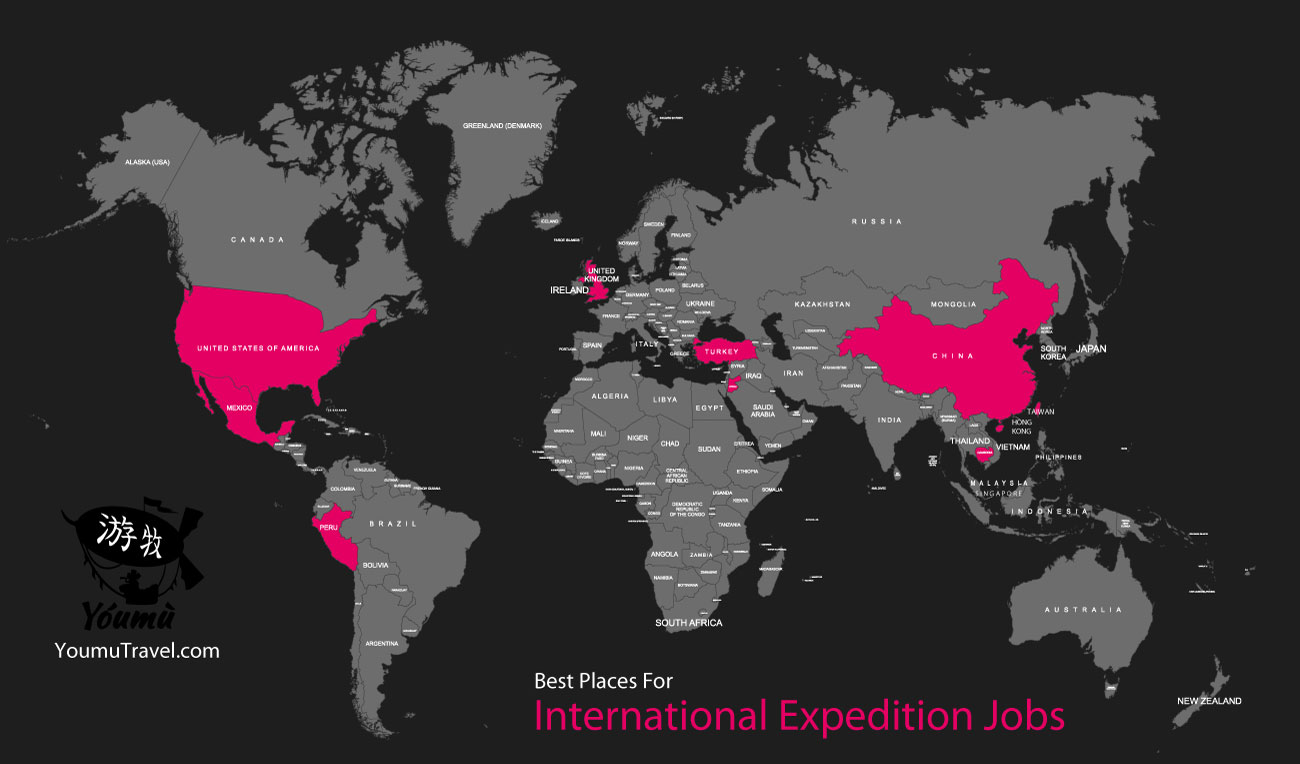
The Best Places for International Expedition Jobs
Most major countries throughout the world that have opportunities for archaeologists have opportunities for those seeking international expedition jobs. Here are some of the best places for international expedition jobs.
- Mexico
- Peru
- Jordan
- Cambodia
- Turkey
- US
- UK
- China
Planning
We’re currently diving deeper into research for this job. However, If you google ‘International expedition jobs’ then you’ll see a number of sites that readily offer these types of jobs. Given that it’s basic labor it should be fairly straightforward and easy to obtain.
Can you make a living working international expedition jobs?
Don’t count on it. These jobs are often low paid labor and/or short-term.
Backpacking Guide Jobs – Guide
Backpacking guides are responsible for leading individuals and groups on trips in the backcountry and wilderness. They will help people explore the natural landscape safely and informatively.
Contents
- Summary
- Job Opportunity – Who’s a good fit, duties, typical schedule
- Job Compensation – Pay range, reliability, housing?
- Job Flexibility – Where you can work, schedule, language skills?
- How To Get Backpacking Guide Jobs & Succeed: Step-by-Step From First-Hand Experts
- Backpacking Guide Jobs – Tips
- Backpacking Guide Jobs – Tools & Resources
- FAQ
This job is in somewhat high demand but requires some experience to get.
Demand
- Somewhat High Demand
Experience & Degree
- At Least One Year of Experience Required
- No Degree Required
- Native English Speaking Preferred
Citizenship
- No Restrictions
This job is reliable with reasonable pay and room & board is sometimes included.
Pay Range
- Hourly: $15-$31/hr.
Reliability
- Reliable
Housing
- Room and Board Sometimes Provided
This job’s schedule is somewhat flexible and you can work in many parts of the world.
Location
- Flexible
Schedule
- Flexible
Language
- Can get by with English only
Who can get Backpacking Guide Jobs?
Anyone with a love for and ample experience with backpacking can be a backpacking guide. You need to be prepared for hard training and a lot of research.
What are the responsibilities for Backpacking Guide Jobs?
The primary function of a backpacking guide is to lead individuals safely through the backcountry, but a few tasks go into accomplishing this.
Key Responsibilities
- Have a thorough understanding of the local ecology, flora and fauna, navigation techniques, and weather patterns.
- Organize and plan routes through the country, creating comprehensive itineraries.
- Ensure quality and quantity of food and other supplies.
- Read maps well to select proper routes and campsites, and to anticipate changes in terrain.
- Cook without a kitchen.
- Set up tents and campsites.
- Be prepared to encounter wild animals.
- Understand and use the best clothing, techniques, and other gear.
- Have a comprehensive knowledge of first aid and rescue abilities.
- Have great leadership–understand individual/group needs, feelings, and frustrations.
What’s the typical schedule for Backpacking Guide Jobs?
Backpacking tours can be as short as a few days or as long as a few months, and you will be essentially working 24/7. Backpacking guide jobs don’t have an hourly schedule like a more traditional, indoors job. Survival in the wilderness is not a 9-5 occupation, but a constant task.
Income Reliability
The income reliability for backpacking guides is variable.
Typical Job Duration
Backpacking guide jobs can be short-term or long-term.
Estimated Hours Per Week
It’s estimated that you can work full time, 40 hours per week or more, as a backpacking guide.
Room & Board
Backpacking guides are not provided with room and board in the wilderness.
Backpacking Guide Jobs – Country Map
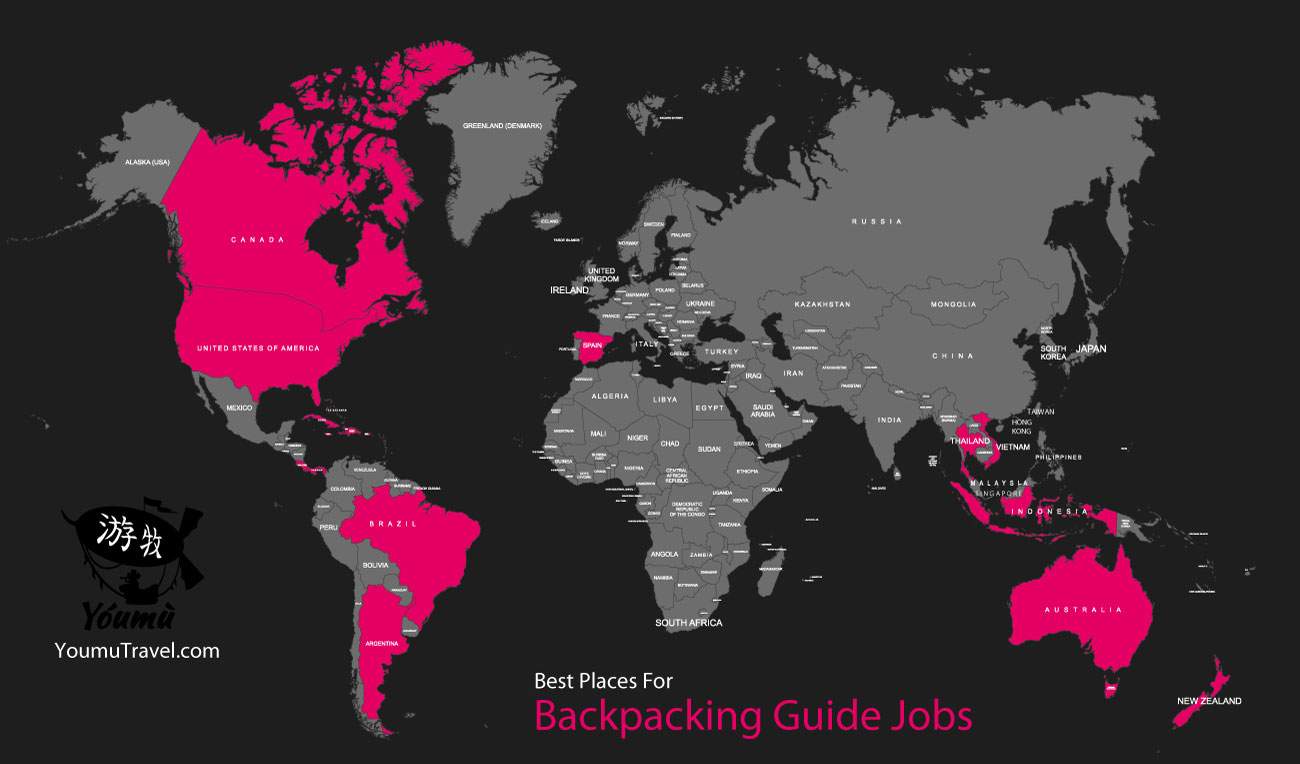
The Best Places for Backpacking Guide Jobs
Most major countries throughout the world have opportunities for those seeking backpacking guide jobs. Here are some of the best places for backpacking guide jobs.
- Argentina
- US
- Australia
- New Zealand
- Canada
- Thailand
- Vietnam
- Indonesia
- Brazil
- Panama
- Costa Rica
- Spain
- Caribbeans
- Seychelles
Understand the position.
You’ll need a comprehensive understanding of the job and what is required of you so you know what you might be signing up for. Find where you would most enjoy guiding–various national parks or parts of the wilderness–and understand that this job requires you to be outdoors 24/7 for up to a few months, and you won’t have much contact (if any) with anyone outside the group you’re guiding.
Hone your hiking abilities.
Make sure to train your mind and body so that you’re properly prepared for the demands of being a backpacking guide. You need to have a comprehensive working knowledge of hiking and climbing so that you can help other, perhaps less experienced people, do the same things you can.
Have experience backpacking.
You’ll need to understand the feelings and challenges your customers might be facing on a trip, so take a few tours yourself to really be able to put yourself in their hiking boots. What did you like about your guide? What did you wish was done differently? Asking these questions will make you a better guide.
Decide where to work.
Don’t limit yourself, but it helps to have a starting point when you’re conducting your job search. Do you have a favorite kind of terrain? Perhaps you love temperate forests or harsh mountain conditions–use these preferences to decide where you want to work.
Research.
You’ll need to do ample research on work permit or visa requirements in the places you plan on working, and then take the steps to secure such documentation.
Apply.
Make sure you apply at the correct time of year. Most tour companies take in new hires for the peak backpacking season, but there will be training beforehand. If you want to work in the Northern Hemisphere, apply around September, so that the company has time for the interview and on-boarding process before training begins in the new year. If you want to work in the Southern Hemisphere, apply in the middle of the year so that you can work in the summer. If you want to work somewhere where seasonal changes aren’t as big of a factor (such as Southeast Asia), look at various companies to see what their training schedule is like to determine the best time to apply. Once you’ve done this work, apply via job platforms/tour operator platforms like acacamps.org or wildlandtrekking.com.
Research again.
Make sure you research the tour operators you apply for, and make sure the company’s values align with your own. One company might prefer to focus on history and more leisurely trips for a mature group, and another might prioritize exciting adventures at a fast pace for younger travelers. Decide what you prefer and apply to those companies.
Interview.
Prior to the interview, make sure you do ample preparation. The recruitment process for tour companies can be highly variable, but make sure you come to whatever kind of interview prepared to discuss first aid, leadership/public speaking abilities, your knowledge of the local ecology and history, and your prior experience. Have examples mentally at the ready. Additionally, your resume should be tailored to be an “outdoor resume” that includes all of your various outdoor experiences.
Study.
Once you’ve been accepted for a job and negotiated the terms, study up on the local history, culture, food, language, economy, politics, topography, geography, ecology, and flora and fauna. You obviously will learn more on-site than by simple research, but it’s good to have a basis of knowledge to work from.
Prepare for your first tour!
Congratulations–you’ve completed all the above steps and you’re officially a backpacking tour guide. Pack your bags with the appropriate gear and be on your way.
- Practice. Before departing on your big backpacking trip, be confident in your gear and endurance. Take frequent day hikes leading up to your departure to ensure you’re fit and accustomed to how it feels to tote your backpack around. Get strong!
- Acquire proper gear. Though more expensive, the cost is worth it for nice, lightweight but effective gear. Renting gear is also an option. Remember also that you’ll want to keep warm at night, so read reviews before picking your sleeping bag.
- Bring calorie-dense food. Camping and outdoor stores sell freeze-dried food, which is a great way to lighten your pack. Pack food that’s going to keep you full: oatmeal, protein bars, nuts, pasta, potatoes, etc.
- Know what is manageable for you. Look into where you’re hiking, how many miles it is, and the elevation, etc. You’ll want to do the easier ones when your pack is heaviest and full of food. The beginning will likely be more difficult as you get used to backpacking and the weight of your pack. Take everything at your own pace.
- Don’t go alone unless you have experience and are confident in your backpacking ability. If you are alone, meet people on the trails to stick with! Sign in at any trail registrars or park offices. Bring a map, and be sure someone else is aware of where you’re hiking.
- “Leave no trace.” All hikers are aware of this general principle. Don’t use the restroom or wash dishes or laundry in the river. Don’t use soap in rivers, either, if bathing. Though tempting, try not to get into pure glacial water at all. Bring all trash with you as you go, including toilet paper.
- You need less than you think you do. Though socks and underwear should be changed frequently, there isn’t a need for changing clothes every day. One set of hiking clothes and one set of sleeping clothes is sufficient. Cleansing wipes are nice, but items like deodorant aren’t necessary. Make carrying your pack as easy as possible.
- Let go of anything troubling you and enjoy the beauty of nature! Take plenty of pictures to make all your friends and family jealous at home!
When backpacking, your gear, supplies, weather conditions, and navigation are all extremely important.
Gear. Before making any purchases, calculate what you actually will need for your trip. For example, will you need rain gear? A stove? Water purification? Gear necessity will vary depending on where you’re going. Books such as “Trail Tested” by Justin Licher can help walk you through gear and packing tips.
Supplies. Supplies refer to everything that will be used or consumed during your trip, i.e. food, toilet paper, sunscreen. As with gear, there are plenty of books and online resources to help you plan meals and help you shop. REI.com for example has a great article about meal planning for backpacking.
Weather conditions. When planning your trip, you’ll need to take the weather into account. Check out the average weather conditions in your destination for when you’ll be there. Sites like https://wrcc.dri.edu/ are great for predicting the climate. Also consider sunrise and sundown times for multiple day-long hikes.
Navigation. You’ll want to first have a good idea where you’re going prior to departing, but maps and compasses are also important for finding your way while backpacking. Seek a course online or at a nearby outdoors store for map & compass navigation, specifically for the backcountry.
Other resources to look into include but aren’t limited to: guidebooks for the location you’ll be backpacking in, illustrated trail maps, and outdoor apps such as Gaia GPS and AllTrails.
How much does a backpacking guide make?
Backpacking guides are paid hourly, and usually make between $120-$250 each day.
Can you get paid to hike?
Yes! Your expertise is extremely valuable and plenty of companies, groups, and individuals would be willing to pay for your guidance.
How do you become a wilderness guide?
To become a wilderness guide, you’ll have to do research into WGA approved Training Institutes, choose your area of specialization, contact the training institute you found, and send your application.
Do fishing guides make good money?
On average, professional fishing guides can make around $55,000 each year, but people who are highly in demand in popular tourist areas can make $85,000 each year.
How much do white water rafting guides make?
The base pay is usually around $30 per trip, with the addition of tips from passengers.
How do you prepare for a difficult hike?
Make sure you prepare your body by taking brisk walks for at least 30 minutes a few times a week, while wearing the hiking shoes you plan on wearing to get used to them. Additionally, carry a weighted backpack so you can get used to carrying your pack on your hike.
How long is a 5 mile hike?
A five mile hike takes, on average, three and a half hours.
Stagehand Roadie Jobs Abroad – Guide
Stagehands are people who work behind the scenes in film and television studios, on location and in theatre, and concert halls creating scenery, props, lighting, and special effects as well as loading and unloading vans of equipment.

This job has a somewhat high demand and is easy to get.
Demand
- Somewhat High Demand
Experience & Degree
- No Experience Required
- No Degree Required
Citizenship
- No Restrictions
This job is somewhat risky and is low pay.
Pay Range
- Hourly: $6-$19/hr.
Reliability
- Somewhat Risky
Housing
- Room and Board Sometimes Provided
This job’s schedule and location flexibility are decent.
Location
- Somewhat Flexible
Schedule
- Somewhat Flexible
Language
- Can get by with English only
Who can get Stagehand Roadie Jobs Abroad?
Basically anyone can become a roadie/stagehand, but it’s important to have some kind of experience with live shows and touring. Some positions and companies may require formal education, but most don’t.
What are the responsibilities for Stagehand Roadie Jobs?
The main function of a roadie or stagehand is to set up, dismantle, and transport equipment for various events such as filming, concerts, theatre shows, and more. Many individual tasks can go into accomplishing this.
Key Responsibilities
- Load/unload equipment from transport vehicles.
- Aid carpentry team.
- Set up the stage/set prior to a performance or rehearsal.
- Move equipment/set pieces when necessary.
- Move equipment safely.
- Aid the sound department in setting up the pit for the orchestra, etc.
- Operate mechanical equipment.
- Clean set, stage, and backstage area.
What’s the typical schedule for Stagehand Roadie Jobs?
There isn’t much flexibility in this job because you have to have the stage ready for shows before the specified time of soundcheck and the show. Also, you are on call 24/7 while you are on the road with the touring company.
Income Reliability
In general, being a roadie/stagehand is a reliable job that provides a constant stream of work, but it depends on how many gigs you can get and the duration of the shows.
Typical Job Duration
Being a roadie/stagehand is usually short-term.
Estimated Hours Per Week
It’s estimated that you can work over 40 hours a week as a roadie/stagehand.
Room & Board
Being a roadie/stagehand sometimes provides room & board.
Stagehand Roadie Jobs Abroad – Country Map
The Best Places For Stagehand Roadie Jobs Abroad
Most major countries with well established music festivals have opportunities for those seeking stagehand roadie jobs abroad. Here are some of the best places for stagehand roadie jobs abroad.
- Europe
- US
- Japan
- Australia
- New Zealand
Learn the live music business.
This is a vital step for getting yourself work because the more knowledge you have of the music business, the more valuable you are to employers. You’ll need to know the terms, what each role is and what they do, and who you will be working for and who you answer to.
Learn the various road crew jobs.
There are plenty of roles within the music business including artist managers, booking agents, and promoters. These people organize the performance, but the road crew are the ones who actually set the shows up. To get a concert running, there are three groups needed- stagehands, artist’s touring crew, and the supplier’s touring crew. So you will need to find out which role best suits you.
Freelance it.
You will need to be able to self-employ yourself as a business because there are no full-time roadie jobs. Artist tours are set for a specific time, they employ crew they need, and then have their break off the road. While on the break, they cannot employ tour crews so being self-employed means you could finish one tour and start a new one once the one finishes. You’ll need to be able to work for many different bands and go where the work is.
Get work.
In order to get work, it’s important to network, market, and train. Start mingling with emerging talent in your area and volunteer help to them. Think of questions like:
- How many times do you hear bands you know complaining about house sound engineers? Could you run their sound instead?
- How many times are musicians or DJs late shows and sound checks? Could you organize their schedules and transportation better?
- How many times do band members forget or break their instruments? Could you repair their equipment or act as the roadie who gathers their equipment?
Always watch for opportunities to offer your skills even if it’s not for money because you’ll need all the experience you can get.
Succeed & get more gigs.
Work hard and do an even better job the next gig. You’ll need to market yourself to other bands, DJs, managers, theatres, etc and network with other roadies. In order to do a good job, you will need to focus on your strengths, realize your weaknesses, and prepare working on both.
How much do roadies make on tour?
On average, roadies earn around $60,000 per year while road managers and tour coordinators make approximately $125,000 per year. This all varies according to your experience.
How do I get a job as a roadie?
You’ll want to do unpaid gigs with local bands, church choirs, or amateur theatre groups to gain experience of how behind the scenes of a live show work. Technical knowledge such as lighting or sound engineering will be a plus too.
What skills do you need to be a roadie?
Experience with traveling live shows and knowledge with electronics, electrical work, sound production, music technology, or lighting are important to have in order to stand out to employers.
What is the job of a roadie?
A roadie/backstage crew/road crew is someone who helps musicians while they’re touring by setting up and dismantling equipment, loading and unloading the van, and maybe even driving them from show to show.
How much money do rock stars make?
In 2017, musicians and singers earned around $26.96 an hour according to the Bureau of Labor Statistics.
How do you get a job with a band?
Some tips for getting jobs with bands on tour include having a thorough knowledge of the live music business, as well as an understanding of the various type of positions available on the road crew.
How do you get a job as a stagehand?
Some tips for getting a job as a stagehand include having and using your transferable skills, garnering casual experience on crews, try to be in the right place at the right time, and have a thorough comprehension of the role of backstage crew.
Where do roadies sleep?
Where you sleep depends on the budget of the band you are working for. With smaller bands, you may be sleeping on the floor of a shared hotel room or even sit in a crowded van for hours. However, with larger well-known bands, you could be sleeping in 5 star hotel suites and private jets.
What does roadie mean?
According to the Urban Dictionary, the definition for roadie is “an individual who is responsible for setting up, tearing down, and generally maintaining the equipment for a band”.
What is a union stagehand?
A union stagehand is someone who works full-time for a company, typically television or film studios, with responsibilities including building, placing, and changing sets; setting up sound systems, lighting, and props; and completing miscellaneous duties related to the production they’re working on.
How do you become a tour manager?
To become a tour manager, it’s important to have:
- Organization skills
- Interpersonal skills
- Listening skills
- Problem-solving skills
- Business skills
- Creativity
- Technical knowledge of musical instruments and sound system equipment
Traveling Street Vendor Jobs Abroad – Guide
A street vendor is someone who runs a small business that sells goods and services from a temporary or mobile stall.

This job is in low demand and may be hard to get the required permits.
Demand
- Low Demand
Experience & Degree
- No Experience Required
- No Degree Required
Citizenship
- Some Restrictions
This job is risky, typically part-time, and does not pay well.
Pay Range
- Hourly: $7-$25/hr.
Reliability
- Risky
Housing
- Room and Board Not Provided
This job has a flexible schedule but may have trouble working in parts of the world.
Location
- Somewhat Flexible
Schedule
- Very Flexible
Language
- Basic understanding of the local language.
Who can be a Traveling Street Vendor Abroad?
Anyone who has goods and/or services to sell can be a traveling street vendor if they choose to. Just make sure to obtain the proper permits and documentation to do so, as well as all the necessary equipment to keep your business running on the road.
What are the responsibilities of a traveling street vendor?
The general function of a street vendor is to sell goods and services from a temporary or mobile location, but so much goes into accomplishing this task.
Key Responsibilities
- Provide goods for customers to peruse and purchase.
- Take orders for food items, check inventory as needed.
- Have a thorough knowledge of goods to market to and inform customers.
- Process payment and make change.
- Search for prospective clients in crowds.
- Properly store food items to ensure safety.
- Provide condiments, plasticware, and napkins to customers.
- Be prepared to barter prices.
- Keep the workspace clean.
- Be sure that food meets health and safety requirements.
What’s the typical schedule for a traveling street vendor?
The great thing about being self employed is that you get to choose your own hours. Your typical schedule can be whatever you want it to be, but keep in mind that the more hours you’re open and working, the more customers you’ll get, and the more money you’ll make.
Income Reliability
The income of a traveling street vendor is highly variable.
Typical Job Duration
Being a traveling street vendor can be long-term or short-term.
Estimated Hours Per Week
It’s estimated that you can work full time, 40 hours per week, as a traveling street vendor.
Room & Board
Being a traveling street vendor doesn’t typically provide room & board.
Traveling Street Vendor Jobs Abroad – Country Map
The Best Places for Traveling Street Vendor Jobs Abroad
Many countries throughout the world have street vendors. Here are some of the most well known places with street vendors and perhaps the best places for traveling street vendor jobs abroad.
- US
- UK
- Thailand
- Vietnam
- Malaysia
- Singapore
- Indonesia
- Netherlands
- Spain
- Mexico
- Argentina
- Peru
- India
Determine what to sell.
This could be something you’re good at and can do while traveling–painting, making jewelry, carving wood, etc. You could also provide traveling entertainment with singing, dancing, live artwork (such as caricatures), and puppet shows. Also, you could sell your specialty food dishes on the road.
Find good location(s).
It’s best to choose a central area that gets a lot of foot traffic. The more people that pass by your shop, the more customers you’ll have. If you’re selling food, consider where and when people are on their lunch breaks, and provide yummy, portable meals for them. For people selling goods and services, farmer’s markets and fairs are a great place to get many customers. Also, be sure to check if the place you’ve picked is legal to sell in, and be sure to respect other businesses and vendors like yourself nearby. If someone is performing classical music on the same block you want to play the drums, there may be some conflict.
Sell legally.
Make sure you have the correct permits to sell your goods and services in your chosen location.
Decide how to sell your goods.
You should realistically calculate the prices of your goods and services based on what they cost you to achieve, and what price will allow you to continue your business. Additionally, work on your interpersonal marketing–customers like to know a bit about you and the things they’re buying, so be sure to tell them the story in an enticing way.
Appearance matters.
The way you and your business look will be a huge factor in whether or not people approach your stall. This is a part of your marketing. If you’re selling food, you don’t want you or your equipment to look dirty. The way you present yourself and your business should match with the customers you want to attract and the things you sell.
Market on social media.
Social media can be a great way to gain a following, even if you are constantly traveling. Let your followers know where you are and where you’re heading next, so people in those places can get excited to see you and purchase your goods.
How do I become a street vendor?
An aspiring street vendor will need to get a sales tax permit, as well as a tax certificate from the government’s revenue agency. Additionally, a business license from the local clerk’s office and a vendor/peddler’s license will be necessary.
What do street vendors sell?
Street vendors can sell a huge variety of goods, from fresh produce to hot meals, or artisan crafts and clothing items, or even services like haircuts and styles.
What does street vendor mean?
A street vendor is someone who sells goods or offers services to people from a mobile stall or temporary shop.
Do you need a business license to be a vendor?
Yes–to be a street vendor, you must have a vendor’s license from your state/local government.
How do I sell food on the street?
It varies by location, but the general requirements are a tax ID number, health permits, a retail food license, and safety inspections. You should speak to your insurance agent to determine if there are other specific requirements you might need to meet based on your location and business.
What are the problems faced by vendors?
Many street vendors face issues of uncertainty and insecurity. Without a static structure to conduct business in, street vendors are at the mercy of the elements, other vendors, and constantly changing customers.
Traveling Yoga Instructor Jobs Abroad – Guide
Yoga teachers have been thoroughly trained to teach yoga poses and practices. Some teachers will also weave mental, emotional, and spiritual elements into their courses so that the experience they provide is not purely physical.

This job is in somewhat high demand but takes a considerable amount of time and effort to become one.
Demand
- Somewhat High Demand
Experience & Degree
- At least One Year of Experience Required
- Hard Certification Required
- Native English Speaking Preferred
Citizenship
- Some Restrictions
This job is somewhat reliable and it’s likely you’ll only get part-time hours but the hourly rates are reasonable.
Pay Range
- Hourly: $13-$45/hr.
Reliability
- Somewhat Reliable
Housing
- Room and Board Sometimes Provided
This job has a somewhat flexible schedule and you can work in many parts of the world.
Location
- Flexible
Schedule
- Somewhat Flexible
Language
- Can get by with English only.
Who can be a traveling yoga instructor?
To be a traveling yoga instructor, you should be certified to teach yoga by taking a 200 hour certification course. You should also have some experience teaching yoga already–whether it was volunteer work or paid employment. Additionally, you should understand the unique challenges posed by working in various different countries.
What are the responsibilities of a traveling yoga instructor?
The main function of a yogi is to teach students yoga poses and mindsets, but a lot goes into this task.
Key Responsibilities
- Instruct and help students in the different yoga postures
- Create lesson plans
- Ensure the safety of students via demonstrations and guidance so that they don’t hurt themselves by doing a pose incorrectly.
- Be able to work with the very earliest beginner to a seasoned pro.
- Make sure you are able to adapt the routines to those with physical ailments, especially if they are using yoga to help bring relief for those ailments.
- Foster a safe, nurturing environment for everyone to learn in.
What’s the typical schedule for a traveling yoga instructor?
This is highly variable. It depends on you, where you work (from country to company), and your students. You can fill in gaps in your teaching schedule with other yoga-related services and activities as well.
Income Reliability
This is variable depending on who you work for and what type of position you have.
Typical Job Duration
Traveling yoga instruction can be short-term or long-term.
Estimated Hours Per Week
It’s unlikely that you’ll spend 40 hours per week in the studio teaching yoga, but other responsibilities could add up to full-time work week.
Room & Board
Traveling yoga instruction sometimes provides room and board, especially if you’re doing a work exchange.
Traveling Yoga Instructor Jobs Abroad – Country Map
The Best Places For Traveling Yoga Instructor Jobs Abroad
Most major countries throughout the world have opportunities for those seeking traveling yoga instructor jobs abroad. Here are some of the best places for traveling yoga instructor jobs abroad.
- India
- Indonesia
- Thailand
- Portugal
- US
- UK
- Costa Rica
- Mexico
Complete your 200-hour training certification.
There are teacher training certification courses all over the globe and you could travel to a distant location, or receive training in your own hometown. Some things to look into when choosing your training course are whether or not the program is certified by the Yoga Alliance, the schedule, how they teach anatomy, the program’s history, and do research on specific instructors. All of these factors can greatly impact your learning experience and you should find a course that fits you and your potential students’s needs.
Volunteer.
Before you can become a traveling yoga instructor, you’ll have to get some teaching experience under your belt. Volunteering gives you the experience you’ll need in order to make a living off teaching yoga. Use this time to hone your teaching abilities and practice yourself, so that when it’s time for you to teach in your own practice you are confident.
Write your yoga resume.
Your resume should both stand out in a pile of resumes, and be polished and professional. Sell yourself and your abilities as a teacher. Make sure to include details of other qualifications and experience you might have that’s relevant to your goals. You want to display to employers what qualities you can provide that other applicants might not have. Be sure to include links to your yoga-related social media platforms (discussed in the next step) and a good quality picture of yourself. Also, you might be able to ask the program that certified you to provide a reference to help you get hired.
Create a social media/web presence.
You should have a website and various social media profiles like Instagram, Twitter, and Facebook. These will help prospective employers and students understand what your personal brand is and decide if you’re a good fit for them. Definitely include student reviews on these pages to show what people love about you as an instructor.
Understand what you want in a job.
There are various methods of traveling and teaching. You might want a remote retreat or a luxury urban experience. Do ample research to determine what qualities you want in a teaching position so that you know what the best fit for you is. Once you have a complete understanding of that, it will make your job search a million times easier.
Search online for open positions.
There are a few websites like Yoga Trade and Yoga Travel Jobs where you can find international work opportunities. There will be listings for paid positions and work exchanges. Work exchanges won’t pay a salary, but usually provide room, board, and meals.
Apply!
Once you’ve determined the type of position you want and the location you want it in, it’s time to apply for positions that fit your criteria. A great place to look is at vacation resorts or various retreat centers. These places will have busy seasons where there are many people seeking to take yoga classes, and will likely have open positions.
Interview.
As you interview, be sure to discuss salary and requirements before you agree to work, so that you and your employer begin your journey together on the same page. Note down figures and contact details, especially if there is no written contract (which is common for these positions.) You should come away from the interview with a clear understanding of how you’ll be paid.
Get the appropriate documents.
As a traveling yoga instructor, you won’t be able to work in countries you visit as a tourist. Work visas, additionally, are costly and hard to get. Make sure to do research online and ask your employer if they can provide aid with your visa. Understand your situation and the risks of working illegally–and if you do work illegally, don’t announce it too much on social media.
Can you make a living as a yoga instructor?
In short, yes. The median income of a yoga/pilates instructor is around $62,000; however, most of these teachers earn their income outside of the studio from workshops, online sponsors, etc.
Do you have to be flexible to be a yoga instructor?
No. You’ll learn in your training that the most valuable part of yoga is meditation, which only requires a desire to learn, explore, and progress. If you’re limited in some postures, that’s okay.
What is the difference between yoga instructor and yoga teacher?
Yoga instructors will use class time to practice themselves–doing the various asanas and movements along with the class. A yoga teacher might prefer to dictate to the students rather than participate with them.
Is it worth it to become a yoga instructor?
This is highly subjective and depends on what you consider “worth it.” If you have a passion for yoga and have a strong desire to help others discover a similar passion, then absolutely. You just need to be willing to follow the steps to get there.
Is it hard to become a yoga instructor?
Like any specialized skill, becoming a yoga instructor will have its challenges. It requires passion and dedication. You’ll also need to get a certification to teach yoga, which can take time and hard work.
What is a female yoga teacher called?
The sanskrit term for a female yoga instructor is “yogini” (sometimes spelled “jogan”).
Who is the youngest yoga teacher?
Jaysea DeVoe.
Can a beginner do yoga teacher training?
It’s a good idea to take some yoga classes yourself before you start training to be an instructor, but some studios offer yoga teacher training courses for beginners that are up to 200 hours of training.
How long should you practice yoga before teaching?
Roughly six months to get a good foundation, as well as ample at-home practice.
How do I start yoga training?
You should decide if you’re going to register as a RYS, create or purchase a manual and curriculum, set a specific schedule to train, figure out the financial aspects of your practice, create a contract, create your schedule, and make sure students can register with you via a website or software.
What is a yoga instructor called?
Yogi or yogini. Yogini is used primarily to refer to female yoga teachers and yogi is traditionally male, but “yogi” has come to be a universal term.
Do I need a business license to teach yoga from my home?
Yes. All yoga teacher businesses or entities require a business license.
Massage Therapist Jobs Abroad – Guide
Massage therapists use strategic touch to massage and manipulate muscle and soft tissue on the client’s body, with the goal of providing relief for the client’s pains and ailments.

This job is in high demand but takes a considerable amount of time and effort to become one.
Demand
- High Demand
Experience & Degree
- At Least One Year of Experience Required
- Hard Certification Required
- Native English Speaking Preferred
Citizenship
- Some Restrictions
This job is somewhat reliable, reasonable pay but part-time work.
Pay Range
- Hourly: $15-$30/hr.
Reliability
- Somewhat Reliable
Housing
- Room and Board Not Provided
This job is in high demand but takes a considerable amount of time and effort to become one.
Location
- Flexible
Schedule
- Somewhat Flexible
Language
- Can get by with English only
Who can get Massage Therapist Jobs Abroad?
Anyone who is a certified massage therapist can practice their profession abroad.
It is also a physically and often emotionally demanding job, so be prepared to contend with these factors.
What are the responsibilities for Massage Therapist Jobs Abroad?
The main goal of a massage therapist is to provide quality massages to clients to help manage the client’s concerns about their body. Many tasks may go into accomplishing this goal.
Key Responsibilities
- Determine the condition of the client’s muscle strength, motion, joint function, and soft tissue
- Create treatment plans to help with the determined issues, taking into account other healthcare professionals the client has conversed with like physiotherapists, chiropractors, doctors, and psychologists.
- Discuss client’s medical history, stress levels, and pain levels to help develop treatment plans
- Perform the massage according to the client’s needs and desires
- Formulate oils to apply to the client’s skin to aid in the massage
- Keep detailed records on client’s history and progress
- Go to and participate in meetings, workshops, and training sessions
What’s the typical schedule for Massage Therapist Jobs Abroad?
Most massage therapists do about 2-4 massages a day, and including the time between clients it adds up to about a 6 hour shift. If you are also working on marketing, laundry, record keeping, and more, you will likely be working 40 hours a week but not all of this will be massages. You may also choose to only work 2-4 days a week doing more massages per day.
Income Reliability
In general, massage therapy abroad is a reliable job that provides a constant stream of work.
Typical Job Duration
Massage therapy abroad can be short-term or long-term.
Estimated Hours Per Week
It’s estimated that you can work full time, 40 hours per week, as a massage therapist abroad.
Room & Board
Massage therapy abroad sometimes provides room & board.
Massage Therapist Jobs Abroad – Country Map
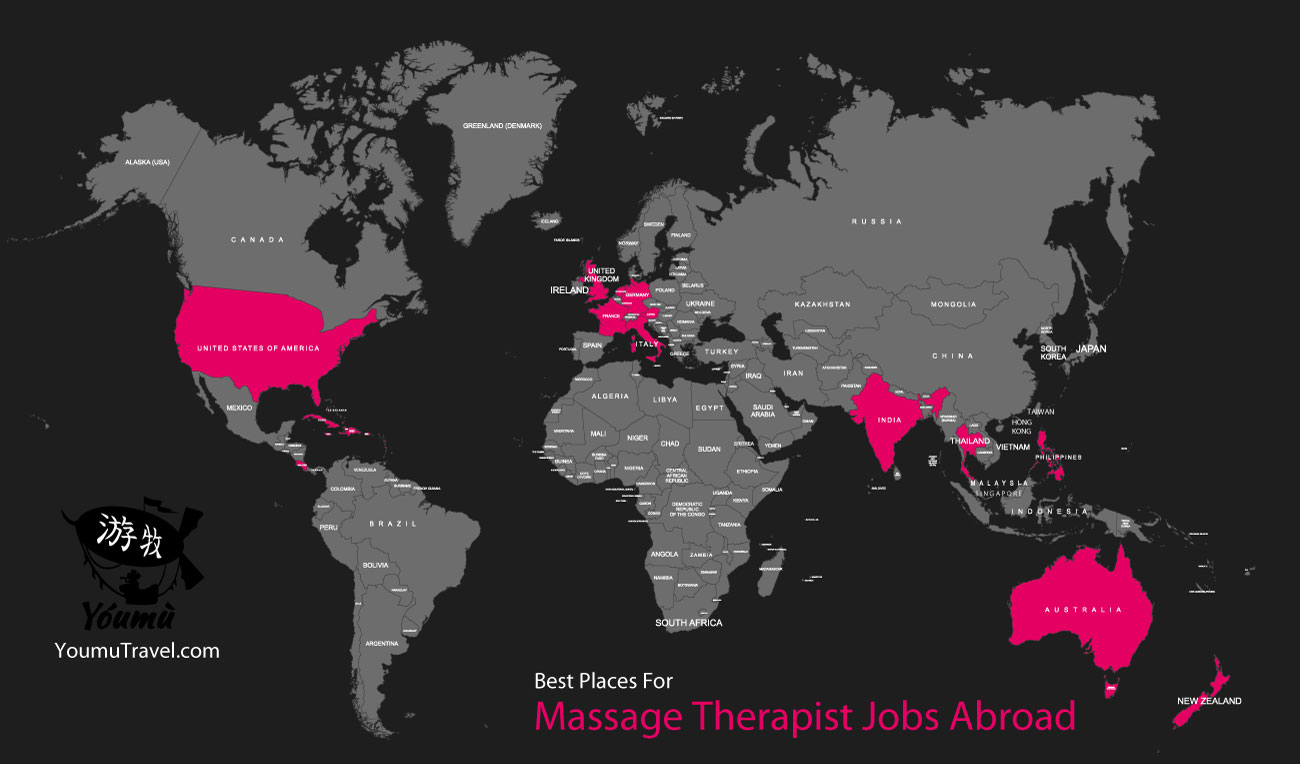
The Best Places For Massage Therapist Jobs Abroad
Most major countries throughout the world have opportunities for those seeking massage therapist jobs abroad. Here are some of the best places for massage therapist jobs abroad.
- UK
- US
- Thailand
- Philippines
- Australia
- New Zealand
- India
- Costa Rica
- Netherlands
- France
- Germany
- Austria
- Italy
- The Caribbeans
Decide what kind of massage therapy to do.
There are many styles, including but not limited to: Thai, Swedish, Hot Stone, Deep Tissue, Aromatherapy, etc. Decide on a specialty to practice to make your branding as a massage therapist more specific.
Become certified.
Once you have chosen a specialty, get certified in that type of massage. Certification programs can be as short as 300 hours or as long as 1,000. Prior to enrollment, you should look at your state/regions massage licensing requirements to ensure that you pick a program that fits these requirements. Additionally, decide if you want to take a course that’s highly specialized for a particular group of people–such as massages for seniors, trauma victims, or pregnant women. Make sure that the programs you look at are accredited.
Look for jobs.
There are so many places for massage therapists to work–hotels, spas, sports organizations, cruise ships, etc. So there are, accordingly, many places to look for massage therapist jobs. There are plenty of job sites to look at, one great one is SpaStaff.com which has job postings from over 40 countries. If you want to work on a cruise ship, look at specific cruise line sites to see what job postings they have. If you want to work on resorts, look at their websites or, if you can visit, deliver your CV in person. Essentially, decide what kind of organization you want to work for and look at the appropriate website or job board to see what you can find. Lastly, if you decide on freelancing, make sure you buy all the required equipment like a portable massage bed that you can travel around with while you offer your services.
Market yourself.
You should make social media profiles on sites like Facebook to help get your name and business out there. Make sure you list your qualifications and what makes you the best massage therapist for prospective clients.
Get the appropriate travel documentation.
Make sure you get the right kind of visa for what you plan to be doing in your chosen location(s). See if your employer can help you with a business visa. Make sure you don’t get into trouble by working with only a tourist visa–you’ll have to put the work in to work legally abroad.
Can you travel as a massage therapist?
Yes! There are many positions for massage therapists on cruise ships, in luxury hotels, or at vacation resorts.
What qualifications do you need to be a masseuse in the UK?
The GCMT suggests a course that lasts at least 6 months (full time) or 12 months (part time) to be considered qualified.
How much do RMTS make in Canada?
On average, a registered massage therapist in Canada makes roughly $42/hour, or around $81,900/year. The spectrum begins at around $37,050 for beginner massage therapists to $139,230 for seasoned massage therapists.
How many massages can a therapist do in a day?
Most massage therapists do about 2-4 massages a day, and including the time between clients it adds up to about a 6 hour shift. If you are also working on marketing, laundry, record keeping, and more, you will likely be working 40 hours a week but not all of this will be massages.
Why I quit being a massage therapist?
Some massage therapists seek other professions because of physical and emotional burnout. Massage therapy has many physical and emotional demands, as massages for the client can be a time to let out their frustrations.
What are the cons of being a massage therapist?
As with any profession, being a massage therapist has its own downsides. Mainly, the physical effects on your body can be tiring, as you’ll be standing for long hours, working with your hands, and your back may hurt from being bent over the massage table.
How much does a massage therapist make a hour UK?
On average, massage therapists in the UK earn around 19 pounds an hour.
How much does a massage therapist earn in the UK?
Entry level massage therapists might make around £16,500 a year, but more seasoned therapists can make closer to £40,000 a year.
Can I give massage without a license?
Some US states–such as Wyoming, Vermont, Oklahoma, Minnesota, and Kansas, don’t require a massage license, but they may have their own additional requirements, so look into the laws in those states if you want to practice massage therapy there.
Traveling Tattoo Artist Jobs Abroad – Guide
A traveling tattoo artist creates designs on the client’s skin according to their specifications in various locations like local salons or using a registered mobile environment.

This job is in high demand but takes a considerable amount of time and effort to become one.
Demand
- Somewhat High Demand
Experience & Degree
- At Least Two Years of Experience Required
- No Degree Required
- Native English Speaking Preferred
Citizenship
- Some Restrictions
This is a somewhat risky job that is typically part-time but with reasonable pay.
Pay Range
- Hourly: $16-$50/hr.
Reliability
- Somewhat Risky
Housing
- Room and Board Not Provided
This job’s schedule is somewhat flexible and you can work in many parts of the world.
Location
- Somewhat Flexible
Schedule
- Flexible
Language
- Can get by with English only
Who can be a traveling tattoo artist?
Tattoo artists should have superb hand-eye coordination, artistic ability, a stable hand, and ample creativity.
They should also be licensed to tattoo and have completed an apprenticeship with a seasoned tattooist.
Additionally, a tattoo artist who wants to travel should familiarize themselves with tattoo customs and culture where they travel.
What are the responsibilities of a traveling tattoo artist?
The primary function of a traveling tattoo artist is to apply designs to a client’s skin according to the client’s requests, but a lot of steps go into this task.
Key Responsibilities
- Ensure cleanliness and sterility of equipment such as needles and work areas
- Conceiving and drawing new designs
- Stay on top of tattoo trends
- Conduct meetings with clients to flesh out ideas
- Schedule appointments
- Instruct clients in proper aftercare for their new tattoo so that it heals well
- Make sure you are on top of necessary health and safety protocol
What’s the typical schedule for a traveling tattoo artist?
The hourly schedule will depend on the establishment you tattoo in. If you work for a tattoo shop, you’ll work within their hours. If you run your own tattooing practice, you’ll set your own hours.
In a tattoo parlor, artists are generally expected to work at least six hours a day, six days a week.
Income Reliability
The income for a traveling tattoo artist is variable.
Typical Job Duration
Being a traveling tattoo artist can be short-term or long-term.
Estimated Hours Per Week
It’s estimated that you can work full time, 40 hours per week, as a traveling tattoo artist, but some may work less than that.
Room & Board
Being a traveling tattoo artist doesn’t typically provide room & board.
Traveling Tattoo Artist Jobs Abroad – Country Map
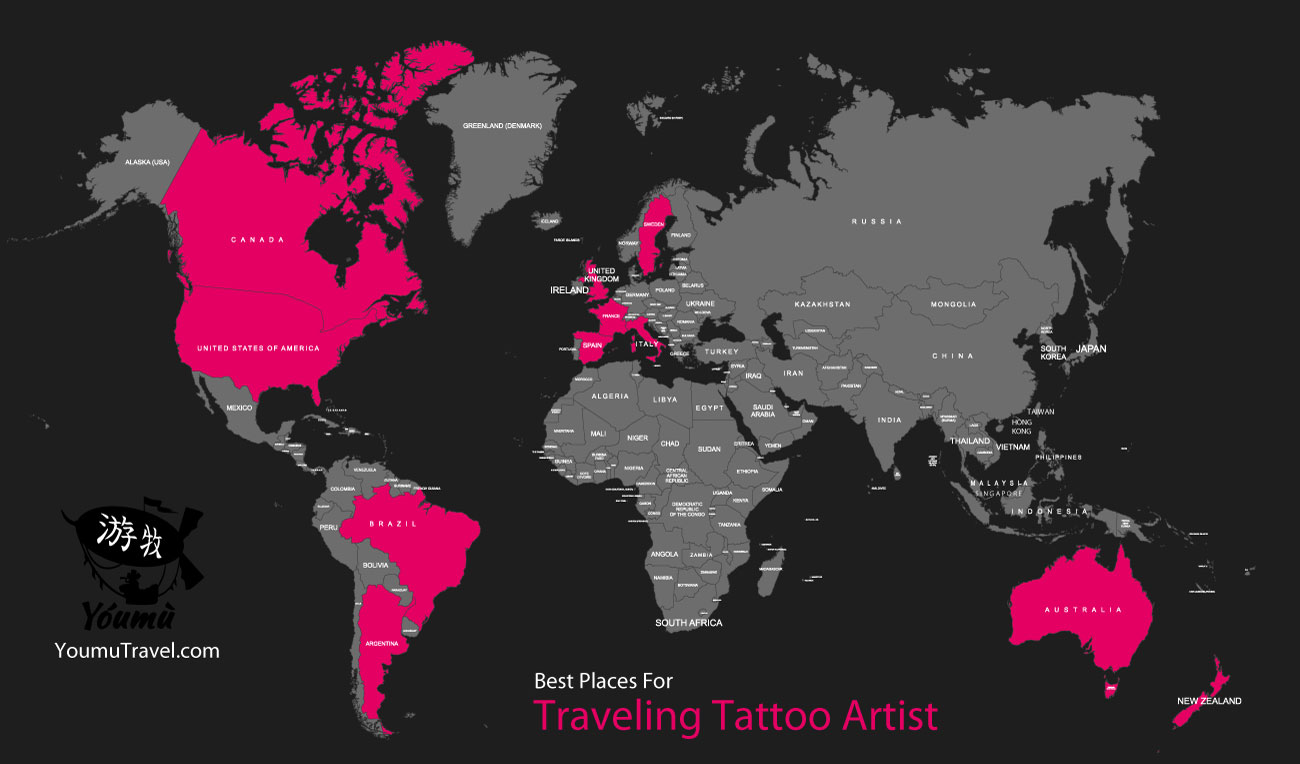
The Best Places For Traveling Tattoo Artist Jobs Abroad
Most major countries throughout the world have opportunities for those seeking traveling tattoo artist jobs abroad. Here are some of the best places for traveling tattoo artist jobs abroad.
- Australia
- New Zealand
- US
- Italy
- Sweden
- Argentina
- Canada
- UK
- Spain
- Brazil
- France
Hone your artistic abilities.
Obviously not every visual artist will be able to tattoo, but all tattoo artists should know how to create a polished piece of art on paper before they can move on to human skin. You should practice as much as possible, learning both traditional and digital art skills. Many clients want a custom piece that is borne from your own creativity, so you should know how to exercise your artistic abilities with little guidelines.
Understand the criteria for a quality tattoo artist.
Once you know the art side of things, you should delve into the business and interpersonal aspects of the profession. You’ll need to know how to appropriately price your work, schedule appointments, handle clients, and run your own shop (if that’s something you’re interested in.) You should also be prepared to handle talkative and sometimes emotional clients. Tattoos often carry significance for people and they may want to explain to you why they have chosen this particular design, so develop great listening skills while still being able to focus on your work.
Take classes.
There are a lot of tattoo training classes to be found. You’ll learn about the history, fundamentals, theories, and safety practices of tattooing. There are also online courses like this if there aren’t any you want to attend nearby.
Obtain your license.
You cannot work as a tattooist without a tattooing license. The requirements of this depend on your home state or country and usually include a valid form of ID, a national police check, and records of past and current employment. There also may be an application fee along with the paperwork you’ll have to fill out.
Get an apprenticeship.
Since tattooing is so highly specialized, the best way to learn is by working with an experienced tattooist. You’ll have to demonstrate interest and artistic talent to be accepted. Most apprenticeships are not paid, so be prepared to work another job while you work with the tattooist. Sometimes you’ll have to purchase your own equipment, but this is dependent on who you work for and is highly variable.
Create a website.
This website should display your artwork and entice prospective clients and employers. The site can also be a great way to show off your personal brand and what makes you unique as a tattoo artist.
Acquire tattoo equipment.
Whether or not you needed to purchase equipment for your apprenticeship, you’ll need to buy it now. You can get it online or from a specialty store. You’ll need a tattoo machine, needles, ink, skin pens, and various hygienic supplies.
Determine where to travel.
You should decide where you’d like to travel as a tattoo artist so that you can look for opportunities in these places. You can have a few options.
Contact tattoo shops in those places.
Contacting those shops might provide you with a sense of security knowing that there are job opportunities in your selected destination.
Or, find jobs on the go.
If you’d prefer to travel and see what opportunities you find once you get there, be sure to bring along an art portfolio. You should also network with local tattoo shops/artists, since many establishments seek guest artists for short periods of time, or might refer a client that they can’t tattoo for whatever reason to you. Social media can be great for this, so be sure to cultivate a social media presence in the tattooing scene.
Understand the local culture.
Stylistic preferences can be highly variable by country, state, or region, and so you should familiarize yourself with local tattooing culture to provide the best tattoos you can in those places.
Can you do mobile tattooing?
Yes! Many states require that you register before beginning to do business, but in most cases the registration process is the same as it would be for a stationary tattoo artist.
How do most tattoo artist get paid?
The rate is, on average, between 40 and 50 percent. So for a $200 tattoo, the shop might get $100 and the artist might get $100, but this depends on the particular business and artist.
Can you get a license to tattoo at home?
It is unfortunately illegal to practice tattooing in an unlicensed location such as a home, but it is possible to get a license to tattoo in your home.
Entertainer and Street Performer Jobs Abroad – Guide
Street performers, or buskers, are people who provide entertainment in public places–usually streets, parks, and other areas with heavy foot traffic.

This job has just an average demand and it takes considerable time and effort to succeed.
Demand
- Average Demand
Experience & Degree
- No Experience Required
- No Degree Required
Citizenship
- Several Restrictions
This job is risky, typically part-time work, reasonable hourly pay.
Pay Range
- Hourly: $13-$80/hr.
Reliability
- Risky
Housing
- Room and Board Not Provided
This job provides some schedule freedom and great location flexibility.
Location
- Somewhat Flexible
Schedule
- Very Flexible
Language
- There are no language requirements
Who can get Entertainer and Street Performer Jobs Abroad?
Anyone with a talent that they want to show to the world and the discipline to be self-employed can be a street performer.
What are the responsibilities for Entertainer and Street Performer Jobs Abroad?
The main function of a street performer is to provide entertainment in public spaces, but many tasks go into this.
Key Responsibilities
- Prepare/rehearse your act.
- Find an unclaimed place to perform.
- Set up your performance area.
- Gather your audience and interact with them periodically.
- Perform.
- If your act could be dangerous, do it as safely as possible and don’t harm your audience members.
- Offer merchandise (CDs, T-shirts, etc.)
- Continually look for performance opportunities.
What’s the typical schedule for Entertainer and Street Performer Jobs Abroad?
Street performers do not adhere to the typical 9-5 job schedule. Each performer will have a drastically different schedule depending on their act, their preferences, and where they perform. People who perform on street corners in a financial district, for example, should take advantage of the regular schedule of the passersby and perform during rushes. People who perform in parks or shopping centers should pick their performances on weekends, or on days with nice weather.
Income Reliability
In general, street performance is not a reliable source of income.
Typical Job Duration
Street performance can be short-term or long-term.
Estimated Hours Per Week
The hours of a street performer are highly variable.
Room & Board
Street performance doesn’t typically provide room & board.
Entertainer and Street Performer Jobs Abroad – Country Map
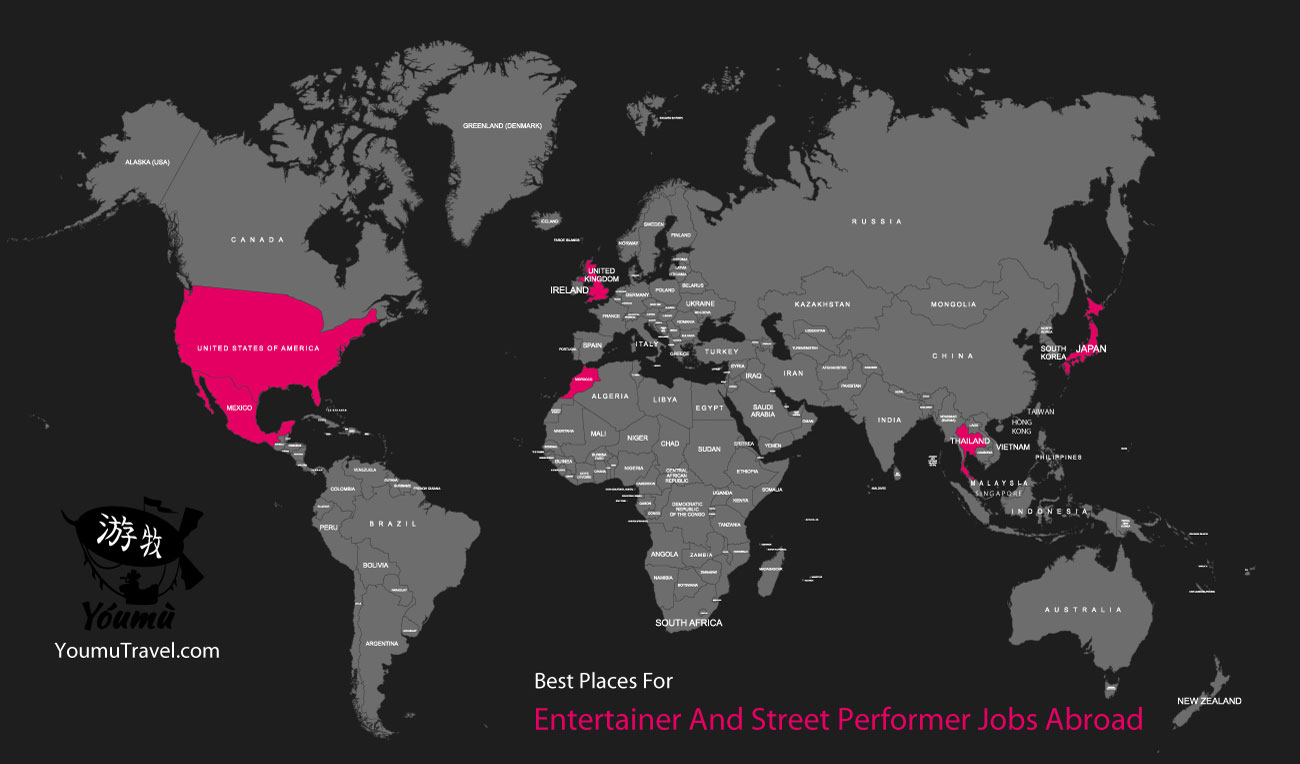
The Best Places For Entertainer and Street Performer Jobs Abroad
Most major countries throughout the world have opportunities for those seeking entertainer and street performer jobs abroad. Here are some of the best places for entertainer and street performer jobs abroad.
- Thailand
- Scotland
- Morocco
- US
- Japan
- Mexico City
- UK
Create your act.
There are so many options for street performers, so pick something you’re talented at that you think could attract an audience and an income. If you’re an amazing singer, figure out what songs you 1. Want to sing and 2. Would attract an audience. What about your talent is unique from other people with that talent? Play up your own uniqueness to stand out from the crowd.
Once you have the big idea for your act, make sure you have at least one hour of material to work with. Your audience will change as they continue on with their own daily tasks, but you want to make sure people see you doing a variety of things within your act.
Research and get licensed.
You should look at your local laws/the laws of the place you plan on working to see what requirements you need to meet. Once you know, take the appropriate steps to complete the requirements. Additionally, make sure you comply with any local restrictions and laws on street performing. If you are ever asked by law enforcement to take your performance elsewhere, comply so that you can continue performing somewhere else.
Consider your audience.
If there are a lot of parents and children in your audience and you have a raunchy comedy routine, consider using your most children-friendly material, lest you upset your audience. It is important to keep your audience in mind in every performance. If you’re a musician and someone has a request that you can comply with, do so! That audience member will be happy and might give a bit more money.
Stay positive.
There may be negative comments and responses from audience members, but do your best not to react to these things. Don’t take it personally–for every negative audience member, there’s ten more who are happy to watch you perform. Don’t respond to hecklers, as it will diminish the quality of your performance, and impede the experience of your other audience members.
Pick a good area to perform.
A great performance area is somewhere with a lot of foot traffic. Near public transportation or outdoor shopping centers, town squares or parks, etc. can all be great options. Additionally, consider what your act entails. If you’re going to do gymnastics, make sure you have enough room and even terrain. If you are a musician, pick an area away from other musicians with good acoustics. Most importantly, don’t obstruct the flow of traffic.
Time your performances well.
Rush hours and lunch rushes are great to consider, or weekends at shopping centers. You want to perform when most people are out. As you get more experience, you can tailor your performances to the rhythms of your city.
Optimize your set up.
Your stage should be simple, easy to remove/move, and eye catching. Consider a sign or banner that displays your name and social media information, and even a stand for merchandise and business cards. Make sure you have all the equipment you need–instruments, microphones, amplifiers, etc. Lastly, make sure you have a place for people to put money, whether it’s an instrument case or a hat, and label it well and creatively.
What do you call a street performer?
“Street performer” is a fine term for someone who performs in public places. You could also call them a busker in the UK.
How much does a street performer make?
The income of a street performer is extremely variable–it depends on the performer(s), location, and who happens to be passing by the performance that day. On a really good day for seasoned street performers, they might be able to accumulate around $21/hour each, but this cannot be expected everyday or even frequently. Some street performers might only make a few dollars a day–no overarching statements can be made about the income of street performers.
Is it legal to perform on the street?
Street performing is definitely legal, though there may be local laws that seek to regulate street performing in some way. If you are obstructing foot traffic or creating a public annoyance, law enforcement may step in.
Are street performers homeless?
Not always. While there may be some homeless street performers, many street performers use their craft as a secondary source of income, and they may have another job, homes, and families.
Is busking begging?
Street performance is not begging. One of the main differences is that begging is illegal, and busking is not. Street performers are providing a service and entertainment for their income, just in the same way a musician is paid for their performance.
How can I make money playing guitar on the street?
Some tips for making money as a street guitarist include: using an amp, build a pleasant relationship with your audience members, have a unique setlist/performance, and record/film yourself and post it on social media.
How much do street performers make in Vegas?
There aren’t any definitive numbers on what a street performer in Vegas can make–but one performer on the Vegas strip says he can make anywhere from $75 to $400 each day.
Can you make a living busking?
Most people use street performance as a supplemental income versus their main source of income, but it is possible to make a modest living.
Can you play instruments in public?
Yes, as long as you are in compliance with local street performance laws and you are on public property.
Is busking illegal in the US?
No. As long as you’re performing in a public area without causing a public nuisance, street performance is perfectly legal under the First Amendment.
Musical Instrument Instructor Jobs Abroad – Guide
As a music teacher abroad, you will be moving to another country to educate students in music theory and assist them in learning to play instruments. This will include teaching physical technique/skills, assessing progress, and putting together live performances. Your job is to encourage and inspire students to express themselves through music. Transfer your musical passion to them!

This job has just an average demand and requires considerable time and effort to succeed.
Demand
- Average Demand
Experience & Degree
- At Least One Year of Experience Required
- No Degree Required
Citizenship
- No Restrictions
This job is somewhat risky, typically part-time work, reasonable hourly pay.
Pay Range
- Hourly: $15-$50/hr.
Reliability
- Somewhat Risky
Housing
- Room and Board Not Provided
This job’s schedule is flexible and can work in many parts of the world.
Location
- Flexible
Schedule
- Flexible
Language
- Can get by with English only
Who can get Musical Instrument Instructor Jobs Abroad?
A music teacher is like any other teacher at a public school; applicants are expected to have, at minimum, a bachelor’s degree (music related) and be certified by an accredited teacher preparation program. This is no different for those who move abroad to teach music. Undergraduate schooling will have prepared future music teachers for teaching musical theory and, hopefully, music that children find engaging.
Teaching music to willing students is the dream for talented musicians who also have the passion of an educator. It is a demanding job and requires much more than simply having the musical knowledge. It means inspiring students to love music the way you do. Convincing them to practice in their free time, to work with and listen to their peers. And, of course, the rewarding sensation of seeing them grow.
What are the responsibilities for Musical Instrument Instructor Jobs Abroad?
As a music teacher abroad, your main job is teach students to play instruments. Your responsibilities will include:
- Preparing lesson plans in both technique for learning the instrument as well as music theory/how to read music and notations; age range of students will be crucial when planning how/what to teach – do research!
- Teaching a number of different genres and instruments to keep students engaged.
- Learning what motivates your students and constantly adjust how you teach to best suit their interests.
- Improving your own skill and knowledge-base along the way, especially concerning the local music history and instruments that originated from the country you teach in.
- Assessing and providing feedback on student performance/skill.
- Holding office hours/allow students to approach you outside of class for advise, or even start a music club after hours for jamming/furthering skill.
- Being an active member of the school and supporting other arts/programs such as theater, etc, and possibly bringing students together for a joint performance.
What’s the typical schedule for Musical Instrument Instructor Jobs Abroad?
Your schedule will depend on the school you work for. Expect to be at the school all day between 8-9am to around 4-5pm, Monday thru Friday. You’ll likely teach around 20 classes per week (4 a day) at around 40min-1hr each. Time outside of lessons will be used for planning and preparation for class and upcoming performances. Research the occasional excursion/field trip as well, to local concerts or music-related sites. Live student performances will take place outside of school hours, normally on weekends or Friday nights. Any music clubs/extracurricular bands will also be held after the school day ends.
Income Reliability
In general, teaching as a musical instrument instructor abroad is a stable job so long as you are in a long-term contract with a school. Volunteer programs will not be paid.
Typical Job Duration
Teaching music abroad can be short-term or long-term.
Estimated Hours Per Week
You will likely be working full-time (40 hrs per week), same as the other teachers, unless you do not have an office at the school and are only paid for the hours spent teaching (20 hrs).
Room & Board
There is a decent amount of international schools abroad that are willing to provide accommodation on campus or pay for an apartment; these positions may also offer a meal plan/free breakfast and lunch at the school.
Musical Instrument Instructor Jobs Abroad – Country Map
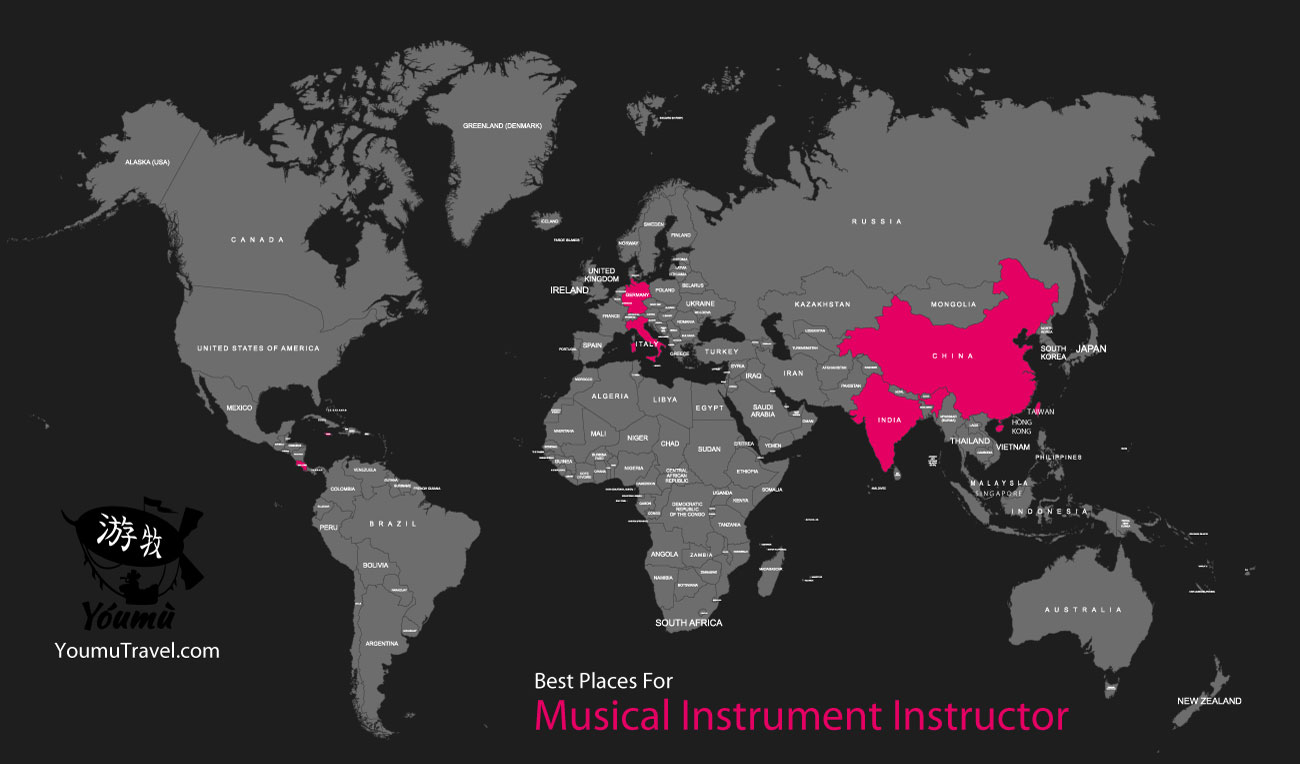
The Best Places For Musical Instrument Instructor Jobs Abroad
Most major countries throughout the world have opportunities for those seeking musical instrument instructor jobs. Here are some of the best places for musical instrument instructor jobs.
- Italy
- China
- Germany
- Jamaica
- India
- Costa Rica
How To Get Musical Instrument Instructor Jobs Abroad & Succeed: Step-by-Step From First-Hand Experts
A bachelor’s degree is always required for teachers to work at public/private schools, music teachers included. A program in music education will help prepare you to teach music theory and instrumental skill to a variety of age groups. If you already have a degree in music, consider an alternative teacher certification, or a master’s degree in education. It is important to understand how different age groups will respond to different types of teaching and musical styles. Furthermore, you will likely complete a term of student teaching to gain some experience. Here is the standard process for becoming a school music teacher:
Learn an instrument and consider a degree
Obviously, learn the instrument and learn how to teach the instrument to others. If you plan on becoming an official teacher at schools then you’ll need a degree.
Student teaching
Following graduation or as part of your studies, intern as a student music teacher (with the age group you’re wanting to teach, if applicable).
Teaching certificate
Complete a program for and receive your teaching certificate.
Applications
Apply for music teacher jobs, teach students privately, or find volunteer opportunities (to gain experience).
Take your music teaching skills abroad!
Research schools and programs in countries you are considering (make sure you are prepared for cultural differences/language barriers, etc). Apply and interview for positions. Accept the job offer, pack, and move!
What is the role of a music teacher?
To teach music, most likely to children/young teenagers. This will include instruction on physical technique for playing instruments, as well as music theory and sight reading. Most music programs will lead up to tests, auditions, and oftentimes even performances. The music teacher will provide appropriate material depending on age. For example, children may focus on how to keep tempo and learn to play basic instruments such as the kazoo or recorder. Older kids will be instructed on more complex theory and technique for instruments such as the piano, guitar, violin, drums, etc.
Can I be paid to teach music abroad?
Yes. There are paid teaching positions at schools (likely an international school where the kids speak English). While finding a permanent, long-term position may be more difficult than joining a short-term program or event (which can be a great experience!), it is worth seeking if you are passionate enough. There are also lots of unpaid volunteer opportunities, if you are interested in first seeing what it might be like to teach abroad and make connections. Volunteer work/workshops are usually in less-privileged communities that don’t have the funding to keep a music program.
Is there a demand for music teachers?
The count for music teachers in the United States is close to 123,000 with an estimated growth rate of 12.0% between the years 2016 and 2026.
What instruments should I know?
Expect the job to require you be proficient in a decent number of instruments, the most popular being guitar (acoustic/classical/electric), piano/keyboard, violin, cello, percussion. Remember that each country is going to have its own traditional instruments as well, which means learning them may require knowledge of a different musical notation system than you are used.
Do I need a degree to be a music teacher abroad?
Yes, pretty much all schools will expect a bachelor’s degree in music as well as certification and experience in teaching. Music teachers must be prepared to invest in both the development of their students as people and as musicians.
What are the benefits of being a music teacher abroad?
Lots. For one, you’ll be in another country experiencing another culture and having ample opportunity to further your knowledge of music in that area. Working as a music teacher for a school abroad usually offers the same stability as a job in the U.S. A decent amount of schools offer accommodation, paid flight/relocation compensation and sometimes even meals. Public holidays are paid, and full/half-pay is sometimes given on school breaks in the winter and summer vacations. As with other jobs, you will also receive health insurance (sometimes paid for you!) . You receive a work visa allowing you to reside in that country, and have teaching resources available to you.
Where can I teach music abroad?
Pretty much every country will have either a school that offers music lessons or a volunteer outreach program to teach music to the local youth. Here are some examples:
Italy: famous for its opera scene and classical concertos, it’s vast history in music still shapes how we play today (allegro, andante, forte, etc) – check out Associazione Culturale Linguistica Educational for workshop opportunities.
China: years and years of dynasties mean rich history in the art of music; pick up a traditional Chinese instrument you’ve likely never seen in Western music – check out Knowledge Must for opportunities in sharing your knowledge while gaining more about Chinese arts and culture.
Germany: home of the classics; Bach, Strauss, Wagner, Beethoven are all German musicians you studied from childhood lessons to your undergrad – check out Nomaden Berlin for more information on settling in Berlin to teach.
Kenya: step into another world of festive music traditions and tribal music to learn, join, and create with the (perhaps limited) resources available to you; the students will surely be excited to discover Western instruments such as the guitar or piano – check out International Volunteer HQ for opportunities to volunteer in Kenya and help combine their traditional music with your knowledge of theory and instrumentation.
Greece: the word music itself is derived from the Greek word mousa – check out Remarc Sunseafun to learn more about being paid to teach resort guests about music.
Jamaica: who hasn’t heard of Bob Marley? This country loves music, especially reggae (birthed in Jamaica) – check out Projects Abroad for volunteer music teaching opportunities in Jamaica.
Cambodia: musical dance and the Khmer people dominate this country – check out Kaya Responsible Travel for more on how to start singing and dancing with kids in Cambodia.
India: we’ve all watched a few Bollywood music videos before; this country loves music and it loves dance, it’s size allows for such diverse musical style – head over to Kaya Responsible Travel for this location, too!
Costa Rica: the arts and music is well funded here; be a part of helping keep a vibrant cultural and modern art community alive – check out Performing Arts Abroad for a chance to teach music around town.
Brazil: dance your way to work with the year round drumming, clapping, and music that fills the streets; students will be dying to become part of this scene and learn more about the many genres and instruments that stem from their homeland – check out Iko Poran for opportunities in teaching youth to express themselves through music.
Bolivia: home to many indiginous people and isolated communities, get ready to time travel through traditional folk music – check out Projects Abroad for the chance to assist local music teachers with bringing music to orphans and underprivileged children.
Peru: bring the classics to Peru for a well-rounded combination of Peru tradition, modern jives, and old school symphony – check out Vive Peru to learn more about their program for teaching music to the youth.
Online Vocal Coach Jobs – Guide
An online vocal coach works with singers–beginners and professionals alike–to improve their vocal range, pitch, tone, and delivery.

This job has just average demand and takes a considerable amount of time to become one.
Demand
- Average Demand
Experience & Degree
- At Least One Year of Experience Required
- No Degree Required but Certification Preferred
- Native English Speaking Preferred
Citizenship
- No Restrictions
This job is risky and typically part-time but pays well.
Pay Range
- Hourly: $25-$60/hr.
Reliability
- Risky
Housing
- Room and Board Not Provided
This job has a flexible schedule and you can work almost anywhere in the world.
Location
- Very Flexible
Schedule
- Very Flexible
Language
- Can get by with English only
Who can be an online vocal coach?
Online vocal coaches should generally have a degree in music, extensive vocal training, and some prior experience teaching music or conducting vocal training.
What are the responsibilities of an online vocal coach?
The main function of an online vocal coach is to work with beginning and experienced singers to improve their singing voices. Many tasks go into this.
Key Responsibilities
- Listen to the student to perform vocal assessments
- Discuss the needs and goals of the student
- Design lessons tailored to the individual student
- Teach student a variety of techniques and exercises for their voice
- Conduct warm up exercises
- Work with students to prepare them for performances such as concerts, competitions, or a cappella performances
- Teach students how to keep their voices strong and healthy over time
- Attend workshops yourself to make sure you are up-to-date with the latest vocal training techniques
- Remain aware of trends in the music industry
What’s the typical schedule for an online vocal coach?
Online vocal coaching is a fairly flexible position. You can choose your own hours of operation in accordance to you and your students’s needs. Generally, your lessons will be about an hour long, so use that and your overhead costs to determine when and how often you’ll conduct sessions.
Income Reliability
In general, online vocal coaching is a reliable job that provides a constant stream of work.
Typical Job Duration
Online vocal coaching can be short-term or long-term.
Estimated Hours Per Week
It’s estimated that you can work full time, 40 hours per week, as an online vocal coach.
Room & Board
Vocal coaching online doesn’t typically provide room & board.
Online Vocal Coach Jobs – Country Map
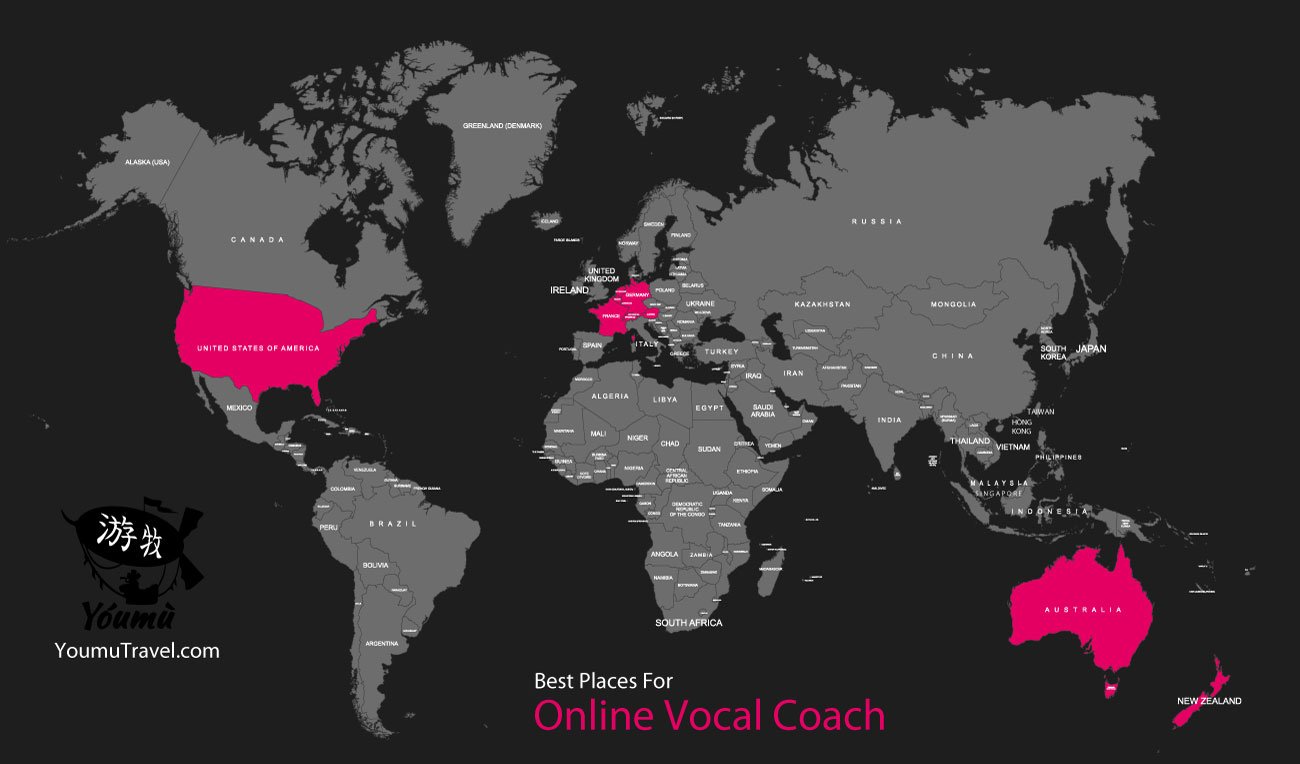
The Best Places For Online Vocal Coach Jobs
This remote job can technically be done anywhere in the world. However, you’ll want to make sure your clients or employer are okay with the timezone difference. Here are some of the best places for online vocal coach jobs.
- US
- Western Europe
- Australia
- New Zealand
Practice your singing.
To be a vocal coach, you’ll first need to know how to sing yourself. Determine your vocal type, abilities, and range.
Attend vocal training yourself.
Find vocal coaches near you or online and work hard to get your voice to the best place it can be–this may take months to years. You can also take professional vocal training classes from performing arts schools.
Study music.
To be a serious vocal coach, you’ll need a college degree in music so that you can get the most thorough training and knowledge. You’ll learn music theory, how to read music, and how to hear harmonies, tones, and other necessary elements of music.
Decide what kind of vocal coach you want to become.
Do you want to be a certified teacher? A private instructor? A commercial vocal coach? Do you want to work in a studio? For a recording company? Once you can answer these questions, you’ll have a direction to aim your career in, and you can continue developing your skills toward these goals. Many professional vocal coaches spend up to 10 years training and developing their own vocal abilities.
Become a vocal coach.
You’ll need a resume and a cover letter that highlights your education, certifications, training, and experience so far in your career. Consider designing a personal logo that fits you and your brand, and even a slogan for your service/business. You should also acquire business cards and marketing materials so that you can advertise your services on-the-go when you meet prospective students. It’s also a good idea to create a website so people searching for a vocal coach can find you in a few quick searches. With the popularity of social media, having profiles where you promote your work is a great idea.
Get an internship or work experience.
Look on job boards to find internships, part-time, or temporary work opportunities as a vocal coach. You can also look for vocal coaches in your area and contact them to ask if you can shadow or assist while they teach their classes to get practical experience and make networking connections.
Garner clients.
Ask your friends and family to advertise your services to people they know, as well as use your online platforms. Go to networking events to meet other vocal professionals and prospective students. You can also offer free or discounted vocal coaching sessions to gain some students who would work with you in the future at full price. You need to build credibility and experience to keep your business running.
Choose your price point and hours.
Look around online or ask your industry peers what other vocal coaches charge for their sessions. Depending on your experience, charge the same price point or just a bit above or below. It’s also important to consider the expenses of keeping your business running when you choose how often you conduct sessions and how much you charge for each. When just starting out, try to remain as flexible as possible in your hours to get as many students as possible.
Stay professional.
Make sure you are punctual and presentable, as well as approachable and friendly with your students. Make sure to listen to any concerns or comments students or their parents have about the lessons so that you can develop a great rapport, and people will continue coming to you for their vocal coaching sessions.
Is a vocal coach worth it?
This depends on your subjective definition of “worth it,” but keep in mind that a vocal coach can help you improve your natural abilities through proven techniques. Vocal coaches can help you hit that elusive high note, support a very long note, and make sure you don’t damage your voice in the process.
How much does it cost to have a vocal coach?
On average, voice lessons cost around $60 an hour, but this can be highly variable depending on the coach and where you live.
Can someone with a bad voice learn to sing?
Yes. Only 3% of people are actually tone-deaf, and anyone not in this 3% can learn to carry a tune.
What is a good age to start vocal lessons?
Students of any age can start vocal lessons, but children are usually ready to start when they are between 7-9 years old.
How many voice lessons do you need?
Ideally, a student will be able to have a lesson for a full hour once a week.
What makes a good vocal coach?
A great vocal coach can make their students feel comfortable. Students want to learn with someone they trust and who listens to their needs and requests.
Dancing Instructor Jobs Abroad – Guide
Dance teachers lead dance classes and instruct various types or techniques of dance to individuals or a group of people.

This job has just an average demand and requires considerable time and effort to succeed.
Demand
- Average Demand
Experience & Degree
- At Least One Year of Experience Required
- No Degree Required
Citizenship
- No Restrictions
This job is somewhat risky, typically part-time work, reasonable hourly pay.
Pay Range
- Hourly: $18-$43/hr.
Reliability
- Somewhat Risky
Housing
- Room and Board Not Provided
This job’s schedule is flexible and can work in many parts of the world.
Location
- Flexible
Schedule
- Flexible
Language
- Can get by with English only
Who can get Dancing Instructor Jobs Abroad?
Anyone with a high school diploma or equivalent and extensive, professional dance training can become a dancing instructor abroad. If you want higher level positions, however, it is recommended that you get a bachelor’s degree in dance or a related field. And depending on where in the world you want to work, you may need dance teacher certifications.
What are the responsibilities for Dancing Instructor Jobs Abroad?
The main function of a dance instructor abroad is to teach dance routines to their students, and many steps go into this.
Key Responsibilities
- Familiarize yourself with different dance styles, techniques, and methodologies at various levels.
- Prepare lesson plans and curriculums.
- Communicate with other teachers and students.
- Motivate and encourage students.
- Evaluate student performance and provide constructive criticism.
- Choreograph routines and numbers to selected music.
- Prepare for recitals and concerts.
- Ensure that the classroom is a fun, creative environment.
- Keep your own abilities up-to-date.
What’s the typical schedule for Dancing Instructor Jobs Abroad?
One of the perks of being a dance instructor is the variety and flexibility of your schedule. It depends on who/what you work for, but you can work part-time, seasonally, or full-time. You might only teach night classes, or work 9-5 in a university teaching position. There is a wide variety of schedule types available to dance instructors.
Income Reliability
In general, dance instruction abroad is a reliable job that provides a constant stream of work.
Typical Job Duration
Teaching dance abroad can be short-term or long-term.
Estimated Hours Per Week
It’s estimated that you can work full time, 40 hours per week, as a dance instructor abroad.
Room & Board
Dance instruction abroad might provide room & board.
Dancing Instructor Jobs Abroad – Country Map
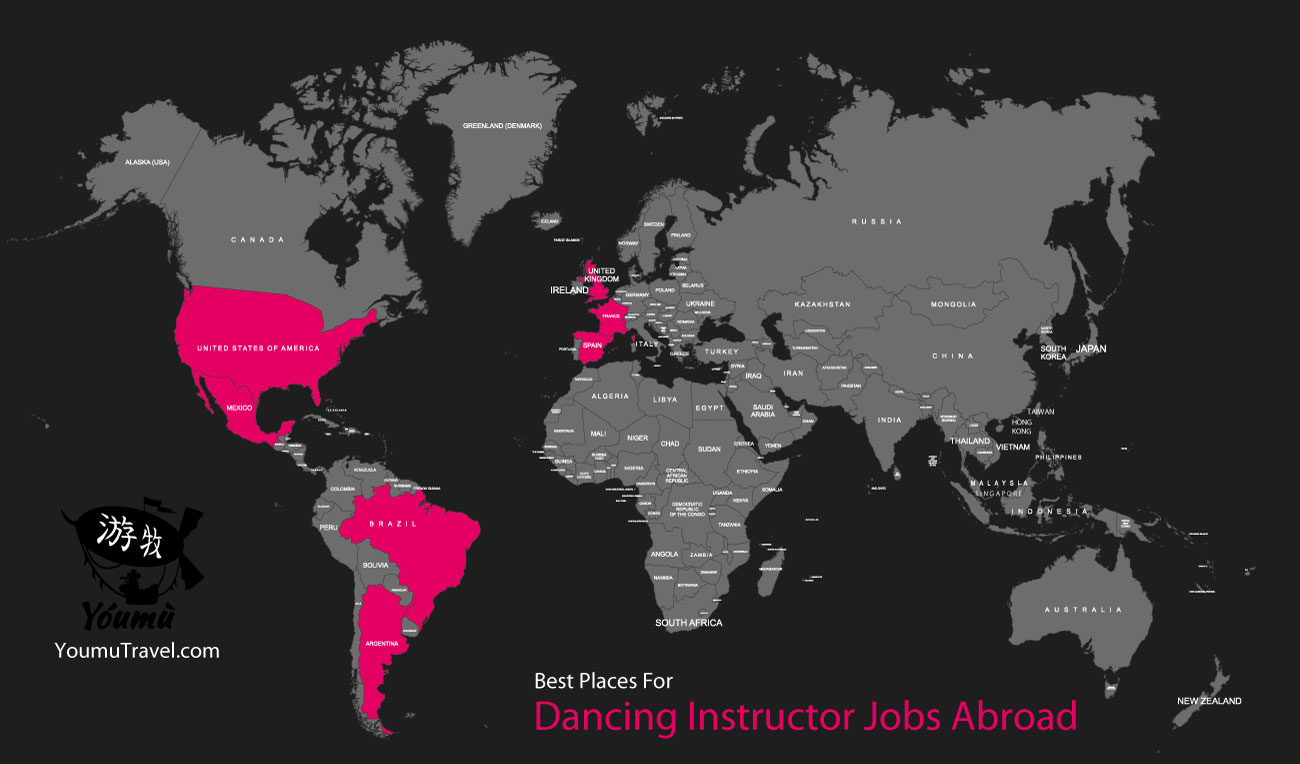
The Best Places For Dancing Instructor Jobs Abroad
Major countries in North and South America, and Western Europe have opportunities for dancing instructor jobs abroad.
- US
- Spain
- Brazil
- France
- UK
- Mexico
- Argentina
Build your dance abilities.
You’ll have to first be an accomplished, trained dancer before you can teach others to dance. This can take many years of dance classes, competitions, intensives, and performances. It’s also imperative that you keep your body in excellent condition to support the constant physical activity you’ll be engaging in. You should also pick a couple genres to specialize in–some popular choices are ballet, tap dance, jazz, ballroom, hip-hop, and modern.
Get your high school diploma or equivalent.
This will demonstrate that you have the necessary communication, reading, and writing skills that are necessary to successfully communicate and work with students, parents, vendors, and other instructors. Remember that some dance teaching positions may also require some type of college degree.
Get certified.
You’ll need to have a dance teacher certification if you want to teach at a private studio. The requirements for dance instructors are also likely to vary by studio–they may have their own certification program, or may ask that you get your certification from an independent organization. It will also vary widely by location–for example, in the UK you’ll need a particular qualification from the Council for Dance Education and Training whereas in the US, you could get certified from groups like the Royal Academy of Dance, the American Ballet Theatre, the National Dance Teachers Association of America, or the American Tap Dance Foundation, among others. Make sure to do research on what might be required where you want to teach.
Additionally, consider a fitness certification if you want to teach dance at a gym, such as Zumba, Barre, or Jazzercise. There is an increasing demand for teachers of this kind, so it is a good opportunity to consider.
Get a bachelor’s degree in dance.
If you want more advanced opportunities, such as teaching in a competitive setting or at a college/university, you’ll have to have a bachelor’s degree in dance, performing arts, or your preferred type of dance (ballet, tap, etc.)
Write your resume.
Make sure this showcases all your relevant skills and experience, as well as some references. Include where you trained, the choreographers and companies you’ve worked with, and any relevant awards or roles you earned.
Job search.
If you’re looking for entry-level positions, consider assistant jobs or co-choreographers. This can be great to garner experience so that you can climb up the ladder to a position with your desired level of leadership and independence. Additionally, if you need flexible hours to work another job or go to school, try finding part-time positions, or even seasonal work. Of course, apply to the full-time positions at dance studios, schools, and community organizations as well. Ask your dance connections if they know of open positions, or look on online forums and job boards. Your networked connections will really come in handy when you’re looking for dance teaching jobs abroad, and if you attended a college or university for dance, see if they have any connections to dance studios and schools abroad.
Create a reputation for yourself.
Conduct private lessons for students and create a social media following so that your name as a dance teacher spreads around. Social media is great because pictures and videos will allow you to offer dance tips that might entice people to your classes, and establish your credibility as an instructor. Additionally, you can connect with potential students and potential employers. Male sure to follow other instructors, studios, dance schools, famous dancers, famous musicians, and more. These connections could lead to job opportunities abroad.
Research.
When looking for dance teaching positions abroad, make sure you conduct ample research and ask potential employers plenty of questions. Dance instruction abroad could be very different from the local training you received, so make sure you have a thorough understanding of the position’s job requirements and conventions. Use their website and social media to your advantage. Once offered a position abroad, make sure to ask if you will be compensated for relocation costs, transportation, etc. Is room and board provided or do they have recommendations for where their employees should live? You want to have a clear grasp before you embark on your journey.
Who is a dance teacher?
Dance teachers instruct students in the art of dance and various dance types and techniques. They may teach individuals or groups at dance studios, production companies, schools, universities, and colleges.
How can I become a good dance instructor?
A great dance teacher is passionate, flexible (both physically and mentally), dedicated, patient, educated, and professional.
What skills does a dance teacher need?
It’s important that you have a thorough knowledge of the fine arts, the ability to plan and design lessons, great communication skills, cooperative ability, and leadership skills.
How do dance teachers make resumes?
A dance teacher’s resume should include an energetic, dynamic, and confident personal summary, as well as any relevant work and educational experience. Make sure to include what you’re best at, and quality reference from trusted people.
International DJ Jobs Guide
An international DJ is someone who entertains public audiences with music suitable for dancing by selecting popular tracks that fit the mood of the particular setting/gig.

This job is somewhat low demand but is easy to get.
Demand
- Somewhat Low Demand
Experience & Degree
- Basic Understanding Preferred
- No Degree Required
- Native English Speaking Preferred
Citizenship
- Some Restrictions
This is a somewhat risky job that is typically part-time but with reasonable pay.
Pay Range
- Hourly: $10-$50/hr.
Reliability
- Somewhat Risky
Housing
- Room and Board Not Provided
This job’s schedule is somewhat flexible and you can work in many parts of the world.
Location
- Somewhat Flexible
Schedule
- Somewhat Flexible
Language
- Can get by with English only
Who can get International DJ Jobs?
There is no formal education for becoming an international DJ so anyone can be one. As long as you have a love for music and you are sociable, you’ll be able to begin your career as a DJ in no time!
What are the responsibilities for International DJ Jobs?
An international DJs responsibilities will vary depending on the kind of event they are working.
Key Responsibilities
DJs playing events, festivals, clubs, bars, etc.
- Make mixes of songs.
- Seamlessly transition music.
- Ensure that the volume remains consistent.
- Gauge the mood of the audience when choosing the playlist.
- Play the role of announcer or emcee to keep the party on track.
DJs working at radio stations/similar programs.
- Conduct reviews of the playlist for the day/week.
- Make sure programming sticks to the schedule.
- Introduce presenters for weather, traffic, and news segments.
- Comply with music requests and be friendly with listeners.
- Interact with people on social media.
- Conduct competitions while on-air.
- Conduct interviews.
- Present at live events.
- Mix music for events.
- Present advertisements on the air.
What’s the typical schedule for International DJ Jobs?
It’s a pretty sporadic and unpredictable schedule. You’re constantly on the road looking for gigs and it could be a good week where you have a gig every night for 5 nights in a row. Or you go three weeks without a single one. The good thing about this position is you decide what gigs you take or don’t take so you don’t end up overworking yourself.
Income Reliability
In general, an international DJ is a reliable job that provides a constant stream of work.
Typical Job Duration
Being an international DJ can be short-term or long-term.
Estimated Hours Per Week
It’s estimated that you can work full time, 40 hours per week, as an international DJ.
Room & Board
Being an international DJ doesn’t typically provide room & board.
International DJ Jobs – Country Map
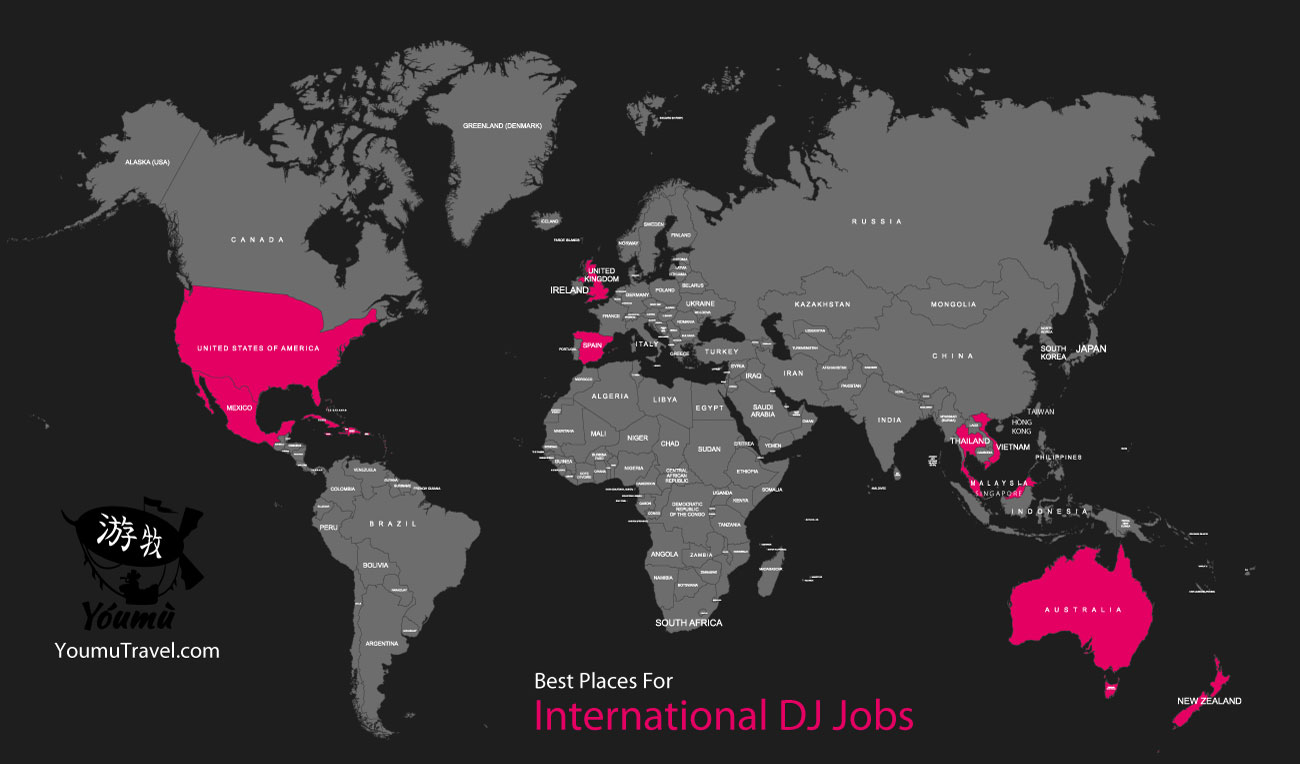
The Best Places For International DJ Jobs
Most major countries with a stake in the tourism industry throughout the world have opportunities for international DJ jobs. Here are some of the best places for international DJs.
- The Caribbeans
- Thailand
- Vietnam
- Malaysia
- UK
- Spain (Ibiza)
- Mexico (Cancun)
- Australia
- New Zealand
- US
Study.
You don’t need any formal education to become a DJ, but many DJs study under an established DJ to learn the basics of mixing and editing to create the right mood of the crowd and the place you’re performing. The success of your job depends on networking and promoting your content. If you want to study, there are plenty of books and online resources which will help establish foundational knowledge of this job. It’s important to learn all there is about the terminology, techniques, genres of music, types of equipment, etc before you can move on to the next step.
Hone your abilities.
- Learn the BMPs of the songs you like to play
- Learn the intros and outros of those songs as well
- Learn how to scratch
- When first starting out, keep it simple by only mixing two songs that are within 3 BPMs of each other and in the same key. The software you bought would be able to tell you this. Once you’ve got this done, you can start experimenting with looping, toggle functions, and adding effects.
Make a website.
You’ll want to create a website to show off your skills or keep up a presence of social media. You’ll want to include information about what your style is, the equipment you use, and add samples of your mixes to your website and social media. This is one of the most important advertising and marketing tool for your career as well as building up an online network.
DJ locally.
To begin, you’ll want to start DJing in your own country and practice as much as you can. Try setting up gigs with your local clubs, bars, and music venues to play small, private events for a low fee or a slow weeknight shift or even ask a friend if you could play at their house party. It’s going to be low pay at first, but once you get better at it, you’ll make better pay.
Write and submit your resume.
Create a well-written resume, cover letter, and a sample CD and submit all of these to DJ agencies around the world. With an agency in your home country, you can book local gigs, but to book international, you’ll need to get agents in different countries. Before you submit to everyone though, you’ll want to contact agencies and ask them what their submission procedure is because some will not take unsolicited submissions. Cruise ship industry is always looking for DJs and entertainers, though.
Here are a few websites that are helpful in finding gigs:
- DJ jobs https://djjobs.uk/
- Entertainers worldwide https://www.entertainersworldwidejobs.com/
- DJ Agency https://djagency.co/dj-jobs/
- Cruise job directory https://cruisejobdirectory.com/
- Carnival entertainment https://www.carnivalentertainment.com/
Interview.
During the interview, you’ll want to highlight your love for music and how sociable you are so you can easily network with many types of people and personalities. You’ll also want to be prepared to talk about past gigs no matter how small they were.
Network.
If you choose to find DJing gigs during your travels without pre-arranging anything, you’ll want to go to locations that are known for their party scenes. When you get there, be sure to take a few days to visit the clubs and bars in the area to get used to the style of the parties and the people you’ll be performing for. Introduce yourself to the bars and club managers and give them a CV and/or a sample of your work for future work.
Who is the No 1 DJ in the world?
The number one DJ in the world is the Belgian brothers, Dimitri Vegas and Like Mike, taking the place of three-time winner Martin Garrix.
Who is in the top 10 DJs in the world?
The following are the top 10 best DJs in the world of 2020:
- Alan Walker.
- Skrillex.
- Marshmello.
- Hardwell.
- Tiësto.
- Calvin Harris.
- David Guetta.
- Armin van Buuren.
How do I become an international DJ?
Some helpful tips to help your international DJ career succeed include: DJ on vacation or DJ for free–these tips can help you promote your name and lead to better gigs in the future. Make sure to do plenty of networking and tasteful self promotion, as well as adopt an international sound so that you can get gigs in various places.
What does a DJ do exactly?
A disc jockey, or DJ, is an individual who plays recorded tracks of music for crowds of people with audio equipment that can play at least 2 songs at once. They then mix the two or more songs together to create smooth transitions and developing unique mixes.
Who is the most famous DJ?
The top 10 best DJs in the world for 2020 are:
- Armin van Buuren.
- David Guetta.
- Calvin Harris.
- Tiësto.
- Hardwell.
- Marshmello.
- Skrillex.
- Alan Walker.
Who is India’s No 1 DJ?
The number 1 DJ in India is DJ NYK also known as Nikhil Shani.
Who is the best female DJ?
Some of the best and most well-known women DJs include tINI, Ellen Allien, Nicole Moudaber, Monika Kruse, Magda, Annie Mac, Blond:ish, and Cassy.
Who is the richest DJ?
Calvin Harris is the richest DJ in the world with a net worth of about $190 million.
Who is the richest EDM DJ?
The richest EDM DJs are as follows:
- David Guetta ($18 million)
- Martin Garrix ($19 million)
- Tiësto ($24 million)
- Diplo ($25 million)
- Steve Aoki ($30 million)
- Calvin Harris ($38.5 million)
- Marshmello ($40 million)
- The Chainsmokers ($46 million)
Who is the number 1 EDM artist?
Armin Van Burren is the best EDM artist according to awards while Avicii made the list for touching people’s hearts, Alan Walker because of his groundbreaking track, and Calvin Harris due to him making the most money.
Swim Coach Jobs Abroad – Guide
Swim coaches are professionals who instruct people how to swim in schools, swim clubs, community centers, summer camps, and colleges.

This job has a somewhat low demand and requires considerable time and effort to succeed.
Demand
- Somewhat Low Demand
Experience & Degree
- At Least One Year of Experience Required
- No Degree Required
- Easy Certification Required
Citizenship
- No Restrictions
This job is somewhat risky, typically part-time work, reasonable hourly pay.
Pay Range
- Hourly: $10-$20/hr.
Reliability
- Somewhat Reliable
Housing
- Room and Board Not Provided
This job’s schedule is somewhat flexible but you can work in some great parts of the world.
Location
- Somewhat Flexible
Schedule
- Somewhat Flexible
Language
- Can get by with English only
Who can get Swim Coach Jobs?
To be a swim coach, you’ll need at least a high school diploma or equivalent, if not a Bachelor’s Degree in a relevant field if you want to coach at a higher level. Additionally, you’ll need a certification specific to the country you’ll be coaching in.
What are the responsibilities for Swim Coach Jobs?
The main function of a swimming coach is to help swimmers improve their swim speeds and techniques, and a lot of tasks go into this.
Key Responsibilities
- Evaluate a student’s ability and skill level prior to training.
- Create and implement training programs according to the student’s skills to improve speed, technique, style, and stroke placement.
- Teach new styles or strokes.
- Educate swimmers about water safety.
- Give lifesaving training lessons.
- Design activities to improve water confidence.
- Record and analyze training sessions.
- Set achievable goals for teams and individuals.
- Instruct and perfect specific skills.
- Ensure that the pool area is clean and free of hazards.
- Scout new swimmers.
- Prepare teams/individuals for meets and competitions.
What’s the typical schedule for Swim Coach Jobs?
A swim coach’s schedule will be fairly variable depending on who/what they are coaching for. For high school swim coaches, for example, it is likely that you’ll have training sessions before and/or after the team members finish school. In college, the schedule may be different. Work could even be seasonal, if you coach swimming at a summer camp or community center.
Income Reliability
In general, swim coaching abroad is a reliable job that provides a constant stream of work.
Typical Job Duration
Swim coaching abroad can be short-term or long-term.
Estimated Hours Per Week
It’s estimated that you can work full time, 40 hours per week, as a swim coach abroad.
Room & Board
Swim coaching abroad doesn’t typically provide room & board.
Swim Coach Jobs Abroad – Country Map
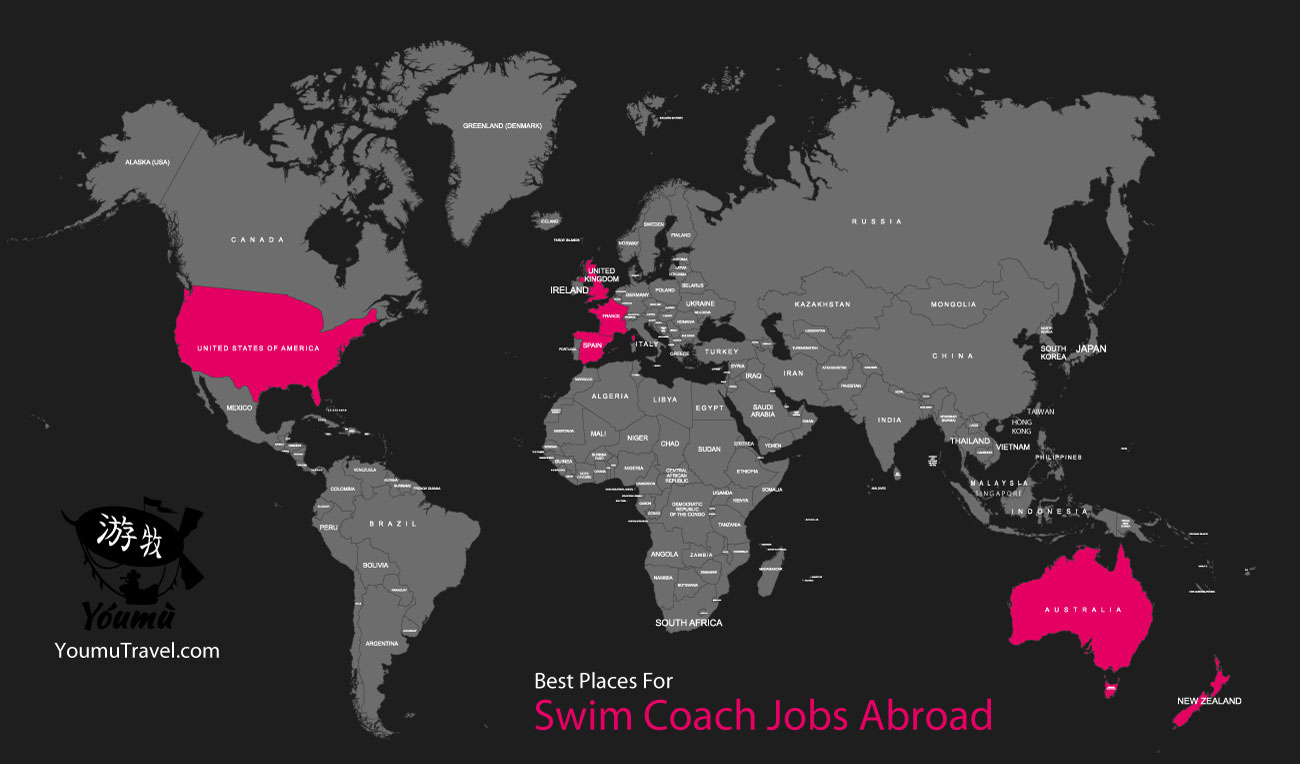
The Best Places For Swim Coach Jobs Abroad
Most major countries throughout the world have opportunities for those seeking swim coach jobs abroad. Here are some of the best places for swim coach jobs abroad.
- US
- Australia
- New Zealand
- Spain
- France
- UK
Get certified.
The certification you need will vary depending on where you plan on coaching. For example, to be affiliated with USA Swimming, you’ll have to do a two-part, seven-hour Foundations of Coaching course to obtain your certification. Look into the laws in the places you plan on coaching to ensure that you’re properly qualified.
Study.
You’ll need to have a thorough understanding of your league’s rules and regulations, and you’ll need to make sure that your swimmers also have a thorough understanding of these rules, which include safety procedures to prevent accidents.
Become part of a swim coach organization.
This may not be required by your league, but it can provide you with a lot of resources to enhance your coaching. You will have opportunities to interact with other coaches to exchange information on best techniques and practices.
Improve your coaching.
You can find a lot of online materials and books on how to be the best swim coach you can be, and these can be great to improve your own techniques. Take a look at the reviews and speak to your colleagues to see what resources are particularly helpful.
Be yourself!
As a swim coach, you call the shots. While it’s great to learn from other people’s techniques and experts, make sure that you coach the way that works best for you.
Job search.
To find international swim coach positions, check and follow international job boards and send your applications out!
What is a swim coach?
A swim coach is a professional who can help swimmers improve their swimming technique, performance, and overall fitness.
What is the role of a swimming coach?
Swim coaches have a lot of responsibilities from evaluating swim techniques/performance and skill level, to creating programs designed to help the swimmer improve, educating swimmers on techniques they can use, and preparing them for meets.
What degree do you need to be a swim coach?
Depending on where you want to work as a swim coach, you need at least a high school diploma or equivalent and at least a year of swim instruction experience. If you want to coach at a college level, however, you’ll need a bachelor’s degree in a relevant field, such as physical education.
What makes a good swim coach?
The best swim coaches are passionate about what they do and they care immensely about the sport and their pupils.
How do you become a certified swim coach in USA?
To coach at a USA Swimming practice or competition, a coach must be a member of USA Swimming and have completed safety training, concussion training, anti-doping courses, background checks, and athlete protection training.
How do I become a swimming coach UK?
In the UK, you’ll need the Swim England Level 1 Certificate. This allows you to act as a support coach for a more seasoned or licensed coach, and you’ll have to gain more experience and certifications from there.
How do I become a swimming coach in Singapore?
To register as a Swimming Coach with the NROC, you’ll need an SG Coach certification, a Lifesaving 1 Award course, Basic Sports Science course, and a Standard First Aid with an AED certification.
How do I become a swimming coach in South Africa?
To become a swim coach in South Africa, you have to be able to swim at least 25m back survival, 25m side survival, and 25m of a FINA recognized stroke, as well as possess a First Aid Level 1 certification. Additionally, you’ll need valid police clearance and you have to be at least 18 years old.
How much do Division 1 swim coaches make?
The median salary for a college swim coach is $55,358.
How much do YMCA swim coaches make?
Hourly pay at YMCA can range from $9-$17 per hour, but swim coaches will typically make $11/hour.
How do I become a certified swimming instructor in India?
You’ll have to be able to swim 100 meters in 3 minutes, and a valid certification training course.
Is swimming an expensive sport?
Swimming is often considered an expensive sport.
How do you coach competitive swimming?
Some tips for great competitive swim coaching are to never use your cellphone during workouts, smile and stay positive, make sure you give swimmers at least one constructive compliment at every practice, know your techniques, and stay creative to win competitions.
Mystic Artist Jobs Abroad – Guide
Mystic artists are individuals who receive and transmit messages of revelation regarding the divine matrix of Creation and use their mediums of tarot cards and palmistry to answer customer’s questions about health, love, and fortune.

This job has a somewhat low demand and requires some experience to get.
Demand
- Somewhat Low Demand
Experience & Degree
- Basic Understanding Required
- No Degree Required
- Certification Optional
Citizenship
- No Restrictions
This job is risky, typically part-time, but with reasonable hourly pay.
Pay Range
- Hourly: $12-$20/hr.
Reliability
- Risky
Housing
- Room and Board Not Provided
This job is very flexible and you can technically get away with doing this job anywhere in the world, you may not be permitted legally without the proper work visa, which may difficult for this job.
Location
- Somewhat Flexible
Schedule
- Very Flexible
Language
- Can get by with English only
Who can Get Mystic Artist Jobs Abroad?
Any individual who is patient and disciplined enough to learn the mechanics of readings and interacting with their customers can become a mystic artist.
Some parts of this position are considered very intuitive and spiritual, so you have to be open-minded and positive as a person.
What are the responsibilities for Mystic Artist Jobs?
As a mystic artist, you will be responsible for interacting with the energy of people as well as spiritual interaction in several mediums.
Key Responsibilities
- Answer a customer inquiry with tarot cards and the customer’s palm lines
- Interpret a customer’s intention and discuss with them what the best path for them is
- Interpret and foretell a person’s future and present state of mind
What’s the typical schedule for Mystic Artist Jobs?
Depending on where you work, whether it’s an established business where you guest as a reader, or if you are working for yourself, the work schedule of a mystic artist varies.
You can choose and negotiate how many hours a week you are willing to do readings and artistry, or you can have a by-appointment schedule set up for yourself.
Income Reliability
In general, work as a mystic artist does not guarantee consistent work, but the amount of money you can make per hour can compensate.
Typical Job Duration
Being a Mystic Artist can be short-term or long-term.
Estimated Hours Per Week
It’s estimated that you can as many hours as you wish, or by-appointment when it comes to performing readings.
Room & Board
Being a Mystic Artist doesn’t provide room & board.
Mystic Artist Jobs Abroad – Country Map
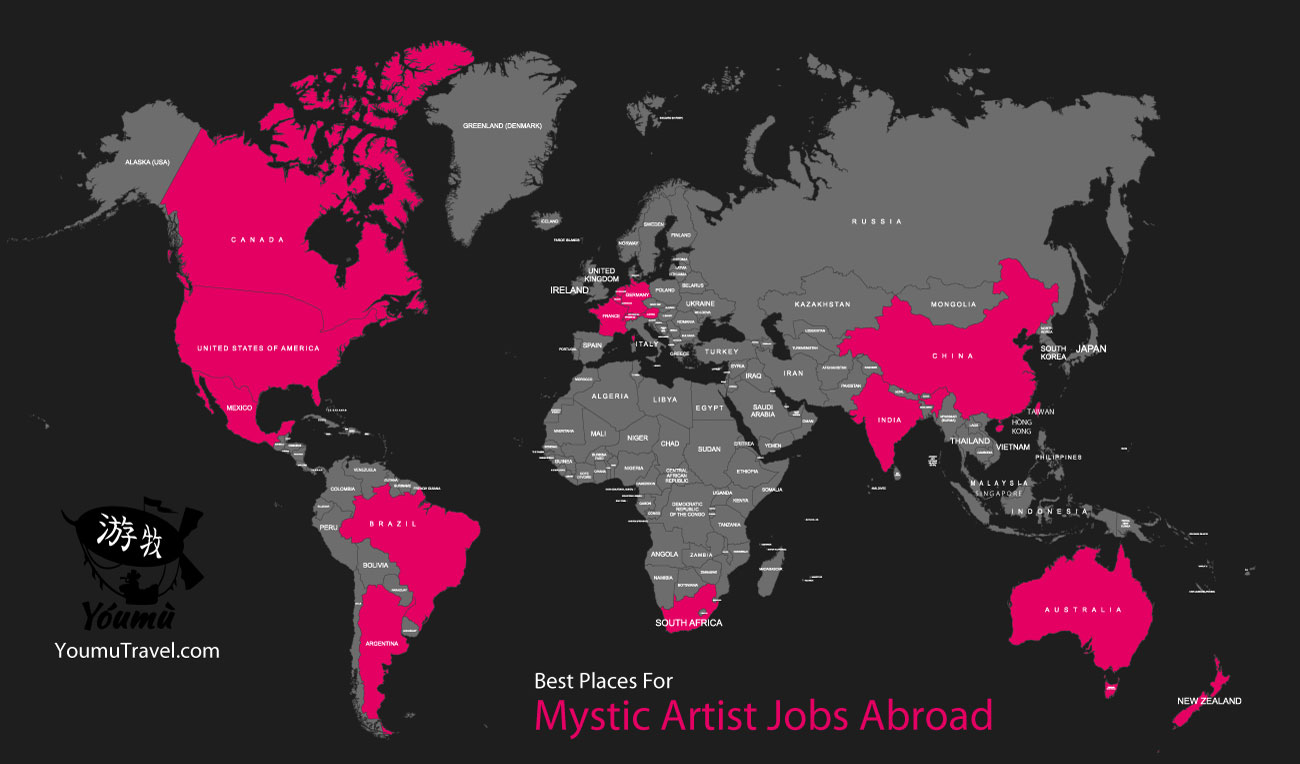
The Best Places For Mystic Artist Jobs Abroad
Here are some of the best places where you might be able to establish yourself as a mystic artist jobs abroad.
- US
- Canada
- Mexico
- Australia
- New Zealand
- China
- Brazil
- Argentina
- South Africa
- Western Europe
- India
Know what you’re doing
You need to know how to perform readings before you start doing them. Often, tarot deck boxes will include instructions on using the cards and you can find books and organizations that will teach cartomancy and palmistry.
Hone your skills
In the end, it won’t matter how much you learn about the mechanics, you need to practice interacting with people and talking to them, just like you will when you’re a professional.
Get a certification
This step is not necessarily a requirement for becoming a mystic artist, as a matter of fact, most professionals would advise against it. Since being a mystic artist is such an intuitive and spiritual engagement, it is a common belief that you cannot truly learn the mechanics in a program. But this is a personal step for becoming a mystic artist, and if you want to appear more credible to your customers then programs can be sought out.
- Find a reputable organization in the community of cartomancy and palmistry
- Find a teacher that you feel a connection with, and try to learn everything you can
- Look for an end-to-end program experience where you can record hours of readings and study for any written requirements to complete your program.
Look for a position
Find a job in a positive environment to perform your readings.
What is tarot reading?
The practice of reading tarot cards is using cards to look into the past, present, or the future for insight from a question and then dealing and interpreting the card’s meanings. This is a kind of cartomancy.
What is a mystic artist?
A mystic artist uses their art as a platform for the messages of revelation that they receive from the matrix of divine Creation.
Can anyone be a reader?
Yes, if you possess the discipline and patience to learn how to do tarot readings, then you can do it all on your own. All you need to be able to read tarot is to have a relationship with the tarot cards, and you gain this through study, experience, and the development of your own intuition.
How much does a reading cost?
A reading can cost anywhere between $42-$199.50.
What is palm reading?
Palmistry, the characterization, and claim of foretelling the future by studying the palm, chirology, is known as palm reading.
Which palm do you read?
You read both palms. Usually, the right palm is used for 80% of the reading and the left is used for the rest of it. Typically, a palm reader will use the right palm and then adjust the information obtained by reading the left palm.
How do you become a mystic?
The search for Truth is how you become a mystic. The truth about the Reality, the Cause, and the Source of Life, you are searching to know your soul. It’s a real adventure, it will move you from a typical belief in the material world and change to the realization that everything is actually Spirit.
How many tarot cards are there?
There are 22 cards in the tarot. The Major Arcana are the trump cards of a tarot pack in occult practices.
What are the lines on your palm for?
Some believe that the palm lines on a person’s hand can predict the future through palmistry. Scientifically, lines on a palm help the skin on hands squeeze and stretch, and can also help in identifying specific medical conditions.
What does it mean if your heart lines match up?
This combination means that you are the most independent and assertive in a relationship. It means you are not the kind of person who will go searching for true love, but if you enter a relationship, you will be committed to it and will work to make your relationship a healthier and stronger one.
Does everyone have the same palm lines?
No, palm lines are like thumb impressions and are unique in every instance. The palm consists of several lines, and it’s safe to presume that nobody would have the exact combination of palm lines as another person.
Seasonal & Adventure Travel Jobs Guide

Contents
- What are Seasonal & Adventure Travel Jobs?
- Different Types & Examples of Seasonal & Adventure Travel Jobs
- Seasonal & Adventure Travel Jobs Requirements – Visa, Education, & Experience
- How Much Seasonal & Adventure Travel Jobs Get Paid & How Taxes Work
- Are Seasonal & Adventure Travel Jobs Reliable?
- Pros & Cons of Seasonal & Adventure Travel Jobs
- How To Get Seasonal & Adventure Travel Jobs
- The Best Seasonal & Adventure Travel Job Companies To Work For
- The Best Places To Work Seasonal & Adventure Travel Jobs
- The BEST Seasonal & Adventure Travel Jobs
- Seasonal & Adventure Travel Jobs Tips
- Interesting Seasonal & Adventure Travel Jobs Statistics
- Seasonal & Adventure Travel Jobs Frequently Asked Questions
Seasonal & Adventure Travel Jobs Tools & Resources are included in the parent category of Travel Jobs Tools & Resources on this page.
What is a Seasonal Job?
Seasonal jobs are temporary employment that is available at about the same time every year, and may expire at the same time every year due to seasonal changes. This is because some businesses have more customers in summer or winter, spring or autumn, or are only able to conduct business during a particular season (for example, water parks close in the winter.) When business is slow, some companies that rely on seasonal activities close down or take on fewer part-time staff members.
Different Types & Examples of
Seasonal & Adventure Jobs
There are many types of seasonal and adventure travel jobs, some on land, others that involve water sports or exploring mountainous terrain. These jobs will enable you to play as hard as you’re going to have to work. General examples include:
- Canoe, kayak, and fishing guides, guides who take people white-water rafting or exploring rivers, as well as boat captains, sailing instructors, and cruise-ship workers.
- Cycling, horseback, zipline, and trail guides, natural history and safari guides, as well as those who are employed to be tour leaders.
- Mountaineering, climbing, and ski guides, to take you to new heights.
- And for outdoor adventure, outdoor educators, wilderness specialists, trip leaders and a different type of tour guide, as well as outfitting staff.
Summer Travel Jobs for College Students
Summer travel jobs include awesome opportunities for college students looking to work abroad. The five most popular job options for college students traveling in summer are those that involve summer camps, working in hospitality, bartender, waiter, and WWOOfing (if you like physical labor), teaching English, or working as an au pair. These opportunities don’t require you to have finished your degree yet, and you can travel during your few months off, while still earning some cash to support yourself.
Seasonal Summer Jobs
Summer jobs in the US available to seasonal workers include internships, summer camp counselor, and H2B seasonal work which requires a short-term seasonal job visa. US summer jobs are popular with graduates taking a gap year and for international students looking to enroll as interns. Summer jobs don’t have to be outdoorsy, plenty summer internships are in air-conditioned offices.
The best seasonal summer jobs give you the opportunity to have fun in the sun while earning an income. Whether you want to earn money working on a cruise ship, work as a lifeguard on a gorgeous beach, or work within an amusement park, there are plenty of outdoor summer fun (and income!) to be had.
Winter Seasonal Jobs
Winter seasonal jobs are not as popular as most summer seasonal jobs, there are still many opportunities for winter seasonal jobs, especially in areas where it snows and there are snow sports and related attractions. These jobs can include ski resort jobs, gift wrapping, Christmas store staff, ice fishing guides, and many more.
Seasonal Travel Nurse Jobs
Seasonal travel nurse jobs offer nurses the unique opportunity to be in an ideal climate just about any time of the year. But generally, there will be more jobs in the high season, wherever that happens to be. Many healthcare employers count on seasonal staffing. So, in the US winter, there are more jobs in Florida, Texas, Arizona, California, and Colorado. In summer, travel nurses will be more likely to get jobs in Massachusetts, Connecticut, Maine, and New Hampshire. Hawaii is good all year round.
Seasonal Part-Time Jobs
Most seasonal part-time jobs offer a flexible schedule and the more availability you can offer the better your prospects. Sometimes people end up making a career in their part-time jobs. Most of the options outlined in the sections above can be part-time positions. Generally, the earlier you apply for seasonal jobs, the more options you will find. Summer hiring usually starts in winter and continues through spring – so don’t wait until summer to apply for a summer job.
Seasonal Work from Home Jobs
A lot of seasonal work-from-home jobs are temporary contract positions in either retail or online sales. They are available during holiday seasons when companies get busy and need additional staff for sales, admin work, or customer service support. The job description and responsibilities that go with it will depend on each and every job, so poke around the listings to see what fits your preferences and qualifications.
Christmas Jobs
The commercialization of Christmas means that companies everywhere have to prepare for a boom in business in the weeks leading up to December 25th, and most companies need extra hands on deck to handle the influx of business. There are always lots of seasonal Christmas jobs available every year. And the good news is that they are incredibly varied–running from a landscape crew member who installs Christmas lights, or a cashier who works in an outlet selling Christmas trees, gift wrapper, to a Christmas kettle coordinator who works with an organization like the Salvation Army fundraising during the holiday season.
Seasonal Jobs for Retired People
Seasonal jobs retired people want to do are generally flexible options that give them the opportunity to go back to work after retirement and make some money. Many don’t want to commit to full-time jobs. There are lots of options, particularly if you can return to your own company or get a job in the same industry sector you worked in previously. Plenty of retail stores need extra employees around the holiday season, and these jobs can be a great way to earn some extra income without working full-time, all year round.
Summer Jobs for Adults
There are lots of summer jobs for adults that are ideal for making extra money. These include tutoring kids, or being a swim coach. Or you might prefer to be a summer camp counselor. City tour guide jobs are also plentiful, or, if you are good with words, why not get a job as a freelance writer? You could even write about seasonal travel and adventure.
Adventurous Jobs, No Experience
Many of these jobs don’t require formal education or much training, just experience in the type of adventure you would be working in. For example, you don’t need a degree to lead hikes, but you do need to be an experienced hiker. In addition, there are plenty of people that need a ski or snowboard instructor, surf instructor, skydive professional, or even crew for a yacht! Whatever your adventurous passion, there’s bound to be people who will pay you for your expertise, guidance, and aid.
International Trip Leader Jobs
International jobs for trip leaders are in high demand in the adventure travel industry. In fact, this is one of the most popular adventure travel jobs. Instead of opting for a laid-back beach holiday, more people want to do something different like climb a famous mountain or cross uninhabited terrain. An international tour operator who can offer off-the-beaten-track vacations will be able to take travelers on this kind of adventure route and guide them through their experience. So not only do you get to go on an amazing international trip, but you get to help people have the time of their lives all while making an income.
Outdoor Education Jobs
Outdoor education jobs are ideal for people who care about the planet and have a deep love of nature and the environment. Those who want to share their knowledge and help to educate others can get jobs that involve developing environmental education programs and sharing outdoor adventures. Many opportunities include valuable education and training.
Feasibility
Are Seasonal and Adventure Travel Jobs Right For Me?
In this section we cover all the primary aspects of seasonal and adventure travel jobs to ensure they’re right for you. This includes seasonal and adventure travel job requirements, pay and reliability. We also provide an overall pros & cons comparison table.
How Much Seasonal & Adventure Travel Jobs Get Paid
Best Paying Seasonal Jobs
The best paying seasonal jobs available from recruitment sites offer people the opportunity to get flexible work at certain times of the year. Seasonal job opportunities are varied and they pay anything from around $22 for a personal gift shopper to a little more than $11 for a gift wrapper–both during the Christmas season or in stores at any time of the year. Other well-paid positions include chefs at more than $15 an hour, fitness trainers at around $21-$22, and tutors who can demand more than $21 an hour.
For a full list of seasonal jobs and their pay, check out our travel job rankings.
How much do adventure travel jobs pay?
The average pay for adventure tourism and travel jobs is $44,648 per year, but ZipRecruiter reports that they range from $13,500 to as much as $90,500 globally. In the US they range from $27,000 to $53,500. ZipRecruiter, a leading recruitment company, regularly scans its database of millions of active jobs to get these figures.
For a full list of adventure travel jobs and their pay, check out our travel job rankings.
General Requirements for Seasonal and Adventure Travel Jobs
The general requirements for seasonal and adventure travel jobs range from experience and physical ability to communication and organizational skills. Outdoor adventure guides working seasonal travel jobs cater for tourists and resort guests as well as adventurous people and sports enthusiasts. Essential requirements include:
- Leadership and instruction skills.
- Thorough knowledge of the environment, terrain, and the area where they are working.
- Customer relations skills.
- The ability to maintain and repair the equipment used for the job, be it kayaks or hang gliders.
- Thorough knowledge of safety and emergency procedures.
- Obviously, a fearlessness and taste for adventure!
Education and Experience Requirements
Many seasonal and adventure travel jobs don’t require you to have any education beyond a high school diploma or equivalent, making them perfect for a free-spirited person who wants to work and play all in one job. Even if you’re still a high school student you can still be considered for many seasonal and adventure travel jobs.
There are plenty of fun jobs that pay well without a degree–remote travel agent jobs, for example, allow you to plan dream vacations for your clients while making around $37,000 a year. Additionally, if you don’t have an advanced degree in education but love working with children, you can be a camp counselor and spend your days having fun in the wilderness with your campers and colleagues, with provided lodgings and a steady income (for the season.) Most seasonal jobs, because of their temporary nature, don’t require an advanced degree.
That said, if you want to pursue an education to give yourself a leg up in the adventure travel job industry, then you could get a degree in things like outdoor education, forestry, environmental science, etc. These degrees will give you the practical and theoretical knowledge needed to succeed in most adventurous outdoor jobs. You could also pursue certifications in relevant skills according to your favorite types of adventures, and use these to market yourself as a guide in these activities.
As for experience, many seasonal jobs are happy to take on people who have little experience. Seasonal retail jobs, for example, often provide free training for a few days before you start interacting with customers. Adventure jobs are more likely to require some experience, but if you’re interested in adventure travel jobs, it’s likely you already have it. If you want to be a hiking guide, then you’ll have to have gone on some hikes in your life! Potential employers and clients will want to know what experiences you have under your belt, but it doesn’t have to be formal employment experience.
Visa Requirements
Visa requirements for adventure travel jobs and seasonal work vary, depending on where you are planning to work. In many parts of the world, you can get a tourist visa that will allow you to stay there for 90 days. You won’t be allowed to be employed and work legally, but you can probably get away with teaching English, babysitting, or doing other odd jobs. There are, though, visas that allow young (under 30s) people to live and work in some countries such as Australia and New Zealand. A working holiday visa will allow them to get seasonal jobs or do short-term work.
Are seasonal jobs worth it?
Absolutely. It’s paid short-term work that also help build your resume or even if it’s just to fill in gaps in employment on your resume. In addition, they give you the chance to try job opportunities to see if you like the industry – without having to commit long-term. They can sometimes lead to full-time employment, if you want to go that route. And they will always get you some extra cash.
Pros & Pros & Cons of getting Seasonal Travel Jobs & Pros/Cons of Getting Adventure Travel Jobs
Before you commit to getting a seasonal travel job, you should consider the pros and cons to make an informed decision.
Pros of Getting Seasonal Travel Jobs
- You get a good chance to build your resume by doing a job that aligns with your long term career goals. This gives you an opportunity to learn more about your chosen industry, gain valuable experience, and essentially do a “test run” of your long-term goals to make sure you’re on the right track.
- A seasonal job in your chosen industry will help you get your foot in the door.
- If you’re between full-time jobs, you can fill a time gap on your resume with a seasonal position and earn money at the same time, even if it isn’t a lot. And who knows–sometimes seasonal jobs turn into full-time opportunities!
- Seasonal travel jobs can be great for people who want to work and live abroad, but have never done it before. Working abroad for a season whets your appetite for travel, while also having a distinct end date to hold onto if it turns out working abroad just isn’t for you.
Cons of Getting Seasonal Travel Jobs
- Many seasonal jobs traditionally don’t need experience or training, and if they don’t the pay won’t be great – but at least there will be pay.
- Seasonal jobs are so short employers generally expect workers to just get on with it and so there’s little training, if any. It can help to choose jobs where you have at least some rudimentary knowledge.
- Work schedules can be challenging. For instance, if you get a seasonal job in retail it’s because demand is high and you’ll likely have to work late hours and weekends. Agricultural and production-based seasonal jobs also demand long, tiring hours.
- Traveling can be expensive, and coupled with the usually low-wages of seasonal jobs can create a bit of a financial strain if you don’t prepare properly.
Don’t just embrace the excitement and adrenaline rush that goes with adventure travel jobs–make sure you always look before you jump. Consider the pros and cons to make a well-informed decision.
Pros of Getting Adventure Travel Jobs
- Traveling, of course, is a perk in itself. Not only do you get to visit places you’ve dreamed of, but you get to live and work there, and feel like you’re part of that place, not simply a tourist.
- Traveling jobs also strengthen the bonds between coworkers, clients, and other people you might meet. When you are in a completely foreign place, familiarity with anyone can be a great asset and comfort, and these connections can serve you professionally or otherwise in the future.
- Adventure travel jobs often come with free food and drink.
- Because you are living the nomad working lifestyle, you get points for staying in hotels, renting cars, and for flying. These bank up and give you personal freebies you can take when you aren’t working.
Cons of Getting Adventure Travel Jobs
- Don’t forget that you’re not getting paid to travel to your favorite locations and do all your favorite activities–depending on your job and schedule, you might not get to go exactly where you want to, and even if you do, you might be so busy with your work that you don’t get to see or do everything you wanted to.
- It’s not as easy to network when you aren’t in your home country or city. Frequently, there might be language or cultural barriers that can make creating connections difficult.
- Travel and adventure put a strain on the body, and it can be difficult to stay healthy when you’re putting your body through that kind of stress. Additionally, if you do get sick in a foreign place, it can be difficult to get doctor’s appointments or prescriptions.
- Homesickness. It’s natural, of course, to miss your family, friends, and home, but that doesn’t make it any easier to deal with. Homesickness is something you should expect and prepare for before you leave–take mementos with you, schedule Skype calls as often as possible, and stay positive!
How To Start:
The Best Approach to Seasonal and Adventure Travel Jobs
In this section we provide a list of the best seasonal and adventure travel jobs, where each job is linked to a comprehensive guide. In addition, we cover the basics on how to get seasonal and adventure travel jobs, identify some of the best companies to work for, as well as the best places to look for jobs. In addition we’ll provide a list of the most popular countries and cities for seasonal and adventure travel jobs.
The 7 Best Seasonal & Adventure Travel Jobs
There are plenty of jobs that allow you the freedom to travel and have adventures in your spare time, and then there are also many jobs that include traveling and adventures within the daily tasks. Below are the best seasonal and adventure travel jobs.
Best Summer Jobs
The best summer jobs for high school students are those that allow teens to earn a few bucks and become independent. This young labor force annually works during the summer break, focusing on jobs that they find interesting and financially rewarding. Most, like babysitting, cleaning pools, working in movie theaters, delivering newspapers, dog walking, or being a golf course caddy where the tips and perks are great, need no training at all. On a different level, students can take the opportunity to become interns, testing out possible careers. While the summer job market is saturated with high school and college students on summer vacation, that doesn’t mean there aren’t available positions for adults out of school.
Best Outdoor Jobs
The best outdoor jobs for those who hate working in an office environment include outdoor adventure travel jobs as well as recreation jobs. Top of the list is getting paid to be an environmentalist, simply because it fits so many possibilities from environmentally-related fundraisers to lawyers who protect environmental resources and even lobbyists and researchers. If your biggest requirement for a job is the ability to spend your days outside, you could also be a camp counselor, an outdoor educator, a landscaper, a hike guide, a lifeguard at a beach, park ranger, etc.
What Are the Most Adventurous Jobs?
Adventurous jobs are those that provide the adrenaline and fulfillment dreamers and adventure-seekers crave. These are the jobs that take you outdoors and make you feel like you are on a movie set! Most will see you taking adventurous travelers where they want to go, like on safari, trying exhilarating water sports, scuba diving, skydiving, or snowboarding. Or you could work on sailboats or cruise ships or just become an adventure tour guide.
Be sure to check out our best adventure travel jobs just above this section.
How do I get seasonal jobs abroad?
- Target a job you might like or have experience with . To start, you have to decide what suits your preferences, your experience, and your qualifications. If you happen to be a native English speaker with a TEFL certification, then teaching English abroad can be a great seasonal gig. If you don’t have time to get a TEFL certification before the start of the season, consider working in hospitality. Plenty of hotels, bars, and restaurants hire for the tourist season, and you could become a bartender or server abroad. If child care is something you have experience in, you could be an au pair in places like the Middle East or Australia.
- Determine where you want to go abroad, and where the opportunities for work are. If you want to find a seasonal job just think laterally. Companies hire extra staff to cope with the season, whether it’s summer in countries that appeal to tourists who want to lie on the beach, or winter when they want to ski. If the jobs aren’t available all year round, they are seasonal. Irrespective of the hemisphere, Christmas is probably the busiest season of the year and you’ll be likely to find a seasonal job in December.
- Consider a working holiday visa from countries such as Australia and New Zealand. While these jobs are typically limited to folks in their younger 30s and 20s, they’re an amazing resource to take advantage of while traveling. Both of these countries have great minimum wages that allow you to travel the country but also save for future travels.
- Search online job boards to find listings, write your resume and cover letter, and send off your application!
- Prepare for interviews. When you hear back from hiring managers after you apply, it’s important to consider the interview step in getting your dream seasonal job abroad. Knowing how to answer employer’s questions is an important part of acing an interview and getting hired–even if it’s the busy season, it’s not always easy to get seasonal jobs. Hiring managers are just as fussy about seasonal workers as they are about permanent staff. The interviewer is likely to ask you traditional interview questions, but they may also ask some questions particular to the temporary nature of the position. If they ask why you want a short-term job that might only last a few weeks, put a positive spin on it and say it will help you to meet your business goals for the season and learn more about that particular type of business, as well as help the business run smoothly during the peak season.
- Get your visa documentation and pack your bags!
Where to Look for Seasonal and Adventure Travel Jobs
There are hundreds of websites that provide invaluable information about every type of seasonal travel jobs and outdoor adventure jobs possible. If you know where to look, you’ll be able to find a job. Examples include:
- Worldwide seasonal adventure jobs from Wanderjobs.
- Outdoor adventure jobs from Backdoor Jobs.
- Au Pair jobs from Pair World that match au pairs and families worldwide.
- Commercial and private yacht, boat, and cruise ship jobs from Find a Crew.
- Hospitality jobs on cruise ships from All Cruise Jobs.
- Yoga instruction jobs offered by Yoga Trade.
- Summer camp and education jobs on the ACA Camp site.
- SCUBA diving jobs from Divers Jobs.
- Jobs that involve skiing from Snow Season Central.
- Work exchange and volunteer jobs from Workaway that will take you to beautiful destinations.
- Wilderness conservation options from Conservation Association and the American Conservation Experience.
- Social activism corps jobs for adventurous souls from Americorps and several other websites.
- TEFL jobs all over the world from The International Educator or from localized areas like China and Asia offered by Teach Away.
The Best Places to Work Seasonal Travel Jobs and Best Places to Work Adventure Travel Jobs
If you’re looking for seasonal jobs or adventure travel jobs, you need to look in places where there are an abundance of opportunities for that type of work. For seasonal jobs, it’s best to look in places where the seasons bring big changes, either in terms of the climate or the amount of tourists flocking there at a certain time of year. And if you’re looking for adventure travel jobs, then you have to look in places that can provide a lot of adventure: mountainous regions for hiking, lakes and oceans for water activities, historical cities for tours and guides, etc.
Below we have outlined some of the best places to find seasonal and adventure travel jobs. This list is not exhaustive–if there’s a particular place you dream of working, then look for opportunities there! However, the list below can help point you in the right direction depending on the type of location you’re looking for, and the job opportunities there.
Top 9 Most Popular Places To Work Seasonal and Adventure Travel Jobs
- Alaska – Whether you’re after adventure travel jobs or international tour guide jobs, there’s lots of choice in Alaska during the summer months. You can get a job as a laborer or in environmental education, or you could grab the opportunity to become an intern for the summer, working in media, education, and outreach, in cultural resources, or you could sign up as an interpretation intern. The sunny summer skies in Alaska are the limit!
- London – So you’re gunning for recreation jobs or outdoor adventure jobs in London and the UK. It might take a bit of searching to find exactly the niche you are looking for, but there are lots of opportunities out there. We chose two from the Indeed.co.uk website as examples. One was an advert for an adventure games host to run the games stands at the Chessington World of Adventures. The other was for a full-time assistant manager for an outdoor and travel store in central London. For the latter, it was essential to be passionate about traveling.
- India – There are adventure travel jobs everywhere. Naukri.com is a good place to look for those being advertised in India. Jobs for adventurous souls in India right now include one for a travel sales consultant for a company called Adventure & Nature Network. Another, for a sales executive to work for Dare2Gear in an adventure travel job lists multiple activities, which they guarantee will provide an enriching experience for the employee.
- Seattle – What is your idea of adventure travel jobs in Seattle? Those advertised will vary at any one time, but here are a few examples, and the adventures offered are very varied. Adventure careers on cruise ships are quite common and you could become a deckhand on American Cruise Lines for the season. Or you could apply to become a host for Seattle’s New Day Northwest talk show. A job as an adventure specialist with Escape Campervans would get you road-tripping and camping. But something more daring on offer is to train dogs to search cargo and identify explosive threats.
- Bristol – A highlight of adventure travel jobs offered in Bristol comes from Swoop, a travel agency just outside the city that is close to becoming the number one choice for adventure travel to the polar regions and Patagonia. They also operate at home in the UK and offer micro-adventures to the outskirts of Bristol. The company has a big team already, but is always one the lookout for new talent. They employ all sorts, from singers and dancers, horse riders and fishermen, to photographers, bakers, climbers and cyclists.
- Scotland – If you want an adventure travel job in Scotland, you should link up with a Scottish company that offers jobs for adventurous souls and outdoor careers. Haggis Adventures is an example of a company that has an adventures team that is passionate both about traveling and Scotland. Two of their areas of employment are for driver guides that go everywhere possible to show visitors how to live the Scottish dream, and reservations staff who help to create the experience.
- Colorado – You can find adventure travel jobs in Colorado by searching through the best recruitment sites, but try to find companies that offer adventure guides specifically. For instance, there’s a startup in Denver Colorado looking for people to join the company right now as adventure and travel guides. They have positioned themselves as a company that provides travelers with the opportunity to learn new skills.
- Outdoor jobs in Colorado – There are a plethora of outdoor jobs on offer in Colorado and you will find them by searching recruitment company sites. These are just a handful from Indeed.com, some of which could kick-start adventure careers. You could become an education specialist or an O ranger during the peak season for Soaring Tree Top Adventures. Or, how about working as an environmental education outreach coordinator for AmeriCorps. Other outside jobs include working as a ski and ride school instructor, a whitewater guide, or a guide who specializes in unforgettable Rocky Mountain adventures.
- Australia – Seek is an employer site that offers adventure tourism and travel jobs from tour guide positions to orchard apple picking opportunities. Many are referred to as casual/vacation jobs or contract/temp jobs, and a lot are seasonal jobs. The adventures promised vary immensely. You could become “a working holiday hero” picking an Aussie farmer’s apples or work in hospitality and tourism in World Heritage National Park.
- Sydney – The best way to find adventure travel jobs in Sydney is to search the jobs listed on the jobs board of an Australian recruitment site. Indeed specializes in global sites, and you will find all sorts on their website. A goodie is the award-winning Adventure World Travel that specializes in “soft-adventure” trips to unique and exotic destinations. Whether you want to lead wilderness or wildlife trips, or provide culturally-immersive experiences, this is the kind of job you might be looking for.
- Canada – Looking for adventure travel jobs in Canada can be time-consuming because a search for this topic is likely to link to all sorts of travel positions that you might not consider to be adventure travel jobs. But you will find positions that require traveling cross-border and for extended periods of time. Most are travel agent and consultant or hotel jobs, but you can also find those that require a taste for adventure and travel, like becoming a deckhand on a Canadian coast guard ship.
Seasonal and Adventure Travel Worker Tips
Tips for Seasonal Jobs
- Know where the jobs are. You’ll increase your chances of getting hired for seasonal employment in, say, a retail position if you know what retailers are doing particularly well this year and are expecting a lot of seasonal business. Do some research on the market to see what businesses are going to need help during the summer or the holiday season. Additionally, chains are likely to be hiring seasonally, so keep an eye out for those.
- Show up. While applying online is the norm these days, it can help if you visit the location you applied at to introduce yourself to the hiring managers. Don’t interrupt if the store seems especially busy or if the hiring managers are occupied. Try to make it more of a casual-but-still-professional introduction. When they look at your application, they’ll remember your face and your demeanor, and it can help you get hired.
- Apply early! By the time the holiday season rolls around, many of the positions will already have been applied for or hired. It’s best to get your application in the door early–for both you and the business. It will be overwhelming for you to learn the ropes of a new job during the peak season, and consequently less helpful or efficient for the business. If you apply a month or two early, you can get your training out of the way and feel comfortable by the time hoards of holiday shoppers come in.
- Consider the possibility of continuing. It is possible at the end of a seasonal job–especially one that doesn’t rely entirely on the seasons–that you may be offered more consistent employment. You should consider if this is a good option for you before you’re asked, so you can be prepared to accept or refuse. If you know you want to continue, then during your seasonal employment make sure you do your absolute best job, make relationships with your coworkers and managers, and even mention that you’ll still be in the area after the season ends.
Tips for Adventure Travel Jobs
- Search by location. It can be really helpful to your job search if you narrow down where you’re looking to travel and work. For example, if you’re seeking word as a hiking guide, look in mountainous areas where there are likely to be companies and patrons seeking hiking guides. Distill that even further and narrow down the options based on your own criteria. If you want to work somewhere you’ve been and hiked before, then look in those places, or if you want to work somewhere new, exclude places you’ve been from your search.
- Look at companies you know about. Some jobs are not always posted on job boards, so it can be helpful to look at the “careers” section of a company or business’s website to see all of their postings. You’ll have to do some research to find the companies you’re interested in, their locations, and their peak hiring season. Also, be sure to check if that company is a parent company to any other businesses you’d like to work for, and check out their website as well.
- Prepare for paperwork! Make sure you know about the visa requirements if you’re interested in working in a foreign country. Working abroad, even at the coolest job, is going to require a lot of research and documentation on your part–but it’s feasible and worth it!
- Get good equipment. Whatever your chosen adventure, if you’re doing it professionally, you’re going to need good equipment. This is to ensure that you’re comfortable on the job, and able to help your clients as well. You won’t be a good tour guide if you have terrible walking shoes, for example, and you certainly won’t be a good ski teacher without nice skis!
- Make friends. Traveling can be both incredibly social and incredibly lonely. On one hand, you’re meeting people from all over the world, but on the other, you’re constantly on the move and homesick. It can be difficult to forge long lasting connections, but try your best to make friends from your coworkers and even clients–it will make the experience just that much more amazing.
Interesting Seasonal and Adventure Travel Worker Statistics
TrekkSoft produced a report mid-2019 that provided travel statistics, trends, and insights. Here are some tidbits:
- Booking Trends
- About 55% of global travelers now make sustainable travel choices.
- Sustainable decisions include accommodation with 73% of global travelers aiming to stay in green or eco-friendly places at least once in the next year.
- Even if not looking for sustainable accommodation, 70% of global travelers said they would be more likely to book eco-friendly establishments.
- More than half (51%) of travelers said they would take less than seven days to research trips.
- Travel Trends
- With half the UK and US workforce working freelance, and about 40% of children being home-schooled, parents are embracing freedom and traveling more.
- For 95% of family travelers it is important for families to be entertained. Deals and value ranked 89% and outdoor activities, planning travel around kids’ holidays, and being near to major attractions was 85% important.
Seasonal and Adventure Travel Jobs Frequently Asked Questions (FAQ)
How many months in a seasonal job?
Seasonal jobs usually last about three months, though some positions might extend to four or more.
Do jobs hire around the holidays?
The answer is yes and no. It does appear that there are fewer full-time permanent jobs during the holiday season, but there are also fewer people looking for jobs. However, temporary hiring increases dramatically during the holiday season.
Is it easy to get a seasonal job?
Yes. While getting any job comes with a certain level of difficulty, there are almost always seasonal opportunities available during the summer and the holiday season. The sheer amount of businesses and retailers who need extra help makes finding job opportunities easier, and seasonal jobs frequently require less experience.
What jobs have the summer off?
There aren’t a lot of jobs that have the summer off, but those that do usually do because they are governed by unions or there are standardized certifications that allow them to take the time off. A typical example is teachers or professors.
Do you have to give 2 weeks notice for a seasonal job?
The employment contract generally determines how seasonal work is terminated. It is common practice to give about two weeks’ notice.
Which country gives a visa easily?
There are a number of countries where it’s easy to get a work visa and/or claim residency:
- Cambodia,
- Mexico
- Belize
- Panama
- New Zealand
- Australia
- Bali, Indonesia
- Thailand
- Poland
Which country has the most job opportunities?
Countries with growing economies need professionals to fill job positions and so they provide the best job opportunities. The UK, followed by Germany, China, and Hong Kong top the list.
Is part-time the same as seasonal?
No. Part-time refers to the amount of hours per week an employee works, whereas seasonal refers to the entire duration of employment. Seasonal jobs are frequently part-time. Seasonal jobs are available at specific times when there is extra demand. Part-time jobs are more consistent and can last for many years, but you won’t be working a 40 hour work week like with a full-time position.
Where can I find seasonal employees?
Seasonal employees can be recruited by posting positions a few months before you need them. You might also appeal to customers who might like the challenge, or retirees. Current employees might also have friends who can do the job.
What happens after a seasonal job?
Most seasonal jobs end at the end of the season. But if you do things right and show you are good for the long haul, you might get employed in a permanent position.
What is the most badass job?
The most badass job can be any number of titles as long as the description requires a passionate pursuit of your dreams while helping others do the same.
It can be as simple as being a stay-at-home parent, to ensure their contribution to the new generation is a functional and thoughtful individual, or it can be as awe-inspiring as Elon Musk, a person who made $180 million and chose to risk it all to focus on projects that can help humanity rather than exploit humanity (over-capitalism). Both examples are equally successful.
Do seasonal employees get fired?
Seasonal employees can be fired like any other kind of employee if the person in charge has a valid reason to fire them. If you need to fire a seasonal employee, you will need to give them advance notice and they could be entitled to pay, depending on the contract. If the worker works regularly as a seasonal employee, then the situation will be a bit different, but you will need to give sufficient notice.
What to do while working abroad over the summer?
There are many jobs you can get if you want to work abroad during the summer season, from working on cruise ships to teaching scuba diving. Being a Summer Camp Counselor abroad is becoming popular in Asia. It’s quite a fun experience for the counselors!
Be sure to check out our full list of travel jobs as we have many more jobs you can do while working abroad over the summer.
Yacht Jobs Abroad – Guide
A yacht job is where you work on a yacht as part of a crew. You can work on a superyacht which is a large, luxurious, professionally crewed motor or sailing yacht, or on a smaller, privately owned yacht. You’ll be working directly for the yacht owner if you choose a privately owned yacht position.
This job is in high demand and easy to get.
Demand
- High Demand
Experience & Degree
- Basic Understanding Required
- Easy Certification Required
- Native English Speaking Preferred
Citizenship
- No Restrictions
This job is somewhat reliable and it’s likely you’ll only get part-time hours but the hourly rates are reasonable.
Pay Range
- Hourly: $10-$22/hr.
Reliability
- Reliable
Housing
- Room and Board Typically Provided
This job’s schedule is not flexible, however, you can work almost anywhere in the world.
Location
- Flexible
Schedule
- Somewhat Flexible
Language
- Can get by with English only
Who can get Yacht Jobs?
Basically anyone can work on a yacht. There are two positions that don’t require prior experience- deckhand and stewardess. However, if you want to be a captain, chef, first officer, or engineer, you’ll need experience and training. Also, anyone boarding the boat is required to obtain a seafarer medical certificate and attend a 5-day basic safety training course.
What are the responsibilities for Yacht Jobs?
There are a variety of positions on a yacht so the responsibilities and tasks differ. Training and experience are required for management positions on a yacht which includes the captain, first officer, engineer, and chef. However, the most common yacht jobs are deckhands and stewardesses because they are the easiest positions to get into without experience. For smaller yachts, an individual will take on multiple roles since the crew is typically smaller. Some of the key responsibilities of particular positions are outlined below, but there are other jobs on yachts that are congruent with the same job on land, such as chefs and sous chefs or nannies.
Key Responsibilities
Steward/ess:
- Detail the interior of the boat.
- Do laundry for guests and crew.
- Perform housekeeping tasks.
- Provide food and beverage service.
Deckhand
- Perform maintenance on the deck.
- Polish the boat exterior.
- Assist guests as needed with banana boats, jet skis, laser sail boats, and more.
- Launch and drive tenders.
Bosun/2nd mate/2nd officer:
- Responsible for maintenance of the hull and hull components such as rigging, anchors, calves, sails, etc.
- Perform deck maintenance.
- Conduct small boat operations.
1st mate/1st officer:
- Acts as the head of the deck department.
- Keeps watch and oversees activities.
- Oversees ship cargo and deck crew.
What’s the typical schedule for Yacht Jobs?
You work long hours, some days being 20 hours long. You’ll need to be the first person up and you’ll be the last person in bed. You’re also on call 24/7 while on the yacht.
Income Reliability
Yacht jobs are not reliable for full-time work since it is more seasonal.
Typical Job Duration
Yacht jobs can be short-term or long-term.
Estimated Hours Per Week
24/7 on-call while on the boat so you work more than 40 hours a week.
Room & Board
Yacht jobs do provide room and board.
Yacht Jobs Abroad – Country Map
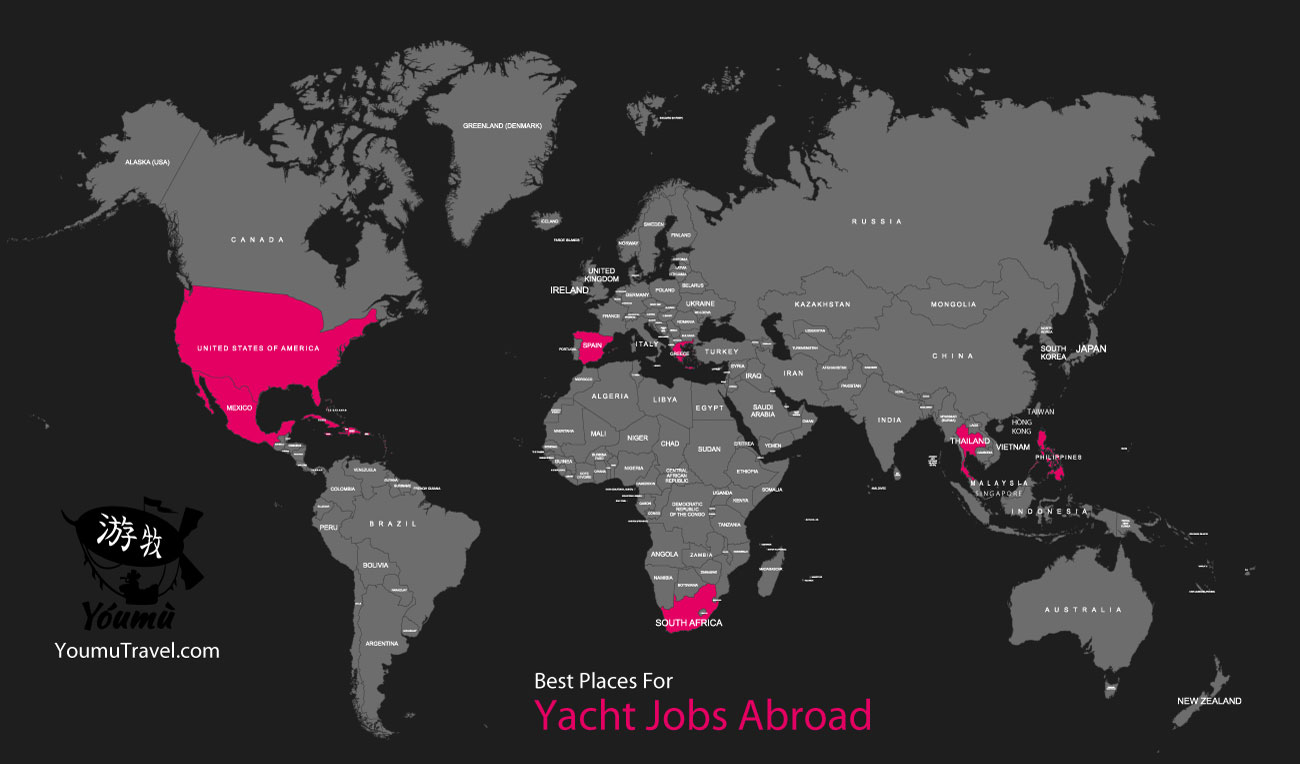
The Best Places For Yacht Jobs Abroad
Most major countries throughout the world have opportunities for those seeking yacht jobs abroad. Here are some of the best places for yacht jobs abroad.
- The Caribbeans
- South Africa
- US
- Mexico
- Thailand
- Philippines
- Greece
- Spain
Research.
You’ll want to read other people’s experiences and make sure you know what all it takes to work on a yacht.
- The majority of a yacht is reserved for the owner and guests so you’ll likely end up sharing a cabin with at least one other person so you’ll rarely be alone and have little personal space or time while onboard.
- Just like any other traveling job, you’ll be away from family and friends for long periods of time. This involves moving aboard or abroad indefinitely with no breaks to visit back home.
- No time for a romantic relationship because you’ll have no time for communication with a current significant other or to even pursue one.
- You’ll end up working very long days and shifts with no social time. You are on call day and night for the owner and guests which means you will be the first one up and the last person to go to bed so be ready for 20-hour shifts with little to no downtime.
Understand the different roles.
- Yacht Stewardess. You’ll want to highlight any hospitality experience you have on your CV, a 5-star experience within a service role, or a housekeeping position. If wanting to become a stewardess, consider doing a ski season to work on the skills needed for working on a yacht.
- Deckhand. Carpentry, diving, or water sports experience is highly beneficial on your CV. Any practical skills, painting, sanding, and varnishing are great skills to have.
- Chef. Experience in fine dining or a 5-star restaurant will help you land a job on a yacht.
Get trained.
Any person working on a boat must have an up-to-date seafarer medical certificate and must complete a five-day basic safety training course. Or you could just choose a role that requires no formal qualifications like deckhand and stewardess.
Write your resume/CV.
- Keep it short but concise
- It’s important to include a portrait because this is what they’ll be looking for first
- Make sure the photo is professional. You’ll want a good head and shoulder shot with a plain or nautical backdrop. You should wear a polo shirt or smart attire. Remember this is your first impression!
- Should not be longer than 2 pages
Start applying.
Be sure to research the agencies you are applying to because some are unreliable. Check if they are MLC certified to find the right agencies like SuperYacht Crew Agency.
Network via dock walking.
Dock Walking is when you walk up and down docks and marinas to meet crews and captains and give them your resume. Here are some tips to help with this:
- Dress appropriately and like you’re ready to start right then and there, preferably a plain polo and smart chino-style shorts.
- Keep your make-up and hair simple and be sure to use sunscreen!
- Wear comfortable shoes cause you’ll be doing a lot of walking.
- Print plenty of CVs because you’ll want to give them to everyone you meet
- Get there early like around 8 am to catch people putting up their flags on their yachts which makes them easier to approach and explain you’re looking for a job. Ask them if they need anyone that day.
- Don’t bring anyone with you because they will act as competition, not a helper.
How do you get a job on a yacht with no experience?
It helps to be in the right place at the right time with a professional resume ready to go. Additionally, registering with Luxury Yacht Group and taking basic STCW classes can be beneficial for starting your career. Make sure you network as well–build up references and maintain contact.
What do you need to work on a yacht?
There are 2 main certificates that are required before you can work as a crew on a yacht:
- STCW Basic Safety Training. A mandatory qualification required by all crew hoping to work on a commercial or charter yacht.
- ENG1 Seafarer Medical Certificate.
Is Yachting a good career?
A career in yachting is good for people who want to travel the world and love being on the water. It’s a rewarding and exciting job with good pay. However, it’s usually just a seasonal job. In the Mediterranean, the season runs from April to September while in the States and the Caribbean, it’s November to April.
Is it hard to get a job on a yacht?
Without experience, finding a job on a yacht is a bit trickier, but it all requires a willingness to work hard and long as part of a team, keep an interest in learning, and being flexible which will increase your odds of landing a position.
How much is an entry-level yacht?
An entry-level yacht that is around 30-35 feet long is going to be around $100,000 with monthly payments of approximately $1,000 and that’s after your $10,000 down payment. Plus you have to consider the money you’ll spend on life jackets and other important equipment and accessories. That’s probably another grand.
Do yacht crews make a salary?
Salaries vary depending on your position, qualifications, yacht size, location of the yacht, and if it’s private or charter. A person with experience is looking at $3,500 to $6,000 a month without tips while an inexperienced individual will only make around $2,000-$3,000 a month.
Do yachties get paid a salary?
A Yachtie’s salary ranges. A first officer will make $6,000 to $12,000 per month and a second officer will pull in around $5,500 and $8,000. A bosun pay ranges from $4,500 and $6,000 per month while the average deckhand is looking at $3,000 to $3,500 per month.
Does below deck cast get paid?
Below Deck positions like charter crews, make pretty good money. Second and third stews make approximately $50,000 per season, chefs earn around $52,000 to $72,000, a bosun makes $52,000, deckhands pay ranges from $40,000 to $52,000, and a captain’s salary starts at $120,000.
Do yachties make salary plus tips?
Yacht captains do get tips. In addition to a salary, the customary tip for yacht captain and crew is usually between 5% and 15% which is the same as the pay for gratuity at American restaurants. The collective tips can add up to $30,000! According to Bravo, a crew collected $168,000 in tips alone in one season.
How long do you work on a yacht?
Most yacht jobs are temporary, lasting only 2-6 weeks. However, if you work for a commercially-owned yacht rather than a private one you could get more hours but even then it’ll still be up and down depending on the season.
How long is a season in yachting?
Yacht season lasts 4 to 5 months typically with the season beginning around August or September. However, places like Florida who have warmer weather for most of the year may have longer boating seasons.
Boat Delivery Jobs Abroad – Guide
A boat delivery crewman, or skipper, is an individual who is hired to help with transporting a boat or yacht from one location to another. Most deliveries are typically on a freelance basis with crews working through a contract. However, some delivery companies will use the same crewman for ongoing projects.

This job has just average demand and requires some experience to get.
Demand
- Average Demand
Experience & Degree
- At Least One Year of Experience Required
- Hard Certification Required
- Native English Speaking Preferred
Citizenship
- No Restrictions
This job is reliable, room & board included, with reasonable pay.
Pay Range
- Hourly: $7-$25/hr.
Reliability
- Reliable
Housing
- Room and Board Typically Provided
This job’s schedule is somewhat flexible and can work in many parts of the world.
Location
- Flexible
Schedule
- Somewhat Flexible
Language
- Can get by with English only
Who can do boat delivery?
Anyone that has the passion or drive to work on a boat can do this job since it requires little to no experience. However, you have to have the willingness to work hard, long hours as part of a team and some employers will require an RYA Yachtmaster Offshore Certificate of Competence or an RYA Yachtmaster Ocean Certificate of Competence.
What are the responsibilities of boat delivery?
The qualifications and responsibilities vary depending on the position, but for any boat position, it’s necessary that you have marine experience and familiarity with terminology and equipment. Employers will look for captains who are licensed and certified in CPR as well as First Aid and they may require that you provide your own sailing gear. This can include GPS, lifejacket, harness line, sleeping bag, and basic tools. Boat delivery jobs vary in distance and the pay is usually proportional to the length of the trip and what tasks you’ll be doing.
Key Responsibilities
- Drive and deliver boats to dealerships and customers.
- Answer customer questions with comprehensive product knowledge.
- Explain and demonstrate features and boat operation.
- Arrange boat delivery.
- Conduct service maintenance on the boat.
- Assist with casting off and tying up the boats.
- Move boats in and out of the showroom.
- Possess advanced Seamanship abilities.
- Perform minor maintenance on display boats.
- Provide customer service.
What’s the typical schedule for boat delivery?
Depending on the delivery and how far you have to travel to deliver a boat, it can be a full day or stretch into several weeks. The hours are usually long with some ranging from 6am to midnight.
Income Reliability
In general, boat delivery is a reliable job that provides a constant stream of work.
Typical Job Duration
Boat delivery can be short-term or long-term depending on the distance of delivery.
Estimated Hours Per Week
It’s estimated that you can work full time, 40 hours per week, in boat delivery.
Room & Board
Boat delivery usually does provide room and board.
Boat Delivery – Country Map
The Best Places to Do Boat Delivery
Most major countries in North America and Western Europe have opportunities for those looking to do boat delivery. Here are some of the best places for boat delivery.
- USA
- Australia
- New Zealand
- Norway
- Sweden
- Greece
- UK
- Spain
- Italy
- France
Get qualified.
To become a skipper, the requirements vary on where the delivery will take place and the nature of the passage. However, the minimum qualification is that you obtain the RYA Yachtmaster Offshore Certificate of Competence as well as have professional experience on vessels of a similar style and size of the one being delivered. Then if you are working longer passages and transocean deliveries, you’ll need the RYA Yachtmaster Ocean Certificate of Competence. The higher your qualification and the more experience you have, the more likely you are to get a job in the boat industry.
Get equipment.
You will need to bring your own equipment so you want to make sure you have the right tools! It’s recommended that you have your own handheld VHF, GPS, lifejacket, harness line, wet weather gear, and a sleeping bag. You may also want to consider bringing basic tools like a knife, pliers, screwdrivers, multi-meter, sail repair tape, and cable ties.
Be insured.
You are expected to have your own insurance as well and there are plenty of different types to consider. You should definitely have your own professional indemnity cover, personal belongings covered, and health insurance, especially if traveling outside of your country.
Use a tracking device.
Want to impress your client? Buy a yacht tracking device. At Halcyon Yachts, they send out a number of trackers to their skippers before they depart. Spot Tracker, DeLorme, or Yellow Brick are great trackers that let the owner see where exactly their yacht is and are now very affordable as well as offer additional safety.
Write your resume.
As with any job, first impressions are the most important. Develop a well-written, thought out, easy to read CV that highlights your experiences and qualifications. You’ll also need to format an invoice template so you can easily have one available at the end of each job.
Gather references.
The yacht delivery industry is a small one so gaining a good reputation is vital. Many contracts are employed through personal recommendations so fill your CV with useful and relevant references and reach out to other skippers. Networking is key to your next job.
Apply.
Many deliveries are organized through agencies that hire self-employed delivery skippers. Here are a few of their websites:
Interview.
Inform the interviewer why this job is perfect for you and what you can provide for them. Be patient in your answers, but most importantly be prepared!
How much do delivery captains make?
With the right assignment, commercial lead captains earn around $625 to $900 a day.
How much does yacht delivery cost?
Yacht delivery can range from approximately $300 to $500 a day. It all depends on the captain’s license, size of the boat, and if it’s a power or sailboat.
How do I get a job on a boat with no experience?
If you’re looking to get a job on a yacht with little to no experience, you will want to do the following:
- Be in the right place at the right time.
- Have a professional resume.
- Register with Luxury Yacht Group.
- Complete basic STCW classes.
- Build references with day work.
- Maintain contact 24/7.
Do yacht captains get tips?
Yacht captains do get tips. The customary tip for yacht captain and crew is usually between 5% and 15% which is the same as the pay for gratuity at American restaurants.
How much does it cost to transport a sailboat?
Moving a sailboat costs approximately $5.56 per mile for less than 100 miles but costs $1.21 per mile to transport it less than 100 miles. However, the cost depends on distance, specifications of the boat, and any specific services that will assure the safety of transportation.
How much does it cost to haul a boat per mile?
To haul a legal-sized boat on a trailer will typically cost $1.65 per mile while open transport will be approximately $2.50 a mile.
Is it hard to get a job on a yacht?
Without experience, finding a job on a yacht is a bit trickier, but it all requires a willingness to work hard and long as part of a team, keep an interest in learning, and being flexible which will increase your odds of landing a position.
How do deckhands get paid?
Deckhands aid in launching and docking the yacht as well as be the go-to workers for dressing up or joining in guests’ challenges on Below Deck. The average pay for this position is $40,000 to $55,000 a year.
How long is a season in yachting?
Yachting season is usually 4 to 5 months long and begins in August or September. However, there are places, like Florida, that having boating weather for most of the year.
What are the positions on a boat?
The front of a boat is the bow, the rear is the stern, and, looking at the bow while on the boat, the left-hand side of the boat is the port, and the right side of the boat is the starboard.
Does below deck cast get paid?
Below Deck positions like charter crews, make pretty good money. Second and third stews make approximately $50,000 per season, chefs earn around $52,000 to $72,000, a bosun makes $52,000, deckhands pay ranges from $40,000 to $52,000, and a captain’s salary starts at $120,000.
Do yachties get paid a salary?
A Yachtie’s salary ranges. A first officer will make $6,000 to $12,000 per month and a second officer will pull in around $5,500 and $8,000. A bosun pay ranges from $4,500 and $6,000 per month while the average deckhand is looking at $3,000 to $3,500 per month.
What is a junior deckhand?
A junior deckhand is an entry-level position that helps clean and keep up the maintenance of the yachts. Although this position requires little to no experience, some experience with boats or watersports is highly recommended.
Sailboat Jobs Abroad – Guide
People who work sailboat jobs are part of the boat’s crew and they aid in everyday tasks and duties in terms of navigation, cleaning, maintenance, and food.

This job is easy to get.
Demand
- High Demand
Experience & Degree
- No Experience Required
- No Degree Required
- Native English Speaking Preferred
Citizenship
- No Restrictions
The pay is low but the job provides consistent work.
Pay Range
- Hourly: $10-$25/hr.
Reliability
- Consistent Work
Housing
- Housing Not Provided
This job provides some schedule freedom and great location flexibility.
Location
- Work Anywhere
Schedule
- Flexible
Language
- Can get by with English only
Who can get Sailboat Jobs?
Anyone that is passionate about the sea and is ready to be in hard work as well as working long hours as part of a team, can work get a sailboat job. There are two certifications you’ll need to get- STCW Basic Safety Training and ENG1 Seafarer Medical Certificate. The best part is you won’t need experience to get a position either.
What are the responsibilities for Sailboat Jobs?
People who work sailboat jobs need to keep the vessel and crew running as well as possible, and there are many tasks that go into this.
Key Responsibilities
- Clean and ensure all equipment and areas are hygienic.
- Conduct maintenance on the vessel/equipment.
- Cook responsibly.
- Do night shifts as scheduled.
- Aid in navigation when needed.
What’s the typical schedule for Sailboat Jobs?
It’s a 24/7 job with long hours with days that could be up to 20 hours long. You’ll be the first up in the mornings and the last person to go to bed. Some trips can last 10-25 days at a time. It’s also a seasonal job so expect slow months.
Low Hourly Rate: $10.00
Average Hourly Rate: $17.00
High Hourly Rate: $25.00
Income Reliability
In general, working on a sailboat is a reliable job that provides a constant stream of work.
Typical Job Duration
Working on a sailboat can be short-term or long-term.
Estimated Hours Per Week
It’s estimated that you can work full time, 40 hours per week, working on a sailboat.
Room & Board
Working on a sailboat typically provides room & board.
Sailboat Jobs – Country Map
The Best Places For Sailboat Jobs
Most major countries throughout the world have opportunities for those seeking sailboat jobs. Here are some of the best places for sailboat jobs.
- US
- UK
- Italy
- France
- Spain
- Portugal
- Pacific islands
- SE Asia
Garner Experience.
You’ll need to get as much experience as you get if you’re passionate about the sea and working on a boat. If your friends own a boat, work for them, or attend sailing lessons whenever you can. You’ll also want to study nautical vocabulary.
Pick the right moment.
You’ll increase your chances of working on a boat if you’re in the right place at the right time so you’ll need to know where to be and when. Most boats will be in the Mediterranean like places such as Croatia, Greece, Italy, etc for the summer before heading to Morocco or the Canary Islands in September or October. If you’re wanting to be on one of these boats, you’ll want to be at Las Palmas de Gran Canaria and Santa Cruz de Tenerife between October and December because that’s when they get ready to cross the Atlantic. Lanzarote is another location to be in September to December when boats arrive from the Mediterranean.
Find a ride.
There are three main methods to find a position on a boat- internet, personal contact at the harbor, or networking. None of them are the “best” way to get a position and it depends on what kind of experience you’re looking for as well as luck and your effort. You should try all three for the best chances.
- Personal Contact. Print off plenty of copies of your resume and walk up and down the docks at the harbor. You’ll want to be there early, around 8 am, to catch people raising their flags on their yachts to talk to them more easily and hand them a resume. Ask if they need any help that day.
- Network. Boats will reach out to their network of people first and if they can’t find anyone that meets their qualifications, then they’ll look online or in the harbor. You’ll want to build up your network by spreading the word about your skills and what you’re looking to do through friends and utilizing social media. Also, check out the Ocean Nomads fleet and talk to those who have gone before you or are already out there.
- Internet. There are plenty of resources online for you to check out to learn the skills you need and to find positions that are a great fit for you. It also helps in being able to reach out and make connections for your network. Here are a few websites that will help you research openings.
Apply.
It’s going to take a while for you to get answers so you’ll need patience, but don’t be afraid to be consistent in reaching out to boat owners and searching for new opportunities. It’s important to be respectful, honest, and humble when speaking to boat owners because you’re not only asking for a job but to be welcomed into their home.
Save up.
Many yachts ask that you pay for your food which can range from 10 to €15 per day and you’ll be on the water for 15 to 25 days, depending on the weather and boat. This means you’ll need around 150 to €300 for the crossing alone. Some boats, especially bigger yachts where you’ll scrub the deck and polish their railing, food will be included. However, during the ARC regatta, boats can ask you to pay up to €50 per day due to high inscription fees.
Gather equipment.
You’ll want to own a head torch, waterproofs, and good shoes. They’ll be expensive but they’re important to have and sometimes the boat you’ll be working on might provide them. The Canary Islands are cheaper compared to mainland Europe, but in Gibraltar, there are sailor’s “jumble sales” so you might save quite a bit. Also, be sure to have your passport or ID when traveling.
Get the appropriate documentation.
Be sure to research if you need a visa for the places you are visiting before departure. You’ll also want to go to the Immigration offices to get our passport stamped a day or two before you leave. Typically, each port will have its own immigration office but if not, then you will need to go to the nearest airport to do so.
How do I get a sailing job?
Some tips on how to get sailing experience include: attending a sailing course at a local ASA school, embark on a skippered or bareboat charter, and get as much practice in as possible with a local club or school.
How do you get a yacht job with no experience?
To be able to get a yacht job without experience you need a bit of luck–to be in the right place at the right time–but you also need a professional, thorough resume, to register with the Luxury Yacht Group, to take basic STCW courses, and to network by building references and maintaining contact.
Where can I get a free sailboat?
Check out these places to find a free sailboat:
- Gone – 42 Irwin Center Cockpit (Labelle FL)
- Sailboat on stands (Elkton MD)
- 2 boats with engines (Rosenberg TX)
- 1974 Yorktown 39 (Fallbrook CA)
- 24 sailboat on trailer (Ottsville MA)
- Escape Captiva Sailboat (South Shore MA)
- 28 Catalina Sailboat (Tracys Landing MD)
- Multiple boats need homes (Tracy’s Landing MD)
How much do yacht workers make?
A yacht worker with prior experience can make around $3,500 to $6,000 a month without tips, but someone without experience will earn somewhere from $2,000 to $3,000 a month. Tips range from 5 to 15% of the cost of the charter per week which is divided amongst the crew.
Do yachties get paid a salary?
Yes, yachties get paid a salary. As a bosun, you can expect to make $48,000 to $52,000 on a smaller vessel but on the larger ones, you can earn almost $60,000.
How do deckhands get paid?
Deckhands earn from 1.5% to 10% of the adjusted gross catch which is all decided on location and the skills the workers have.
Is yachting a good career?
Yachting is a good career if you enjoy traveling and being out in the water for weeks to months at a time. You also have to take into consideration that it’s more of a seasonal job so expect slow months. The traditional yachting season in the Mediterranean is from April to September while in the States and the Caribbean, it runs from November until April.
Is it hard to get a job on a yacht?
It takes hard work and long hours as part of a team as well as an interest in learning and being flexible. If you can do all of that, you’ll be in a good spot to land a position on a yacht.
What qualifications do you need to work on a superyacht?
To work on a superyacht, you will need these two certificates:
- STCW Basic Safety Training.
- ENG1 Seafarer Medical Certificate.
What is a good size sailboat to live on?
The good size of a sailboat to live on is 30-32’ and should be easy for single handling too.
Is owning a sailboat worth it?
Buying a used sailboat isn’t always expensive, but you’ll be paying more into maintenance and mooring, but if it’s something you’re really interested in, it’s rewarding to learn and you have your own boat!
How much is a cheap sailboat?
When buying a used sailboat, you’re going to spend an average of $20,000. A brand new 36’ cruiser is approximately $150,000 but a used on is only about $40,000. Plus the maintenance cost will be between $3,000 to $7,000.
Do yachties get paid salary plus tips?
Yes, yachties make both a salary and tips, but you’re going to take a lot of abuse and have to put in hard work for the tips. It’s worth it though, with collective tips reaching almost $30,000. One crew made $168,000 in tips alone in one season according to Bravo.
Do below deck cast get paid?
Yes, below deck cast get paid and actually make pretty decent money. Second and third stews earn around $50,000 per season, chefs are looking at $52,000 to $72,000, a bosun makes $52,000, deckhands will earn anywhere from $40,000 to $52,000 and a captain makes the most at $120,000.
Scuba Diving Instructor Jobs Abroad – Guide
Diving instructors are specially trained in demonstrating safe scuba diving techniques, working for most of the day, and often underwater outdoors.

This job has a somewhat high demand but takes some effort to get.
Demand
- Somewhat High Demand
Experience & Degree
- At Least One Year of Experience Required
- No Degree Required
- Hard Certification Required
Citizenship
- Some Restrictions
This job is somewhat reliable, reasonable-to-low pay, room sometimes included.
Pay Range
- Hourly: $5-$30/hr.
Reliability
- Somewhat Reliable
Housing
- Room Sometimes Provided
This job’s schedule is somewhat flexible but you can work in some great parts of the world.
Location
- Somewhat Flexible
Schedule
- Somewhat Flexible
Language
- Can get by with English only
Who can get Scuba Diving Instructor Jobs?
Anyone who has taken the PADI Open Water Certification course, as well as EFR/ First Aid certification, has completed the Instructor Development Course (IDC), and the accompanying Instructor Examination and the required amount of logged dives for PADI divemaster recognition can become a scuba diving instructor.
What are the responsibilities for Scuba Diving Instructor Jobs?
Diving instructors are specially trained in demonstrating safe scuba diving techniques, working for most of the day, and often underwater outdoors. They teach students both individually and in groups with demonstrations and discussions with the goal of teaching dive safety to boost student’s confidence in basic scuba skills.
Key Responsibilities
- Lead other certified divers on underwater tours
- Assess, repair and build structures with underwater equipment and tools
- Maintain a log to record diving experience details
- Inspect and clean boats or marine farm structures
- Inspect and clean diving equipment
- Be in charge of emergency situations, such as rescuing divers in distress
- Teach diving students
What’s the typical schedule for Scuba Diving Instructor Jobs?
This job can follow a fairly normal work schedule as you are operating within certain hours each day where you are giving diving lessons and working with students.
Not the typical 9-5 workday, but very close to it.
Income Reliability
In general, being a scuba diving instructor is a somewhat reliable job that provides a constant stream of work.
Typical Job Duration
Scuba dive instruction can be short-term or long-term.
Estimated Hours Per Week
It’s estimated that you can work full time, 40 hours per week, as a scuba diving instructor.
Room & Board
Scuba dive instruction doesn’t provide room & board.
Scuba Diving Instructor Jobs – Country Map
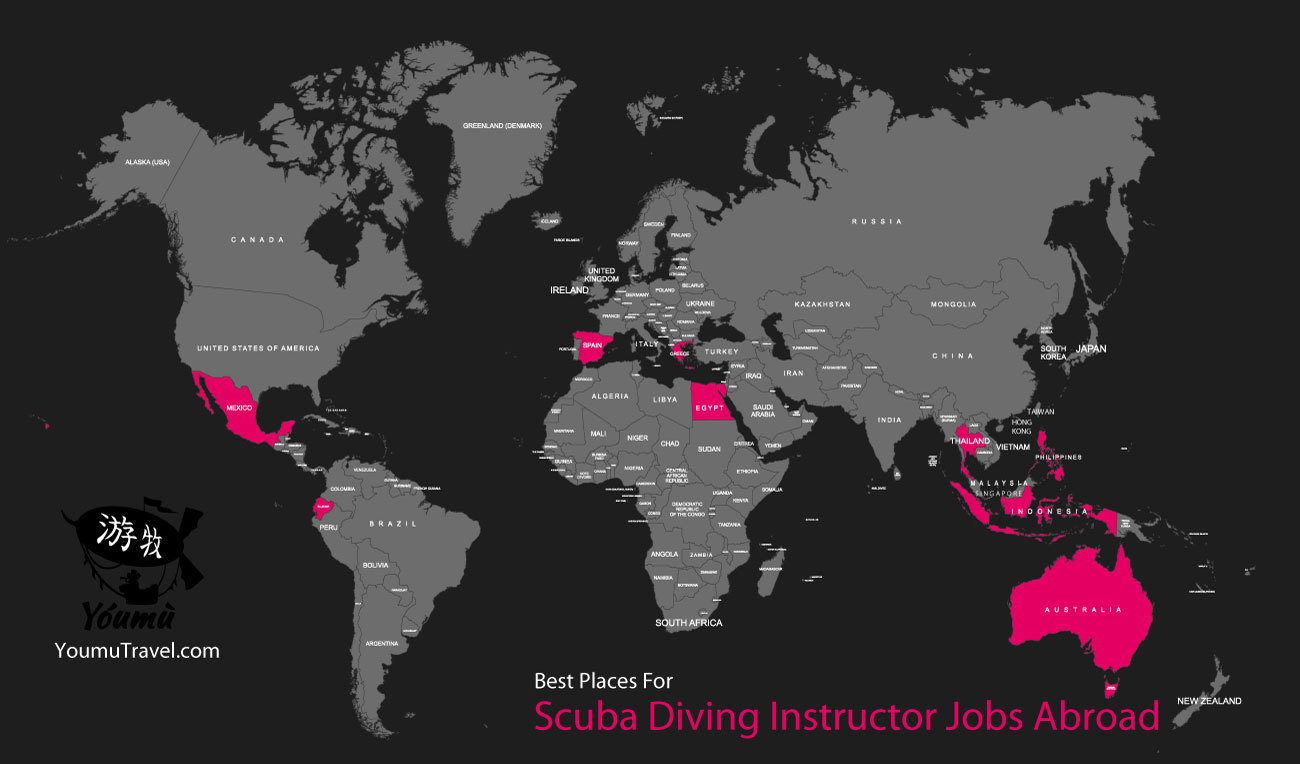
The Best Places to Get Scuba Diving Instructor Jobs
Most major countries throughout the world have opportunities for those seeking scuba diving instructor jobs. However, Thailand presents the best opportunities. Here are some of the best places for scuba diving instructor jobs.
- Thailand
- Indonesia
- Philippines
- Mexico
- Spain
- Greece
- Ecuador
- Seychelles
- Egypt
- Australia
- Hawaii
- Solomon Islands
- Micronesia
Learn to be an Open Water Diver
The course for Open Water Diving will include 4 open water dives and confined water dives, as well as E-Learning. The instructor will show you how to be a safe and reliable diver.
Go Diving!
Practice diving as much as you can.
Take the Advanced Open Water class
After you’ve earned your Open Water certification, the Advanced Open Water diver course is next. You will expand upon your previously learned skills and learn many more parts of diving.
Emergency First Responder and Rescue Diver
In the Rescue course, you will learn life-saving techniques for scuba diving. You are required to possess a CPR/first-aid certificate or to take the EFR course.
Dive
Continue practicing your dive techniques and skills.
Learn to be a PADI Divemaster
For your first PADI pro course, you will need at least 40 dives to be enrolled in the program, and after the two-week course, you will have to have a total of 60 logged dives. This course will teach the basics of the PADI system, how to assist other divers, and how to work within the diving industry.
Book your Instructor Development Course
To apply for the PADI IDC you need to have 100 logged dives. Be ready for many long hours and nights spent preparing for the Instructor Examination. Once you’ve completed the IDC, you will possess the skills and knowledge to pass the IE, and will have made some lifetime diving buddies!
Walk confidently into your Instructor Examination
Be strong and confident, and you will pass your IE with flying colors.
Look for positions and prepare for interviews
Keep updated with dive-related job boards, and joining diving-related Facebook groups. So long as you know where in the world you would like to teach, you can follow announcements or inquire about any diving centers in need of instructors where you are searching.
How much do dive masters make a year?
According to Simply Hired, the average annual salary for dive masters was $38,000 as of 2013.
How can I become a scuba diving instructor in India?
To apply for a PADI Open Water Diver course, you must be at least 10 years or older, possess adequate swimming skills, and be in good physical health. No previous scuba diving experience is needed.
How much money does a professional scuba diver make?
PayScale.com disclosed in 2019 that the annual salary for commercial scuba divers was between $33,000 and $118,000, which included bonuses. Amateur divers with 0-5 years of experience earned $51,000 and professionals with at least 10 years of experience earned a median salary of $95,000.
What kind of jobs can you get scuba diving?
Top 7 Jobs as a Scuba Diver
- Dive Instructor
- Dive Shop Manager/Owner
- Boat Captain
- Public Safety Diver
- Marine Biology/Scientific Diver
- Archaeology
- Golf ball Diver
Can you make a living scuba diving?
It is possible to make a modest living if you work in the dive industry for several years. There are significant costs for running your own dive shop and running your own boat and fill your own tanks.
Do you tip scuba instructors in Thailand?
Tipping is not expected but always appreciated on Thai boats.
How do I get a job in scuba diving?
In the industry of recreational diving, there are many scuba diving careers available. Some positions require a high level of experience, training, and certification like dive masters, others only require a healthy interest in diving recreationally and minimal dive experience.
Where can I learn to dive?
Around the world, the best spot for learning to scuba dive cheaply is Thailand, specifically Koh Tao. The high-density of dive operators and beautiful dive sites make for great diving for your first scuba certification.
What is a scuba diving license?
The PADI Open Water Diver course is where you learn to scuba dive, it’s easy and the most popular scuba course in the world. With the PADI Open Water Diver certification allows you to rent equipment and take part in dive trips all around the world.
How difficult is diving?
As far as active recreational engagements are concerned, scuba diving is one of the easiest to learn. You are only using three skills: breathing, kicking, and floating while taking in the underwater sights
Is it illegal to scuba dive without a license?
No, it is not illegal to dive without being certified, however, no reputable dive club or center would allow someone inexperienced to dive without having someone certified to scuba dive with them.
How quickly can you get scuba certified?
It is possible to complete a PADI certification from any dive school that’s affiliated with them in 2-4 days, since they are performance-based it can go faster if you are a quick study.
What should you not do after scuba diving?
- Flying after scuba diving is a widely-known risk for divers.
- Drinking alcohol after diving is discouraged.
- Mountain climbing.
Surfing Instructor Jobs Abroad – Guide
A surfing instructor teaches clients of a range of ages on marine safety and the basics of surfing and stand-up paddleboarding around the world.

This job is in somewhat high demand but takes a considerable amount of time and effort to become one.
Demand
- Somewhat High Demand
Experience & Degree
- At least One Year of Experience Required
- Hard Certification Required
- Native English Speaking Preferred
Citizenship
- Some Restrictions
This job is somewhat reliable with reasonable pay but typically not full time.
Pay Range
- Hourly: $10-$25/hr.
Reliability
- Somewhat Reliable
Housing
- Room and Board Sometimes Provided
This job is somewhat flexible with its schedule and location availability.
Location
- Somewhat Flexible
Schedule
- Somewhat Flexible
Language
- Fluency in English
Who can get Surfing Instructor Jobs?
To become a surf instructor, you’ll need to get two certifications: an International Surf Association Level 1 and a lifesaving certification. These are not easy qualifications to obtain so you will need to have been a surfer for quite some time with plenty of experience.
What are the responsibilities for Surfing Instructor Jobs?
The main function of a surfing instructor is to teach students how to surf, but many tasks go into accomplishing this.
Key Responsibilities
- Schedule lessons.
- Sometimes provide wetsuits and equipment, depending on the type of surf school.
- Clean wetsuits and ensure they are in good condition.
- Be professional and welcoming with students.
- Have intermediate surf experience at least, as well as ability in basic turns.
- Teach various surf techniques.
- Keep students well informed on ocean safety and surf etiquette.
- Keep the shop, boardroom, and facilities clean.
What’s the typical schedule for Surfing Instructor Jobs?
The schedule can be pretty flexible so you can choose how many lessons you give, how long the sessions are, and how many people you’ll teach. When working with a company, you’re looking at all-day lessons with breaks in-between.
Income Reliability
In general, being a surf instructor abroad is a reliable job that provides a constant stream of work.
Typical Job Duration
Being a surf instructor abroad can be short-term or long-term.
Estimated Hours Per Week
It’s estimated that you can work full time, 40 hours per week, as an abroad surf instructor.
Room & Board
Being an abroad surf instructor doesn’t typically provide room & board.
Surfing Instructor Jobs – Country Map
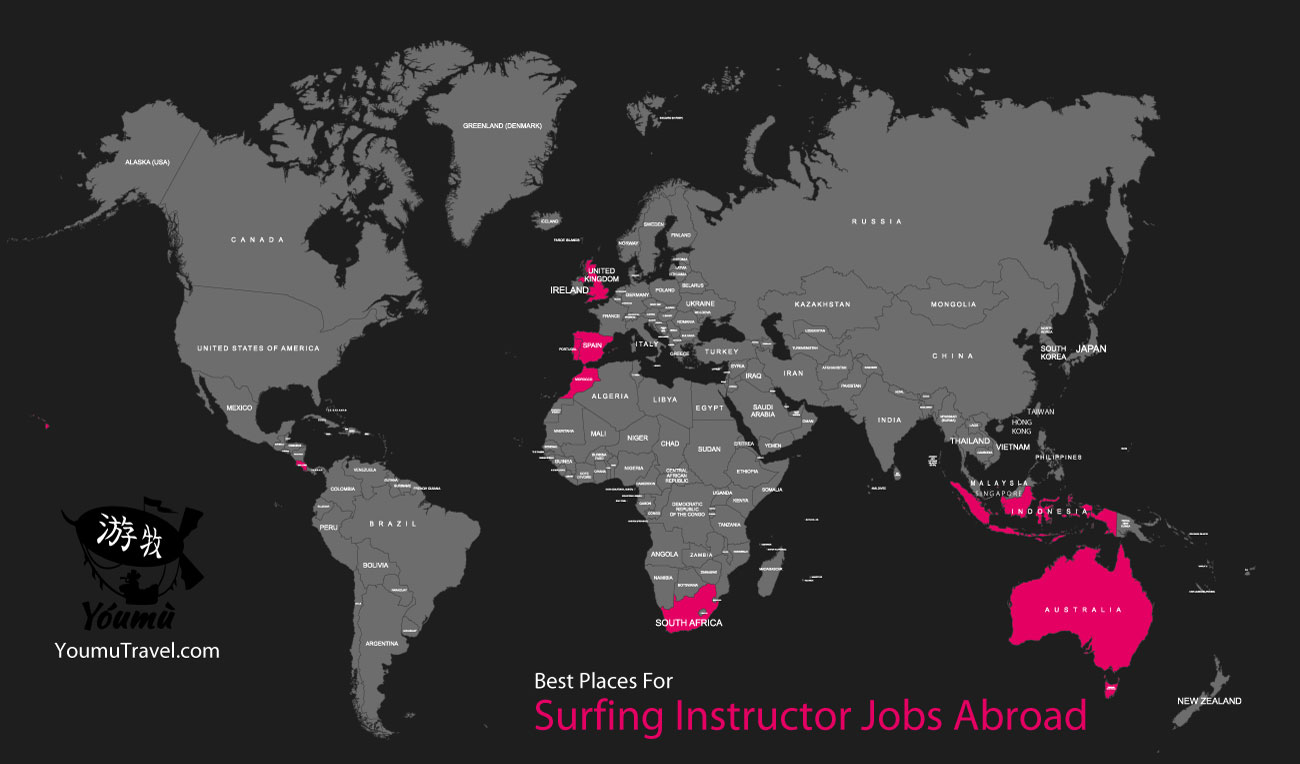
The Best Places For Surfing Instructor Jobs
Most major countries throughout the world have opportunities for those seeking surfing instructor jobs. Here are some of the best places for surfing instructor jobs.
- Costa Rica
- South Africa
- Morocco
- Indonesia
- Australia
- Tahiti
- Portugal
- UK
- Hawaii
- Spain
Learn to surf.
Before you enroll in an instructor course, you’ll want to do your research and practice because many people fail their Level 1 Surf Instructor courses by not reaching the required standard. Along with this, you will need a surf lifesaver certification.
The level of surfing you are expected to do is as follows:
- Paddle out back in head high surf
- Turn left and right on green, unbroken waves
- Perform a top and bottom turn both left and right
- Kick out of the wave safely
Get qualified as an instructor.
In order to be employed by any surf school, especially a reputable one, you will need an instructor qualification. The ISA Level 1 (International Surf Association) is the most common, accepted worldwide, and is a way to get your surf instructor started. Any surf school that offers surf instructor programs will have the ISA Level 1 certification. If you’ve been a surfer for awhile, you can complete your instructor course in just under a week.
Get a lifesaving qualification.
You must obtain a valid lifesaving qualification to work as a surf instructor for legal reasons. You’ll need the Surf Coach Safety and Rescue award which Surf Lifesaving Great Britain created, but keep in mind you can’t be a beach lifeguard with this; it’s specifically for surf instructors. Most of the time you can take both certificates together if you wanted because most places that offer the surf coach courses also offer lifesaving qualifications. However, the lifesaving qualification can take around a week too.
Update your skills.
You should be able to offer other skills rather than just surfing. Stand up paddle, coasteering, and kayaking are also popular activities and if you can provide clients those as well, you’ll bring in more opportunities for employment.
Get good equipment.
Sometimes you’re going to have to battle against the weather as a surf instructor, especially when it gets cold. You should invest in a couple of wetsuits if you’re working in a cold environment and if you’re suffering, your clients will be just as miserable.
Here are some of the best wetsuits and rash guards:
- Xcel Men’s 2mm Axis Fullsuit
- Xcel Calf Length Sport Tight UV Wetsuit
- Rip Curl Women’s Dawn Patrol Short Sleeve Spring Suit
- Rip Curl Aggrolite 2mm Short John
- Dakine Women’s Flow Snug Fit Long Sleeve Rashguard
- Dakine Men’s Wrath Snug Fit Rashguard
- Patagonia Women’s Micro Swell Rashguard
- Patagonia Men’s RØ Top
- O’Neill Psycho-Freak Zen Zip 3/2 Wetsuit
Choose a location.
You’ll want to move where there is a demand for surfing. There are plenty of surf schools with different styles and personalities all over the world to decide on.
Have thorough industry knowledge.
Clients will always have questions and it’s best for you to stay up-to-date to be able to answer those questions. Things like what’s the best equipment and where are the best surf destinations. With the internet, it should be no problem to keep up with your changing industry.
Write your resume/CV and apply.
Create a CV that highlights your certifications and past experiences as a surfer. There are plenty of websites that can help you find a surf instructor position.
Here are a few of those:
Now pack your bags, get a visa, and start teaching surfing!
What country is best for surfing?
Some of the best places in the world for surfing include Playa Grande in Costa Rica, Bundoran in Ireland, Jeffreys Bay in South Africa, Huntington Beach and San Clemente in California, Bondi Beach in Sydney, Australia, and more.
How do I become a surf instructor?
To become a surf instructor you first need to be able to surf at an intermediate level, get qualified to be an instructor, get qualified to save lives, and do a lot of networking and diversification. Additionally, you’ll need to get good equipment, knowledge of the industry, and be professional and ambitious.
How do I become a surf instructor UK?
To become a surf instructor in the UK, you will need to have at least two years of real and personal surfing experience and a current Beach Life Saving Qualification acceptable to both the ISA and Surf Great Britain.
Is surfing the hardest sport to learn?
Surfing is considered the most difficult sport in the world because it is difficult to learn. The hardest part about it is that it’s different every time, depending on the water and your balance.
Who is the richest surfer in the world?
The richest surfers in the world are:
- Kelly Slater – $22 Million net worth.
- Laird Hamilton – $10 Million net worth.
- John John Florence — $5 Million per year.
- Dane Reynolds — $3.9 Million per year.
- Joel Parkinson — $3 Million per year.
- Mick Fanning — $2.9 Million per year
What’s the Surfing capital of the world?
The surfing capital of the world is Banzai Pipeline, Hawaii.
How do I become a surf instructor in Australia?
In Australia, you will need a Level 1 Surf Instructor Qualification to teach with a surf school. This will typically be face to face instruction over 2 to 3 days and full course attendance is required to pass.
How many surfers die a year?
The number is approximately 10 or less per year which is very low in a world of around 23 million surfers, but this is without concrete data so it’s just an estimate. However, there are several different main causes of death as well. The most common is a blow to the head on the surfboard or hitting the bottom which knocks someone unconscious and they subsequently drown when they fall into the water. The second most common are drownings due to multiple wave hold-downs, rip-currents, or even a caught leash holding the surfer underwater. Shark attacks and other wildlife attacks are a small percentage and the rest are pre-existing conditions like aneurysms or heart attacks.
Why is surfing so hard?
Surfing is difficult because it isn’t physical but rather understanding the ocean such as learning to judge waves. Of course, the only way to learn about how ocean waves is just by getting in the ocean and practicing so it’s going to take a lot of time to become a surfer.
What is harder, surfing or snowboarding?
Surfing is pretty similar to snowboarding once you get the basics down, but it’s a lot harder than snowboarding to learn because it takes longer to learn and even longer to become a decent surfer.
Ski Resort Jobs Abroad – Guide
Ski resort workers have a variety of positions to take on but each one includes supervising the activities on the ski slopes, operating at the lodge, providing instructions to skiers, ensuring the safety of resort patrons. It’s usually a seasonal job starting from November and ending in April.
This job has just average demand but is easy to get.
Demand
- Average Demand
Experience & Degree
- No Experience Required
- No Degree Required
- Native English Speaking Preferred
Citizenship
- Some Restrictions
This job is reliable with reasonable pay.
Pay Range
- Hourly: $11-$30/hr.
Reliability
- Reliable
Housing
- Room and Board Sometimes Provided
This job’s schedule has little flexibility but you can potentially work at any ski resort in the world.
Location
- Somewhat Flexible
Schedule
- Little Flexibility
Language
- Can get by with English only
Who can get Ski Resort Jobs?
Anyone can get a ski resort job with an entry-level position. Once you gain enough experience, you can start applying for higher up positions.
What are the responsibilities for Ski Resort Jobs?
Ski resort workers can be entry level to highly skilled and each is important for maintaining order and operations of the resort. Here are a few main positions and their tasks.
Key Responsibilities
Ski Lift Operator
- Remove ice, snow, and branches from machinery.
- Ensure safety of passengers.
- Clean and ensure all machinery runs safely.
- Conduct trial runs.
- Punch and collect tickets.
- Adjust seats.
- Adjust lift speed.
- Answer passenger questions.
- Provide directions.
- Occasionally reprimand passengers who don’t follow the rules.
Ski Patrol
- Monitor the run/surrounding area.
- Prevent accidents.
- Maintain predetermined safety standards.
- Aid injured skiers.
- Indicate trails/courses that are unsafe and closed.
- Be prepared to administer CPR and first aid.
Ski Instructors
- Conduct group or individual lessons for skiers.
- Ensure students know how to ski well, safely, and responsibly.
- Demonstrate basic moves and advanced techniques.
Ski Technicians
- Aid skiers with proper equipment.
- Answer questions about the equipment.
- Demonstrate/explain proper use.
Lodge Staff
- Lodge staff members can include waitstaff, housekeeping, gift shop employees, managers, and HR staff. Each of these jobs will have their own set of responsibilities congruent to similar positions outside of ski resorts.
What’s the typical schedule for Ski Resort Jobs?
Depending on your position and how busy the resort is, determines how long you work. However, you will probably be working from the time the resort is open to the time it closes.
Income Reliability
In general, working at a ski resort is a reliable job that provides a constant stream of work.
Typical Job Duration
Working at a ski resort can be short-term or long-term.
Estimated Hours Per Week
It’s estimated that you can work full time, 40 hours per week, at a ski resort.
Room & Board
Working at a ski resort doesn’t typically provide room & board.
Ski Resort Jobs – Country Map
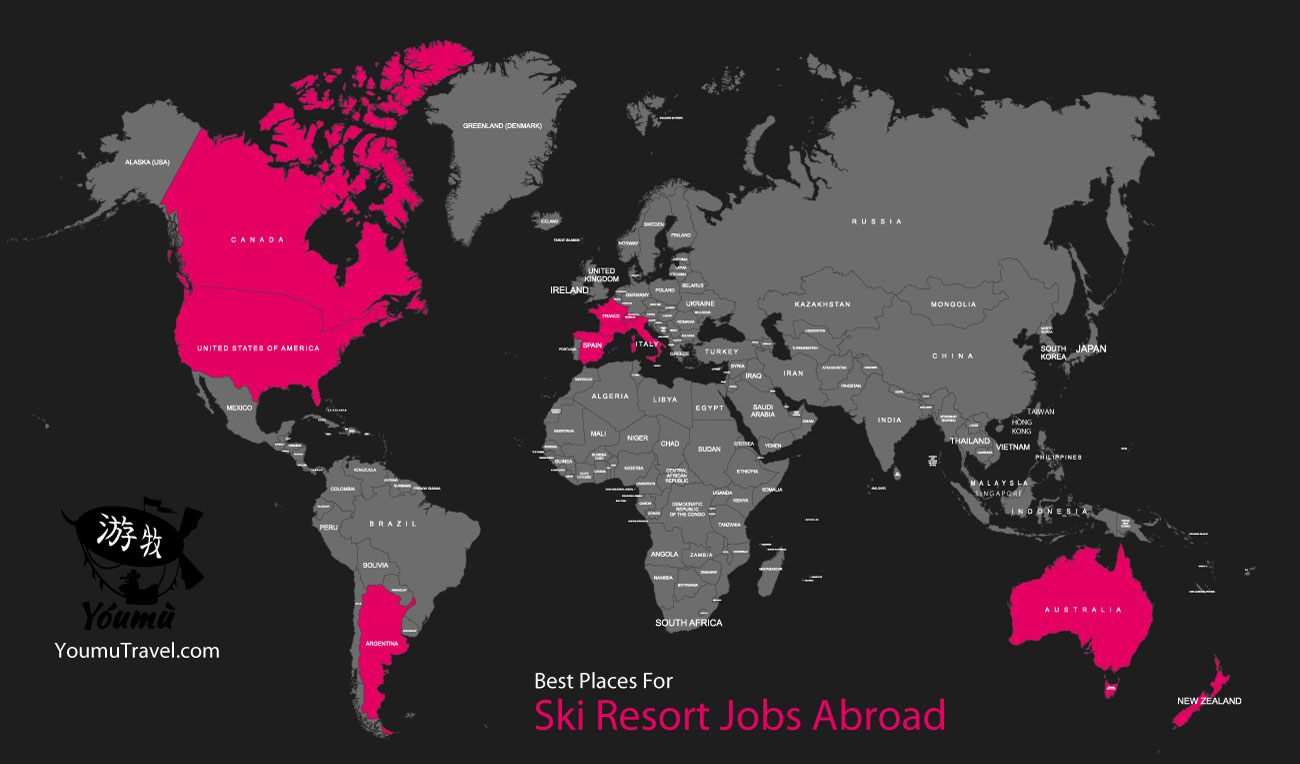
The Best Places For Ski Resort Jobs
Most major countries throughout the world have opportunities for those seeking ski resort jobs. Here are some of the best places for ski resort jobs.
- US
- Canada
- France
- Italy
- Switzerland
- Austria
- Spain
- Argentina
- New Zealand
Plan ahead.
You will want to plan your season early so you know what resorts are open, what jobs are available, your accommodations, and how much money you’ll be spending. In the northern hemisphere, resort job advertisements will be posted around July for a November to December start while in the southern hemisphere, resort jobs will go up in February for a June or July start. Most resorts will look for staff throughout the entire season especially if people quit or leave, but more well-known resorts will fill their positions quickly before the season even starts. So if you have your eyes on a specific resort, you’ll need to apply as soon as the job is listed.
Decide on a location.
You need to think of what kind of weather you are comfortable with and where you would like to live for quite some time while you work. Once you decide on a location, you’ll want to keep that in mind for the next few steps.
Write your resume.
You should keep your resume/CV short, to the point, and easy to read. It should highlight your most relevant experience for the role you are applying to.
Pick a resort.
You’ll need to decide whether you would want to work for a party resort or a family resort. If you enjoy independence, you’ll want to look into smaller resorts with a smaller team with more autonomy, but if you want lots of support, bigger resorts with bigger teams will be best for you.
Apply.
Utilize the following websites to find the right ski job for you:
Get the appropriate documentation.
Depending on where you work, you will want to get a visa and it’s important to remember that each country has its own set of requirements for working visas. Be sure to apply in advance because the process can take some time. Canada, Australia, and New Zealand are the easiest countries to obtain working visas, the US is much more restrictive for working visas, and Japan offers a working holiday visa program.
Pack your gear.
Prepare your snow gear such as things like:
- Skis and Poles.
- Snowboard.
- Ski or snowboard boots.
- Bindings.
- Tuning gear if you want your gear to perform properly.
Get accommodations.
Finding housing can be the hardest part of moving to a ski resort. You’ll want to look into cheap apartments in the area on resources like Trulia or Zillow. You’ll want to look for jobs that have affordable housing included because seasonal jobs that provide housing on-site will save you money, time, and frustration.
Make your travel arrangements.
Once you land a job and found yourself somewhere to live, it’s time to start booking your travels and transfers. You’ll want to make sure you have a visa and a passport if traveling abroad.
Work.
Now it’s time to get there and start working! Be sure to give it your all because the more experience you get and the more references you can obtain, the quicker and easier you can get bigger and better opportunities.
What is the best ski resort to work at?
The Top 10 States to Find a Job at a Ski Resort:
- Mt Baker, Washington State.
- Telluride, Colorado.
- Breckenridge, Colorado.
- Jackson Hole, Wyoming.
- Snowbird, Utah.
- Big Sky, Montana.
- Mammoth, California.
- Vail, Colorado.
- Aspen, Colorado
- Crested Butte, Colorado.
In what states might people work at a ski resort?
Top states with most ski resorts:
- New York: 50.
- Michigan: 38.
- Wisconsin: 34.
- Pennsylvania: 32.
- California: 29.
- Colorado: 28.
- New Hampshire: 26.
- Vermont: 24.
What is the best ski resort for beginners in Europe?
Here are a few of the best European ski resorts for beginners:
- Jasná, Slovakia.
- Passo Tonale, Italy.
- Bansko, Bulgaria.
- Avoriaz, France.
- Myrkdalen, Norway.
- La Rosière, France.
- Saalbach-Hinterglemm, Austria.
- Les Deux Alpes, France.
Is skiing for the rich?
Downhill skiing is a more expensive sport than most due to the costs of equipment and lift passes.
What is the best ski town to live in?
The following are the best ski town to live in year-round:
- Fraser, Colorado.
- Jackson, Wyoming.
- Whitefish, Montana.
- Truckee, CA.
- Durango, Colorado.
How do I get a job in the ski industry?
Here are a few tips on landing a job in the ski industry:
- Find internships or a low-level job that’s related to skiing such as mountain, ski shop, product company, media, etc.
- Network with people in ski resorts and other areas of the industry like sales reps and managers of related companies, etc.
- As you gain experience and network with others plus show great performance in the smaller positions, you can work your way up to bigger and better opportunities.
- Be sure to do different positions because if you don’t do anything different, nothing different will happen so learn new skills and work for free if you have to.
- There are so many product companies, shops, mountains, media groups, and more hiring all the time so apply to them and ask where they list job opportunities. SIA is a good resource to find companies in the ski industry and many companies have brands under them as well that need positions filled like K2 Sports so check them out too!
What is it like working at a ski resort?
It’s a very rewarding job from the beautiful views to friendly staff. If you prosper in the cold and love playing in the snow, it’s perfect for you! Plus you get to meet people from all over the world and free season ski passes.
Which state has the best ski resorts?
Colorado and Utah are the two states that have the best ski resorts. Followed by California, Wyoming, and Montana.
What country has the most ski resorts?
The following are the top 10 countries with the most ski resorts:
- Japan: 543
- USA: 447
- Austria: 317
- Italy: 228
- Switzerland: 211
- Germany: 197
- France: 185
- Canada: 170
- Czech Republic: 105
- Slovakia: 97
What is the cheapest ski resort in Europe?
Here are the cheapest ski resorts in Europe:
- Bansko. Bulgaria.
- Borovets. Bulgaria.
- Vogel-Bohinj. Slovenia.
- Serre-Chevalier-Briançon. France.
- Jasna – Demänovská Dolina. Slovakia.
- Les Houches. France.
- Livigno. Italy.
- Poiana-Brasov. Romania.
What is the most expensive ski resort in the world?
Most expensive ski resorts in the world are as follows:
- Carlton Hotel, Switzerland.
- Les Suites de la Potiniere, France.
- Aurelio Lech Ski Resort, Austria.
- Suvretta House Resort, Switzerland.
- Almhof Schneider Resort, Austria.
Is Austria cheaper than France for skiing?
Austria is typically cheaper than French ski resorts and is one of Britain’s favorite ski destinations because it’s easy to reach.
Sky Diving Instructor Jobs Abroad – Guide
A skydiving instructor is someone who teaches people the essentials of skydiving such as safety procedures and necessary processes.

This job has just an average demand and takes a considerable amount of time to become one.
Demand
- Average Demand
Experience & Degree
- At Least One Year of Experience Required
- No Degree Required
- Hard Certification Required
Citizenship
- Some Restrictions
This job is somewhat risky, pay is reasonable.
Pay Range
- Hourly: $12-$30/hr.
Reliability
- Somewhat Reliable
Housing
- Room and Board Not Provided
This job’s schedule is somewhat flexible but you can work in some great parts of the world.
Location
- Somewhat Flexible
Schedule
- Somewhat Flexible
Language
- Can get by with English only
Who can get Sky Diving Instructor Jobs?
There is extensive training–outlined in the step-by-step below–required to be a sky diving instructor. You must be at least 18 years old and extremely experienced.
What are the responsibilities for Sky Diving Instructor Jobs?
The essential function of a skydiving instructor is to ensure that jumpers skydive safely, and many tasks go into this.
Key Responsibilities
- Help both amateur and experienced jumpers.
- Train and evaluate other instructors/licensed skydivers.
- Conduct safety seminars.
- Train on the ground.
- Evaluate in the air.
- Give divers safety advice.
- Conduct thorough equipment inspections before and after jumps.
- Thoroughly read parachute user manuals and have a complete understanding of how they work.
- Ensure proper function of mechanical components to avoid accidents.
- Program equipment as necessary.
- Write reports.
What’s the typical schedule for Sky Diving Instructor Jobs?
Sky diving instruction is not your typical 9-5 job, so the schedule is not standard. On average, sky diving instructors can expect to work 40 hours a month, instead of 40 hours a week. The specific times will vary by jump.
Income Reliability
In general, sky diving instruction is not a reliable job.
Typical Job Duration
Skydiving instruction can be short-term or long-term.
Estimated Hours Per Week
It’s estimated that you can work around 40 hours per month as a skydiving instructor.
Room & Board
Skydiving instruction abroad doesn’t typically provide room & board.
Sky Diving Instructor Jobs – Country Map
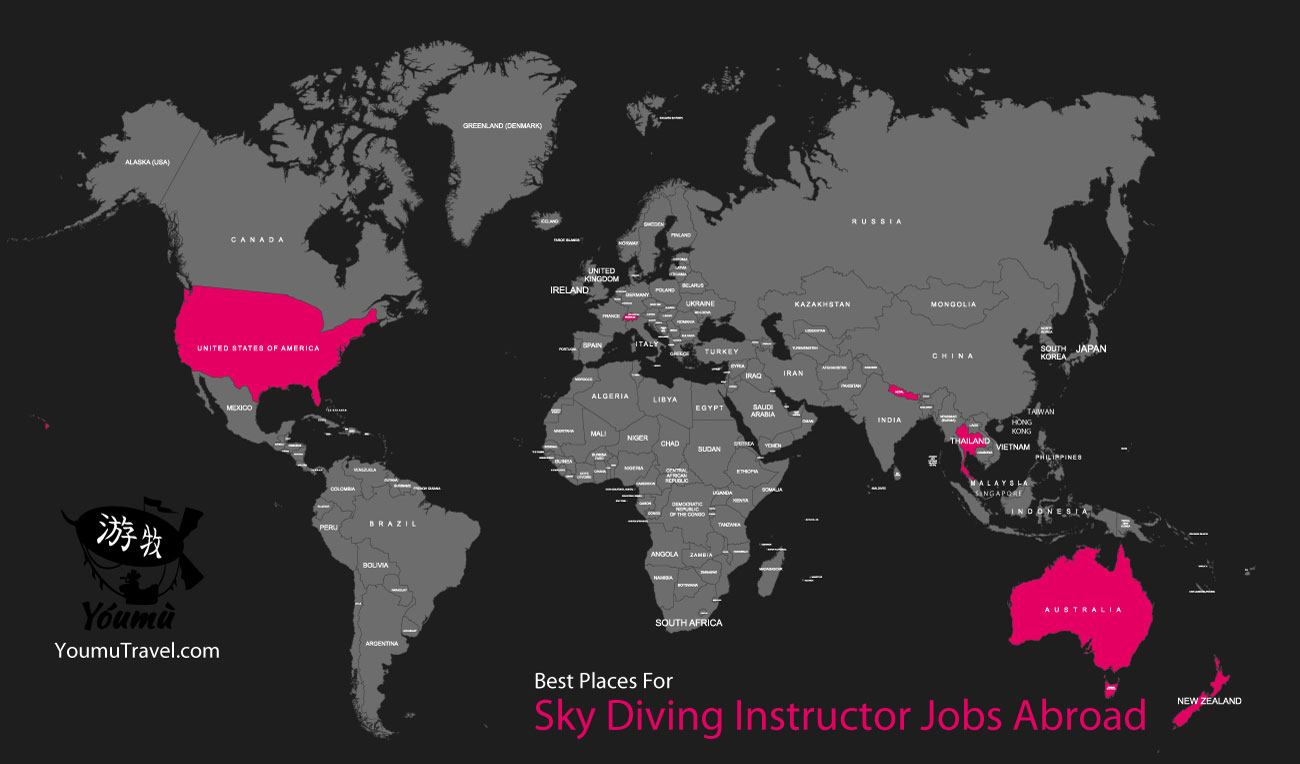
The Best Places For Sky Diving Instructor Jobs
Most major countries throughout the world have opportunities for those seeking sky diving instructor jobs. Here are some of the best places for sky diving instructor jobs.
- US
- New Zealand
- Thailand
- Australia
- Switzerland
- Hawaii
- Nepal
Get licensed.
You’ll have to be a licensed skydiver to be an instructor. In the US, this is given through the US Parachute Association. The first license you’ll be able to acquire is the “A License,” which requires 25 successful jumps, six hours of ground school training (called Accelerated Free Fall), a parachute packing class, and wind tunnel training. Once you have earned this license, you can skydive without the supervision of an instructor.
Continue training.
To be an instructor, you’ll need to be qualified specifically for that. That license requires 500 successful dives over at least 3 years. This is to ensure that a skydiving instructor encounters as much as they are able to encounter, so that nothing will take them by surprise when aiding first time jumpers.
Additionally, attend an intro USPA Coach Course to start to teach people who are new to skydiving. The requirements of this course are only that you be 18 years old or older, have 100 successful jumps under your belt, and a USPA B License.
Become a Tandem Skydiving Instructor.
Once you have acquired your USPA Coach Rating, USPA D License, at least 500 skydives with 50 in the past year, three years of experience, and four hours of free fall time, you only have to take the USPA Tandem Training Course to become an official skydiving instructor.
How do I become a skydive instructor?
You’ll have to be a member of the US Parachute Association and accumulate 500 jumps and 3 hours of freefall experience.
How much does skydive instructor make?
Skydiving instructors are paid per jump–usually between $20 and $40/jump. With 500 jumps per year on average at a high pay rate, skydiving instructors make around $20,000/year or less. If the instructor takes on other tasks such as preparing parachutes and recording jumps, they might be able to make a little more.
How do I become a skydive instructor UK?
If you want to be a skydiving instructor in the UK, you have to take two instructor training courses arranged by British Skydiving.
How much do skydiving instructors get paid Australia?
In Australia, skydiving instructors can expect to make around $27.78/hour, with 40 hours per month.
Can you breathe while sky diving?
Yes–there is plenty of oxygen even in freefall.
Can you make a living skydiving?
Skydiving instructors can make a modest living in their profession. Some reports say the upper salary limit is $20,000, but others report $30,000.
Does your stomach drop when you skydive?
In fact, your stomach does not drop when you jump from the plane because of the quick transition into terminal velocity, which feels stable.
How cold is skydiving?
It depends on the season–so don’t skydive in the winter. At the jumping altitude, it is likely to be 30 degrees colder than on the ground.
How much does it cost to get a skydiving license in the UK?
In the UK, a membership costs around £107 each year, and you might have to update your license frequently, which incurs more fees.
How much does it cost to get certified for skydiving?
In the US, annual skydiving memberships cost around $220, and you might have to update your license frequently, and to do that you’ll need training, which can cost up to $160.
Who Cannot skydive?
In the US, people under 18 years old cannot skydive.